
Testing Methodologies: How Each Approach Works and When to Use It
Testing methodologies explained from waterfall to agile to TDD. Covers SDLC-aligned and practice-driven approaches, comparison table, and how to choose the right methodology for your team.
Gautam · 16 min read
autosana.ai
A testing methodology is the structured approach a team follows to plan, design, execute and evaluate software tests, defining when testing happens in the development cycle, who owns it, and how results feed back into the build process. The methodology shapes every downstream decision: what gets automated, how much coverage is enough, and whether a bug found late costs a patch or a recall.
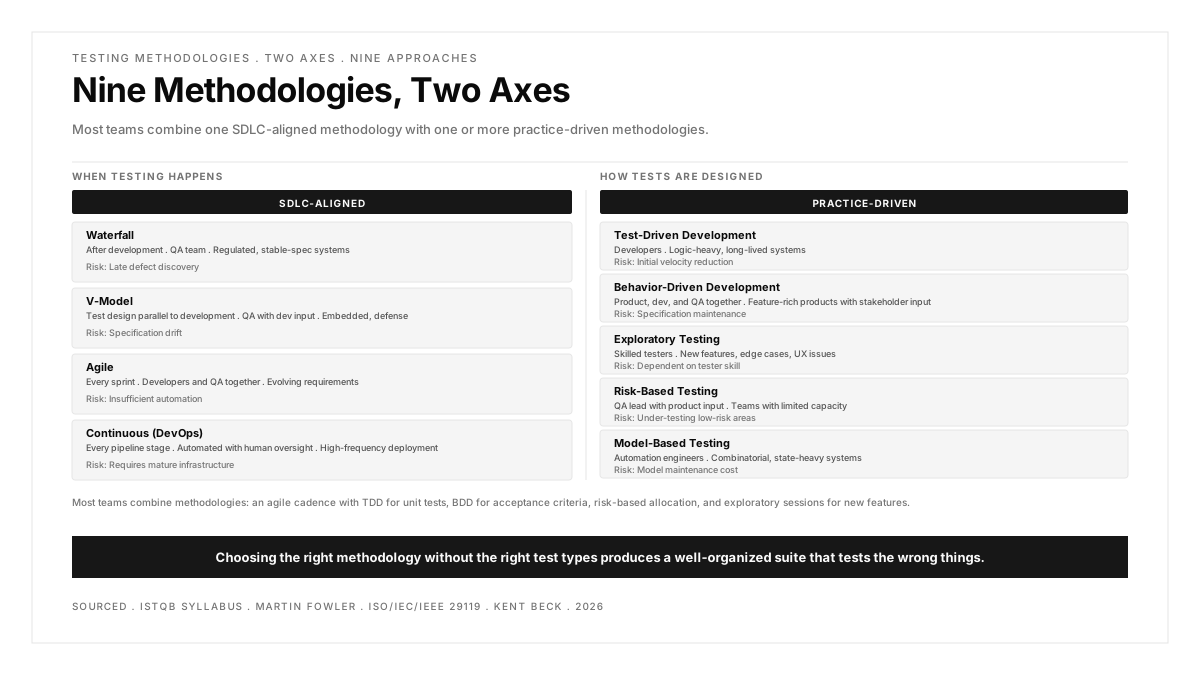
The term covers two distinct categories. SDLC-aligned methodologies (waterfall, V-Model, agile, continuous) determine when testing enters the development timeline. Practice-driven methodologies (TDD, BDD, exploratory, risk-based) determine how individual tests are designed and executed regardless of timeline. Most teams combine one from each category: an agile cadence with risk-based test design, for example, or a continuous pipeline with behavior-driven specifications.
This guide explains each methodology, compares them in a single table, and walks through the selection criteria that matter in practice.
Key Takeaways
- Testing methodologies split into two axes: SDLC-aligned (when testing happens) and practice-driven (how tests are designed). Mature teams combine one from each.
- Waterfall testing concentrates all testing after development completes. It works for stable, well-specified systems but discovers integration defects late, when they are most expensive to fix.
- Agile testing distributes testing across every sprint, which catches defects earlier but requires automation to keep pace with the release cadence.
- Test-driven development (TDD) writes the test before the production code. The methodology produces high unit test coverage as a side effect of the development process rather than as a separate activity.
- Risk-based testing allocates effort proportionally to business impact, which returns the most for teams with limited QA capacity because it replaces an implicit even spread with an explicit ranking.
- No single methodology fits every team. The deciding factors are release cadence, regulatory requirements, team structure, and the ratio of new feature work to maintenance.
SDLC-aligned testing methodologies
These methodologies define where testing sits in the development lifecycle. The choice determines how early defects surface and how much rework a late discovery costs.
Waterfall
Testing occupies a dedicated phase after development finishes. Requirements are written, the system is built to specification, and then the testing team verifies that the build matches the requirements document.
How it works in practice:
- Requirements are frozen and signed off
- Development builds the complete system
- The testing phase begins: test planning, test case design, execution, defect logging
- Defects return to development for fixing
- Regression testing confirms the fixes
- The system moves to acceptance testing and release
Where it works: Regulated industries (medical devices, aviation, defense) where requirements stability is high and audit trails are mandatory. The linear structure maps cleanly to compliance documentation.
Where it breaks: Products with changing requirements. A defect discovered during the testing phase that traces back to a requirements misunderstanding costs far more to fix than the same defect caught during development. The feedback loop is measured in months rather than days.
V-Model
An extension of waterfall that pairs each development phase with a corresponding testing phase. Requirements map to acceptance tests, architecture maps to integration tests, and detailed design maps to unit tests. The pairing is defined before coding begins, so the test design runs in parallel with development rather than after it.
How it works in practice:
The left side of the V is the development sequence (requirements, architecture, detailed design, coding). The right side is the testing sequence (unit testing, integration testing, system testing, acceptance testing). Each level on the left produces a test specification for the corresponding level on the right.
Where it works: Projects where the requirements are stable enough to write detailed test specifications before a line of code exists. Defense contracts, embedded systems, and infrastructure software commonly use the V-Model.
Where it breaks: The same place waterfall breaks, with the additional risk that test specifications written against early-stage designs become obsolete if the design changes during implementation.
Agile
Testing is continuous activity distributed across every sprint rather than a separate phase. Developers write unit and integration tests alongside production code. QA engineers run functional tests within the same sprint that produces the feature. Exploratory testing happens before the sprint closes.
How it works in practice:
- User stories include acceptance criteria that define the test scope
- Developers write automated unit and integration tests as part of the definition of done
- The CI pipeline runs smoke tests on every commit and regression tests on every merge to main
- QA runs exploratory sessions on new features within the sprint
- The testing pyramid governs the distribution: many unit tests, fewer integration tests, fewest end-to-end tests
Where it works: Product teams shipping frequently (weekly to daily) with evolving requirements. The tight feedback loop catches defects within the sprint that introduced them.
Where it breaks: Teams that adopt the agile label without automating the test suite. Manual testing cannot keep pace with two-week sprints, and the testing phase collapses into the final day before release, which recreates the waterfall problem inside a sprint boundary.
Continuous testing (DevOps)
Testing runs automatically at every stage of the delivery pipeline: on commit, on merge, on deployment to staging, on deployment to production. There is no testing phase because testing never stops. This is the methodology behind shift-left testing, where verification moves as early in the pipeline as the test type allows.
How it works in practice:
- A developer pushes a commit
- Unit and integration tests run in seconds
- A merge to main triggers the full regression suite
- Deployment to staging triggers smoke and sanity tests against the live environment
- Production deployment triggers synthetic monitoring and canary checks
- Production monitoring feeds crash and performance data back into the test backlog
Where it works: Teams with mature automation, a well-maintained CI/CD pipeline, and the discipline to treat a failing test as a deployment blocker rather than a notification to investigate later.
Where it breaks: Without sufficient automation coverage, continuous testing becomes continuous manual verification, which is not sustainable. The methodology requires investment in test infrastructure before it returns value.
Practice-driven testing methodologies
These methodologies define how tests are designed, written, and maintained. They operate independently of the SDLC model: a team using waterfall can still apply risk-based test design, and an agile team can still practice TDD.
Test-driven development (TDD)
TDD inverts the conventional sequence. The developer writes a failing test first, writes the minimum production code to make it pass, then refactors. This cycle (red, green, refactor) repeats for every unit of behavior.
The practical effect: High unit test coverage emerges as a side effect of the development process. The suite is never "added later" because the tests exist before the code they verify. Design decisions are tested by default because the code is written to satisfy a test specification.
Trade-off: TDD adds time to initial development. A feature that takes two days without TDD might take two and a half days with it. The payback comes during maintenance: the comprehensive test suite catches regressions immediately, reducing the time spent debugging production issues. Teams that measure cost over the full lifecycle (development plus maintenance) consistently find TDD net positive for code that persists longer than six months.
Behavior-driven development (BDD)
BDD extends TDD by writing test specifications in structured natural language that non-technical stakeholders can read and validate. Specifications follow the Given/When/Then format and serve as both documentation and executable tests.
The practical effect: The specification becomes the single source of truth for what a feature does. Product managers write or review the scenarios, developers implement them, and the framework executes them as automated tests. Miscommunication between product and engineering surfaces during specification review rather than after delivery.
Trade-off: BDD requires a framework (Cucumber, SpecFlow, Behave) and a discipline for maintaining the Gherkin files. Teams that write the specifications but skip the automation step produce documentation that drifts from the codebase. Teams that automate without stakeholder participation produce specifications that no non-technical person reads, which eliminates the methodology's primary benefit.
Exploratory testing
Structured investigation without a predefined script. A tester receives a charter (a focused goal such as "test the checkout flow under network interruption") and explores the application using domain knowledge, intuition, and heuristics. Sessions are time-boxed, typically 60 to 90 minutes.
The practical effect: Exploratory testing finds the defects that scripted test cases structurally exclude. Scripted cases verify known behaviors. Exploration discovers unknown behaviors: edge cases, unusual navigation sequences, race conditions, and accessibility gaps.
Trade-off: Results depend on the tester's skill and domain knowledge. Two testers with the same charter will find different defects. The methodology complements automation rather than replacing it: automation covers the known, exploration covers the unknown. Findings from exploratory sessions that are worth keeping should be converted into automated regression cases, which is the step most teams skip.
Risk-based testing
Test effort is allocated proportionally to business impact multiplied by failure probability. High-risk areas (payment processing, authentication, data migration) receive deep coverage with multiple test types. Low-risk areas (settings screens, informational pages) receive smoke tests and little else.
The practical effect: The team explicitly ranks product areas by risk and allocates test effort accordingly. This surfaces misallocations that accumulate naturally: a settings screen with 40 test cases and a checkout flow with 12. The risk register becomes a living document reviewed quarterly.
Trade-off: The methodology requires someone to make and defend the risk rankings. In teams without clear product ownership, the ranking becomes a political exercise. The methodology also carries the risk of under-testing a "low-risk" area that turns out to harbor a critical defect. Periodic exploratory sessions on low-risk areas mitigate this blind spot.
Model-based testing
Tests are derived automatically from a model of the system's expected behavior: state machines, activity diagrams, or decision tables. The model defines all valid states and transitions, and a test generation tool produces test cases that cover the model according to a coverage criterion.
The practical effect: Model-based testing excels at combinatorial coverage. A login flow with three input fields, each with five valid states and three invalid states, produces hundreds of combinations. A model encodes these combinations and generates test cases that a human would not write manually because the volume is too large.
Trade-off: Building and maintaining the model is the bottleneck. The model must accurately represent the system, which means it needs updating whenever the system changes. For rapidly evolving UIs, model maintenance can cost more than the testing it automates. The methodology fits best for stable, logic-heavy systems (protocol implementations, state machines, form validation engines).
Testing methodology comparison
| Methodology | When Testing Happens | Who Drives It | Best For | Primary Risk |
|---|---|---|---|---|
| Waterfall | After development | QA team | Regulated, stable-spec systems | Late defect discovery |
| V-Model | Test design in parallel, execution after build | QA with development input | Embedded, defense, infrastructure | Specification drift |
| Agile | Every sprint | Developers and QA together | Products with evolving requirements | Insufficient automation |
| Continuous | Every pipeline stage | Automated with human oversight | High-frequency deployment teams | Requires mature infrastructure |
| TDD | Before production code | Developers | Logic-heavy code, long-lived systems | Initial velocity reduction |
| BDD | Before development, as specifications | Product, dev, and QA together | Feature-rich products with stakeholder involvement | Specification maintenance |
| Exploratory | During and after development | Skilled testers | New features, edge cases, UX issues | Dependent on tester skill |
| Risk-based | Throughout, weighted by risk | QA lead with product input | Teams with limited capacity | Under-testing low-risk areas |
| Model-based | Generated from system models | Automation engineers | Combinatorial, state-heavy systems | Model maintenance cost |
How to choose a testing methodology
The choice depends on four factors, and each points toward a different methodology.
Release cadence
Teams releasing weekly or daily need agile or continuous testing. The feedback loop must fit inside the release cycle. Waterfall and V-Model testing cannot keep pace with frequent releases because the testing phase takes longer than the release interval.
Regulatory requirements
Industries with mandatory audit trails (healthcare, finance, defense) need traceability from requirement to test case. Waterfall and V-Model provide this structure inherently. Agile teams in regulated industries add traceability tooling (requirement management systems, test case management platforms) to satisfy the same constraint within a sprint-based workflow.
Team structure
TDD and BDD require developer involvement in testing. Teams where testing is entirely delegated to a separate QA organization need methodologies that separate the two roles more cleanly: risk-based or requirement-based test design executed by dedicated testers.
Ratio of new work to maintenance
Products in active feature development benefit from TDD and BDD because the test suite grows with the codebase. Products in maintenance mode benefit from risk-based and exploratory testing because the goal shifts from building coverage to finding regressions efficiently.
Most teams combine methodologies. A common combination: agile cadence with TDD for unit tests, BDD for acceptance criteria, risk-based allocation for test effort, and exploratory sessions for new features. The software testing lifecycle provides the structural framework within which these methodologies operate.
The testing methodology and test type relationship
Testing methodologies determine how and when to test. Test types determine what to test. The two are independent axes that combine in practice.
A risk-based methodology might allocate heavy black-box testing to the checkout flow and light white-box testing to utility functions. An agile methodology might run functional tests on every PR and acceptance tests at the end of each sprint.
The methodology is the governing principle. The test types are the instruments. Choosing the right methodology without choosing the right test types produces a well-organized suite that tests the wrong things. Choosing the right test types without a methodology produces a useful but ungoverned suite that drifts over time.
FAQs
What is the difference between a testing methodology and a testing strategy?
A testing methodology is the approach to how and when testing is performed: waterfall, agile, TDD, or risk-based. A testing strategy is the document that applies one or more methodologies to a specific product, defining scope, coverage allocation, automation boundaries, and quality gates. The methodology is the principle. The strategy is the application of that principle to a particular context.
Which testing methodology is best for agile teams?
Agile teams benefit most from combining continuous testing with TDD or BDD. Continuous testing keeps the feedback loop short enough to catch defects within the sprint. TDD ensures unit coverage grows with the codebase. BDD bridges the gap between product requirements and executable tests. Risk-based allocation determines where to focus the effort within each sprint.
Can a team use multiple testing methodologies at the same time?
Yes, and most teams do. A common combination: agile cadence (SDLC-aligned) with TDD for unit tests (practice-driven), BDD for acceptance specifications (practice-driven), and exploratory testing for new features (practice-driven). The SDLC-aligned methodology sets the timing. The practice-driven methodologies determine how tests within that timing are designed and executed.
What is the most common testing methodology?
Agile testing is the most widely adopted SDLC-aligned methodology in product companies. Among practice-driven approaches, risk-based testing is the most common because most teams naturally prioritize testing around the features with the highest business impact, even when they do not formally label the approach. TDD adoption varies significantly by engineering culture and language ecosystem.
How does testing methodology affect test automation?
The methodology determines what gets automated, when, and at what layer. TDD produces automated unit tests by definition. BDD produces automated acceptance tests. Continuous testing requires automation at every pipeline stage. Waterfall typically automates regression testing to support the testing phase. The testing pyramid provides the distribution model: many fast unit tests, fewer integration tests, fewest end-to-end tests, regardless of methodology.
Is exploratory testing a methodology or a technique?
Both, depending on context. As a technique, it is a way to investigate software without scripted cases. As a methodology, it is a structured approach with charters, time-boxed sessions, session reports, and a feedback loop into the automated suite. The distinction matters because ad hoc testing without structure is not exploratory testing. The methodology requires planning (what to explore), execution (time-boxed investigation), and follow-through (converting findings into regression cases).
How do testing methodologies apply to mobile development?
Mobile development adds complexity that some methodologies handle better than others. Continuous testing maps well to mobile CI/CD pipelines where builds run on every commit. Risk-based testing helps allocate effort across the device fragmentation matrix, where testing every combination is impossible and prioritization is essential. TDD works for business logic but does not cover device-specific behaviors like push notifications or biometric authentication, which require UI-level testing on real hardware.