
Test-Driven Development: What It Costs and What It Returns
Test-driven development cut defect density 40 to 90 percent across four industrial teams while adding 15 to 35 percent to development time. The cycle, the limits, and mobile.
Yuvan Sundrani · 9 min read
autosana.ai
TL;DR
- Test-driven development means writing a failing test before the code that satisfies it, then refactoring once the test passes.
- Four industrial teams at Microsoft and IBM recorded defect density falling 40 to 90 percent under test-driven development, with development time rising 15 to 35 percent.
- The practice covers unit-level design well and leaves a gap at the integration and user-journey layers, which is where most production defects actually surface.
- Autosana closes that gap by running intent-based end-to-end flows on real iOS, Android, and web devices, so the outer loop gets the same discipline as the inner one.
A study published through IEEE tracked four industrial teams at Microsoft and IBM adopting test-driven development. Defect density fell between 40 and 90 percent against comparable projects. Development time rose between 15 and 35 percent.
Both numbers matter. Test-driven development is a trade, and teams that adopt it while expecting only the first number abandon it around week three when the second one arrives.
This guide covers the cycle, what the practice buys at the unit level, where it stops helping, and how the same discipline extends to the layers it leaves uncovered.
What Test-Driven Development Is
Test-driven development inverts the usual order. You write a test describing behavior that has yet to exist, watch it fail, then write the minimum code making it pass.
Kent Beck formalized the practice, and Martin Fowler's description frames it as a design technique that happens to produce tests. The Agile Alliance lists it among the core Extreme Programming practices.
The design claim is the part teams underrate. Writing the test first forces you to use your own interface before it exists, which surfaces awkward APIs while changing them is still free.
The Red-Green-Refactor Cycle
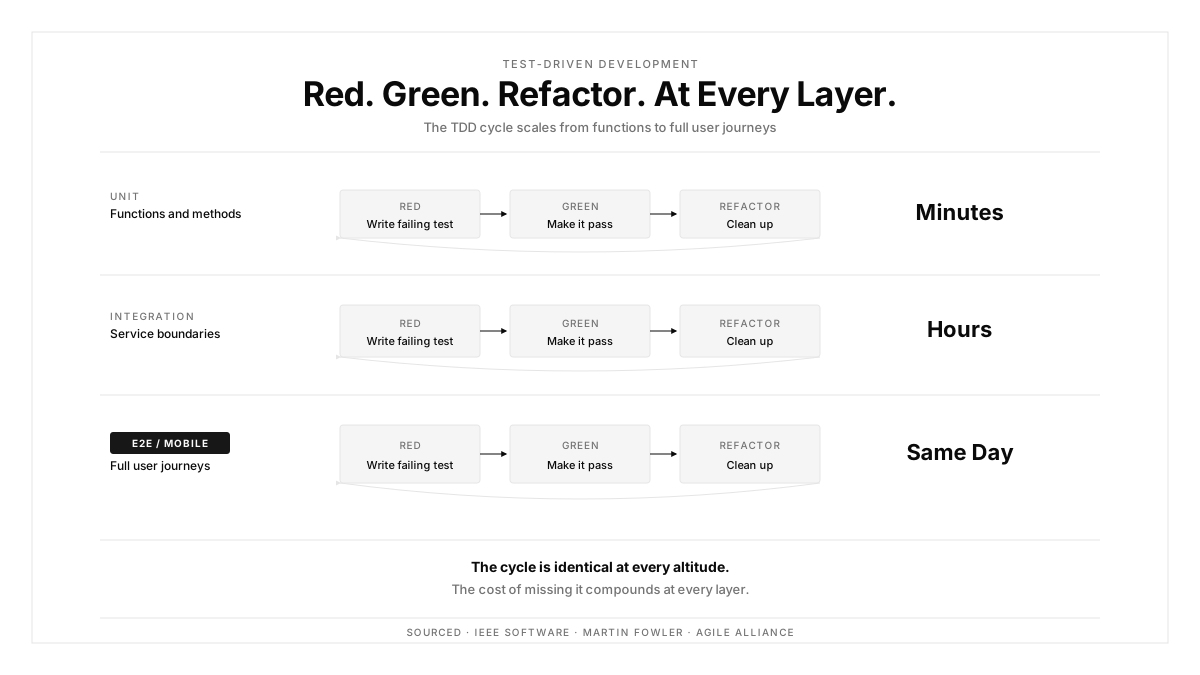
Three steps, repeated in minutes rather than hours.
Red comes first. Write a test for behavior that has yet to exist and run it. Watching it fail confirms the test actually exercises something, since a test passing against absent code is testing the wrong thing.
Green follows. Write the smallest amount of code making the test pass. Ugly solutions are acceptable here, because the next step handles that.
Refactor closes the loop. Improve the structure while the test holds you honest. Rename, extract, deduplicate, then run the test again.
Cycle length is the usual failure point. A loop running 30 minutes has drifted away from the practice. Two to ten minutes keeps the feedback tight enough to be useful.
What the Research Shows
The IEEE study covering Microsoft and IBM teams remains the most cited industrial evidence. Defect density dropped 40 to 90 percent. Development time increased 15 to 35 percent.
Read those together and the trade becomes clear: you pay in initial velocity and collect in defect reduction. The return arrives later than the cost, which is why adoption stalls when teams measure only the first sprint.
Two findings from the same body of work deserve attention. The benefit concentrated in code with meaningful branching logic, and it thinned out for straightforward data mapping. Teams with existing automated test culture adopted faster than teams starting cold.
Practices That Keep It Working
Write one assertion per test where practical. A test failing on its third assertion tells you less than a test whose name states exactly what broke.
Name tests after behavior rather than method names. A test called calculateDiscount ages badly after a rename, while one describing an order above the threshold receiving ten percent survives it.
Keep the cycle short. If you are writing more than a few lines between runs, the loop has stretched.
Treat test code as production code. Duplication and unclear naming rot a suite faster than anything else, and a suite people distrust stops getting run.
Watch the red step every time. Skipping it is how suites accumulate tests that pass regardless of whether the code works.
Where Test-Driven Development Stops Helping
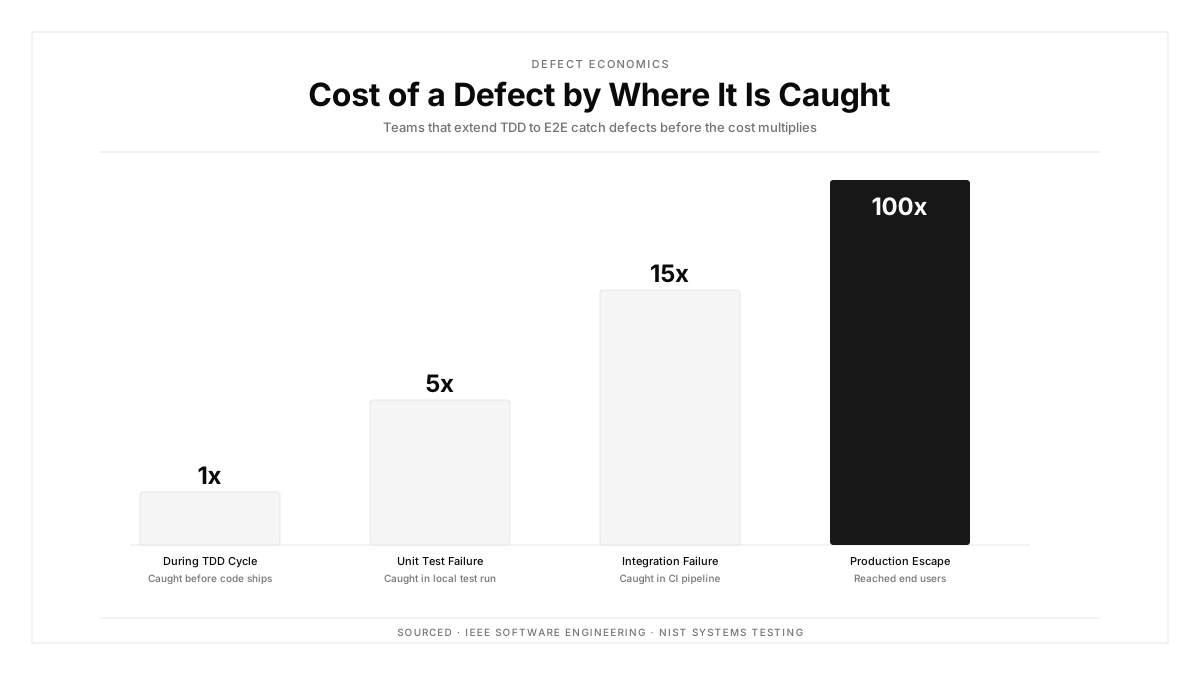
Unit tests verify a function in isolation. Production failures usually involve several correct functions interacting in an unanticipated way.
A payment calculator passes every unit test. The API returns the amount in cents while the display layer expects rupees. Both units are correct, and the user sees a total inflated a hundredfold.
This is the gap test-driven development leaves by construction. The discipline operates below the level where integration defects live, so a team with excellent unit coverage can still ship broken checkout flows.
Closing it means applying the same write-the-test-first habit at the outer layers: API testing for contracts between services, and end-to-end flows for user journeys crossing the whole system.
Test-Driven Development for Mobile
Mobile splits cleanly into code that suits the practice and code that resists it.
Business logic, view models, data transformations, and networking layers all work well. They are pure functions or close to it, and the cycle runs fast against them.
UI behavior, platform permission flows, and hardware interactions resist it. Writing a failing test for how a permission dialog renders under a vendor OS fork costs more than the test returns.
A practical split puts test-driven development on the logic layer and intent-based mobile test automation on the interface layer. The first catches calculation and state errors early. The second catches what happens when real hardware gets involved.
One constraint shapes everything here: a mobile inner loop depends on build speed. An 11-minute Gradle build destroys a two-minute cycle, so teams adopting the practice on mobile invest in build caching first.
Extending the Discipline Into CI/CD
The habit generalizes past unit tests. Before fixing a reported defect, write the check that reproduces it and watch it fail. Then fix, then watch it pass.
That converts every bug into permanent coverage, and it works at any layer. A defect reported against a checkout flow becomes a flow-level test rather than a unit test, and it runs in the pipeline from then on.
Tier by runtime so the loop stays fast. Unit tests on every commit. Smoke tests and API checks on every pull request. Full regression suites before merge or on a schedule.
The failure to avoid is running everything on every commit. A suite taking 45 minutes gets bypassed, and a bypassed suite provides zero protection regardless of how well the tests were written.
Test-Driven Development With AI Coding Agents
Coding agents changed the economics of this practice in a specific way.
An agent generating implementation code produces plausible output fast. Verifying that output is now the bottleneck, and a failing test written first is a precise specification an agent can work against.
The workflow that holds up: write the test yourself, hand the agent the failing test plus the interface, and accept the implementation once the test passes. The test is what keeps the agent honest, since an agent asked to write both the test and the code can satisfy itself trivially.
That makes test-driven development more relevant now than it was when the IEEE numbers were collected, because the cost side of the trade has dropped while the verification problem has grown.
How Autosana Fits
We built Autosana for the layer test-driven development leaves open, which is the user journey across real devices.
Our flows describe intent in plain language, so writing the test first works at the journey level: describe the behavior, watch it fail against the current build, then implement. Our guide to writing effective flow instructions covers phrasing that executes reliably, and quickstart gets a first flow running quickly.
We execute across real iOS, Android, and web hardware, which covers the integration and platform failures that unit tests structurally exclude.
We trigger from your pipeline through CI/CD integration and automations, so the outer loop runs on the same cadence as the inner one.
Because we anchor to intent, a UI refresh leaves the flow valid. That property matters for an outer-loop suite, since journey tests bound to selectors decay fast enough that teams stop maintaining them.
Conclusion
Run the trade on your own codebase before committing to it. Pick one module with real branching logic and apply the cycle for a sprint.
Then measure two things: how much longer the work took, and how many defects the module produced afterward compared with its history. The IEEE ranges are wide because the answer depends heavily on what the code does.
Where the logic is complex, the numbers usually land in favour of the practice. Where the code mostly moves data between shapes, they usually do the opposite, and knowing which situation you are in is worth more than adopting either position wholesale.
.png)
FAQ
What is test-driven development?
Test-driven development means writing a failing test that describes intended behavior, writing the minimum code to make it pass, then refactoring while the test holds. The cycle repeats in minutes.
What is the red-green-refactor cycle?
Red means writing a test and watching it fail. Green means writing the smallest code that passes it. Refactor means improving structure while the passing test protects you from breaking behavior.
Does test-driven development actually reduce defects?
An IEEE study of four teams at Microsoft and IBM recorded defect density falling 40 to 90 percent, alongside development time rising 15 to 35 percent. The benefit concentrated in code with meaningful branching logic.
How long should a TDD cycle take?
Two to ten minutes. A cycle stretching past thirty minutes has lost the fast feedback the practice depends on, and usually means too much code is being written between test runs.
What are the limits of test-driven development?
It operates below the level where integration defects live. Two correctly unit-tested components can still fail together, so API contract tests and end-to-end journey tests cover what the practice structurally excludes.
Does test-driven development work for mobile apps?
It works well for business logic, view models, and networking layers. UI behavior, permission flows, and hardware interaction suit intent-based end-to-end automation better. Build speed is the main constraint on the inner loop.
How does TDD differ from BDD?
Test-driven development focuses on function-level design, written by developers in code. Behavior driven development describes user-visible behavior in business language, written collaboratively. A common arrangement runs the second as the outer loop.
How does test-driven development apply to AI coding agents?
A failing test written by a human is a precise specification an agent can implement against. Asking an agent to write both the test and the code removes the verification value, since it can satisfy itself trivially.