
Shift-Left Testing for Mobile: Running E2E on Every PR
Shift-left failed on mobile for a mechanical reason, not a cultural one. The four costs that pushed mobile E2E rightward, and what to actually gate on a PR.
Yuvan Sundrani · 19 min read
autosana.ai
.png)
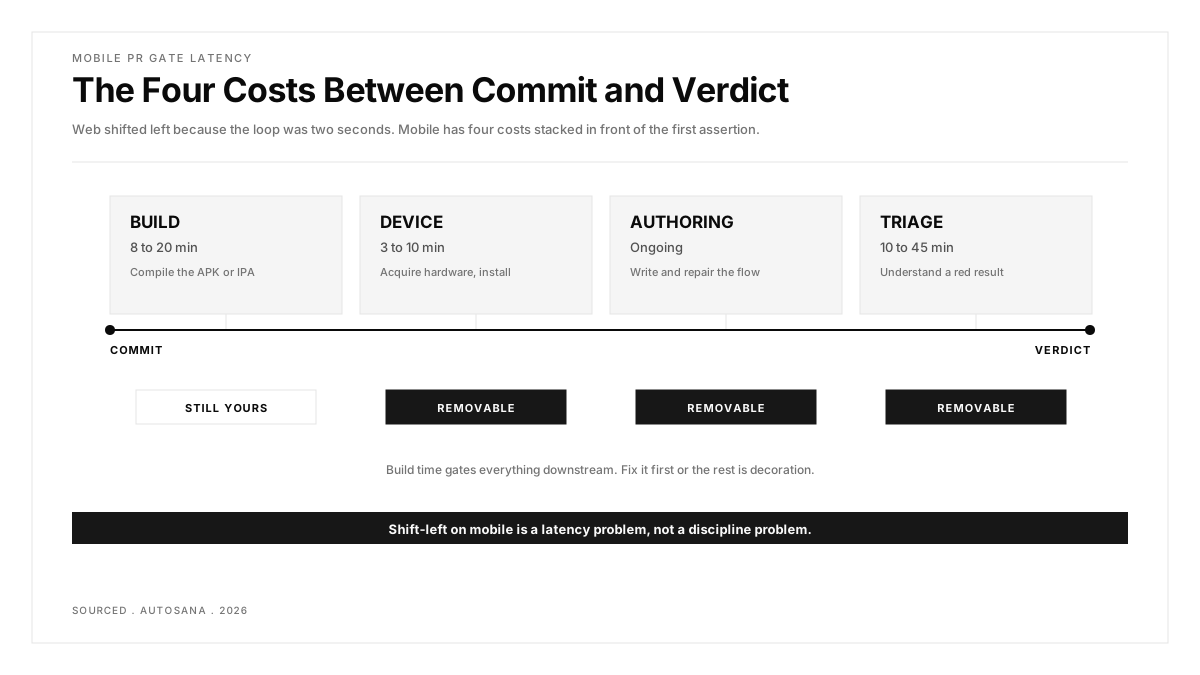
Shift-left testing for mobile means moving end-to-end validation from a nightly job onto the pull request, so a broken checkout flow is caught by the developer who broke it rather than by QA the next morning. Mobile teams were told to do this for a decade and mostly could not, because four costs stack up before a mobile E2E test can run at all: building the artifact, provisioning a device, authoring the flow, and triaging the result. Three of those four are now removable. The fourth is still yours.
Key Takeaways
- Shift-left stalled on mobile for a mechanical reason, not a cultural one. A headless browser boots in about two seconds. A mobile test needs a compiled IPA or APK, a provisioned device, and an install step before the first assertion runs.
- The four costs that pushed mobile E2E rightward are build, device, authoring, and triage. Attack them in that order, because build time gates everything downstream.
- A PR gate should run fewer tests, not more. Target under ten minutes end to end for a smoke tier on two or three device configurations, and leave the full matrix to nightly.
- A slow, flaky PR gate is worse than an honest nightly job, because developers learn to bypass it and you lose the signal and the trust at the same time.
- Autosana removes the device, authoring, and triage costs with hosted real devices, intent-based flows, and session replay posted to the PR. Build time stays your pipeline's problem, because Autosana does not compile your app.
Why did shift-left testing never take hold on mobile?
Shift-left is a web-era idea. It spread because web teams could act on it cheaply. A headless Chromium process starts in roughly two seconds, runs against a preview deployment, and reports back before the developer has finished reading the diff. Running end-to-end checks on every pull request was not a cultural victory on web. It was an economic one. The loop was short enough that nobody had to be persuaded.
Mobile inherited the vocabulary and none of the economics.
The unit of test on mobile is not a URL. It is a build artifact. Before any assertion executes, the pipeline has to compile an APK or an IPA, acquire a device or boot an emulator, install the binary, and wait for the app to reach a testable state. On an unoptimised pipeline that sequence runs twenty to forty minutes. A developer will not wait that long for feedback on a one-line change, and a gate that developers resent is a gate that gets bypassed.
So mobile E2E drifted rightward. It became a nightly job, or a pre-release regression gate, or a manual pass before a store submission. Every one of those placements shares a defect: the person who introduced the regression is no longer looking at the code when the failure surfaces. A QA engineer on r/QualityAssurance described the downstream effect of that gap, where a nightly red lands in a queue the following morning and gets triaged by someone who has to reconstruct the change from the commit log before they can even reproduce it.
The reframe worth holding onto: shift-left is not a discipline problem on mobile. It is a latency problem. Fix the latency and the discipline follows, because developers will happily wait for feedback that arrives before they have context-switched.
What are the four costs blocking mobile E2E on every PR?
Every minute between a push and a verdict falls into one of four buckets. They are worth separating because they have different owners and completely different fixes.
| Cost | What It Is | Typical Unoptimised | Who Owns the Fix |
|---|---|---|---|
| Build | Compiling the APK or IPA for the commit | 8 to 20 min | Your pipeline |
| Device | Acquiring hardware or booting an emulator, then installing | 3 to 10 min | Your device strategy |
| Authoring | Writing and maintaining the flow being run | Ongoing, not per-run | Your test framework |
| Triage | Human minutes spent understanding a red result | 10 to 45 min per failure | Your reporting |
Build and device are wall-clock costs that delay the verdict. Authoring and triage are human costs that do not show up in the pipeline duration at all, which is exactly why they get ignored in planning and then dominate the actual expense.
How do you cut mobile build time enough to gate a PR?
Build time is the hard floor. No amount of test-layer cleverness helps if the artifact takes eighteen minutes to produce, because the verdict cannot arrive before the build does.
Three levers matter. Cache aggressively and then verify the cache is actually hitting rather than merely configured, because a cache that reports a miss on every run is a silent multi-minute tax. Build incrementally where the toolchain supports it, so an unchanged module is not recompiled. And reuse artifacts across jobs: compile once per commit, then let every downstream test job pull that same binary rather than rebuilding it per matrix leg. That last one is the single most common waste in mobile CI, because a six-way device matrix that each builds its own APK is paying the build cost six times for one commit.
A practitioner on r/softwaretesting made the point that suite runtime conversations usually focus on the tests while the build step quietly consumes the majority of the wall clock, which is the right diagnosis and the wrong place most teams start.
Why is device provisioning the cost teams underestimate?
Booting an Android emulator inside a CI container is slower than people expect, particularly without hardware acceleration enabled. On iOS, simulator startup is faster but you are constrained to macOS runners, which are billed at a multiple of Linux and are frequently the queue bottleneck rather than the compute bottleneck.
Real hardware removes an entire class of false signal, because an emulator does not reproduce OEM skin behaviour, real network conditions, or the specific vendor quirks that cause production incidents. The historical objection to real devices was that maintaining a physical lab was its own full-time job. Hosted real-device clouds removed that objection. The relevant question in 2026 is no longer whether to use real devices but whether your provider keeps a warm pool, because a cold device acquisition reintroduces the exact latency you were trying to delete.
Why does test authoring cost more than the pipeline shows?
Authoring never appears in a pipeline duration graph, which is why it survives budget scrutiny for years.
A selector-bound mobile suite requires maintenance proportional to UI churn. Every renamed test ID, every restructured navigation stack, every migration from Views to Compose invalidates some fraction of the suite. That work is unplanned, it lands on whoever is least able to refuse it, and it competes directly with writing new coverage. Teams in this state are not short of testing ambition. They are spending their testing budget on repairs.
A tester on r/softwaretesting described the steady state plainly: a suite large enough to matter becomes a suite large enough to need an owner, and the owner spends their week on upkeep rather than coverage.
Why is triage the cost that decides whether anyone trusts the gate?
A red job is not a finished product. It is a ticket that says somebody has to go find out why.
When the only artifact is a stack trace and the last fifty lines of stdout, reconstructing what the device actually did is slow and frequently inconclusive. The failure gets re-run, passes, and is quietly filed as flake. Do that often enough and the organisation stops reading failures altogether.
Triage cost is what converts a working gate into theatre. A gate nobody investigates is not gating anything. Attaching a video of the run, the device logs, and the screen state at the moment of failure is the difference between a two-minute diagnosis and a forty-minute archaeology session. An engineer on r/Everything_QA framed pipeline test strategy around exactly this: the value of a check is capped by how quickly a human can act on its output.
What should actually run on a pull request versus nightly?
This is the part teams get wrong in the most expensive direction. Having decided to shift left, they move the entire regression suite onto the PR gate, the gate takes fifty minutes, and within a month developers are merging with the check red and a shrug.
Moving everything left is not shifting left. It is relocating the bottleneck.
Tier the suite instead:
| Trigger | Scope | Device Coverage | Time Budget | Blocking |
|---|---|---|---|---|
| Pull request | Smoke tier: auth, core transaction, one critical read path | 2 to 3 configs, newest and oldest supported OS | Under 10 min | Yes |
| Merge to main | Broader regression, feature-area suites | 5 to 8 configs | Under 30 min | Yes, on main |
| Nightly | Full suite, edge cases, long flows | Full matrix | Unbounded | No, reports |
| Pre-release | Full suite plus manual exploratory | Full matrix plus physical spot checks | Unbounded | Yes, release gate |
The PR tier should answer exactly one question: did this change break something a user would notice within thirty seconds of opening the app? That is typically three to eight flows. Not eighty.
Choosing which flows earn a slot is a revenue question rather than a coverage question. Whatever generates money, whatever gates access to the product, and whatever would trigger a rollback if it broke in production. Everything else can wait for the nightly run without anyone getting hurt.
A ten-minute budget is the number worth defending. Past roughly fifteen minutes, developers context-switch, and a verdict that lands after the context switch has lost most of its value even when it is correct. If the smoke tier will not fit in ten minutes, cut flows rather than extending the budget. A six-flow gate that developers wait for beats a thirty-flow gate they learn to ignore.
How do you roll this out without the team revolting?
Run the gate in non-blocking mode first. Let it report for two sprints while you measure its first-attempt pass rate and fix whatever is unstable. Only promote it to a required check once it is boring.
Promoting an unstable gate to blocking on day one is how shift-left initiatives die. The first false red that stops a hotfix merge will cost you the political capital for the entire programme. A practitioner on r/servicenow described the same dynamic in enterprise automation rollouts, where the gate that is introduced as advisory and earns its promotion survives, and the one mandated from above gets routed around within a quarter.
Sequence the rollout to match the cost table. Fix build time first, because it gates everything after it. Then device acquisition. Then authoring. Then reporting. Teams that start with authoring because it feels most tractable end up with beautifully maintainable tests behind an eighteen-minute build nobody waits for.
How do you know the gate is actually working?
Three numbers tell you whether the thing you built is helping or quietly rotting.
First-attempt pass rate on the PR gate is the headline metric. If it sits below ninety-five percent, developers are being blocked by noise and will route around the gate within weeks. Track it weekly, not quarterly, because the decay is gradual and nobody notices the month it crosses the line.
Median time from push to verdict is the second. Watch the trend rather than the absolute number. A gate that was eight minutes in January and is fourteen minutes in June has not failed yet, but it is on the path, usually because flows were added without anything being removed.
Escaped-defect rate is the one teams forget. Count the regressions that reached main despite a green gate. If that number is not falling after a quarter, your PR tier is testing the wrong flows, and adding more tests will not fix a selection problem.
One qualitative check is worth more than all three. Ask a developer whether they wait for the gate before switching tasks. If they say yes, the latency budget is working. If they say they push and move on, the verdict is arriving after the context switch and you have built a nightly job that runs more often.
When is shift-left the wrong call for a mobile team?
Three cases, stated plainly.
If your build cannot get under roughly twelve minutes and you have no path to fixing that, a PR gate is not viable yet. Fix the build first. Anything else is decoration.
If your release cadence is quarterly rather than continuous, the economics shift. A nightly job that a human reviews each morning may genuinely serve you better than a per-PR gate, because the feedback-latency argument carries much less weight when nothing ships for ten weeks.
And if your E2E suite currently has a first-attempt pass rate below roughly ninety-five percent, do not gate on it. You will be blocking merges on noise, and the team will correctly conclude the gate is lying to them. Stabilise first, promote second.
How does Autosana fit into a shift-left mobile pipeline?
Autosana is an AI-native E2E testing agent for iOS, Android, and web. Flows are expressed as intent rather than as selector scripts, and the agent re-plans against whatever the UI currently shows on each run.
Mapped against the four costs, it removes three of them.
Device cost goes away because runs execute on hosted real devices rather than on emulators you boot inside your own container. No KVM configuration, no macOS runner queue for the device layer, no cold boot timeout.
Authoring cost drops because there is no pinned selector to maintain. A renamed test identifier or a restructured navigation stack does not invalidate the flow, which matters disproportionately on a PR gate, where a maintenance-induced false red is indistinguishable from a real regression at the moment it blocks someone.
Triage cost drops because results arrive through the GitHub integration as a PR comment with session replay attached. The reviewer watches what the agent did on the device instead of reconstructing it from a log tail. Teams driving work from a coding agent can trigger the same flows through the MCP server, which closes the loop for PRs that an agent opened in the first place.
Build cost stays yours. Autosana does not compile your app, and no testing tool will rescue an eighteen-minute build. That remains a caching and incremental-compilation problem for your pipeline, and it is still the first thing to fix.
Where to start this week
Measure before you change anything. Take your last fifty pipeline runs and split the wall clock into build, device acquisition, and execution. Most teams discover the split is not what they assumed, and the assumed split is what their improvement plan was built on.
Then pick the three flows you would roll back a release for. That is your PR tier. Not thirty flows, three. Run them non-blocking for two sprints, watch the first-attempt pass rate, and promote the gate to required only once it has earned it.
The goal is not more testing earlier. It is a short, trustworthy signal that reaches the person who caused the problem while the change is still in their head.
.png)
FAQ
What is shift-left testing for mobile apps?
Moving end-to-end validation earlier in the development cycle, typically onto the pull request, so regressions are caught by the developer who introduced them rather than by a nightly job or a pre-release QA pass.
Can you really run mobile E2E tests on every pull request?
Yes, if the full loop fits a time budget developers will wait for. That means a cached incremental build, a warm device pool, and a smoke tier limited to a handful of critical flows rather than the full regression suite.
How long should a mobile PR test gate take?
Target under ten minutes end to end, including build and device acquisition. Past roughly fifteen minutes developers context-switch, and a verdict that arrives after the context switch has lost most of its practical value.
What tests should run on a PR versus nightly?
Pull requests should run a smoke tier of three to eight revenue-critical or access-critical flows on two or three device configurations. Broader regression belongs on merge to main. The full device matrix and long edge-case flows belong in the nightly run.
Why is mobile shift-left harder than web shift-left?
The unit of test differs. Web runs against a URL and a headless browser that boots in about two seconds. Mobile requires compiling a build artifact, provisioning a device or emulator, and installing the binary before the first assertion executes.
Should a mobile PR gate block merges?
Eventually, but not initially. Run it non-blocking for two sprints and measure the first-attempt pass rate. Promoting an unstable gate to a required check is the most reliable way to lose team trust in the programme.
Do you need real devices for a PR gate, or are emulators enough?
Emulators are acceptable for smoke-tier checks if boot time is controlled. Real devices catch OEM skin behaviour, genuine network conditions, and vendor quirks that emulators do not reproduce, so they are worth it for flows tied to revenue.
Can Autosana run E2E tests on every PR?
Yes. Autosana runs intent-based flows on hosted real devices and posts a session replay to the pull request through its GitHub integration. It does not compile your application, so build time remains a pipeline concern you own.