
Testing Pyramid: The Shape, and Why Mobile Bends It
The testing pyramid balances many fast unit tests against few end-to-end tests. The economics behind it, the ice cream cone and hourglass anti-patterns, and why mobile flattens the shape.
Yuvan Sundrani · 11 min read
autosana.ai
TL;DR
- The testing pyramid is a heuristic about proportions: many fast unit tests at the base, fewer integration tests above, fewest end-to-end tests at the top.
- The reasoning is cost and speed. A unit test runs in milliseconds and fails with a precise location; an end-to-end test takes minutes and fails with a journey name.
- Mobile bends the shape, because the defects users actually hit live in rendering, vendor OS forks, and hardware, which the base layer structurally cannot reach.
- Autosana makes the top layer cheaper to own, running one intent-based flow across real iOS, Android, and web devices in parallel.
A suite of 2,000 unit tests runs in 90 seconds and catches a wrong discount calculation instantly. The same suite stays silent about a checkout button sitting below the fold on an iPhone SE, because a unit test has no screen.
The testing pyramid is the heuristic that explains how to balance those two facts. It is widely cited, frequently misread as a rule, and genuinely useful once you understand what it is actually optimising for.
This guide covers the three testing pyramid layers, the economics underneath them, the two shapes teams drift into instead, and why mobile products reasonably sit higher than the classic diagram suggests.
What Are the Three Layers of the Testing Pyramid?
Mike Cohn introduced the testing pyramid and Martin Fowler's practical test pyramid remains the clearest treatment of it. ISO/IEC/IEEE 29119-1 defines the underlying test level vocabulary.
The base is unit tests. One function or class in isolation, running in milliseconds, written by the developer who wrote the code. These are numerous because they are nearly free.
The middle is integration tests. Two or more components together, verifying the contract between them rather than the logic inside either. Slower, fewer, and the layer that catches mismatched assumptions between parts that each work correctly.
The top is end-to-end tests. The assembled system exercised the way a user does, through the interface. Slowest, fewest, and the only layer that verifies the thing a customer actually experiences.
Why Does the Testing Pyramid Recommend This Shape?
The testing pyramid is a cost argument, and stating it plainly makes the shape obvious.
| Layer | Runtime | On Failure, You Learn | Maintenance Trigger |
|---|---|---|---|
| Unit | Milliseconds | The exact function | Refactoring |
| Integration | Seconds | The boundary between two parts | Contract change |
| End-to-end | Minutes | A journey broke, somewhere | UI change |
Two properties drive the testing pyramid recommendation. Speed determines how often a test can run, and a suite that runs on every keystroke catches errors while the author still has context. Diagnostic precision determines how long a failure takes to act on.
The third property is the one that bites. End-to-end tests break for reasons unrelated to the product, because they depend on the interface, and interfaces change for design reasons. That fragility is the real argument for keeping the top layer small, rather than runtime alone.
Which Two Shapes Do Teams Drift Into Instead?
What Is the Ice Cream Cone Anti-Pattern?
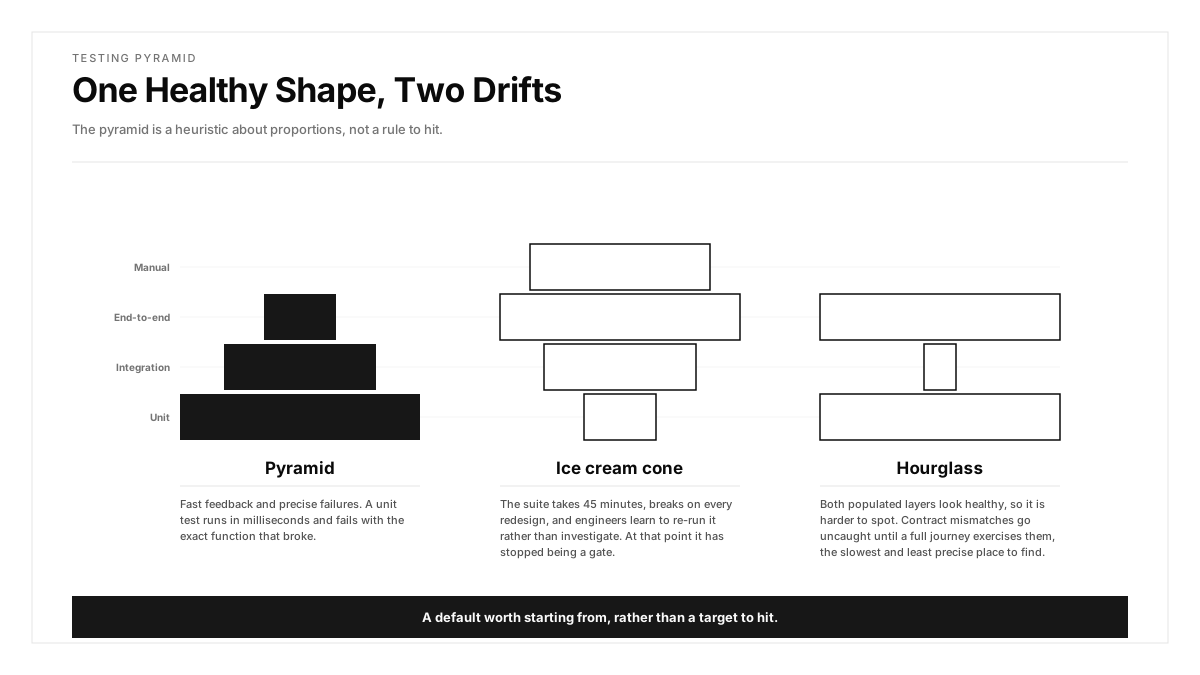
Inverted: many end-to-end tests, few unit tests, and often a layer of manual testing sitting on top of everything.
It appears through a reasonable sequence. The product exists before the tests. Writing end-to-end tests against a finished UI is easier than retrofitting unit tests into code that lacks the structure for them. The suite grows upward.
The outcome is predictable. The suite takes 45 minutes, breaks on every redesign, and engineers learn to re-run it rather than investigate. At that point it has stopped being a gate.
What Is the Hourglass Anti-Pattern?
Many unit tests, many end-to-end tests, and almost no middle.
This one is more common than the diagrams admit and harder to spot, because both populated layers look healthy. The missing middle means contract mismatches between services go uncaught until a full journey exercises them, which is the slowest and least precise place to find them.
API testing is usually the layer absent here, and adding it moves defects down a level where they are cheaper to diagnose.
Why Mobile Bends the Shape
The classic testing pyramid was articulated for server-side software, where the base layer can reach most of the risk. Mobile changes that in a specific way.
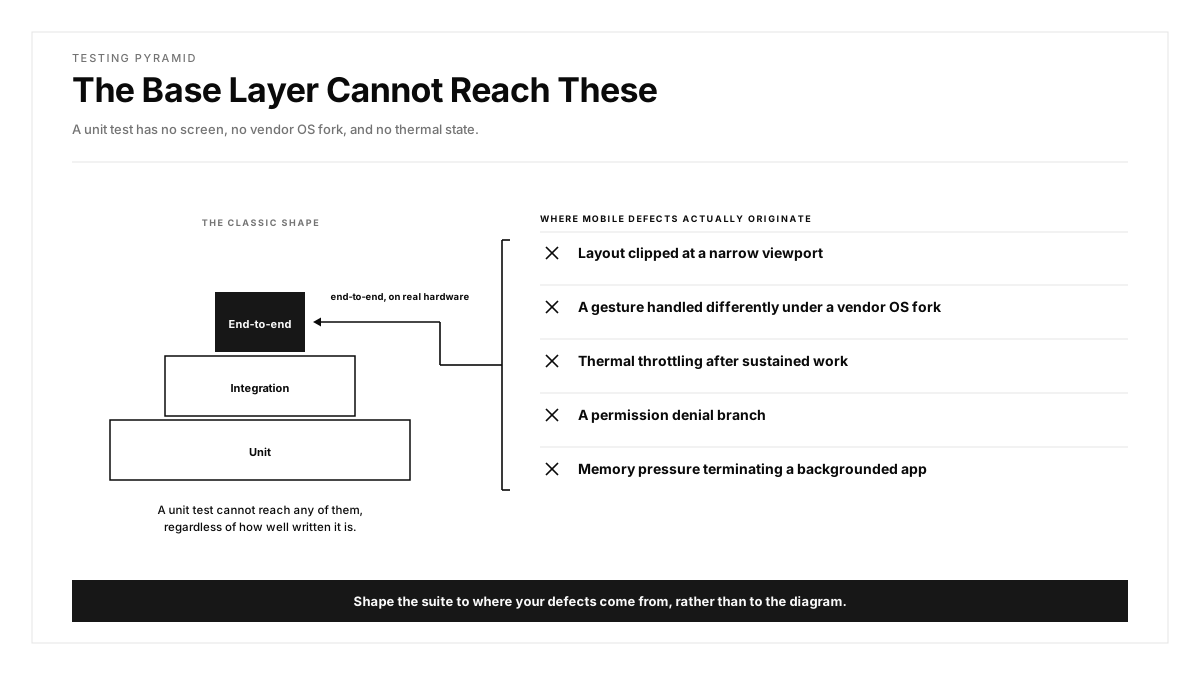
Consider where mobile defects actually originate. Layout clipped at a narrow viewport. A gesture handled differently under a vendor OS fork. Thermal throttling after sustained work. A permission denial branch. Memory pressure terminating a backgrounded app.
Every one of those requires a running application on a device. A unit test cannot reach any of them, regardless of how well written it is.
That makes a strict interpretation of the testing pyramid actively misleading for mobile. The base still deserves heavy investment for business logic, view models, and data transformation, which genuinely are cheap to test in isolation. The difference is that the top layer carries more of the real risk than it does on a backend, so squeezing it to match a diagram leaves the actual failure modes uncovered.
The useful reframing: keep the proportions determined by where your defects come from rather than by the picture. Testing a mobile app usually produces a flatter shape, and that is a correct response to the risk profile rather than a failure of discipline.
What Makes the Top Layer Expensive
Three costs drive the testing pyramid advice to minimise end-to-end tests, and each has a mitigation worth knowing.
Runtime. A journey takes minutes. Mitigation: run the full set on a schedule rather than on every commit, and run a small critical subset as a merge gate. Smoke tests serve this purpose well, and mobile test automation across devices belongs in the scheduled tier.
Flakiness. Timing, animation, and network variance produce failures unrelated to code. Mitigation: wait on conditions rather than durations, and quarantine anything below a stable pass rate instead of re-running it.
Maintenance. Selector-bound tests break on every redesign. Mitigation: anchor to user intent rather than element identifiers, so a renamed class leaves the test valid.
That third mitigation changes the economics most. Where the top layer stops breaking on cosmetic changes, the argument for keeping it minimal weakens considerably, and the shape you can afford shifts.
How Do You Apply the Testing Pyramid in Practice?
Four practical moves for applying the testing pyramid, in order of return.
Measure your current testing pyramid shape. Count tests per layer and total runtime per layer. Guesses about your own distribution are usually wrong, and the count takes an afternoon.
Audit your last twenty production defects by the layer that should have caught each. Where a pattern appears, that layer is your gap regardless of what the counts say.
Fill the middle before adding to the top. Contract tests between services are cheap relative to journeys and they localise failures far better.
Then tier by runtime rather than by layer name. Under five minutes on every commit, under fifteen on every pull request, full regression suites before merge or overnight. The tier a test belongs to is decided by how long it takes, which correlates with layer without being identical to it.
How Autosana Fits
We work on the top of the testing pyramid, and our purpose is making it cheap enough to own at the size your risk profile actually calls for.
Our flows anchor to user intent rather than element selectors, which removes the maintenance cost that makes end-to-end tests expensive. A redesign that renames every class leaves the flow valid.
We execute across real iOS, Android, and web devices in parallel, so adding a configuration costs wall-clock time rather than multiplying it. That is what lets a mobile team cover vendor OS forks without the top layer dominating the pipeline.
Suites map to runtime tiers, keeping a small critical set on every commit while the full matrix runs overnight through CI/CD integration. Execution happens on real devices rather than emulators, which is what reaches the defect classes above.
Every run records video and step-level results per device, which addresses the diagnostic weakness of the layer. A failing journey arrives with the exact failing step on the exact device rather than as a journey name.
Conclusion
Count your tests by testing pyramid layer, then list where your last twenty production defects actually came from.
Where the two disagree, the defect list is right. A team finding most of its escaped bugs in rendering and vendor behaviour has a risk profile the classic testing pyramid was drawn without, and following the picture anyway means testing thoroughly in the places that are already safe.
Shape the suite to the defects. The testing pyramid is a default worth starting from rather than a target to hit.
.png)
FAQ
What is the testing pyramid?
The testing pyramid is a heuristic about test proportions: many fast unit tests at the base, fewer integration tests in the middle, and fewest end-to-end tests at the top, balanced on cost and speed.
Who created the testing pyramid?
Mike Cohn introduced the model, and Martin Fowler's practical test pyramid article remains the most widely referenced treatment of how to apply it.
Why should there be fewer end-to-end tests?
They take minutes rather than milliseconds, they report that a journey broke without naming where, and they break on interface changes unrelated to the product. Fragility matters more than runtime.
What is the ice cream cone anti-pattern?
The inverted shape: many end-to-end tests, few unit tests, often with manual testing on top. It appears when tests are retrofitted onto a finished product, and the suite eventually stops being trusted.
What is the hourglass anti-pattern?
Many unit and end-to-end tests with almost no integration layer. Contract mismatches between services then surface only during full journeys, which is the slowest and least precise place to find them.
Does the testing pyramid apply to mobile apps?
Partly. The base still suits business logic and data transformation. Mobile defects concentrate in rendering, vendor OS forks, and hardware behaviour, which no unit test can reach, so the shape reasonably flattens.
How do you decide the right proportions?
Audit where your last twenty production defects came from and compare that against your test counts per layer. Where the two disagree, the defect list is the more reliable guide.
Does self-healing change the pyramid?
It changes the economics. The main cost of the top layer is maintenance from interface changes. Anchoring to user intent rather than selectors weakens the argument for keeping that layer minimal.