
API Testing Strategies: 7 Approaches That Scale With Your Codebase
Seven API testing strategies organized by layer: functional, contract, performance, security, fuzz, integration and production monitoring. Practical guidance for teams scaling past a single service.
Gautam · 14 min read
autosana.ai
An API testing strategy is a structured plan for validating endpoints, contracts, performance and security across every service a team ships. It determines which test layers get coverage, which tools serve each layer, and when tests run in the pipeline. Without that plan, teams write tests reactively and the suite becomes a changelog of past incidents rather than a safety net.
Most teams start with functional tests in Postman and never progress further. A single service with ten endpoints can survive that way. A system with forty services exchanging hundreds of calls cannot, because the failure surface has shifted from individual endpoints to the agreements between them.
This guide covers seven strategies that address each layer of that surface.
Key Takeaways
- API testing splits into seven layers (functional, contract, performance, security, fuzz, integration and production monitoring). Each layer uses a different tool and runs at a different point in the pipeline.
- Contract testing catches breaking changes between services at build time. Teams running more than three services treat it as a baseline rather than an option.
- Performance testing belongs on the critical path only. Load testing every endpoint wastes budget and produces results nobody reads.
- Security testing works best automated into the CI pipeline. A quarterly penetration test finds vulnerabilities months after the code that introduced them shipped.
- The most common strategy failure is testing only the happy path. APIs break at boundaries: missing fields, wrong types, expired tokens, rate limits and payloads exceeding size constraints.
What are API testing strategies?
API testing strategies are structured approaches for deciding what to test, when in the development cycle to test it, and which layer of the API surface each test targets.
The word "strategy" matters here. A test is one assertion. A strategy is the set of decisions that determines which assertions exist, when they run, and what happens when they fail. Teams without a strategy write tests only after something breaks, and the suite becomes a record of past incidents rather than a coherent safety net.
API testing at the individual test level is well documented. The gap is usually one level higher: how the pieces fit together across services and environments.
Which API testing layers should a team cover?
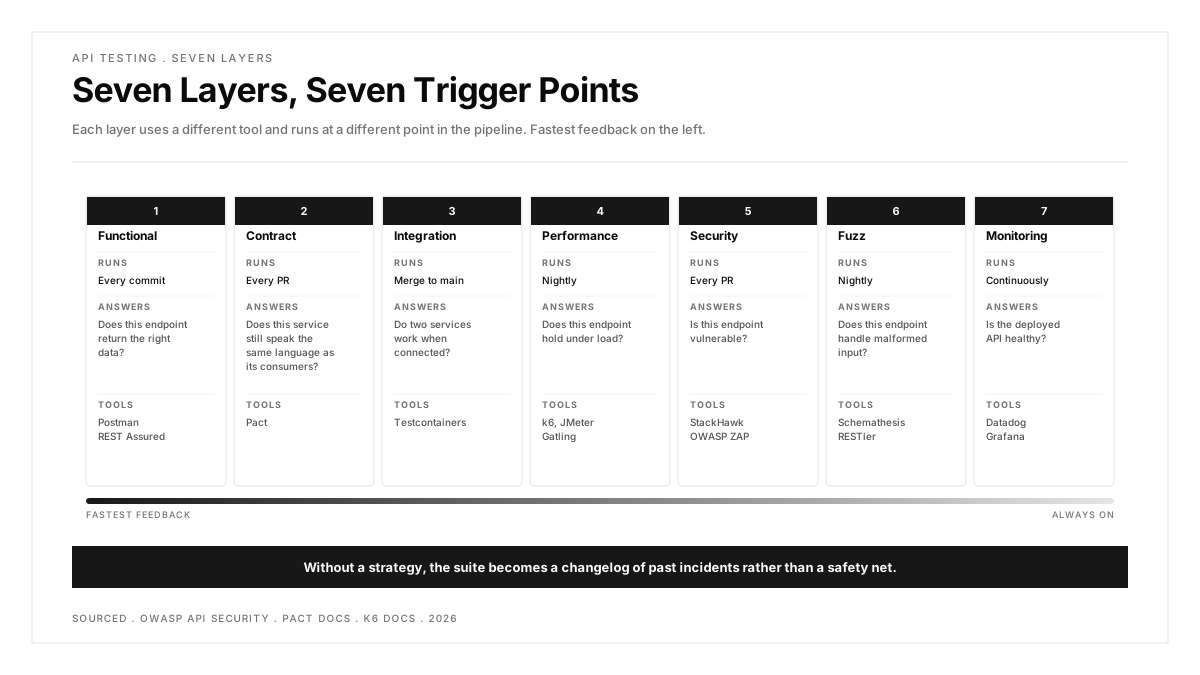
Seven layers, each answering a distinct question.
| Layer | Question It Answers | Run When | Common Tools |
|---|---|---|---|
| Functional | Does this endpoint return the right data? | Every commit | Postman, REST Assured, Playwright |
| Contract | Does this service still speak the same language as its consumers? | Every PR | Pact, Spring Cloud Contract |
| Integration | Do two services work when connected? | Merge to main | Testcontainers, docker-compose |
| Performance | Does this endpoint hold under load? | Nightly or pre-release | k6, JMeter, Gatling |
| Security | Is this endpoint vulnerable? | Every PR and weekly | StackHawk, OWASP ZAP |
| Fuzz | Does this endpoint handle malformed input? | Nightly | Schemathesis, RESTler |
| Production monitoring | Is the deployed API healthy? | Continuously | Datadog, Grafana, New Relic |
The testing pyramid principle applies to APIs exactly as it applies to UI testing. Fast, cheap tests at the bottom. Slow, expensive tests at the top. Functional API tests run in milliseconds. Load tests run for minutes. Building from the bottom up keeps the feedback loop short where it matters most.
How to build a functional API testing strategy
Functional testing validates that an endpoint returns the correct response for a given request. It is the foundation layer, and every other strategy assumes it is already in place.
What to cover:
- Every public endpoint responds with the documented status code for valid input
- Required fields return a 400 when missing
- Authentication rejects expired, malformed and missing tokens
- Rate limiting returns 429 after the documented threshold
- Pagination returns consistent results across pages
- Edge cases: empty collections, maximum payload size, special characters in string fields
How to organize:
One test file per resource. Tests for /users live in users.test.ts, not scattered across a shared file. This makes coverage gaps visible at a glance.
Where to run:
Functional API tests are fast enough to run on every commit. If they take more than two minutes, the bottleneck is usually test data setup. The fix is an isolated test database seeded once before the suite rather than before every individual test.
Teams already running CI/CD pipelines should treat functional API tests as a blocking gate. A PR that breaks an endpoint should not merge.
For a broader view of the API testing tools available at each layer, the comparison covers ten options sorted by testing type.
How to use contract testing between services
Contract testing validates the agreement between an API producer and its consumers without requiring both to run simultaneously. It is the strategy that matters most in microservices architectures and matters least in monoliths.
The concept comes from consumer-driven contracts: each consumer declares what it expects from the producer, and the producer's build verifies it can still satisfy every declared expectation.
When the setup cost is justified:
- More than three services calling each other
- Services owned by different teams deploying on different schedules
- Breaking an internal API would affect multiple consumer applications
When it is not:
- A monolith with internal modules calling each other
- A single team owning both the API and its only consumer
Pact is the most widely adopted contract testing framework. A consumer writes a test describing the request shape and expected response shape. Pact generates a contract file. The producer's CI runs against that contract and fails if the response no longer matches. Neither service needs the other running.
The key advantage: contract tests run at build time, catching a breaking change before it reaches any shared environment. Integration tests require both services deployed and discover the breakage later, after more people are affected.
How to test API performance under load
Performance testing measures how an API behaves when many clients hit it simultaneously. It answers two questions: what is the response time at expected traffic, and at what point does the system degrade.
Three test types serve different purposes:
Load testing simulates expected production traffic for a sustained period. The goal is verifying that response times stay within thresholds. k6 and Gatling are the standard tools. JMeter remains widely used for teams needing protocol coverage beyond HTTP.
Stress testing pushes traffic beyond expected limits to find the breaking point. The goal is knowing whether the system slows down gracefully or collapses entirely.
Spike testing sends a sudden burst after a quiet period. The goal is validating that auto-scaling and connection pooling react fast enough.
The common mistake: load testing every endpoint. Most systems have a critical path (authentication, checkout, data export) while the remaining endpoints handle low traffic. Performance testing the critical path weekly delivers more value than performance testing everything quarterly.
For the tools themselves, the load testing tools comparison covers protocol support and pricing across the main options.
How to automate API security testing
API security testing checks for vulnerabilities that functional tests structurally cannot see: broken authentication, injection, excessive data exposure, and the rest of the OWASP API Security Top 10.
Two categories run at different frequencies:
SAST (static) scans the API definition (OpenAPI spec, GraphQL schema) for known vulnerability patterns. It is fast, produces results in seconds, and runs on every PR. It catches issues such as endpoints missing authentication requirements or response schemas exposing internal fields.
DAST (dynamic) sends actual requests to a running instance, attempting common attack patterns: SQL injection in parameters, SSRF through URL fields, authentication bypass through header manipulation. Slower than SAST, requires a deployed instance, and typically runs nightly against a staging environment.
The practical pattern: SAST on every PR as a blocking check. DAST nightly against staging. A quarterly manual penetration test for the issues automated tools miss.
Security testing catches issues that functional tests are structurally blind to. A functional test for POST /login verifies that valid credentials return a token. A security test for the same endpoint verifies that SQL injection in the username field returns a 400 rather than a 500, and that brute force attempts trigger rate limiting after the documented threshold.
Should you mock external API dependencies?
Yes, with a specific boundary.
Mock everything outside the deployment boundary. If a test calls a third-party payment API, a partner's shipping service, or any endpoint your team does not deploy, that call should hit a mock. Real calls to external services make tests slow, flaky, dependent on third-party uptime, and expensive when the API charges per request.
Use the real service for everything inside the deployment boundary. If two services deploy together or the test environment runs both, let the test hit the real service. Mocking an internal dependency hides the integration failures the test exists to catch.
The implementation pattern: record real API responses during development, store them as fixtures alongside the tests, and use a replay library (WireMock, MSW, Nock) to return those fixtures during test runs. Update fixtures periodically to catch drift.
The risk with mocking: the mock and the real service diverge silently. A mock returning a response shape the real service stopped producing six months ago gives false confidence. Contract testing is the structural fix, because it verifies the mock still matches what the real service actually returns.
How to keep API tests maintainable at scale
Test suites decay. The symptoms are familiar: tests take 40 minutes, half are skipped, and a "known flaky" label means nobody investigates failures anymore. The decay is a strategy problem more than a tooling problem.
Five practices that prevent it:
- One assertion per test. A test checking status code, response body, headers and response time is four tests sharing a name. When it fails, nobody knows which thing broke without reading the implementation.
- Shared setup in fixtures, not in before-each hooks. Database seeding, authentication tokens, and test users belong in a setup script that runs once rather than in hooks that run before every test and multiply suite duration.
- Delete tests that no longer serve a purpose. A test written for a bug fixed two years ago, testing an endpoint that has since been redesigned, is not coverage. It is friction.
- Run the full suite in CI, not locally. Developers run the tests for the resource they changed. CI runs everything. This keeps local feedback fast while keeping the full suite honest.
- Treat test failures as production incidents. A test that has been red for a week is a test that has been lying for a week. Fix the test, fix the code, or delete the test.
Teams practicing regression testing at the API layer already have most of this discipline. The specific addition for API suites is contract verification, since a regression in an API contract affects every consumer rather than one user interface.
How do API testing strategies work in production?
Testing in production sounds reckless, but for APIs it is standard practice under a different name: synthetic monitoring.
A synthetic monitor sends a scripted request to a production endpoint on a schedule, typically every one to five minutes, and alerts when the response deviates from expectations: wrong status code, latency above threshold, or missing fields in the response body.
What it catches that pre-production testing cannot:
- Infrastructure failures: DNS resolution, load balancers, CDN edge caches returning stale data
- Configuration drift: environment variables pointing to the wrong database or service
- Third-party degradation: a payment provider's latency spiking
- Certificate expiration: HTTPS failing after a renewal was missed
Synthetic monitoring is the backstop that catches everything the other six layers missed, because production is the only environment that is fully production-like.
For teams building mobile and web applications, production API monitoring complements front-end E2E testing. A passing UI test confirms the user journey works at the moment the test runs. A synthetic API monitor confirms the backend supporting that journey stays available between runs.
FAQs
What is the best API testing strategy for a small team?
Start with functional tests on every commit and add contract testing only when you introduce a second service. A small team running one service gains nothing from contract testing but gains everything from catching broken endpoints before merge. Performance and security testing can begin as monthly manual reviews and move to automation as the team and the API surface grow.
How is API testing different from E2E testing?
API testing validates the data layer: does this endpoint accept this input and return this output? E2E testing validates the user journey: does tapping this button produce the expected screen? Both are necessary because they catch different failures. API tests are faster and more stable. E2E tests catch issues that exist only when the full stack is assembled.
Should API tests hit a real database or a mock?
Use a real database for the service under test and mocks for external services. A test validating POST /users should hit the actual database to confirm the record was created. A test validating a payment endpoint should mock the external payment provider to avoid flakiness, cost and third-party dependency.
How many API tests does a typical project need?
No single number works. Coverage depends on the number of endpoints, the complexity of input validation, and the number of consumer services. A practical floor: every public endpoint should have at least one test for the happy path, one for authentication failure, and one for invalid input. That baseline alone produces several hundred tests in a system with 40 or more endpoints.
What is the difference between contract testing and integration testing?
Contract testing verifies the agreement (request shape, response shape) without running both services. Integration testing runs both services and sends real traffic between them. Contract tests are faster, run at build time, and catch shape mismatches. Integration tests are slower, run after deployment, and catch behavioral mismatches that shape alone cannot reveal.
How often should API performance tests run?
Run load tests on the critical path (authentication, checkout, data export) weekly or before every release. Run stress tests monthly or before major infrastructure changes. Run spike tests before events that will produce unusual traffic such as product launches or marketing campaigns. Running load tests on every PR is usually too expensive and too slow, but running them never means the first performance regression is discovered by users.