
Best Load Testing Tools in 2026: 10 Compared
Ten load testing tools compared by how they generate load: open-source scriptable, cloud-managed, enterprise on-prem, and browser-based. Honest pricing and tradeoffs.
Yuvan Sundrani · 18 min read
autosana.ai
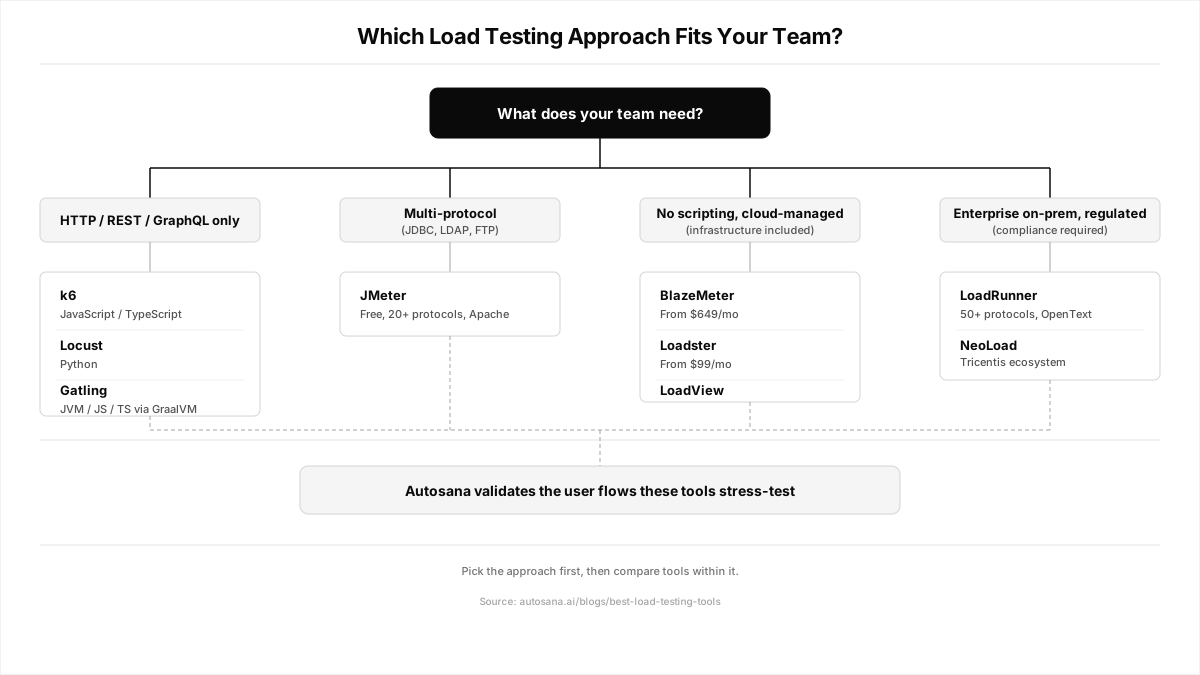
Most comparison guides rank load testing tools in a flat list, hiding three decisions your team needs to make first. What scripting language will your engineers write load tests in? How many protocols does your stack require? Who owns the load generation infrastructure? This guide sorts ten tools by those three decisions so you compare tools that actually compete with each other.
Key Takeaways
- Load testing tools split into four categories: open-source scriptable (k6, Locust, Gatling, Artillery), protocol-heavy open-source (JMeter), cloud-managed (BlazeMeter, Loadster, LoadView), and enterprise on-prem (LoadRunner, NeoLoad).
- The scripting language matters more than the brand. k6 uses JavaScript with native TypeScript support since v1.0 (May 2025). Gatling added JavaScript and TypeScript through GraalVM in 3.12+. Pick the language your team already writes.
- Protocol scope is the hard filter. k6 and Locust cover HTTP/REST/GraphQL/gRPC. JMeter adds JDBC, LDAP, FTP, JMS, AMQP. LoadRunner covers 50+ protocols including Citrix, SAP GUI, and mainframe terminals. Match the tool to your protocol stack.
- Infrastructure cost is the hidden variable. Open-source tools are free but you pay for the compute to generate load. Cloud platforms (BlazeMeter from $649/mo, LoadView from $199/mo, Loadster from $99/mo) bundle compute into pricing.
- Autosana validates E2E user flows functionally across iOS, Android, and web. Load testing finds where the backend breaks under concurrent load; Autosana verifies the user flows work correctly before and after the load test.
Which load testing tools are teams using in 2026?
| Tool | Approach | Best For | Language | Pricing |
|---|---|---|---|---|
| Autosana | E2E functional validation | Verifying user flows work before and after load tests | Intent-based flows | Contact for pricing |
| k6 | OSS scriptable | Developer teams wanting load tests as code | JavaScript/TypeScript | Free (OSS); Grafana Cloud k6 paid |
| Locust | OSS scriptable | Python teams wanting simple, distributed load testing | Python | Free, open source |
| Gatling | OSS scriptable | JVM teams wanting high-throughput simulation | Scala/Java/Kotlin/JS/TS | Free (OSS); Enterprise paid |
| Artillery | OSS scriptable | Node.js teams wanting YAML + JS scenarios | YAML + JavaScript | Free (OSS); Pro paid |
| JMeter | OSS protocol-heavy | Teams needing multi-protocol load testing at zero cost | GUI + Java | Free, open source |
| BlazeMeter | Cloud-managed | Teams wanting JMeter-compatible cloud execution at scale | JMeter/k6/Gatling scripts | From $649/mo |
| Loadster | Cloud-managed | SaaS teams wanting cloud load testing without scripting | Point-and-click + scripting | From $99/mo |
| LoadView | Cloud-managed (browser) | Teams needing real-browser load testing with geo-distribution | Point-and-click | From $199/mo |
| LoadRunner | Enterprise on-prem | Enterprise teams with complex protocol stacks and compliance | Multiple (50+ protocols) | Contact for pricing |
| NeoLoad | Enterprise on-prem | Enterprise DevOps teams in the Tricentis ecosystem | Low-code + API | Contact for pricing |
What scripting language should you use for load testing?
The first decision filters half the tools off the list. k6 scripts are JavaScript. Locust tests are Python classes. Gatling scenarios are Scala, Java, Kotlin, or (as of 3.12+) JavaScript and TypeScript through GraalVM integration. Artillery uses YAML with JavaScript hooks. JMeter uses a GUI with Java under the hood. A senior engineer on r/ExperiencedDevs described the principle that outlasts any single tool: tests that survive architectural changes matter more than tests that are easy to record. Code-first tools earn that durability because load scenarios evolve alongside the codebase in version control.
k6: best JavaScript load testing tool
What you get:
- JavaScript/TypeScript load test scripts on a Go-powered runtime
- Native TypeScript since k6 1.0 (May 2025); v2.0 (May 2026) removed deprecated APIs and broadened Playwright-based browser testing
- CLI execution with native CI/CD integration (GitHub Actions, GitLab CI, Jenkins)
- Built-in metrics: response time, throughput, error rate, checks, custom metrics
- Grafana integration for real-time dashboards and alerting
- Extensions for gRPC, WebSocket, SQL, Redis, and browser testing
- A single instance generates 30,000+ virtual users on commodity hardware
- Free (open source); Grafana Cloud k6 for managed distributed execution
Why teams pick it: k6 is what most developer teams reach for first. Scripts are JavaScript (or TypeScript, natively since v1.0). Execution is a single CLI command. Results feed into Grafana. A DevOps engineer on r/devops described the pipeline shift: teams want performance tests alongside functional tests in the same CI pipeline, not a separate workflow with a separate tool.
The tradeoff: Distributed load testing beyond a single instance requires Grafana Cloud k6 or manual orchestration. No GUI for test creation. Complex scenarios (ramping stages, thresholds, custom metrics) have a real learning curve. For teams whose primary language is not JavaScript, k6 means learning a new language for load tests.
Locust: best Python load testing tool
What you get:
- Python-based load testing with familiar class-based user definitions
- Distributed execution across multiple machines with a web UI for real-time monitoring
- Event-driven architecture for high concurrency on modest hardware
- Simple API: define user behavior as Python classes with @task decorators
- Free and open source
Why teams pick it: Python teams pick Locust because the tests are Python. No new language, no new paradigm. The distributed mode scales across machines with a single command. The web UI shows real-time request stats during execution.
The tradeoff: Python only. Can be CPU-bound on complex scenarios because of the GIL. Less mature plugin ecosystem than k6 or JMeter. Built-in reporting is basic compared to Grafana-powered k6 dashboards.
Gatling: best load testing tool for JVM teams
What you get:
- Scala/Java/Kotlin DSL for load test scenarios, with JavaScript and TypeScript support added in 3.12+ through GraalVM integration
- High-performance Netty-based runtime that is the most resource-efficient per virtual user among open-source load testing tools
- Detailed HTML reports with response time distributions and percentile breakdowns
- CI/CD integration with Maven, Gradle, and SBT plugins
- Free (open source); Gatling Enterprise for cloud execution and advanced analytics
Why teams pick it: Gatling produces the most detailed HTML reports of any open-source load testing tool. The percentile breakdowns and response time distributions give performance engineers the data they need for capacity planning. The GraalVM-based JS/TS support (3.12+) means non-JVM teams can now use Gatling without learning Scala.
The tradeoff: The Scala DSL has a steep learning curve for teams without JVM experience. JS/TS support via GraalVM is newer and less documented than k6's native JavaScript runtime. The open-source version lacks cloud execution. Enterprise pricing is not published.
Artillery: best for Node.js teams needing quick load tests
What you get:
- YAML-based scenario definitions with JavaScript hooks for custom logic
- Support for HTTP, WebSocket, Socket.io, and custom protocols via plugins
- Cloud execution mode for distributed testing without self-hosting
- Lightweight CLI installed via npm
- Free (open source); Artillery Pro for managed execution and team features
Why teams pick it: Artillery is the fastest path from zero to load testing for Node.js teams. YAML scenarios are readable without deep coding knowledge. JavaScript hooks handle dynamic data, authentication tokens, and custom assertions. npm install artillery and you are running tests in minutes.
The tradeoff: Smaller community than k6, JMeter, or Gatling. Enterprise features require Artillery Pro. YAML limits complex branching logic (JavaScript hooks compensate but add verbosity).
Which load testing tools support multi-protocol testing?
Protocol scope is the hard filter that eliminates most tools from consideration. If your stack only uses HTTP, REST, GraphQL, and gRPC, every open-source scriptable tool on this list works. If your backend involves database queries over JDBC, directory services over LDAP, message queues over JMS or AMQP, or file transfers over FTP, the list narrows to JMeter (free) or the enterprise platforms (paid).
JMeter: the best free multi-protocol load testing tool
What you get:
- Protocol coverage beyond HTTP: JDBC, LDAP, FTP, JMS, AMQP, SMTP, TCP, and more
- GUI for test plan creation with thread groups, samplers, listeners, and assertions
- Distributed testing across multiple machines for higher load generation capacity
- Plugin ecosystem (JMeter Plugins Manager) for extended reporting, protocols, and custom functions
- Free and open source (Apache Foundation)
Why teams pick it: JMeter handles protocols that no modern tool touches. A practitioner on r/QualityAssurance described the enduring value: JMeter covers protocol territory that newer, developer-friendly tools simply do not enter. Teams load-testing systems involving database queries (JDBC), directory services (LDAP), or message queues (JMS/AMQP) have no free alternative.
The tradeoff: Java-based and resource-heavy. The GUI struggles with large test plans. Test plans are XML, making version control diffs unreadable. For HTTP-only workloads, k6, Locust, and Gatling offer significantly better developer experience.
Resource efficiency ranking: Among open-source tools, Gatling is the most resource-efficient per virtual user, followed by k6, then JMeter. A single K6 instance handles 30,000+ VUs on commodity hardware. Achieving the same with JMeter typically requires multiple distributed nodes and more memory per thread.
Should you self-host or use a cloud load testing platform?
Open-source tools are free, but generating 100,000 virtual users requires serious compute. You either provision and manage that infrastructure yourself or pay a cloud platform to handle it. The choice depends on how often you run large-scale tests and whether your team has the ops capacity to maintain load generation clusters.
BlazeMeter: the best cloud platform for existing JMeter users
What you get:
- Cloud execution of JMeter, k6, Gatling, Selenium, and Playwright scripts
- Scale to millions of virtual users across global geo-locations
- Real-time dashboards with SLA-based reporting
- Mock services for API virtualization during load tests
- From $649/mo (fixed plans); enterprise pricing available
Why teams pick it: BlazeMeter solves JMeter's scaling problem. JMeter locally runs out of memory at a few thousand virtual users. BlazeMeter runs the same test plan on cloud infrastructure with millions of VUs across distributed geo-locations, no rewrite required.
The tradeoff: $649/mo is the starting price. Teams comfortable managing their own k6 or Gatling infrastructure pay only for compute. BlazeMeter's premium is the managed layer, not the testing engine.
Loadster: best cloud load testing without scripting
What you get:
- Point-and-click test creation with a visual request builder
- Cloud-hosted load generation from multiple global regions
- Real-time monitoring with customizable dashboards
- Support for REST APIs, web applications, and WebSockets
- From $99/mo
Why teams pick it: Loadster is the simplest path to cloud load testing for teams that do not write scripts. The visual builder creates test scenarios from recorded browser sessions or manual request configuration. At $99/mo, it is the lowest-cost cloud option on this list.
The tradeoff: Limited protocol coverage compared to JMeter or k6. Visual test creation limits complex scenario logic. Smaller community and ecosystem compared to open-source alternatives.
LoadView: best real-browser load testing
What you get:
- Load testing using real browsers (not protocol-level simulation)
- Geo-distributed load generation from 40+ global locations
- Point-and-click scripting with EveryStep recorder
- SLA validation with custom thresholds and alerting
- From $199/mo
Why teams pick it: LoadView uses real browsers to generate load, catching rendering performance issues that protocol-level tools miss. JavaScript-heavy SPAs that degrade under concurrent user sessions need browser-based testing to reproduce the failure accurately.
The tradeoff: Real-browser load generation costs more per virtual user than protocol-level simulation. $199/mo gets limited VUs. Scaling to thousands of real-browser sessions costs significantly more. For backend API load testing, protocol-level tools are more cost-effective.
What load testing tools do enterprise teams with compliance requirements use?
A QA lead on r/softwaretesting described the enterprise constraint: some protocol stacks and compliance environments cannot use cloud-based tools. On-prem execution, audit trails, and vendor support contracts are non-negotiable requirements in regulated industries.
LoadRunner: best enterprise multi-protocol load testing
What you get:
- 50+ supported protocols including HTTP, Citrix ICA, SAP GUI, Oracle NCA, mainframe terminals (3270/5250), ODBC, and COM/DCOM
- On-premises execution for regulated environments (finance, healthcare, government)
- Integration with ALM toolchains (OpenText ALM, Octane)
- Correlation engine for dynamic session data across distributed systems
- Contact vendor for pricing
Why teams pick it: LoadRunner exists because some protocol stacks have no alternative. Citrix ICA, SAP GUI scripting, mainframe terminal emulation, and Oracle NCA are protocols that k6, Gatling, and JMeter cannot touch. Regulated industries mandating on-prem execution with audit trails and vendor SLAs have LoadRunner as their primary option.
The tradeoff: Enterprise pricing with long procurement cycles. Dedicated infrastructure and specialized VuGen scripting skills required. For teams load-testing REST APIs, LoadRunner is significant overkill.
NeoLoad: the best enterprise DevOps load testing
What you get:
- Now part of Tricentis, integrated with the Tricentis continuous testing platform
- Low-code test design with a visual interface and API-driven automation
- Deep CI/CD integration for enterprise DevOps pipelines
- Support for web, mobile, API, and SAP protocols
- Contact vendor for pricing
Why teams pick it: NeoLoad appeals to enterprise DevOps teams already in the Tricentis ecosystem. The low-code interface lowers the scripting barrier for performance engineers. The Tricentis integration provides a single vendor across functional testing, load testing, and test management.
The tradeoff: Vendor lock-in within the Tricentis ecosystem. Enterprise pricing with implementation services. Less community support than open-source alternatives.
Where does functional E2E testing fit alongside load testing?
Load testing and functional E2E testing answer different questions. Load testing asks, "Does the backend hold under 10,000 concurrent users?" Functional testing asks, "Does the checkout flow actually work for a single user on a real device?"
Autosana is not a load testing tool. It validates E2E user flows across iOS, Android, and web on real devices. The recommended workflow: run Autosana to verify that login, checkout, and data sync flows work correctly. Then run k6, Gatling, or JMeter to stress those same flows at scale. After the load test, run Autosana again to confirm nothing broke under pressure. A QA engineer on r/QualityAssurance described the growing challenge: testing scope expands each sprint while release cycles shrink. Splitting functional validation (Autosana) from performance validation (load testing tools) keeps both halves manageable as the test surface grows.
The Gobi Maps case study shows this pattern in production. Autosana's GitHub integration posts session replay to every PR, so functional regressions surface before the load test even starts.
How to choose the right load testing tool for your team
Three decisions, in order:
- Script language: JavaScript/TypeScript (k6), Python (Locust), JVM or JS/TS via GraalVM (Gatling), YAML + JS (Artillery), GUI (JMeter, Loadster, LoadView)
- Protocol scope: HTTP/REST/GraphQL/gRPC/WebSocket only (k6, Locust, Gatling, Artillery). Multi-protocol with JDBC, LDAP, FTP (JMeter). Enterprise protocols including Citrix, SAP GUI, mainframe (LoadRunner)
- Infrastructure ownership: Self-hosted (any OSS tool). Cloud-managed (BlazeMeter, Loadster, LoadView, Grafana Cloud k6). Enterprise on-prem (LoadRunner, NeoLoad)
If your team writes JavaScript, tests HTTP APIs, and runs CI on GitHub Actions, k6 is the answer. If your backend involves JDBC and LDAP, JMeter is the only free option. If compliance requires on-prem execution with Citrix protocol coverage, LoadRunner is the only option. Most teams land on k6 or Gatling because most stacks are HTTP-based and most teams prefer code over GUIs.
For teams using coding agents to ship PRs faster, pairing a load testing tool with Autosana closes the loop: the coding agent writes the code, Autosana validates the user flows work correctly, and k6 or Gatling validates the backend holds under load.
Bottom line
The best load testing tool depends on three decisions: what language your team writes, which protocols your stack requires, and who manages the load generation infrastructure. For most teams shipping HTTP-based services, k6 (JavaScript/TypeScript) or Gatling (JVM/JS/TS) covers the need. JMeter remains essential for multi-protocol stacks. Cloud platforms remove infrastructure burden at a price. Enterprise tools like LoadRunner and NeoLoad exist for protocol coverage and compliance requirements that nothing else satisfies. Pick the approach first, then compare tools within it.
.png)
Frequently asked questions
What is the best free load testing tool in 2026?
K6, Locust, Gatling, Artillery, and JMeter are all free and open source. K6 is the most popular choice for JavaScript teams. Locust for Python teams. Gatling for JVM teams. JMeter for multi-protocol requirements. All require self-managed infrastructure for large-scale distributed tests.
What is the difference between load testing and stress testing?
Load testing verifies that an application handles expected traffic levels within acceptable response times. Stress testing pushes beyond expected limits to find the breaking point. Most tools support both: k6 uses ramping stages, JMeter uses thread groups with configurable ramp-up periods.
How many virtual users do you need for a load test?
Start with production traffic data. Take peak concurrent users and add 20-50% headroom. For APIs, measure peak requests per second and simulate that with virtual users. 1,000 VUs with 2-second think time generates roughly 500 requests per second.
Can K6 replace JMeter for load testing?
For HTTP, REST, GraphQL, gRPC, and WebSocket workloads, yes. k6 offers a better developer experience with JavaScript scripts, native TypeScript since v1.0, and Grafana integration. JMeter is irreplaceable when you need JDBC, LDAP, FTP, JMS, or AMQP protocol support.
What is the difference between protocol-level and browser-based load testing?
Protocol-level tools (k6, JMeter, Gatling) simulate HTTP requests without rendering pages. Browser-based tools (LoadView, k6 browser module) launch real browsers that execute JavaScript and render CSS. Protocol-level testing is cheaper per VU and tests backend capacity. Browser-based testing catches frontend rendering bottlenecks.
How do you run load tests in a CI/CD pipeline?
k6: k6 run script.js as a GitHub Actions step. Gatling: Maven or Gradle plugin triggered by CI. JMeter: CLI mode with jmeter -n -t plan.jmx. Artillery: npx artillery run scenario.yml. Set threshold-based gates to fail the pipeline when response times exceed your SLA.
Is cloud load testing worth the cost over self-hosting?
For teams generating 10,000+ virtual users regularly, cloud platforms (BlazeMeter, Grafana Cloud k6) eliminate infrastructure provisioning and maintenance. The cost is justified when infrastructure management time exceeds the subscription price. For smaller tests under 1,000 VUs, self-hosted open-source tools are sufficient.
Does Autosana do load testing?
No. Autosana validates E2E user flows functionally on real devices, not at scale. It verifies that flows work correctly before and after load tests run. Use k6, Gatling, JMeter, or a cloud platform to test those same flows under concurrent load. Autosana and load testing tools are complementary.