
Best API Testing Tools in 2026: 10 Reviewed by Testing Layer
Ten API testing tools reviewed by the testing layer: functional, performance, security, and contract. Honest pricing and tradeoffs from practitioners.
Yuvan Sundrani · 15 min read
autosana.ai
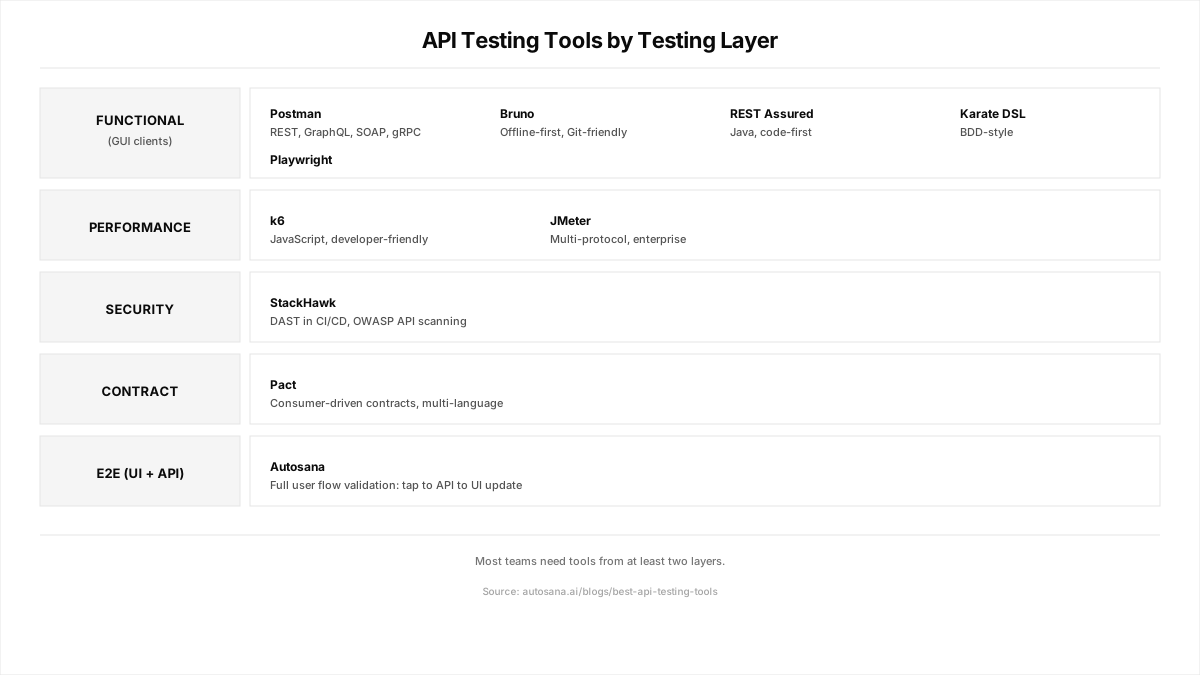
API testing tools fall into four layers that most guides collapse into a single ranked list. A functional testing tool like Postman validates that endpoints return correct responses. A performance testing tool like k6 measures how those endpoints behave under load. A security testing tool like StackHawk scans for OWASP API vulnerabilities. A contract testing tool like Pact verifies that the API contract between services stays intact across deployments. A team choosing between Postman and k6 is not making the same decision. This guide sorts ten tools by the testing layer they serve, so you compare tools that actually solve the same problem.
Key Takeaways
- API testing tools serve four layers: functional (does the endpoint return the right data?), performance (does it hold under load?), security (is it vulnerable?), and contract (does it break downstream consumers?).
- Postman remains the most widely used API client, but teams with CI/CD-heavy workflows increasingly prefer code-first tools like REST Assured or Playwright API testing because tests live in version control, not a SaaS workspace.
- The API testing market reached $2.14 billion in 2026. The growth driver is microservices architecture: more services means more API contracts to validate on every deploy.
- Performance testing and functional testing require different tools. Postman can send requests. k6 can simulate 10,000 concurrent users. Using one for the other's job produces misleading results.
- Autosana covers E2E flows that span UI and API layers across iOS, Android, and web. For teams whose API calls are triggered by mobile or web user actions, Autosana validates the full chain from tap to response.
Which API testing tools are teams using in 2026?
| Tool | Testing Layer | Best For | Protocol Support | Pricing |
|---|---|---|---|---|
| Postman | Functional (GUI) | API development, manual exploration, team collaboration | REST, GraphQL, SOAP, gRPC, WebSocket | Free; from $14/user/mo |
| REST Assured | Functional (code) | Java teams wanting API tests in version control | REST | Free, open source |
| Playwright | Functional (code) | JS/TS teams combining API and browser testing | REST, GraphQL | Free, open source |
| Karate DSL | Functional (BDD) | Teams wanting BDD-style API tests without Java boilerplate | REST, GraphQL, gRPC, SOAP | Free, open source |
| Bruno | Functional (GUI) | Developers wanting an offline-first, Git-friendly API client | REST, GraphQL | Free; paid tiers |
| k6 | Performance | Teams needing scriptable load testing with developer-friendly JS | REST, GraphQL, gRPC, WebSocket | Free (OSS); Grafana Cloud k6 paid |
| JMeter | Performance | Teams needing protocol-heavy load testing at enterprise scale | REST, SOAP, JDBC, LDAP, FTP | Free, open source |
| StackHawk | Security | DevSecOps teams integrating API security scans into CI/CD | REST, GraphQL, gRPC, SOAP | Free tier; from $99/mo |
| Pact | Contract | Microservices teams validating API contracts between consumers and providers | REST (protocol-agnostic contracts) | Free, open source |
| Autosana | E2E (UI + API) | Teams validating full user flows that span mobile/web UI and backend APIs | Via intent-based E2E flows | Contact for pricing |
Functional API testing tools
These validate that endpoints return correct responses with correct data, status codes, and headers. The split: GUI clients for exploration and collaboration vs. code-first libraries for CI-driven automation.
Postman: best GUI-based API client
What you get:
- Visual request builder with environment variables, collections, and team workspaces
- Built-in test scripting with JavaScript (Chai assertions)
- Mock servers, API documentation, and monitoring
- Support for REST, GraphQL, SOAP, gRPC, and WebSocket
- Free plan for individuals; team plans from $14/user/mo
Why teams pick it: Postman is where most developers first interact with APIs. The visual interface makes exploration fast. Collections organize requests by endpoint or workflow. A practitioner on r/QualityAssurance described the QA split: manual API exploration in Postman, automated regression in code. That two-tool pattern is how most teams operate.
The tradeoff: Tests live in Postman's cloud workspace, not in version control. Collaborative features require paid plans. Newman (the CLI runner) bridges to CI, but the source of truth remains Postman, not the repo. Teams with strict "tests in code" policies find this friction.
REST Assured: the best code-first Java API testing
What you get:
- Java library for REST API validation with a fluent, BDD-style syntax
- Deep integration with JUnit and TestNG
- JSON and XML response parsing with JsonPath and XmlPath
- Tests live in the same repository as the application code
- Free and open source
Why teams pick it: REST Assured is the default for Java backend teams. Tests are code. They live in version control, run in Gradle or Maven builds, and produce the same CI/CD artifacts as the application. A senior engineer on r/ExperiencedDevs described the principle: the framework matters less than whether tests survive refactors. REST Assured tests survive because they are Java code, maintained alongside the API.
The tradeoff: Java only. Teams using Python, JavaScript, or Go need a different library. No GUI for API exploration. Requires coding skill that non-technical QA engineers may lack.
Playwright: best for combining API and browser testing
What you get:
- API testing alongside browser E2E testing in a single framework
- JavaScript/TypeScript with built-in request context for direct HTTP calls
- JSON schema validation and response assertion APIs
- Runs in Node.js with full CI/CD integration
Why teams pick it: Teams already using Playwright for browser testing add API tests without introducing a second tool. The request context bypasses the browser for direct HTTP calls, making API tests faster than UI tests while sharing the same test infrastructure.
The tradeoff: JavaScript/TypeScript only. Not a dedicated API testing platform. No GUI for API exploration. Less mature for API-specific features (mock servers, environment management) compared to Postman.
Karate DSL: best BDD-style API testing
What you get:
- BDD syntax for API tests without Java boilerplate
- Built-in JSON/XML assertion, data-driven testing, and parallel execution
- Support for REST, GraphQL, gRPC, and SOAP
- Performance testing mode with Gatling integration
- Free and open source
Why teams pick it: Karate removes Java boilerplate from API testing. The BDD syntax is readable by non-developers while remaining executable in CI. A practitioner on r/softwaretesting described the value of tests that are readable by the whole team, not just developers. Karate sits at that intersection.
The tradeoff: Karate-specific syntax is a learning investment. Not as widely adopted as REST Assured, so the community and job market are smaller. Debugging can be harder than plain Java because the DSL abstracts the underlying code.
Bruno: best offline-first, Git-friendly API client
What you get:
- Desktop API client that stores collections as plain files on the filesystem
- Git-friendly: requests and environments are text files you commit to version control
- No cloud account required. Fully offline-capable
- Support for REST and GraphQL
- Free and open source; paid tiers for team features
Why teams pick it: Bruno solves the version control problem that Postman creates. API collections live in the repo as files, not in a SaaS workspace. Teams that want API exploration with the simplicity of Postman but the version control of code pick Bruno.
The tradeoff: Smaller ecosystem than Postman. No built-in mock servers or monitoring. Team collaboration features are newer and less mature. Less protocol coverage (no SOAP, no gRPC in the free tier).
Performance API testing tools
These measure how APIs behave under load. Functional tests prove the API works. Performance tests prove it works at scale.
k6: best developer-friendly load testing
What you get:
- JavaScript-based load testing scripts with a CLI runner
- Virtual user simulation with configurable ramp-up patterns
- Built-in metrics: response time, throughput, error rate, and custom metrics
- Integration with Grafana for real-time dashboards
- Free (open source); Grafana Cloud k6 for managed execution
Why teams pick it: k6 lets developers write load tests in JavaScript, the same language they use for everything else. The CLI runner fits CI pipelines. A DevOps engineer on r/devops described the shift: teams want performance tests that run alongside functional tests in the same pipeline, not a separate tool with a separate workflow.
The tradeoff: JavaScript only for test scripts. Distributed load testing requires Grafana Cloud K6 or custom orchestration. No GUI for test creation. The learning curve for complex scenarios (ramping, stages, thresholds) is steeper than visual tools.
JMeter: best enterprise load testing
What you get:
- Protocol-heavy load testing: HTTP, HTTPS, SOAP, JDBC, LDAP, FTP, and more
- GUI for test plan creation with thread groups, samplers, and listeners
- Distributed testing across multiple machines
- Plugin ecosystem for extended reporting and protocol support
- Free and open source (Apache Foundation)
Why teams pick it: JMeter has been the enterprise load testing standard for two decades. It handles protocols that modern tools do not (JDBC, LDAP, FTP). Teams testing backend APIs that interact with databases and directory services directly use JMeter because nothing else covers that protocol range.
The tradeoff: Java-based, resource-heavy. The GUI is dated. Test plans are XML files that are difficult to review in pull requests. Newer tools (k6, Gatling) offer better developer experience for HTTP-only load testing.
Security API testing
StackHawk: best CI/CD-integrated API security scanning
What you get:
- Dynamic application security testing (DAST) for REST, GraphQL, gRPC, and SOAP APIs
- CI/CD integration with GitHub Actions, GitLab CI, Jenkins, and CircleCI
- OWASP Top 10 and API-specific vulnerability scanning
- Findings with remediation guidance linked to the specific endpoint and request
- Free tier for personal projects; from $99/mo for teams
Why teams pick it: StackHawk brings security scanning into the development workflow. Instead of quarterly penetration tests, every PR gets an automated security scan. A QA lead on r/softwaretesting described the broader concern: security testing is often an afterthought. StackHawk makes it a pipeline step.
The tradeoff: DAST only (dynamic, not static). Does not analyze source code. Requires a running instance of the API to scan. Enterprise pricing scales with the number of applications.
Contract API testing
Pact: best consumer-driven contract testing
What you get:
- Consumer-driven contract verification between microservices
- Contracts define the expected request/response format between consumer and provider
- Pact Broker for sharing and versioning contracts across teams
- Language support: Java, JavaScript, Python, Ruby, Go, .NET, and more
- Free and open source; Pactflow (hosted broker) for enterprise
Why teams pick it: Pact catches breaking API changes before they reach integration testing. When a frontend team depends on a backend API, Pact verifies that the API still returns what the frontend expects. A senior engineer on r/ExperiencedDevs described the integration test problem at scale: running all services together in a test environment is slow and fragile. Contract tests verify compatibility without deploying every service.
The tradeoff: Requires adoption by both consumers and providers. The contract-first workflow adds overhead for small teams with few services. Not useful for third-party APIs you do not control.
E2E: when API calls are part of user flows
Autosana: best for validating API calls through mobile and web UI
What you get:
- Intent-based E2E flows that exercise APIs through the actual user interface
- Runs on real iOS devices, Android devices, and web browsers
- Self-heals when UI changes affect how API calls are triggered
- Session replay shows the full chain: user tap to API response to UI update
- Posts results to every PR via GitHub integration
Why teams pick it: Dedicated API testing tools validate the API in isolation. Autosana validates the API as part of the full user flow. When a mobile app taps "Submit Order," the test verifies that the correct API call fires, the backend processes it, and the UI updates accordingly. The Gobi Maps case study shows this full-chain validation.
The tradeoff: Not a dedicated API testing tool. Does not replace Postman for API exploration, k6 for load testing, StackHawk for security scanning, or Pact for contract testing. Autosana tests APIs through the UI layer, which means it catches integration bugs but not the edge cases that isolated API tests uncover.
How to choose the right API testing tool
- API exploration and manual testing: Postman or Bruno
- Java backend team, tests in code: REST Assured
- JS/TS team, combined browser and API tests: Playwright
- BDD-style API tests without Java boilerplate: Karate DSL
- Load and performance testing: k6 (developer-friendly) or JMeter (protocol-heavy)
- Security scanning in CI/CD: StackHawk
- Microservices contract verification: Pact
- Full user flow validation spanning UI + API: Autosana
Where API testing tools do not help
- UI testing. API tools validate data, not what the user sees. Visual regressions, layout shifts, and rendering bugs require UI testing tools.
- Mobile device testing. API tools do not interact with device hardware, OEM skins, or OS-level behavior. Mobile-specific failures need mobile testing tools.
- Database testing. Direct database validation (data integrity, migration correctness) requires database-specific tools or queries, not API assertions.
- Infrastructure monitoring. APM tools (Datadog, New Relic, Grafana) monitor API health in production. Testing tools verify pre-release behavior.
Bottom line
The best API testing tool depends on the testing layer: functional (Postman, REST Assured, Playwright, Karate, Bruno), performance (k6, JMeter), security (StackHawk), or contract (Pact). Most teams need tools from at least two layers. For teams whose API calls are triggered by mobile or web user actions, Autosana validates the full chain from tap to response alongside dedicated API tools.
.png)
Frequently asked questions
What is the best free API testing tool?
Postman offers a free plan for individuals. REST Assured, k6, JMeter, Karate DSL, Pact, and Bruno are all free and open source. The best choice depends on your testing layer: Postman for exploration, REST Assured for functional automation, and k6 for load testing.
What is the difference between API testing and API monitoring?
API testing validates behavior before deployment (does the endpoint return the right data under the right conditions?). API monitoring tracks behavior in production (is the endpoint up, how fast is it responding, and what errors are occurring?). Different tools, different purposes.
Should you use Postman or REST Assured?
Use both for different purposes. Postman for API exploration, manual testing, and team collaboration. REST Assured for automated regression tests in CI/CD. Postman tests live in its workspace. REST Assured tests live in your codebase.
What is contract testing, and when do you need it?
Contract testing verifies that the API contract between services stays intact across deployments. You need it when multiple teams independently deploy services that depend on each other. Pact is the leading tool. Skip it if you have a monolith or a small team that deploys everything together.
How do you test GraphQL APIs?
Postman, Bruno, and Karate DSL all support GraphQL queries and mutations. For load testing GraphQL, k6 sends HTTP POST requests with GraphQL payloads. For security, StackHawk scans GraphQL endpoints for injection and authorization vulnerabilities.
Can Playwright be used for API testing?
Yes. Playwright's request context sends direct HTTP requests without a browser. Teams already using Playwright for browser E2E add API tests without a second tool. The tradeoff: less API-specific features than Postman (no mock servers, no environment management).
What is the best tool for API load testing?
k6 for teams wanting JavaScript-based scripts with Grafana integration. JMeter for enterprise teams needing multi-protocol support (JDBC, LDAP, FTP). Gatling for Scala/Java teams wanting code-first load tests with detailed HTML reports.
How does Autosana fit into API testing?
Autosana is not a dedicated API testing tool. It validates API calls as part of full user flows through the mobile or web UI. When the E2E flow triggers an API call (login, checkout, data sync), Autosana verifies the entire chain works. Pair it with Postman, REST Assured, or k6 for isolated API testing.