
Sandbox Environment: Isolating Tests From Everything That Bills
A sandbox environment isolates tests from live systems across data, credentials, network, and third parties. Setup, ephemeral environments in CI, and mobile limits.
Yuvan Sundrani · 10 min read
autosana.ai
TL;DR
- A sandbox environment is an isolated replica of production where tests run against seeded data and stubbed third parties, with zero reach into live systems.
- Isolation has four dimensions: data, credentials, network egress, and third-party integrations. A sandbox environment leaking on any one of them stops being a sandbox.
- Ephemeral sandboxes created per pull request and destroyed afterward remove the state drift that makes long-lived shared environments unreliable.
- Autosana runs tests against your sandbox environment through configurable targets, private network access, and real iOS and Android devices.
Stripe issues a test key that begins with sk underscore test. Twilio publishes magic numbers that always succeed. Those integrations are safe by construction, because the vendor built the isolation for you.
Your own internal services offer whatever the last engineer configured. That is the part of a sandbox environment that fails, and it fails quietly until a test run sends a real notification to a real customer.
This guide covers the four dimensions isolation has to cover, how to build a sandbox environment that holds them, and where sandbox testing stops working for mobile.
What a Sandbox Environment Is
A sandbox environment is an isolated instance of your application and its dependencies, built for testing, with no ability to affect production data or external systems.
The ISO 29119 standard treats test environment management as its own process area, and the isolation property is what separates a sandbox from a second copy of production.
Three properties define it. Data is synthetic or anonymized rather than live. Third-party integrations point at vendor test modes or local stubs. Outbound effects that would reach a real person are blocked at the boundary.
Google's test automation research links reliable delivery to environments teams trust, and trust here means a tester can run any destructive scenario without checking first.
The Four Dimensions of Isolation
Data isolation comes first. The sandbox environment holds seeded records rather than a production copy. Where production data is required for realistic volume, anonymize it before loading, since a sandbox usually carries weaker access controls than production does.
Credential isolation comes second. Separate API keys, separate database users, separate service accounts. A sandbox environment holding production credentials is one configuration error away from writing to live systems.
Network isolation comes third. Restrict outbound traffic at the boundary so email, SMS, and push notifications cannot reach real addresses. Route them to a capture inbox instead, which also makes them assertable.
Third-party isolation comes fourth. Use vendor test modes where they exist and local stubs where they do not. The gap here is internal services owned by other teams, which rarely ship a test mode, and that is where sandbox environments usually leak.
NIST SP 800-115 treats environment isolation as a precondition for security assessment, because a penetration test against a leaky sandbox reaches production.
Setting One Up
Start from infrastructure as code so the environment is reproducible. A sandbox environment built by hand drifts from production within weeks and from its own documentation within days.
Seed data deterministically. Every run should start from a known state, with fixtures covering the accounts, orders, and edge-case records your tests depend on. Randomized seeding produces test failures that vary run to run.
Externalize configuration. Endpoints, feature flags, and credentials belong in variables rather than in the build, so the same artifact runs against sandbox and staging without a rebuild.
Give it a reset path. A documented command returning the sandbox environment to its seeded state takes minutes to write and saves the recurring investigation into why yesterday's data is still present.
Verify the isolation explicitly. Write a test that attempts an outbound email and asserts it was captured rather than delivered. That check is the only thing standing between a test run and a customer receiving a message.
Sandbox and Production Side by Side
| Dimension | Sandbox Environment | Production |
|---|---|---|
| Data | Seeded or anonymized | Live customer records |
| Third parties | Test modes and stubs | Real integrations |
| Outbound effects | Captured at the boundary | Delivered |
| Scale | Reduced | Full |
| Monitoring | Light | Full alerting |
| Reset | On demand | Out of the question |
The scale row is where sandbox testing misleads most often. A query performing acceptably against 500 seeded rows behaves differently against 50 million, so load-sensitive behavior needs its own verification path.
Sandbox Environments for Mobile Testing
Mobile adds three configuration concerns.
Build variants carry the environment target. A sandbox build points at sandbox endpoints, and the risk is a release build shipping with a sandbox target or the reverse. Make the active environment visible inside the app during development builds.
Push notification certificates differ per environment. Apple maintains separate sandbox and production APNs endpoints with separate certificates, so a push path working in the sandbox environment proves relatively little about production delivery.
In-app purchases run through vendor sandboxes. Apple and Google both provide test accounts, and their behavior diverges from production in refund timing and subscription renewal intervals, which are usually compressed.
Mobile app testing against a sandbox environment covers functional flows well. Anything touching real billing, real delivery, or real scale needs verification elsewhere.
Ephemeral Sandboxes in CI/CD
A long-lived shared sandbox environment accumulates state. Someone changes a feature flag for a debugging session, someone else leaves a half-finished order, and a suite that passed yesterday fails today for reasons unrelated to code.
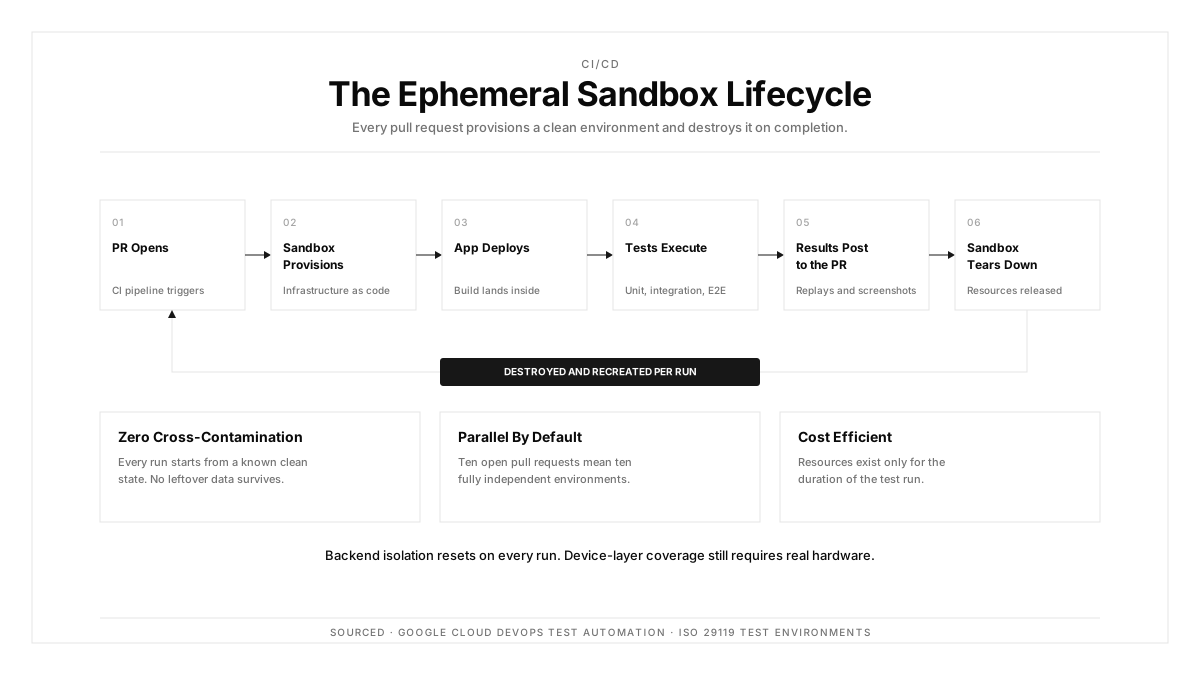
Ephemeral environments solve this by creating a fresh instance per pull request and destroying it after merge.
The requirements are modest. Infrastructure defined as code, a seeding step that completes in a reasonable time, and a teardown that runs reliably including after failed builds.
Three benefits follow. Tests start from a known state every time. Parallel branches stop interfering with each other. And the cost of a badly behaved test drops to zero, since the environment disappears regardless.
The constraint is provisioning time. An environment taking twelve minutes to build adds twelve minutes to every pull request, so caching the base image and seeding incrementally matter more than they appear.
Where Sandbox Testing Stops Working for Mobile
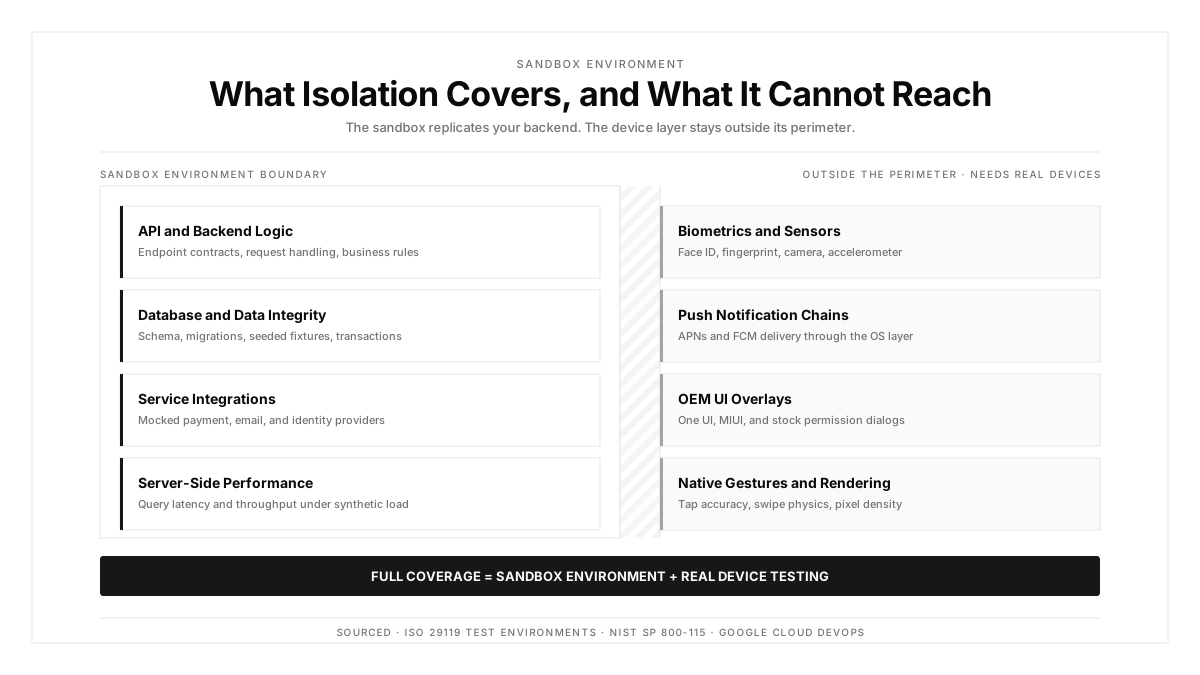
Four failure classes live outside any sandbox environment.
Real device behavior. Thermal throttling, vendor OS forks, and sensor pipelines are properties of hardware, and a sandbox environment controls your backend rather than the phone. Real device testing covers this gap.
Production scale. Response times measured against seeded data tell you little about behavior under real load, which makes performance testing against production-like volume a separate exercise.
Third-party divergence. Vendor sandboxes approximate their production behavior. Payment providers often return success faster in test mode, and rate limits are usually absent, so retry logic tuned in a sandbox environment behaves differently live.
Security posture. A sandbox environment with relaxed controls tells you little about production hardening, so security testing needs a target configured to match production policy.
The resolution is layering rather than replacement. Sandbox testing for functional coverage, staging for integration realism, and production monitoring for everything the first two structurally exclude.
How Autosana Fits
We built Autosana to run against whichever environment your tests need, without rebuilding the suite per target.
Our environments configuration handles backend target, locale, and network profile per run, and variables keeps credentials and endpoints out of the flow definitions themselves.
For sandbox environments behind a corporate boundary, private network access connects our runners to internal hosts, so an environment unreachable from the public internet stays testable.
Our local testing support targets a sandbox environment running on your own machine, which shortens the loop during development.
We execute on real devices, which covers the hardware failure class that no sandbox environment reaches. Mobile test automation across both layers is what closes the gap.
Conclusion
Write one test that attempts to send an email from your sandbox environment and asserts it was captured rather than delivered.
Run it. Where it passes, your network isolation is real rather than assumed. Where it fails, you have just found the path a test run will eventually take to a customer inbox, and you found it before it happened.
Then do the same for SMS and push. Three tests, an afternoon, and the isolation stops being a belief.
.png)
FAQ
What is a sandbox environment?
A sandbox environment is an isolated instance of an application and its dependencies used for testing, running on seeded data with third-party integrations stubbed and outbound effects blocked at the boundary.
How does a sandbox environment differ from staging?
A sandbox prioritizes isolation and resettability, often per developer or per pull request. Staging prioritizes production similarity, with fuller data volumes and closer integration realism.
What are the four dimensions of sandbox isolation?
Data isolation through seeded or anonymized records, credential isolation through separate keys and accounts, network isolation blocking outbound delivery, and third-party isolation through vendor test modes or stubs.
What are ephemeral sandbox environments?
Instances created per pull request and destroyed after merge. They remove the state drift that accumulates in long-lived shared environments and let parallel branches run without interfering.
Why do sandbox environments leak?
Internal services owned by other teams rarely ship a test mode, so those integrations get pointed at live instances for convenience. That single exception is usually where a test run reaches production.
What does sandbox testing miss for mobile apps?
Real device behavior including thermal throttling and vendor OS forks, production-scale response times, third-party divergence in retry and rate-limit behavior, and production security posture.
How should push notifications be handled in a sandbox?
Apple maintains separate sandbox and production APNs endpoints with separate certificates. A push path working in a sandbox environment proves little about production delivery, so verify both.
How do you confirm isolation is actually working?
Write tests that attempt outbound email, SMS, and push, then assert each one was captured rather than delivered. That turns isolation from an assumption into a checked property.