
What Is a CAPTCHA Test, and How Do You Automate Past One?
A CAPTCHA test separates humans from scripts, which blocks your own automation. The four types, three supported bypass routes, and what to do when a third party owns the gate.
Yuvan Sundrani · 13 min read
autosana.ai
TL;DR
- A CAPTCHA test separates human users from scripts, which makes it a deliberate obstacle to your own automation.
- Four types dominate, and the two that show no puzzle cause the most confusion, since a suite passes locally and fails in CI with no visible difference.
- Three supported routes exist: provider test credentials, environment allowlisting, and an application flag gated on build type. Solver services breach provider terms and create permanent maintenance.
- Autosana handles the surrounding journey on real devices, with environment-scoped credentials keeping test keys out of the flow definition.
Google's reCAPTCHA publishes a test site key that always passes. Stripe publishes test cards. Twilio publishes magic numbers. Every provider gating automation also ships a documented way to disable that gate in a test environment.
A CAPTCHA test is the gate teams try to defeat rather than configure, usually because the question went unowned until the suite was already blocked.
This guide covers what a CAPTCHA test measures, the four types and how each breaks automation, the three supported routes, how to diagnose an unexpected challenge in CI, and what to do when a third party owns the gate.
What Is a CAPTCHA Test Measuring?
CAPTCHA stands for Completely Automated Public Turing test to tell Computers and Humans Apart. The challenge is cheap for a person and expensive for a script.
Modern systems have moved away from puzzles. Rather than asking a user to prove humanity, current implementations score behavioural signals: pointer movement, touch pressure and timing, interaction cadence, browser fingerprint, IP reputation, and prior history with the provider.
Google's reCAPTCHA documentation publishes the test keys referenced below, and the NIST digital identity guidelines cover where challenge-response controls belong in an authentication flow.
That shift matters for testing. A scored CAPTCHA test may present no visible challenge and still block your automation, because a script's behavioural signature differs from a person's even where the puzzle stays hidden.
WCAG 2.1 requires challenges offer alternatives in more than one modality, since a purely visual challenge excludes users relying on screen readers. Teams treating CAPTCHA purely as a security control tend to ship one failing this.
What Are the Four Types of CAPTCHA?
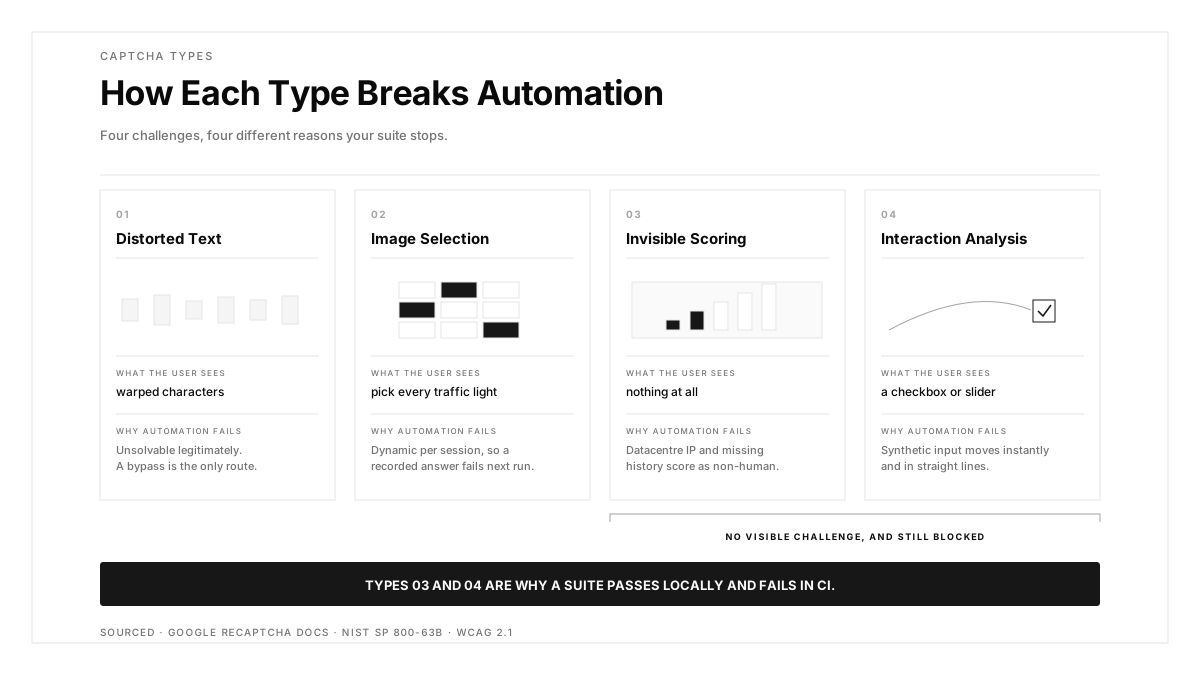
| Type | What the user sees | Why automation fails | Frequency now |
|---|---|---|---|
| Distorted text | Warped characters | Unsolvable legitimately | Largely retired |
| Image selection | Pick every traffic light | Dynamic per session, recorded answers fail next run | Common |
| Invisible scoring | No challenge at all | Datacentre IP and absent history score as non-human | Dominant |
| Interaction analysis | A checkbox or slider | Synthetic input moves instantly in straight lines | Growing |
How Does Distorted Text CAPTCHA Work?
The original form. Warped characters a person reads and early optical recognition failed on. Largely retired, since modern recognition solves it more reliably than people do.
Where you meet one, a bypass is the only supported route.
Why Does Image Selection CAPTCHA Resist Automation?
The challenge regenerates per session, so a recorded answer fails on the next run. This type stops suites outright more often than any other.
What Is an Invisible CAPTCHA, and Why Is It Hardest to Debug?
The provider scores the session silently and returns a confidence value, leaving your application to decide what a low score means.
This produces the hardest failure to diagnose, because the flow sometimes passes and sometimes fails with no visible difference. A suite working locally and failing in CI usually meets this, since datacentre IP ranges score poorly.
reCAPTCHA v2 presents a checkbox or challenge. v3 returns a score with no user interaction at all, leaving the decision to you. Knowing which version your application uses determines which bypass applies, so check before debugging.
How Does Interaction Analysis Detect a Script?
A checkbox or slider measuring how the pointer arrived rather than whether it was clicked. Synthetic input moves instantly in straight lines, which is precisely the signature these systems flag.
Making automation look human is the wrong fix and an arms race you lose.
What Are the Supported Ways to Bypass a CAPTCHA Test?
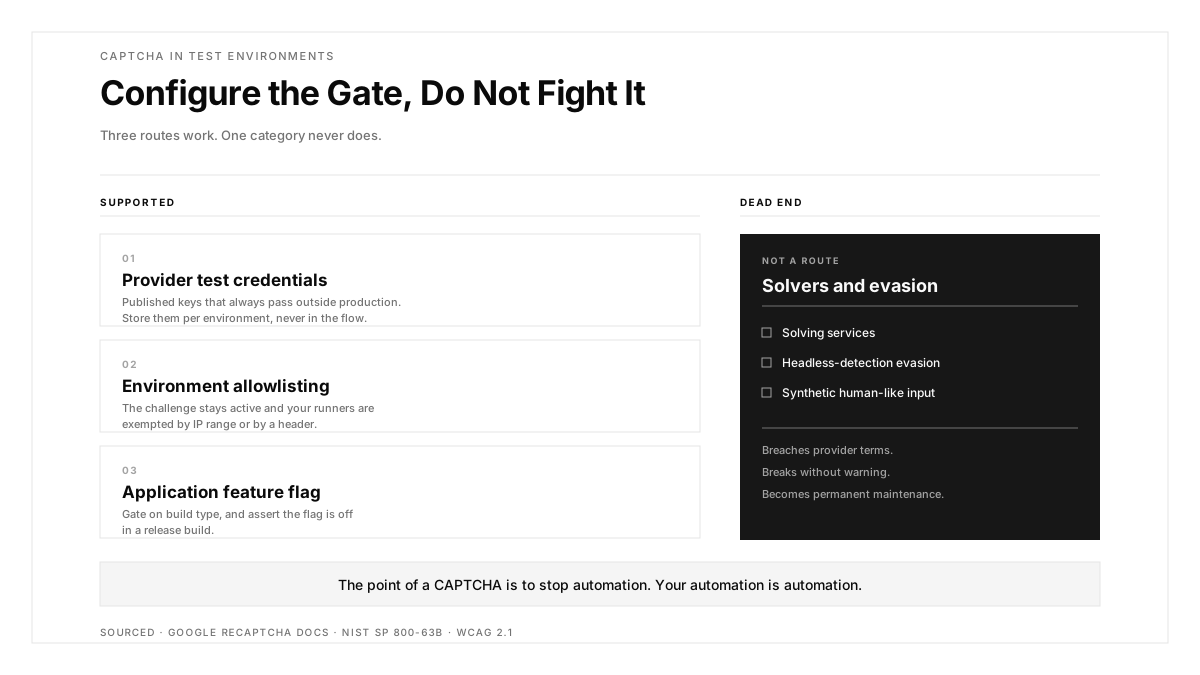
| Route | Works when | Main risk |
|---|---|---|
| Provider test credentials | The provider publishes them | Keys leaking into a production build |
| Environment allowlisting | You control the runner addresses | Allowlist drift as infrastructure changes |
| Application feature flag | You own the integration | Flag reaching production, removing protection for everyone |
How Do Provider Test Credentials Work?
Most providers publish keys that always return a passing result outside production. reCAPTCHA documents test keys. hCaptcha publishes a test site key and secret. Cloudflare Turnstile ships dedicated testing keys returning either pass or fail on demand.
Store them per environment rather than in the flow definition. Our variables and environments configuration scopes a test key to staging, well away from a production build.
When Should You Allowlist Your Test Environment?
The CAPTCHA stays active while your test infrastructure is exempted, usually by IP range or by a header the provider checks.
This is the route when a scored CAPTCHA keeps failing in CI purely because the runner address scores poorly. Anetwork allowlist makes the exempted ranges explicit rather than implicit.
The maintenance burden is drift. Cloud runners change addresses, so pin the allowlist to a stable egress rather than to ephemeral runner IPs.
Is an Application Feature Flag Safe for CAPTCHA Bypass?
It is the simplest to implement and the most dangerous to get wrong, since a flag leaking into production removes protection for everybody.
Gate it on build type rather than a runtime value, and add a test asserting the flag reads false in a release build. That assertion costs minutes and catches the failure that matters.
Why Did a CAPTCHA Appear in CI When It Passes Locally?
Work through four checks in order.
Check the score, where the provider exposes it. reCAPTCHA v3 returns a value between 0 and 1, and seeing the actual number tells you whether you are marginally below your threshold or failing completely.
Check the egress address. CI runners use datacentre ranges carrying poor reputation. This explains the majority of local-passes-CI-fails reports, and the allowlist route above resolves it.
Check whether the test key is actually loading. A key configured in staging and absent from the CI environment produces a live CAPTCHA against a suite expecting a bypass.
Check for velocity triggers. Running the same signup flow two hundred times in ten minutes looks like abuse regardless of the key in use, so vary test data and consider rate limits on the provider side.
What If a Third Party Owns the Gate?
Sometimes the CAPTCHA sits on a system you cannot configure: a payment provider's hosted page, an identity provider's login, a partner portal.
Three options, in order.
Ask. Providers serving business customers usually document a sandbox with the challenge disabled. This is a support ticket rather than an engineering problem, and it is the fastest route when it works.
Stub the boundary. Where the CAPTCHA guards a third-party step rather than your own logic, replace that step with a stub in your test environment and cover the real integration separately through API testing against the provider sandbox.
Split the journey. Test everything up to the gate, assert you arrived correctly, then resume from the far side using pre-authenticated state. The gate becomes a seam rather than a blocker.
What stays off the list: solver services, headless-detection evasion, and synthetic input mimicking human movement. These breach provider terms, break without warning, and convert your suite into a maintenance liability. A CAPTCHA test exists to stop automation, and your automation is automation.
Where Does CAPTCHA Fit Among Challenge Flows?
CAPTCHA belongs to a family of deliberate obstacles, and the handling pattern is shared across all of them.
OTP testing is the closest relative, needing a retrieval path rather than a human reading a message, and our OTP guide covers the mechanics. Payment challenges carry the same shape, which the e-commerce checkout testing breakdown covers across the full revenue path.
Settle this once as a per-environment configuration pattern and the same pattern covers the rest. End-to-end suites crossing several gates are the ones teams abandon, and the cause is almost always ad hoc handling per gate.
How Autosana Fits
We handle everything around the gate, and we expect the gate itself to be configured away in a test environment.
Our environments configuration targets a staging backend where provider test credentials apply, and variables holds those credentials outside the flow definition so a key stays scoped to the environment entitled to it.
Flows describe user intent, so a signup journey reads identically whether the CAPTCHA step is present or configured off. The flow survives the configuration change rather than needing a rewrite.
For runners needing address exemption, network allowlist documents which ranges your provider should treat as trusted.
We run on real iOS and Android devices, which matters for interaction-scored challenges, since real hardware produces genuine touch events rather than synthetic ones. Mobile test automation on emulators meets these gates more often, and real device testing removes that class of false failure.
Conclusion
Find the CAPTCHA in your highest-value journey and name which of the three routes you are on.
Where the answer is something else, your suite either skips that journey or somebody built a workaround that will break. Both are worth finding before a release depends on it.
Then check whether your CAPTCHA offers a non-visual alternative. Teams reach that question through automation and discover an accessibility obligation they had already taken on.
FAQ
What is a CAPTCHA test?
A CAPTCHA test is a challenge distinguishing human users from automated scripts. The name stands for Completely Automated Public Turing test to tell Computers and Humans Apart.
What are the main types of CAPTCHA?
Distorted text, image selection, invisible behavioural scoring, and interaction analysis. The last two present no puzzle and judge the session by timing, pointer movement, fingerprint, and IP reputation.
Why does a CAPTCHA test block test automation?
Because that is its purpose. Scripts move instantly in straight lines, run from datacentre ranges, and lack interaction history, all of which score as non-human even where the challenge stays hidden.
How do you handle CAPTCHA in automated tests?
Use provider test credentials outside production, allowlist your test infrastructure, or gate the CAPTCHA behind an application flag tied to build type. Prefer them in that order.
Is it acceptable to use a CAPTCHA solving service?
No supported workflow requires one. Solver services and detection-evasion techniques breach provider terms, break without warning, and create ongoing maintenance liability.
What is the difference between reCAPTCHA v2 and v3?
v2 presents a checkbox or challenge. v3 returns a score between 0 and 1 with no user interaction, leaving the decision to your application. Which version you run determines which bypass applies.
Why does a suite pass locally and fail in CI at a CAPTCHA?
Usually invisible scoring against a datacentre IP range. Check the returned score, the egress address, whether the test key loaded in CI, and whether repeated runs tripped a velocity limit.
Does CAPTCHA have accessibility implications?
Yes. WCAG 2.1 requires alternatives in more than one modality, since a purely visual challenge excludes users relying on screen readers. Teams often meet this requirement first through automation work.