
E-Commerce Checkout Testing: The Six Handoffs Where Revenue Leaks
Checkout bugs rarely live inside a stage. They live in the handoffs between cart, pricing, tax, shipping, payment and confirmation. How to test the transitions.
Yuvan Sundrani · 18 min read
autosana.ai
TL;DR
- Checkout is a chain of six stages with five handoffs. Stage-level tests pass while handoff defects ship, because each team tests its own box and nobody tests the seams.
- Coupon bugs are the most under-tested high-value category. Calculation order alone can leak a consistent few cents per order, which is invisible per transaction and material per quarter.
- Payment introduces failure modes most suites never simulate: 3D Secure challenges, interrupted authorisation, webhook delivery gaps, and soft declines that are not errors.
- Inventory and pricing are shared mutable state. Two sessions racing the same last unit is a correctness problem that a single-threaded test can never produce.
- Autosana binds flows to purchase outcomes on real devices, so a test asserts that the order was placed at the right total rather than that a particular button was clicked.
Why do checkout bugs survive a passing test suite?
Most checkout suites are organised the way the engineering org is organised. The cart team tests the cart. The payments team tests payments. Each suite is competent within its boundary and the boundaries are exactly where things break.
The chain has six stages and five handoffs:
| Stage | Receives From | Classic Handoff Defect |
|---|---|---|
| Cart | Catalogue | Price changed since add-to-cart |
| Pricing and promo | Cart | Discount applied to the wrong subtotal |
| Tax | Pricing | Tax computed before discount instead of after |
| Shipping | Tax | Free-shipping threshold evaluated pre-discount |
| Payment | Shipping | Authorised amount differs from displayed total |
| Confirmation | Payment | Order recorded while payment actually failed |
Read that right-hand column as a list of production incidents, because that is what it is. Every one of them requires two stages to be correct about each other, and a test that exercises one stage with fixed inputs cannot detect disagreement.
The last row is the expensive one. A confirmation screen that renders on a failed authorisation produces a customer who believes they ordered and a warehouse that never ships, and it is usually discovered through support tickets rather than through monitoring.
A developer on r/brdev described the general shape of this in service-boundary terms: each service is correct according to its own contract, and the incident lives in the mismatch between two contracts that were written by different people at different times.
Which coupon and pricing bugs cost the most?
Promotions are the highest-leverage under-tested area in checkout, because the defects are small per transaction and therefore invisible until aggregated.
Calculation order. Consider a 10 percent discount and 8 percent tax on an 80 unit order. Discount then tax gives 72 plus 5.76, so 77.76. Tax then discount gives 86.40 minus 8.64, so 77.76 as well, which is why teams assume order does not matter. It stops being true the moment rounding enters at each step, or shipping is taxable in one jurisdiction and not another, or the discount applies to a subset of line items. Then the two orders diverge by a few cents, consistently, in the same direction. Nobody notices a four-cent discrepancy on one order. Across two hundred thousand orders it is a line item.
Stacking rules. Can a percentage coupon combine with free shipping? With a loyalty discount? With a gift card? Most systems have rules and most test suites verify each coupon alone, so the combinations ship untested. The combinations are also exactly where somebody constructs a cart that pays you nothing.
Boundary conditions. A coupon valid on orders over 50 should behave predictably at 49.99, 50.00, and 50.01, and should be evaluated against a defined subtotal. Pre-discount or post-discount, pre-tax or post-tax. These are usually unspecified rather than wrong, which means two services each pick a reasonable interpretation and disagree.
Expiry and timezone. A coupon expiring "31 December" expires at a specific instant in a specific timezone, and the customer, the server, and the payment processor may not share one. A tester on r/softwaretesting noted that date and timezone assumptions are the defects most likely to pass every test and fail in a specific market, because the test environment and the failing environment were never configured the same way.
The test that catches all four categories asserts on the final charged amount against an independently computed expected value, rather than asserting that a discount badge appeared.
What does payment testing miss?
Payment is where suites are most likely to test only the happy path, because the unhappy paths are tedious to simulate and the sandbox makes it easy to avoid them.
3D Secure and SCA. A challenge flow redirects the customer out of your app to a bank page and back. That round trip involves an external domain, a variable delay, and a return that may land the user on a different app state than they left. Suites that test with a card configured to skip the challenge never exercise it.
Interrupted authorisation. The customer backgrounds the app, loses signal, or the OS kills the process while the authorisation is in flight. Three outcomes are possible and two are bugs: charged without an order, order without a charge, or a duplicate submission on return. This is the single most expensive category in mobile checkout and almost nobody scripts it.
Webhook delivery gaps. Many payment integrations confirm asynchronously. The order is finalised when the processor's webhook arrives, which may be delayed, retried, or delivered out of order. A test that checks the confirmation screen immediately after submit validates the optimistic path and silently assumes the webhook will behave.
Soft declines. An insufficient-funds decline is not an error, it is an expected outcome with a required behaviour: keep the cart, explain the reason, let the customer retry with another method. Suites that treat every non-success as a failure state never verify that the cart survived.
Idempotency. Double-tapping submit should produce one charge. That requires an idempotency key on the request, and the test that proves it needs two near-simultaneous submissions, which a polite sequential script will never generate.
A practitioner on r/QualityAssurance made the broader point that sandbox environments optimise for a smooth integration experience, which means the default configuration quietly excludes most of the conditions you actually need to test against.
How do you test cart state that two sessions can mutate?
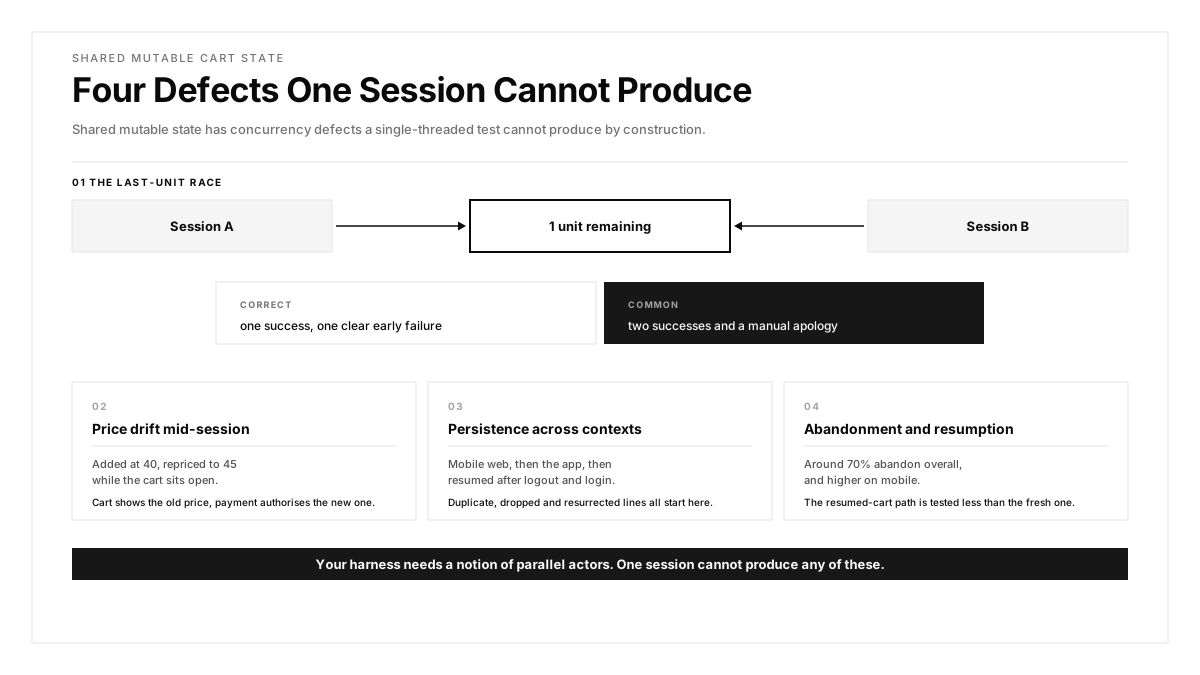
Cart and inventory are shared mutable state, and shared mutable state has concurrency defects that a single-threaded test cannot produce by construction.
The last-unit race. Two customers hold the final item. Both reach payment. Correct behaviour is one success and one clear, early failure. Common behaviour is two successes and a manual apology. Reproducing this requires two sessions acting concurrently against the same inventory record, which means your test harness needs a notion of parallel actors.
Price drift mid-session. An item is added at 40 and repriced to 45 while the cart sits open. Which price does the customer pay, and at which point does the decision become binding? Whatever the business answer is, both the display and the charge must agree with it, and the common bug is that the cart shows the old price while payment authorises the new one.
Persistence across contexts. A cart built on mobile web, then opened in the app, then resumed after a logout and login. Each transition is a merge, and merges have rules nobody wrote down. Duplicate lines, dropped lines, and resurrected lines all come from here.
Abandonment and resumption. Industry figures put cart abandonment around 70 percent overall and higher on mobile, which means the resumed-cart path is not an edge case. It is one of the most-travelled routes in the product and is routinely tested less than the fresh-cart path.
A founder on r/startups captured the commercial version of this, which is that the checkout steps a team instruments most carefully are rarely the steps where customers actually drop.
How should you structure a checkout test suite?
Bind assertions to purchase outcomes rather than to interface mechanics. The difference is concrete.
A mechanics-bound test clicks a selector, checks a discount badge rendered, and passes. It will pass when the badge is right and the charge is wrong, which is the exact failure you most need to catch.
An outcome-bound test asserts that for this cart, this promo, and this address, the amount authorised equals an independently computed expected total, the order record exists with that total, and the confirmation reflects it. That assertion survives a redesign and fails on the bug.
A workable tiering, consistent with how you would gate any revenue-critical flow:
| Trigger | Scope |
|---|---|
| Pull request | One guest purchase, one returning purchase, one declined card |
| Merge to main | Promo matrix, tax jurisdictions, shipping thresholds |
| Nightly | 3D Secure, interrupted authorisation, concurrency, resumed carts |
| Pre-release | Full matrix on real devices, plus a live-mode smoke on a real card |
Keep a live-mode smoke test. Sandbox environments differ from production in routing, latency, and occasionally in decline behaviour, and the gap has a habit of appearing on a Friday.
Two practices pay for themselves. Compute expected totals independently of the code under test, because reusing the application's own pricing function means your test agrees with the bug. And seed each run with its own inventory and promo records, since shared fixtures turn concurrency defects into intermittent noise that gets quarantined instead of investigated.
How do you know your checkout tests are catching the right things?
A checkout suite can be large, green, and still not protecting revenue. Three signals tell you which you have.
Incident-to-test traceability. For each of your last ten checkout incidents, ask whether a test now exists that would have caught it. If the answer is frequently no, your suite is testing what was easy to write rather than what actually breaks. This is the cheapest audit available and almost nobody runs it.
Assertion depth. Sample twenty checkout assertions and classify each as interface-bound or outcome-bound. If most check that an element rendered rather than that a value was correct, the suite is verifying that the page drew rather than that the commerce worked. Those are different claims and only one of them is about money.
Funnel-stage coverage against real drop-off. Pull your analytics funnel and compare where customers actually abandon against where your tests concentrate. The two are usually misaligned, because tests get written where the code is interesting and customers leave where the experience is frustrating. A QA lead on r/QualityAssurance described this mismatch directly, noting that coverage decisions are usually driven by what is convenient to automate rather than by where the business is actually losing.
There is a fourth signal that is qualitative and more reliable than the other three combined. Ask whoever handles support what the three most common checkout complaints are. If your suite does not explicitly cover all three, it does not matter how green it is, because the people talking to customers already know where the product is failing and the test suite has not caught up.
What belongs in monitoring rather than in tests
Some checkout failures cannot be caught before release and should not be chased with more tests.
Processor-side outages, regional card-network degradation, and fraud rules tightening without notice are all production conditions. The correct response is alerting on the authorisation success rate by issuer and by region, with a threshold that fires before support tickets do. A test suite that attempts to simulate these creates maintenance cost and catches nothing.
The useful split: tests prove your logic is correct, monitoring proves the world is behaving. Teams that confuse the two end up with slow suites that still miss incidents, because they were trying to pre-compute conditions that are only observable live.
How does Autosana approach checkout testing?
Autosana is an AI-native E2E testing agent for iOS, Android, and web. Flows are stated as intent and the agent resolves targets at run time from on-screen context, so a flow reads as a purchase rather than as a sequence of clicks.
For checkout that matters in three ways.
Flows survive redesign. Checkout interfaces change constantly for conversion reasons, and a suite pinned to selectors is a suite that breaks on every experiment. A stated intent of completing a purchase with a specific promo and verifying the total does not care that the button moved.
Interrupted-payment cases run on real hardware. Backgrounding the app during authorisation, losing connectivity mid-request, and returning to a recreated activity are conditions that depend on actual operating-system behaviour, and hosted real devices reproduce them where an emulator does not.
Failures are reviewable. When a checkout assertion fails, the question is always what the customer would have seen, and session replay arriving through the GitHub integration answers it directly instead of requiring reconstruction from a log. Teams driving runs from a coding agent can trigger the same flows over MCP.
The limits, stated plainly. Autosana does not compute your expected totals, so the independent oracle remains your responsibility and should stay that way. It does not replace contract tests between your pricing and tax services, which belong lower in the stack. And genuine concurrency testing needs a harness that runs deliberate parallel actors, which is a load-testing concern rather than an E2E one.
CONCLUSION
Take your last twenty checkout-related bug reports and mark each one as living inside a stage or inside a handoff. The handoff column is almost always longer, and it tells you which seam to test first.
Then write one outcome-bound test. Pick your most common promo, compute the expected total by hand, and assert on the amount actually authorised rather than on anything the interface displays. If it passes, you have a template. If it fails, you have found revenue.
.png)
FAQ
What is the most common e-commerce checkout bug?
Handoff defects between stages, where two components each behave correctly in isolation but disagree about a value. Discount applied to the wrong subtotal and tax computed in the wrong order are the most frequent, because both require two systems to agree.
Why does coupon calculation order matter if the math is the same?
It is only the same without rounding, partial-item eligibility, or jurisdiction-specific taxable shipping. Introduce any of those and the two orders diverge by a few cents consistently, which is invisible per order and material across a quarter.
How do you test 3D Secure flows automatically?
Use processor-provided test cards that force a challenge rather than ones configured to skip it. The flow leaves your app for a bank page and returns, so the test must handle an external domain, variable delay, and a possibly different return state.
What happens if a payment is interrupted mid-authorisation?
Three outcomes, two of which are bugs: charged without an order, order without a charge, or a duplicate on retry. Preventing the third requires an idempotency key, and verifying it requires two near-simultaneous submissions rather than a sequential script.
How do you test inventory race conditions?
With concurrent actors against the same inventory record, which a single-threaded suite cannot produce. Correct behaviour for a last-unit race is one success and one early, clear failure, not two successes and a manual apology.
Should checkout tests run against a sandbox or live payments?
Mostly sandbox, with a live-mode smoke test before release. Sandboxes differ from production in routing, latency, and occasionally decline behaviour, and that gap tends to surface at the worst possible moment.
Why bind checkout tests to outcomes instead of selectors?
Checkout interfaces change constantly for conversion reasons. A selector-bound test breaks on every experiment and still passes when the displayed badge is right and the charged amount is wrong, which is the failure that actually costs money.
Can Autosana test payment flows end to end?
Yes, at the end-to-end layer on real devices, including interrupted-authorisation cases that depend on real operating-system behaviour. It does not compute your expected totals, so an independent pricing oracle stays your responsibility.