
Software Testing Strategies: Allocating Coverage Where Risk Lives
Software testing strategies decide where testing effort goes. Five core patterns, a two-page strategy document, the automation boundary, and mobile-first coverage.
Yuvan Sundrani · 11 min read
autosana.ai
.png)
TL;DR
- Software testing strategies decide how testing effort gets distributed across a product, while a test plan applies that decision to one release.
- Five patterns cover most situations: requirement-based, risk-based, data-driven, exploratory, and automation-first. Teams combine several rather than picking one.
- Risk-based allocation returns the most for teams with limited QA capacity, because it forces an explicit choice instead of spreading coverage evenly.
- Autosana runs one intent-based flow across real iOS, Android, and web devices, which makes mobile-first software testing strategies affordable to execute.
Two screens in the same app. Checkout carries every rupee the product earns. The settings screen toggles a notification preference. Open your suite and count the cases covering each.
When those counts come out similar, coverage is following whichever screen someone worked on most recently rather than following risk. Software testing strategies exist to make that allocation deliberate.
This guide covers the five software testing strategies worth knowing, how to write a strategy document short enough that people read it, and what changes when the product ships to phones.
Strategy and Test Plan Are Different Documents
A test plan is tactical. It lists the cases, environments, schedule, and assignments for one release cycle.
A testing strategy is structural. It answers which techniques apply to which product areas, where automation returns the most, how coverage shifts as the product matures, and what risk level blocks a release.
The ISO 29119 standard keeps these separate for a reason: the strategy governs many plans, and rewriting it every sprint defeats its purpose.
Teams skipping the strategy layer go straight to writing cases, which is how software testing strategies end up being inferred after the fact rather than chosen. The suite grows without a governing principle, and after two years it contains thousands of tests whose collective shape matches no particular intent.
Five Patterns Worth Knowing
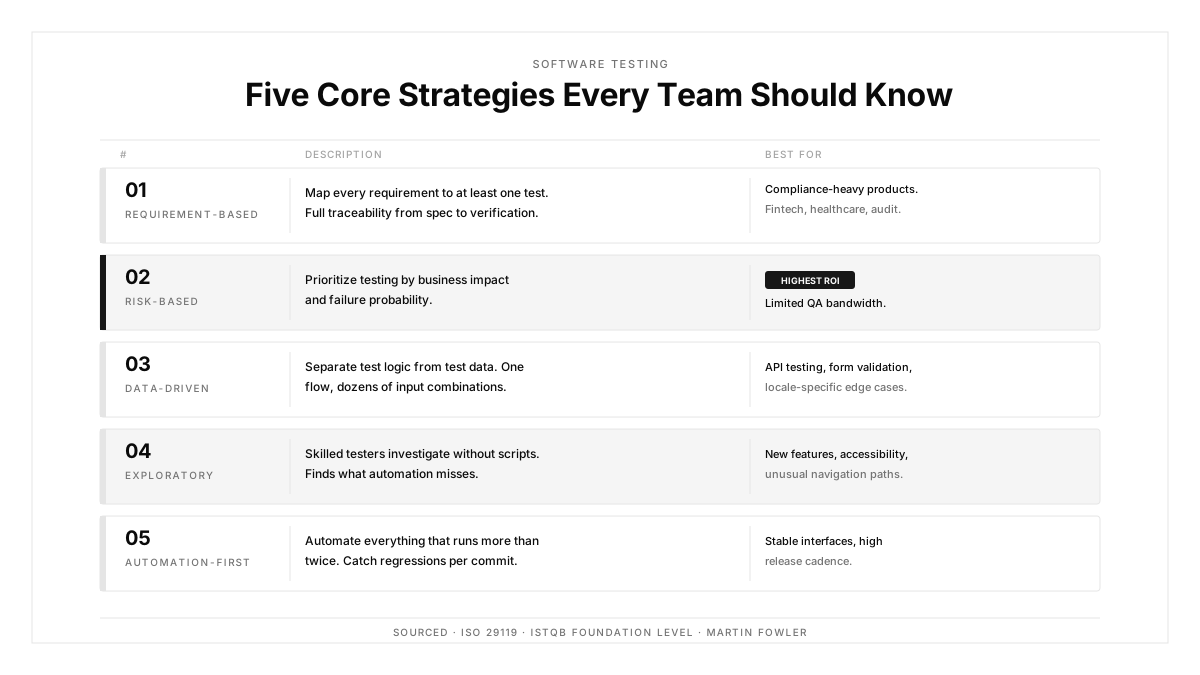
Requirement-based
Every requirement maps to at least one case, giving full traceability from specification through to verification. It suits compliance-heavy products in finance and healthcare where an audit trail is mandatory.
Its weakness is document drift. When the requirements file stops matching the codebase, the tests verify a product that stopped existing.
Risk-based
Among software testing strategies this one allocates coverage by business impact multiplied by failure probability. Payments, authentication, and data migration receive deep coverage. Peripheral screens receive smoke tests and little else.
This returns the most for teams with limited QA capacity, because it replaces an implicit even spread with an explicit ranking someone signed off on.
Data-driven
Test logic gets separated from test data, so one flow runs against dozens of input combinations covering valid, invalid, boundary, and locale-specific values.
It works particularly well for API testing and form validation. The ongoing cost is maintaining realistic data sets, which decays quietly when ownership is unclear.
Exploratory
Skilled testers investigate without a script, using charters to focus sessions. This finds the defects scripted cases structurally exclude: unusual navigation orders, race conditions, and accessibility gaps.
Findings worth keeping get converted into automated regression cases afterward, which is the step teams most often skip.
Automation-first
Anything running more than twice gets automated. Martin Fowler's test pyramid shapes the distribution: many unit tests, fewer integration tests, fewest end-to-end tests.
The pyramid keeps feedback fast and maintenance bounded. Inverting it produces a suite that takes 45 minutes and breaks whenever the UI changes.
Writing a Strategy Document People Read
Two pages, seven questions. Software testing strategies written at greater length get produced once and then ignored.
| Section | What It Settles |
|---|---|
| Objectives | Quality targets as numbers: crash rate under 0.5 percent, zero critical regressions per release |
| Scope | Platforms, OS versions, browsers, and the device matrix |
| Techniques | Which test types cover which product areas, and who owns each |
| Automation boundary | Where automation stops and manual work begins |
| Environments | Which environments exist and what runs in each |
| Risk register | Product areas ranked, with coverage allocated proportionally |
| Cadence | What triggers each suite: commit, pull request, nightly, pre-release |
Review it quarterly and after structural changes: a platform launch, a team restructure, or an architecture migration. A strategy left untouched for a year allocates effort against a product that has moved.
Software Testing Strategies Under Agile
Waterfall placed testing at the end. Agile spreads it across the sprint, so software testing strategies shift on cadence more than on technique.
Unit and integration tests run on every commit. Smoke tests gate each deployment to staging. Regression suites run nightly or on merge to main. Exploratory sessions happen at least once per sprint.
The ISTQB Foundation Level syllabus covers the Agile-specific practices in depth. The requirement underneath all of them is feedback arriving fast enough to change the current sprint rather than the next one.
Shift-left moves testing earlier, into refinement and design. Shift-right moves it later, into production through performance monitoring and synthetic checks. Mature software testing strategies use both, catching what they can before release and detecting the rest within minutes after.
Drawing the Automation Boundary
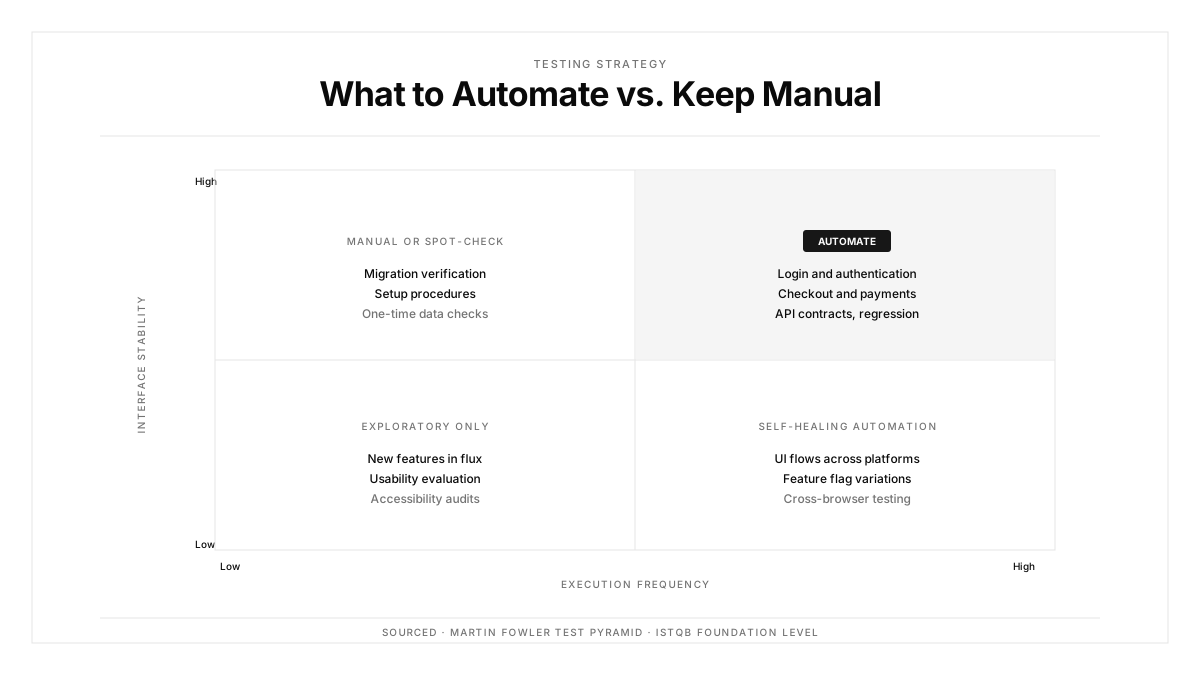
Automate work that repeats against a stable interface:
- Login and authentication
- Checkout and payment paths
- Cross-platform regression on your top device configurations
- API contract validation
- Smoke checks across real devices
Keep manual the work requiring judgment or changing too fast to maintain:
- Exploratory sessions on new features
- Usability evaluation and accessibility review
- Multi-step scenarios still being redesigned each sprint
- One-time data migration verification
Software testing strategies commonly fail in both directions at once. Teams over-automate early, producing a brittle suite that breaks every sprint, while critical flows added later go uncovered because the team learned to distrust automation.
Mobile-First Strategy
Web-first software testing strategies treat mobile as a port, so the question of whether something works on phones arrives late. That sequencing produces most mobile-specific production defects.
Four decisions shape a mobile-first approach.
Real devices against emulators. Emulators catch layout and logic quickly. Physical hardware catches thermal throttling, vendor OS forks, sensor behavior, and network transitions. Testing a mobile app properly needs both, split by failure class.
Cross-platform authoring. One test defined once should verify the same flow on iOS, Android, and web. Maintaining three parallel suites triples cost and guarantees they drift apart.
OS version scope. Android carries many active versions simultaneously. The strategy names which get full coverage, which get spot checks, and which get dropped, with the list revisited quarterly.
Store submission gates. Apple and Google run automated checks that reject builds over crash rates and privacy declarations. Pre-submission mobile app testing that mirrors those checks avoids losing a review cycle.
Intent-Based Tests and Maintenance Debt
Selector-bound tests break when the UI changes. A renamed class or a restructured modal fails the test while the feature works correctly.
Intent-based tests anchor to user goals instead. The test targets the primary action on the checkout screen rather than a specific element identifier, so a redesign leaves it valid.
This matters to software testing strategies because it changes the shape of the cost curve. Under selector binding, each sprint adds coverage and adds maintenance, so the two eventually cancel. Under intent anchoring, coverage accumulates while maintenance stays roughly flat.
The property to insist on is transparency. When a test adapts to a changed interface, the team needs to see what changed and confirm the adaptation was correct rather than accepting a silent pass.
How Autosana Fits
We built Autosana around the allocation problem software testing strategies exist to solve.
Our flows are authored as intent in plain language. One definition runs across iOS, Android, and web, which removes the triple maintenance cost that makes a cross-platform strategy expensive to execute.
We run on real devices rather than emulators alone, covering the failure classes that emulator-only pipelines structurally exclude.
We organize flows into suites mapped to cadence tiers, so risk-based allocation becomes a configuration rather than a document sitting unenforced. Our environments handling covers backend targets, locale, and network profile per run.
We self-heal by intent and log every adaptation, which keeps the transparency requirement above intact.
Conclusion
Go back to the two screens from the opening and write down the actual case counts.
Then write down what each screen is worth: revenue passing through it, users touching it weekly, support tickets it generates. Put the two lists side by side.
Wherever coverage and value disagree sharply, you have found the specific place your software testing strategies need a decision rather than a document. That comparison takes an afternoon and usually reorders a quarter of the suite.
.png)
FAQ
What is a software testing strategy?
A software testing strategy is a structural document deciding which techniques apply to which product areas, where automation returns most, and what risk level blocks a release. It governs many individual test plans.
How do software testing strategies differ from a test plan?
The strategy sets the approach across releases and product areas. The test plan applies that approach to one release with specific cases, environments, schedules, and assignments.
What should a test strategy document contain?
Measurable quality objectives, platform and device scope, techniques mapped to product areas, the automation boundary, environment definitions, a ranked risk register, and the cadence triggering each suite.
Which strategy suits teams with limited QA capacity?
Risk-based allocation, because it forces an explicit ranking of product areas by business impact and failure probability rather than spreading coverage evenly across screens of very different value.
What should be automated and what should stay manual?
Automate repeated work against stable interfaces: login, checkout, API contracts, cross-platform regression. Keep manual anything requiring judgment or changing every sprint, including exploratory and usability work.
Why does a mobile-first testing strategy matter?
Mobile carries failure classes web testing excludes: OS fragmentation, vendor forks, thermal behavior, and store submission gates. Treating mobile as a port means those surface through user reviews instead of your pipeline.
What are intent-based tests?
Tests anchored to user goals rather than element selectors. A renamed class or restructured screen leaves the test valid, which keeps maintenance roughly flat as coverage grows.
How often should a testing strategy be reviewed?
Quarterly, plus after platform launches, team restructures, or architecture migrations. A strategy left unchanged for a year allocates effort against a product that has already moved.