
Quality Engineering: What Changes When QA Stops Being a Stage
Quality engineering builds quality into how software is made rather than inspecting it at a gate. What changes, the role, the metrics, and where transitions stall.
Yuvan Sundrani · 11 min read
autosana.ai
TL;DR
- Quality engineering treats quality as an engineering property built into the product, rather than a stage that inspects it after the fact.
- The practical shift is where testing effort sits: in design reviews and acceptance criteria rather than concentrated in a pre-release window.
- A quality engineer writes code, owns tooling, and builds the systems other engineers test with, which is a different job from executing test cases.
- Autosana supports this model by making test authorship plain language, so quality ownership can sit with whoever owns the feature.
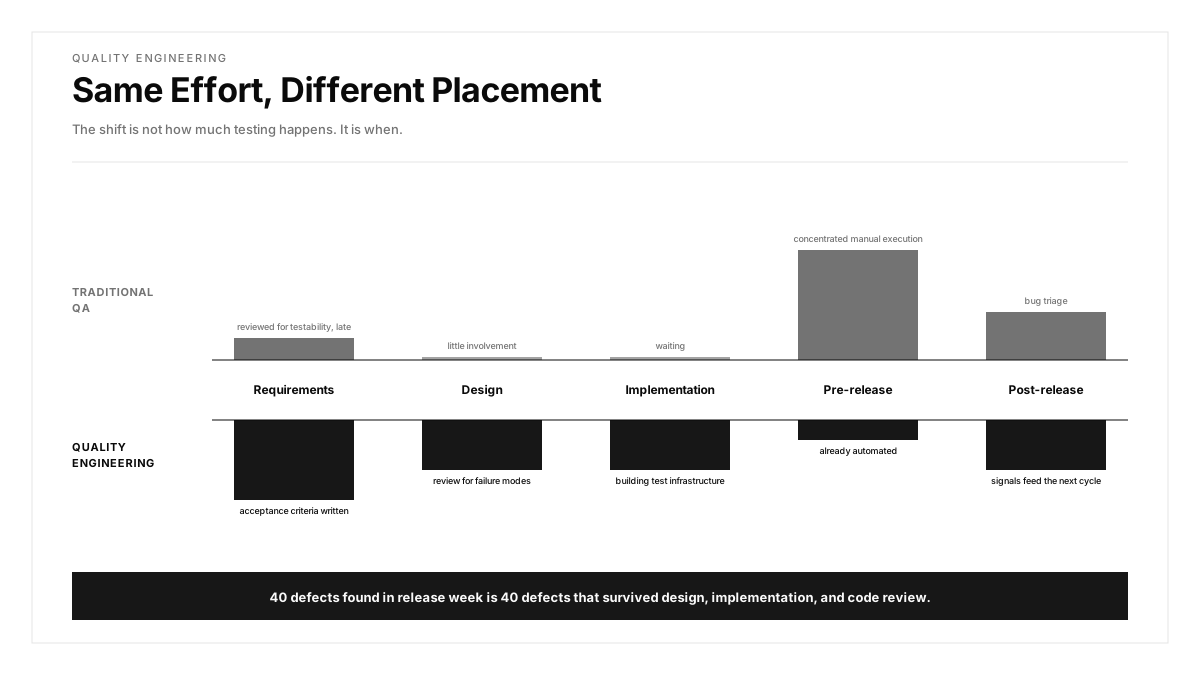
A QA team finds 40 defects in the week before release. That is usually reported as the team working well. Read it another way and it is 40 defects that survived design, implementation, and code review, each now needing a fix under deadline pressure.
Quality engineering is the response to that second reading. The discipline moves effort upstream, toward preventing defects rather than catching them in a window at the end.
This guide covers what actually changes, how the quality engineer role differs from a test engineer role, the metrics that distinguish the two models, and where the transition commonly stalls.
What Quality Engineering Is
Quality engineering is an approach where quality is treated as a property of how software gets built, owned across the team, rather than as a verification stage owned by a separate function.
The distinction from quality assurance is real rather than cosmetic. QA, in its traditional form, inspects output against a specification. Quality engineering builds the conditions under which fewer defects are produced, and then verifies continuously rather than at a gate.
The ISTQB Foundation Level syllabus covers the testing practices involved, and ISO/IEC/IEEE 29119-2 describes the processes. What both leave open is organisational shape, which is where the models diverge most.
Where the Effort Moves
The clearest way to see the change is where hours get spent across a cycle.
| Activity | Traditional QA | Quality Engineering |
|---|---|---|
| Requirements | Reviewed for testability late | Acceptance criteria written before development |
| Design | Little involvement | Review for testability and failure modes |
| Implementation | Waiting | Building test infrastructure alongside |
| Pre-release | Concentrated manual execution | Automated verification already running |
| Post-release | Bug triage | Production signals feeding the next cycle |
Two rows carry most of the benefit.
Writing acceptance criteria before development removes ambiguity while it is still free to remove. A requirement saying a discount applies to large orders is a defect waiting to be built, and a conversation settles it in minutes.
Reviewing design for failure modes catches architectural decisions that make testing expensive forever. A component that depends on wall-clock time, a flow with no way to reach an error state deliberately, a module that requires network access to unit test. Each is cheap to change at design time and permanent afterwards.
What Does a Quality Engineer Actually Do?
The job differs from a test engineer role in what it produces.
A quality engineer writes code. Test frameworks, fixtures, data generators, CI tooling, and the libraries other engineers use to test their own work. The output is capability rather than executed cases.
A quality engineer owns infrastructure. Device access, environment provisioning, test data management, and the reliability of the systems everyone depends on. When a pipeline becomes flaky, this is whose problem it is.
A quality engineer influences design. Attending design reviews with testability as the concern, and arguing for seams that make verification possible.
A quality engineer measures. Defect leakage, flake rates, feedback latency, coverage against risk rather than against lines.
What the role generally stops doing is executing repetitive test cases by hand. That work becomes automation, and where it resists automation it becomes exploratory testing, which is a skilled activity rather than a repetitive one.
Which Metrics Separate Quality Engineering From Traditional QA?
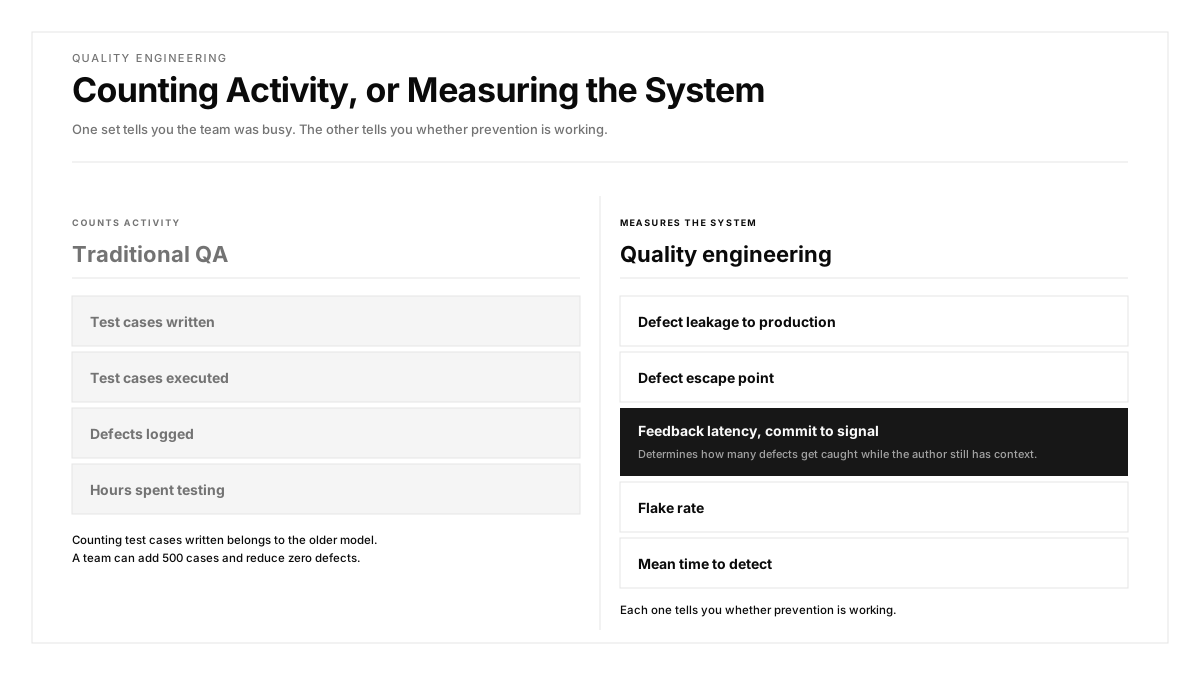
Traditional QA metrics count activity. Quality engineering metrics measure whether the system is improving.
Defect leakage, meaning the proportion of defects found in production rather than before release, is the headline measure. A falling leakage rate means prevention is working.
Defect escape point, meaning the stage where each defect should have been caught. A defect that reached production but was catchable at design review is a different finding from one only reachable on real hardware.
Feedback latency, meaning time from a commit to a trustworthy signal. This one determines how many defects get caught while the author still has context, and it is the metric most worth optimising. Google's DevOps research ties the same measure to delivery performance overall.
Flake rate, because a suite producing false failures trains engineers to ignore it, after which its coverage is nominal.
Mean time to detect a production issue, which is where performance monitoring and crash reporting feed back into the loop.
Counting test cases written belongs to the older model. A team can add 500 cases and reduce zero defects.
What Is Shift Right, and Why Does It Get Forgotten?
Shift left is the familiar half: move verification earlier, into refinement, design, and the developer's own loop.
Shift right is the other half and gets less attention. Production is a test environment with perfect fidelity and real users, and quality engineering treats signals from it as test results. Crash-free session rate, latency percentiles, and error rates all report on quality that pre-release testing failed to predict.
The loop closes when each production finding becomes a test. A crash on a flow with existing coverage points at a weak test. A crash on an uncovered flow names the next piece of work. Regression testing then keeps that finding from recurring.
Running only shift left means optimising for predicted failure modes. Running only shift right means debugging in public. Mobile test automation across real devices is what makes the left half credible for mobile products. Mobile app testing programmes need both, since mobile fixes take days to reach users once a defect ships.
Where the Transition Stalls
Four failure patterns recur.
The title changes and the work does not. A team renamed to quality engineering while still receiving builds at the end of a sprint has changed vocabulary rather than practice.
Developers decline to own testing. Quality engineering distributes responsibility, and that lands poorly where testing is seen as lower-status work. The usual cause is that the testing experience is genuinely bad, and improving the tooling moves this faster than any amount of advocacy.
Automation is treated as the whole of it. Automating a broken process produces faster bad results. The upstream work, acceptance criteria and design review, is what actually reduces defect creation.
Metrics stay activity-based. A team reporting cases executed while leakage goes unmeasured lacks any way to tell whether it is working.
Testing a mobile app under this model usually surfaces the second pattern first, since mobile testing has historically been the most painful to own.
How Do You Make Quality Cheap Enough to Own?
The practical lever is reducing what it costs a developer to verify their own work.
Keep feedback fast. A suite returning in minutes gets used; one returning in 45 minutes gets bypassed. Smoke tests are the cheapest fast tier to start with. Tier by runtime through suites so the fast tier stays fast.
Keep authorship cheap. Where writing a test requires learning a framework, specialist knowledge, and selector archaeology, ownership stays with specialists by default. Our flows are written in plain language for this reason.
Keep failures diagnosable. A failure arriving with video and the exact failing step is actionable by whoever wrote the feature. One arriving as a log line routes back to a specialist.
Keep the environment reliable. Environments configuration and real device testing that works consistently removes the most common reason developers stop running tests.
How Autosana Fits
We work on the cost side of quality engineering, since distributed ownership follows from low friction rather than from policy.
Our flows are plain-language descriptions of user intent, so a developer or product manager can write and read one without framework knowledge. That is what lets quality ownership sit with the person who owns the feature.
We run on real devices across iOS, Android, and web in parallel, so broad verification stays fast enough to run on every pull request.
Failures arrive with per-device video and step-level results, routed through notifications to the owning engineer rather than into a QA queue.
Performance monitoring captures the production-facing signals that close the shift-right half of the loop, and suites organise everything by cadence.
Conclusion
Take your last twenty production defects and mark, for each, the earliest stage it could have been caught.
The count that lands on design review and acceptance criteria is your quality engineering opportunity, because those defects were preventable rather than merely findable. A team discovering that half its escapes were ambiguity in a requirement has a writing problem rather than a testing problem.
Then measure feedback latency from commit to trustworthy signal. Where that number is in hours, defect prevention stays theoretical, because the author has moved on by the time the signal arrives.
.png)
FAQ
What is quality engineering?
Quality engineering treats quality as a property built into how software is made, owned across the team, rather than as a verification stage performed by a separate function after development.
How does quality engineering differ from quality assurance?
QA inspects output against a specification at a gate. Quality engineering builds conditions that produce fewer defects, moving effort into acceptance criteria and design review, then verifying continuously.
What does a quality engineer actually do?
Writes test frameworks, fixtures, and tooling other engineers use. Owns device access and environment reliability. Attends design reviews arguing for testability. Measures leakage, flake rate, and feedback latency.
Which metrics suit quality engineering?
Defect leakage to production, defect escape point, feedback latency from commit to signal, flake rate, and mean time to detect. Counting test cases written measures activity rather than improvement.
What is shift right?
Treating production signals as test results. Crash-free session rate, latency percentiles, and error rates report on quality that pre-release testing failed to predict, and each finding should become a test.
Why do quality engineering transitions fail?
The title changes while builds still arrive at the end of a sprint, developers decline ownership because the testing experience is poor, automation is mistaken for the whole discipline, or metrics stay activity-based.
How do you get developers to own testing?
Reduce the cost. Fast feedback, authorship that requires no framework knowledge, failures that arrive diagnosable, and environments that work consistently. Tooling moves this faster than advocacy.
Does quality engineering remove the need for testers?
It changes the work. Repetitive execution becomes automation, while exploratory testing, design review, and tooling ownership all expand. The skill requirement rises rather than falls.