
Cross Platform App Development: What the Shared Codebase Hides
Cross platform app development shares logic well and platform integration poorly. The four frameworks compared, where sharing stops, and what it does to testing.
Yuvan Sundrani · 13 min read
autosana.ai

TL;DR
- Cross platform app development builds iOS and Android from one codebase using React Native, Flutter, Kotlin Multiplatform, or .NET MAUI.
- Sharing figures describe lines of code. Defects follow boundaries, and the boundary is platform integration: permissions, biometrics, purchases, deep links.
- Testing effort stays close to native. One shared defect now reaches every user at once, and platform code still needs platform coverage.
- Framework upgrades are their own defect class. React Native's New Architecture and Flutter's renderer change both alter runtime behaviour beneath unchanged application code.
- Autosana runs one intent-based flow across real iOS, Android, and web devices, matching the shared-codebase model with a single suite.
A team adopts cross platform app development and expects testing effort to halve with the code. It rarely does.
Cross platform app development changes where the work sits rather than how much exists. The shared layer means one defect reaches both platforms at once. The unshared layer is where the framework stops helping, and it produces most of the bugs.
This guide covers the four architectures, where sharing actually stops, the defect classes each framework generates, and what upgrades do to a suite.
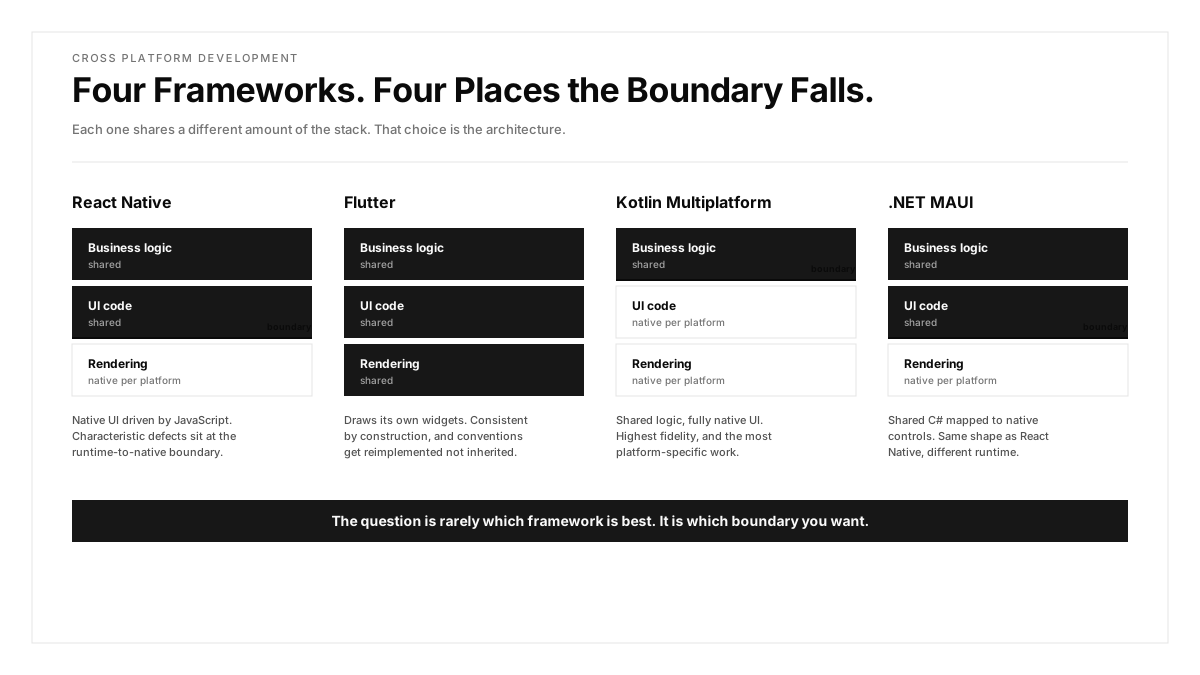
What Are the Four Cross Platform App Development Approaches?
| Framework | How it reaches the screen | Shared | Characteristic weak point |
|---|---|---|---|
| React Native | JavaScript drives native components | Logic, some UI | The bridge between runtime and native layer |
| Flutter | Draws its own widgets onto a canvas | Logic and UI | Platform conventions require reimplementation |
| Kotlin Multiplatform | Shared logic, fully native UI per platform | Logic only | Most platform-specific work to write |
| .NET MAUI | Shared C# mapped to native controls | Logic, some UI | Smaller ecosystem, handler layer divergence |
The deciding question is rarely which framework is best. It is which boundary you want: a shared UI with reimplemented conventions, or native UI with shared logic underneath.
That choice determines your defect profile before a line is written.
Where Does Cross Platform App Development Sharing Actually Stop?
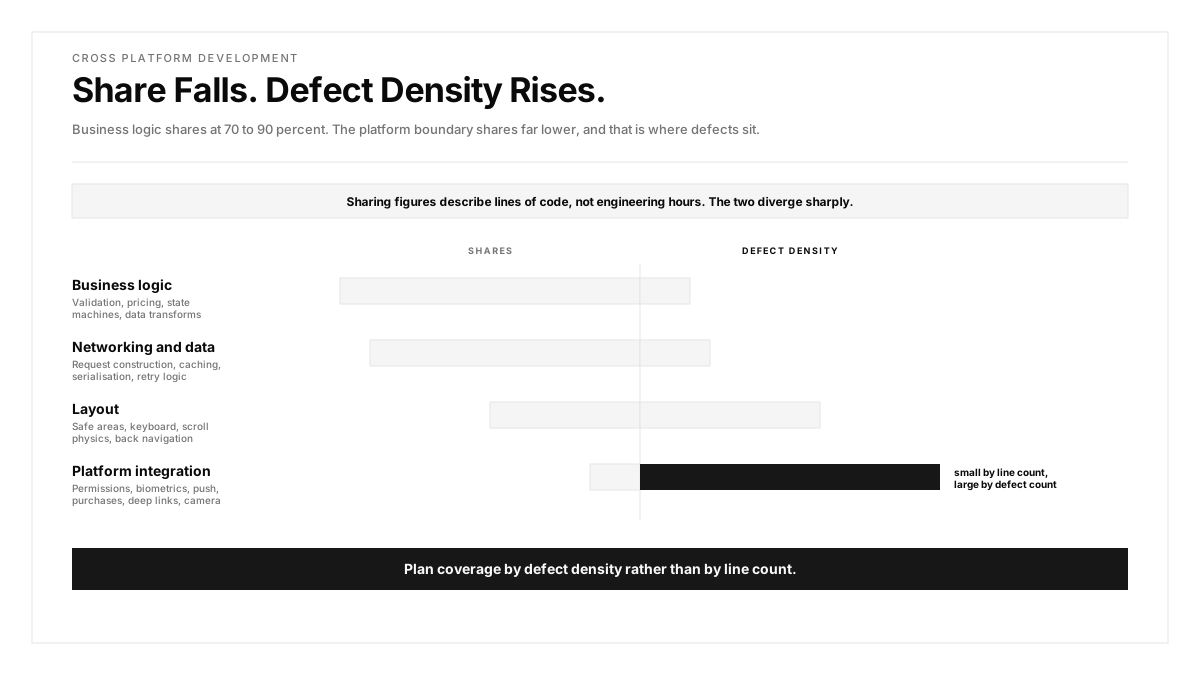
Published cross platform app development sharing figures count lines. Weight your coverage by the right-hand column instead.
| Layer | Shares | Defect density | Examples |
|---|---|---|---|
| Business logic | Cleanly | Low | Validation, pricing, state machines |
| Networking and data | Cleanly | Low | Requests, serialisation, caching, retry |
| Layout | Structure yes, detail no | Medium | Safe areas, keyboard, scroll physics, back navigation |
| Platform integration | Poorly, parts resist entirely | High | Permissions, biometrics, purchases, deep links, background execution, camera |
The bottom row is a few percent of the codebase and the majority of production defects. It sits where the abstraction meets a platform that disagrees with it.
What Does Cross Platform App Development Do to Testing?
Cross platform app development produces three effects on testing. One reduces work.
Shared logic needs testing once. A pricing rule verified at unit level covers both platforms. This is the genuine saving.
Shared defects reach everyone simultaneously. A bug in shared code affects your whole base rather than half, which raises severity for anything in that layer.
Platform code still needs platform coverage, and the framework itself adds a layer that breaks. A permission flow written once against an abstraction can pass on one platform and fail on the other because the abstraction leaks.
So: unit test the shared layer heavily, then run end-to-end coverage on both platforms regardless of sharing percentage. Testing a mobile app built this way follows the native order with a heavier unit tier.
Which Defects Are Characteristic of Cross Platform App Development?
Four defect classes recur across cross platform app development.
Abstraction leaks. One API covering two platform behaviours, failing where the abstraction omitted a case. Permission denial is the standard example, since iOS and Android differ in how many denial states exist.
Bridge and serialisation faults. Where logic runs in a separate runtime, data crossing that boundary loses precision, mangles dates, or arrives late enough to flicker. Large payloads crossing frequently are the usual trigger.
Rendering divergence. Identical layout producing different results from font metrics, density rounding, or safe-area handling. Mobile UI testing across real screens catches these, and the responsive design fundamentals apply directly.
Performance asymmetry. The same screen acceptable on one platform and poor on the other. Startup time is the usual casualty, so measure per platform.
Vendor OS forks multiply all four on Android. A framework verified against stock Android says little about a device running a manufacturer skin, which keeps real device testing necessary.
Why Are Cross Platform App Development Framework Upgrades Risky?
This risk gets underweighted.
Your application code stays unchanged while the runtime beneath it changes. React Native's New Architecture replaces the asynchronous bridge with a synchronous interface layer. Flutter has changed its rendering backend. Both alter timing, and timing is what end-to-end tests depend on.
Three consequences follow.
A cross platform app development major version is a release-sized risk, so treat it as one. Full regression across the device matrix, rather than a smoke pass.
Third-party native modules lag the framework. A library that has yet to adopt a new architecture becomes the blocker, and the dependency audit belongs before the upgrade rather than during it.
Test tooling lags too. Suites bound to element selectors frequently break on framework upgrades because the accessibility tree shifts, even where the UI looks identical.
Run regression testing against the upgrade branch on real hardware before merging, since this is the class of change emulators report most optimistically.
Why Do Debug Builds Mislead in Cross Platform App Development?
Debug and release builds diverge enough to invalidate testing done on the wrong one.
React Native debug builds run JavaScript through a different execution path than release. Flutter debug builds skip ahead-of-time compilation, so startup and frame timing differ substantially. Both make debug builds faster to iterate on and slower at runtime.
A test suite passing against debug builds proves little about the artefact users receive. Run end-to-end coverage against release or profile builds, and reserve debug for the inner development loop.
This single configuration choice explains a large share of "passed in CI, failed in production" reports on cross platform app development projects.
How Should You Pick a Framework With Testing in Mind?
Four properties affect cross platform app development test cost more than any feature comparison.
| Property | Question to ask | Why it matters |
|---|---|---|
| Element identification | Are accessibility identifiers exposed by default? | Canvas-rendering frameworks present a thin tree, which makes selector-based automation brittle |
| Debug against release divergence | What changes between build types? | Determines which artefact your suite must target |
| Platform channel testing | How testable is the shared-to-native seam? | Highest-risk boundary in shared-logic frameworks |
| Emulator fidelity | Does the rendering layer behave the same under emulation? | Decides how much coverage must move to hardware |
Both the Android Emulator and the iOS Simulator document what they reproduce, and the gaps are where a framework's rendering layer diverges most.
Ask these before committing, since migrating a test suite between frameworks costs more than migrating the application.
How Autosana Fits
We match the cross platform app development model by sharing the test definition the way the app shares code.
One flow definition runs across iOS, Android, and web. The app is written once, and the test is written once.
We anchor to user intent rather than element selectors, which matters more here than in native work. A thin accessibility tree breaks selector-based suites, while intent-based flows target the goal and survive both redesigns and framework upgrades.
We run on real devices across vendor OS forks, covering the rendering divergence and performance asymmetry emulators hide. Apps handles build artefacts per platform from one project, including release builds for the reason above.
Our suites organise by feature rather than platform, so a failing feature reports which platforms failed rather than requiring two dashboards compared by hand. Teams comparing frameworks find our cross-platform testing tools roundup and the React Native against Flutter comparison useful alongside this.
Conclusion
List the files in your cross platform app development project touching permissions, biometrics, push registration, in-app purchases, and deep linking.
That list is small and it will produce a disproportionate share of your production defects. Weight end-to-end coverage toward it, and run that coverage on both platforms whatever your sharing percentage says.
Then check which build type your suite runs against. Where the answer is debug, your results describe an artefact no user will ever install.
FAQ
What is cross platform app development?
Cross platform app development builds applications for multiple platforms from one shared codebase, using frameworks such as React Native, Flutter, Kotlin Multiplatform, or .NET MAUI.
How do the main frameworks differ?
React Native and .NET MAUI drive native components from a shared runtime. Flutter draws its own widgets onto a canvas. Kotlin Multiplatform shares logic while leaving each UI fully native.
How much code actually gets shared?
Business logic, networking, and data layers share cleanly. Layout shares structurally. Platform integration shares poorly, and that small group produces most defects.
Does cross platform app development reduce testing effort?
Partly. Shared logic needs unit testing once. Platform code still needs platform coverage, and a shared defect now reaches every user rather than half of them.
What defects are characteristic of cross platform app development?
Abstraction leaks where one API covers two behaviours, bridge and serialisation faults, rendering divergence from font metrics and safe areas, and performance asymmetry between platforms.
Why are cross platform app development framework upgrades risky?
The runtime changes beneath unchanged application code. React Native's New Architecture and Flutter's renderer changes both alter timing, third-party native modules lag, and selector-bound suites break when the accessibility tree shifts.
Should tests run against debug or release builds?
Release or profile builds. Debug builds use a different execution path in React Native and skip ahead-of-time compilation in Flutter, so results describe an artefact users will fail to receive.
What should you check about a framework before adopting it?
Whether accessibility identifiers are exposed by default, how debug differs from release, how testable the platform channel is, and how closely emulator behaviour matches hardware.