
React Native vs Flutter E2E Testing: Why the Render Layer Decides Your Tooling
React Native renders to real native views, so the accessibility tree sees everything. Flutter paints its own canvas and exposes only what you declare. That one difference decides your E2E options.
Yuvan Sundrani · 19 min read
autosana.ai
The tooling question for cross-platform mobile testing is usually framed as a preference between Detox, Patrol, Appium, and Maestro. It is not a preference. React Native renders to real platform-native views, so the operating system's accessibility tree already describes your UI. Flutter paints to its own canvas, so the accessibility tree contains only what you explicitly declared. Every external automation tool reads that tree. One architecture hands it to you and the other makes you build it.
Key Takeaways
- React Native components become genuine UIView and android.view.View instances, so external tools see a populated accessibility tree without any extra work from you.
- Flutter draws every pixel on its own Skia or Impeller canvas. The platform sees one large surface, and only widgets carrying explicit semantics appear in the accessibility tree.
- That difference, not developer taste, is why Detox works for React Native and Patrol exists for Flutter. The tools match the render model.
- Framework-specific tools belong in the integration band. Using integration_test or Detox as your E2E layer binds your test suite to a technology decision you might reverse.
- Autosana runs intent-based flows on real devices at the end-to-end layer, so the suite survives a framework migration that would invalidate a Detox or integration_test suite entirely.
Why does the render layer decide your testing options?
Every external automation tool, meaning Appium, Maestro, UiAutomator, and XCUITest, works by reading the platform accessibility tree. That tree is the operating system's structured description of what is on screen. It is the only public interface a process outside your app has into your UI.
So the question that determines your tooling is simple: what does your framework put in that tree?
React Native compiles JavaScript, runs it in Hermes, and bridges through the JSI to create real platform widgets. A React Native <Text> becomes a UILabel on iOS and a TextView on Android. The platform's accessibility system walks those real views and populates the tree automatically. External tools see a rich, fully populated structure because your UI genuinely is made of native components.
Flutter takes the opposite approach deliberately. Dart code drives a rendering engine, Skia historically and Impeller now, that paints directly to a single canvas. There is no UILabel behind a Flutter Text widget. From the platform's perspective your entire app is one large drawing surface. Flutter maintains its own internal widget tree, and separately synthesises an accessibility tree from widgets that carry semantics information.
That synthesis is the crux. Flutter exposes what it was told to expose. A Text widget contributes its string. A custom-painted control with no Semantics wrapper contributes nothing, because nothing instructed it to.
A developer on r/Frontend made the general version of this point about rendering abstractions: the moment a framework stops using the platform's own primitives, every tool built on those primitives needs a compatibility story, and that story is rarely free.
What breaks when you test a Flutter app with Appium?
Teams usually discover this in one specific way. They point Appium at a Flutter app, dump the page source, and find a shallow tree of a few generic nodes where they expected a hierarchy.
The failures follow a pattern.
Un-annotated widgets are invisible. A custom chart, a gesture-driven slider, a decorative container with a tap handler. If nothing added semantics, the node does not exist for Appium. The element is plainly on screen and genuinely unreachable.
There are no resource IDs. Flutter has no R.id equivalent because it does not create Android views. Locator strategies built on resource-id have nothing to match.
Text is often the only handle. Which makes suites fragile against copy changes and useless for localisation runs, since the identifier is the user-facing string.
Merged semantics hide structure. Flutter merges child semantics into parents by default for screen-reader usability, which is correct for accessibility and lossy for automation. A row that visually contains four distinct controls can surface as one node.
The fix is Semantics widgets and identifiers added deliberately in production code:
That works, and it carries the same structural cost as any identifier scheme: someone must add it, someone must maintain it, and it only exists where somebody remembered. A tester on r/softwaretesting described the predictable consequence of schemes like this, which is that annotation coverage tracks whoever last had time rather than whichever flows matter most.
React Native inverts the problem. The tree is populated by default, so your difficulty is not absence but ambiguity: forty list rows that all look identical to a locator, which is a disambiguation problem rather than a visibility one. Disambiguation is the easier problem.
Which E2E tools actually work for React Native and Flutter?
| Tool | Works With | How It Binds | Real Constraint |
|---|---|---|---|
| Detox | React Native only | Grey-box, inside the app process | Will not test Flutter. Ties the suite to RN. |
| integration_test | Flutter only | In-process, Flutter's own harness | Cannot leave the app. No OS dialogs. |
| Patrol | Flutter, plus native OS | Wraps integration_test, adds native control | Flutter-bound, newer ecosystem |
| Appium | Both | External, via accessibility tree | Needs Flutter semantics. Slower. |
| Maestro | Both | External, YAML flows | Command-based. YAML scales poorly. |
| Agent-based flows | Both | External, intent resolved at run time | Non-deterministic. E2E layer only. |
Detox is genuinely excellent at what it does. It runs grey-box, meaning it has visibility into the React Native bridge, so it knows when the app is idle rather than guessing with timeouts. That eliminates an entire category of flake. It is also React Native only, by construction.
integration_test is Flutter's first-party answer and it is in-process. That is its strength for widget-level work and its hard ceiling for E2E: it cannot interact with anything outside the Flutter surface. A permission dialog, the notification shade, a bank app in a payment handoff, a system share sheet. All out of reach.
Patrol exists precisely to patch that ceiling. It wraps integration_test and adds native interaction so you can tap the OS permission prompt. It is a good tool solving a real gap, and it remains Flutter-bound.
Appium and Maestro are the two that work across both, because both are external and read the accessibility tree. They inherit the Flutter semantics requirement for exactly that reason.
A practitioner on r/QualityAssurance framed the selection question usefully: the useful comparison is not which tool is better but which layer each tool is actually competent at, because most tooling arguments are really two people discussing different layers.
Where should each tool sit in the test pyramid?
This is where most cross-platform suites go wrong, and the mistake is structural rather than careless.
A healthy distribution:
| Band | Share | React Native | Flutter |
|---|---|---|---|
| Unit | ~70% | Jest | flutter_test |
| Integration | ~20% | Detox | Patrol or integration_test |
| End to end | ~10% | Framework-independent | Framework-independent |
The unit and integration bands should absolutely be framework-specific. That is the point of them. Detox's bridge awareness and flutter_test's widget harness are precisely the advantages you want when testing your own components, and a generic tool would be worse at both.
The end-to-end band is different, and here is the reframe this article exists for.
An E2E test is a claim about your product, not about your framework. "A customer can complete a purchase" was true before you chose React Native and stays true if you migrate to Flutter. If that assertion lives in Detox, it is encoded in a tool that only exists because you picked React Native, so a framework migration invalidates your entire top-layer suite along with the code.
That is a real risk rather than a hypothetical. Teams migrate between these frameworks, and they usually do it while the product is live and revenue-generating, which is exactly when you least want to be simultaneously rewriting your safety net.
The second-order version is worse. When the E2E layer is framework-bound, it tends to drift downward into integration testing, because the tool's natural idioms are component-shaped. You end up with a top band that asserts about component state rather than about user outcomes, and nobody notices until a genuine user-facing regression ships past a green suite.
A developer on r/webdev put the general principle well while discussing architecture: the layers that change most often should not be the layers everything else is pinned to.
What about a hybrid or partially migrated app?
Common and worth naming. A React Native shell embedding a Flutter module, or the reverse, or either embedding genuinely native screens.
For the external bands this is fine, because an external tool reading the accessibility tree does not care which engine produced a node, only whether the node exists. For the framework-specific bands it is painful: Detox cannot see the Flutter module and integration_test cannot see the React Native screens, so you end up with two integration suites and a coverage seam between them.
The seam is exactly where bugs live, which is a strong argument for keeping a framework-independent E2E layer that crosses it.
Why do cross-platform suites flake differently on each framework?
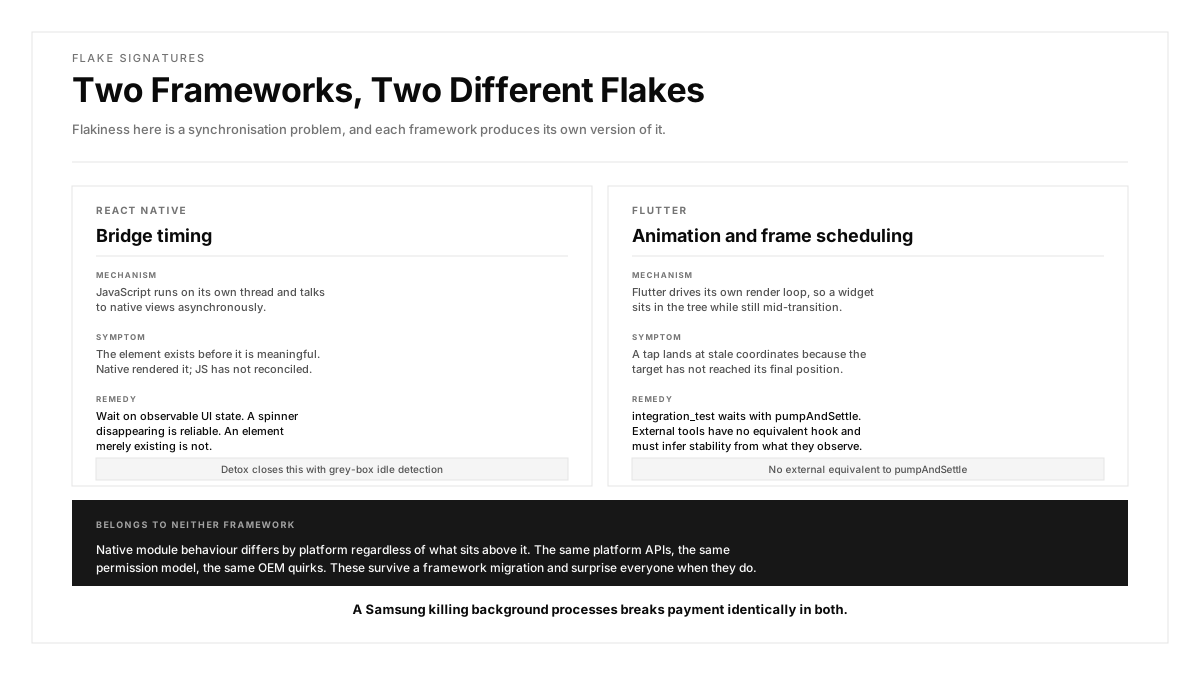
Flakiness in cross-platform mobile is mostly a synchronisation problem, and the two frameworks produce different versions of it.
React Native flake is usually bridge timing. JavaScript runs on its own thread and communicates with native views asynchronously. An external tool that taps a button has no visibility into whether the JS thread has finished processing the resulting state update, so it asserts against a view that native has rendered but JS has not yet reconciled. This is precisely the gap Detox closes with grey-box idle detection, and precisely the gap Appium and other external tools cannot close, because they are outside the process and have nothing to query.
The practical consequence is that an external React Native suite needs condition-based waits on observable UI state rather than on the tool's default element checks. Waiting for a spinner to disappear is reliable. Waiting for an element to exist is not, because in React Native the element frequently exists before it is meaningful.
Flutter flake is usually animation and frame scheduling. Flutter drives its own render loop, so a widget can be present in the semantics tree while mid-transition and not yet at its final position. Tapping a target that is still animating into place produces a tap at stale coordinates. integration_test handles this internally with pumpAndSettle, which waits for the frame scheduler to go quiet. External tools have no equivalent hook and must infer stability from what they can observe.
There is a third category that belongs to neither framework. Native module behaviour differs by platform regardless of what sits above it. A React Native camera library and a Flutter camera plugin both ultimately call the same platform APIs, inherit the same permission model, and hit the same OEM quirks. Bugs in that layer look like framework bugs and are not, which is why they survive a framework migration and surprise everyone when they do.
How do you choose between React Native and Flutter from a testing perspective?
Testability should not be the deciding factor in a framework choice, and it is a legitimate input.
React Native costs less to test externally. The accessibility tree is populated for free, so Appium, Maestro, and agent-based tools work on day one with no production code changes. You also get accessibility closer to correct by default, because you inherit platform behaviour.
Flutter costs more to test externally and gives more control. You must add Semantics deliberately, which is ongoing work. In exchange you get exact rendering parity across platforms, which removes a category of visual regression that React Native teams genuinely do hit when iOS and Android native components diverge.
The honest summary: React Native front-loads less testing work, Flutter front-loads more but makes what you build more uniform. Neither is disqualifying, and a team that writes Semantics as a matter of habit erases most of the Flutter penalty.
One thing that is not framework-specific: OEM and OS variation. A Samsung device aggressively killing background processes will break a payment flow identically in React Native and Flutter, because it is an operating system behaviour rather than a rendering one. A practitioner on r/softwaretesting noted the familiar shape of this, which is that the bugs reaching production are usually environmental rather than logical, and no framework choice protects you from them.
How does Autosana fit a cross-platform mobile stack?
Autosana is an AI-native E2E testing agent for iOS, Android, and web. Flows are stated as intent, and the agent resolves targets at run time from on-screen semantics plus the rendered visual context rather than from identifiers registered in advance.
For this specific problem that matters in two ways.
Because resolution uses visual context in addition to the semantics tree, a Flutter widget that was never wrapped in Semantics is not automatically unreachable. The annotation gap that blocks a purely tree-reading tool is less absolute. Adding Semantics is still correct and still improves real accessibility, and the suite is not hard-blocked while that work is outstanding.
Because flows are not written in a framework's harness, the E2E band stays framework-independent. "Complete a purchase" is the same stated flow whether the screen beneath it is React Native, Flutter, or native, which is what makes it survive a migration. Runs execute on hosted real devices, so the OEM and OS variation that no framework choice protects you from happens on real hardware, and results arrive through the GitHub integration with session replay attached. Coding agents can drive the same flows over MCP.
Where it does not fit, plainly. It does not replace Jest, flutter_test, Detox, or Patrol. Those own the unit and integration bands and they are better at those bands than any external tool, because in-process access is a genuine advantage when you are testing components. Autosana operates at the end-to-end layer only, and a sensible stack uses both.
Where to start
Open your top-layer suite and read ten assertions. Count how many name a component, a test ID, or a framework concept, and how many name something a customer would recognise. The ratio tells you whether your E2E band is actually end to end or is integration testing that drifted upward.
Then ask one question out loud at your next planning session: if we migrated frameworks next year, how much of this suite survives? If the answer is "the unit tests," your safety net is pinned to a decision you may reverse, and the fix is to make the top ten percent framework-independent before you need it to be.
.png)
FAQ
Why is Flutter harder to test with Appium than React Native?
React Native renders real platform-native views, so the accessibility tree is populated automatically. Flutter paints to its own canvas and exposes only widgets carrying explicit semantics, so un-annotated elements are invisible to any external tool reading that tree.
Can Detox test a Flutter app?
No. Detox is grey-box and binds to the React Native bridge, which Flutter does not have. For Flutter, the equivalent tools are integration_test for in-process work and Patrol when native OS interaction is required.
What is the difference between integration_test and Patrol?
integration_test is Flutter's first-party harness and runs in-process, so it cannot interact with anything outside the Flutter surface. Patrol wraps it and adds native control, enabling permission dialogs, notifications, and other operating-system interactions.
Should E2E tests use Detox or integration_test?
Neither, as your top layer. Both are excellent in the integration band. Using them for end-to-end binds your product-level assertions to a framework choice, so a migration invalidates the suite you most need during a migration.
Do you need Semantics widgets for Flutter automation?
For external tools reading the accessibility tree, largely yes. Add Semantics with stable identifiers on interactive elements. It is production code that must be written and maintained, and it improves real accessibility alongside testability.
Which is better for testing, React Native or Flutter?
React Native is cheaper to test externally because the accessibility tree is populated for free. Flutter requires deliberate semantics work but delivers exact rendering parity across platforms. Neither is disqualifying, and habitual semantics authoring erases most of the Flutter gap.
Can one E2E suite cover both React Native and Flutter screens?
Yes, if the suite is external and framework-independent. Appium, Maestro, and agent-based flows read the accessibility tree and do not care which engine produced a node. Framework-specific tools cannot cross that boundary.
Does Autosana replace Detox or flutter_test?
No. Those own the unit and integration bands, where in-process access is a real advantage. Autosana operates at the end-to-end layer with intent-based flows on real devices. A healthy stack runs both.