
Quality Control in Software: Definition, Methods, QA vs QC, and the Testing Pyramid
Quality control in software means inspecting the product against standards to catch defects before users do. Learn QC methods, QA vs QC, and how the testing pyramid is a QC framework.
Yuvan Sundrani · 14 min read
autosana.ai
.png)
TL;DR
- Quality control is the process of inspecting a finished product against predefined standards to find and fix defects before it reaches users. In software, that means testing.
- Quality control and quality assurance are not the same thing. QA prevents defects by improving processes. QC detects defects by inspecting the product. Both sit under quality management.
- The testing pyramid (unit, integration, end-to-end) is a quality control framework. Each layer inspects a different scope: individual functions, component interactions, and complete user journeys.
- On mobile, quality control requires real devices. OEM-specific behavior, hardware sensors, and performance under memory pressure are invisible to emulators and simulators.
Every software team does quality control. Most just do not call it that.
When a developer runs a test suite before merging a pull request, that is quality control. When a QA engineer opens the staging build and taps through the checkout flow on a real phone, that is quality control. When a CI pipeline rejects a build because three tests failed, that is quality control too.
The activity is always the same: inspect the product, compare it against what it should do, and catch defects before they reach the people who paid for the software.
The problem is not that teams skip quality control entirely. It is that they practice it informally. Tests exist, but they grew organically over two years and nobody has asked whether they still cover the failure modes that actually cause production incidents. Code reviews happen, but the checklist was written for a codebase half the current size.
The CI pipeline runs, but nobody has looked at which tests are flaky and which are catching real bugs. Quality control without a deliberate structure is just testing that happens to exist. That is a very different thing from a system designed to catch defects reliably.
This guide covers what quality control actually means when applied to software, how it differs from quality assurance, the specific methods teams use to implement it, and where the biggest gaps tend to hide.
What is quality control?
In the broadest sense, quality control is a set of procedures used to ensure that a product meets predefined standards before delivery. The American Society for Quality defines it as the operational techniques and activities used to fulfill requirements for quality.
The concept comes from manufacturing: an inspector on an assembly line examines the product, compares it against a specification, and either approves it or sends it back.
In software, the product is a build. The specification is a mix of requirements, design standards, and user expectations. And the inspection is testing. Quality control in software means running the build through checks that verify it behaves correctly, performs within acceptable limits, and does not contain defects that would degrade the user experience.
The formal framework behind all of this is ISO 9001, the international standard for quality management systems. Most software teams never reference it directly. But the principles, define standards, measure against them, improve continuously, are exactly what a good testing practice does whether it uses the ISO vocabulary or not.
Quality control vs quality assurance
This is the comparison that shows up in every search related to quality control, and it matters because confusing the two leads teams to think they are covered when they are not.
Quality assurance is proactive and process-focused. It asks whether the team is building software in a way that prevents defects from being introduced. QA activities happen before and during development: defining code review standards, designing CI/CD pipelines, establishing test strategy, training developers on secure coding practices.
The goal is to make the process good enough that fewer defects get created in the first place.
Quality control is reactive and product-focused. It asks whether this specific build, right here, right now, contains defects. QC activities happen after development: running test suites, inspecting results, filing bugs, verifying that fixes actually work. The goal is to catch whatever the process did not prevent.
QA designs the assembly line. QC inspects what comes off it.
Neither replaces the other. A team with excellent QA processes still needs quality control because no process prevents every defect. A team with thorough QC testing still needs QA because catching bugs after they are built is more expensive than not building them in the first place.
The two form a loop: QC finds a pattern of bugs in the login flow, that finding feeds back into QA, QA updates the code review checklist, the next sprint produces fewer login bugs, QC confirms the improvement. When this loop runs continuously, quality improves. When it does not, teams keep finding the same categories of bugs over and over.
How quality control actually works in practice
Strip away the framework vocabulary and quality control in software follows four steps that repeat on every build.
First, you need a standard. Before you can inspect anything, you have to know what "correct" looks like. In practice, this is a combination of functional requirements (the app should let users check out), non-functional requirements (checkout should complete in under 3 seconds), and acceptance criteria written per feature.
The standard does not have to be a 200-page document. It has to be specific enough that a test can verify it.
Second, you inspect the product against that standard. This is where testing happens: automated unit tests, integration tests, end-to-end tests, manual exploratory sessions, and performance profiling. Each check compares one aspect of the build against its expected behavior. A failed check means the product does not meet the standard on that dimension.
Third, you document what you found. When a check fails, the defect gets recorded with enough context to act on it: what failed, what was expected, what actually happened, severity, and evidence. Autosana's issues system handles this automatically during test runs, flagging app bugs, UX problems, and unclear test instructions with screenshots and session replay from the run.
Fourth, you fix it and re-inspect. The development team addresses the defect, and QC re-runs the relevant tests to verify the fix. This is regression testing: confirming that the fix works and that nothing else broke as a side effect.
Then the findings feed back upstream. If QC keeps finding the same class of bug, the process needs to change, and that is where quality control connects back to quality assurance.
Quality control methods that software teams actually use
None of these are exotic. Most teams already use several of them. The question is whether they are applied deliberately as part of a quality control system, or whether they just happen to exist because someone set them up two years ago and nobody has revisited the coverage since.
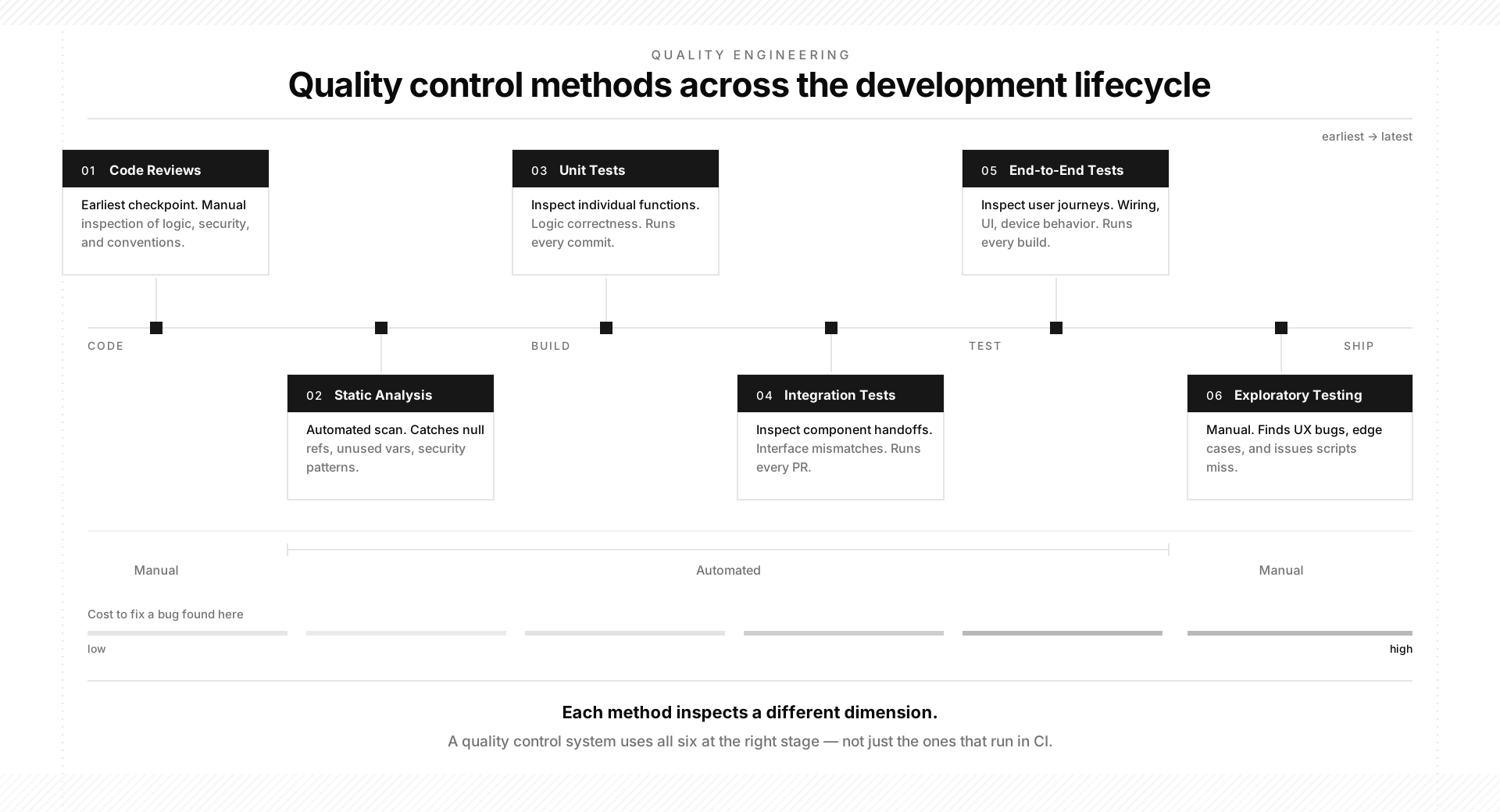
Code reviews are the earliest quality control checkpoint in most organizations. A developer reads another developer's code before it merges. It catches logical errors, security issues, and deviations from conventions. The inspection is manual, the turnaround is measured in hours, and the coverage depends entirely on the reviewer's attention and expertise.
Static analysis automates part of that inspection. Tools scan the codebase for known patterns: unused variables, potential null references, security vulnerabilities, and style violations. It runs without executing the code and catches a class of defect that is easy to miss in manual review. Fast enough to run on every commit, which makes it a reliable first gate.
Automated testing is the highest-volume quality control method in modern software. Unit tests, integration tests, and end-to-end tests run on every pull request, sometimes hundreds or thousands of checks per build. A mature CI pipeline does not just run these tests. It blocks the merge if they fail, which turns automated testing from a reporting tool into an enforcement mechanism.
Smoke testing sits between "the build compiled" and "QA can start serious testing." A focused set of checks that verify the most critical paths still work after a new build. The checkout flow loads. The login succeeds. The home screen renders. If smoke tests fail, there is no point running the full suite because the build is fundamentally broken.
Manual exploratory testing is the quality control method most likely to find the bugs that scripts miss. A tester interacts with the application without following a predefined path, looking for unexpected behavior, confusing interactions, and edge cases that nobody thought to automate. It is slow, it does not scale, and it is irreplaceable for UX bugs and usability issues.
Performance monitoring catches the defects that do not trigger functional failures. The checkout flow works, but it takes 8 seconds on a budget phone. The home screen renders, but it consumes 400 MB of memory after 10 minutes of use.
These are quality control findings even though no test "failed" in the traditional sense. They affect the user experience, which means they affect quality.
The testing pyramid as a quality control framework
Martin Fowler's testing pyramid is usually discussed as a test strategy model. But it is also, and maybe more usefully, a quality control framework. Each layer inspects a different scope of the product, and together they give you coverage across the full range of defect types.
Unit tests sit at the base. They inspect individual functions and methods in isolation. Did this function return the right value for this input? They run in milliseconds, you can have thousands of them, and when one fails, you know exactly which function broke. Unit tests are the quality control layer for logic correctness.
Integration tests sit in the middle. They inspect how components interact when connected. The function works perfectly in isolation, but the checkout page passes the price as a string while the payment service expects a number.
The unit test passed because the function did its job. The integration test fails because the handoff is broken. This is the quality control layer for interface correctness.
End-to-end tests sit at the top. They inspect complete user journeys through the real application. A user signs in, searches for a product, adds it to the cart, and checks out.
Every individual function and integration point might work correctly, but the full flow breaks because a state management bug drops the cart contents between screens. End-to-end tests are the quality control layer closest to the actual user experience.
Most teams under-invest in the top of the pyramid because end-to-end tests are harder to write, slower to run, and more fragile to maintain. But the defects they catch are the ones users actually encounter. A logic error in a utility function is a bug. A broken checkout flow is a revenue event.
Quality control on mobile: where the gaps are widest
This is where quality control gets meaningfully harder, because the number of variables multiplies in ways that web testing does not have to deal with.
A web application runs in a browser. Browsers are standardized rendering engines. Quality control means testing across a handful of browser and OS combinations, and tools like Selenium or Playwright handle that well.
Mobile is a different situation entirely. Over 24,000 Android device models exist in the wild, each running a manufacturer-modified version of the OS that changes how the phone handles background processes, notifications, battery, and permissions.
Samsung One UI, Xiaomi MIUI, Huawei EMUI, OnePlus OxygenOS. These are not cosmetic skins. They modify system-level behavior in ways that directly affect app reliability. An app that passes every quality control check on a stock Android emulator can crash on a Samsung Galaxy because One UI kills background services on a more aggressive schedule.
A push notification that arrives instantly in testing never reaches the user on a Xiaomi device because MIUI's battery optimization blocked it. These are not edge cases. Samsung alone holds roughly 20% of global Android market share.
Mobile app testing on real devices is the quality control method that covers this gap. Emulators run stock Android. Simulators approximate iOS without real hardware. Neither reproduces the OEM-specific behavior, hardware sensor fidelity, touch input latency, or memory constraints that cause the bugs users actually report.
Performance is the other blind spot. A quality control check that runs on a server-grade machine with 64 GB of RAM tells you nothing about how the app behaves on a budget phone with 4 GB. Memory leaks, rendering stutters, and app-not-responding events only manifest under real resource constraints.
If your quality control process cannot measure performance on actual target hardware, it has a gap in its coverage that matters.
How Autosana fits into a quality control process
Quality control needs inspection. Inspection needs testing. And testing needs to run consistently, on the right devices, without someone remembering to start it.
Autosana automates the end-to-end inspection layer. We run test flows on real iOS and Android devices as natural-language instructions that describe user journeys. The agent opens the app, navigates by intent, and verifies that the product meets the standard. When a defect surfaces, the issues system documents it with session replay, screenshots, and context from the run.
The quality control loop closes without manual intervention. Automations trigger suites on every new build and on a recurring schedule. Results post back to the PR with video replay. The team sees what failed, fixes it, and the next build gets re-inspected automatically. That is quality control that runs as a system, not as a task someone has to remember.
Conclusion
Quality control in software is not a complicated idea. Inspect the build. Compare it against what it should do. Catch defects before users do.
The challenge is doing it consistently, at every layer, across every device that matters. Most teams have the lower layers covered: unit tests, integration tests, code reviews, CI pipelines.
Where quality control breaks down is at the top of the pyramid. The end-to-end inspection on real devices, the layer that catches wiring failures, OEM behavior, and performance under real constraints. Close that gap, and quality control stops being something that mostly works and becomes a system that actually catches what matters.
.png)
FAQ
What is quality control in software?
Quality control in software is the process of inspecting a build against predefined standards to find and fix defects before it ships. It includes running automated and manual tests, reviewing results, documenting bugs, verifying fixes, and feeding findings back into the development process to prevent recurrence.
What is the difference between quality control and quality assurance?
Quality assurance is proactive and process-focused: it designs practices that prevent defects from being introduced. Quality control is reactive and product-focused: it inspects the build to detect defects that made it through. QA improves how you build. QC checks what you built. Both are parts of quality management.
What is quality management?
Quality management is the umbrella that covers quality planning, quality assurance, quality control, and quality improvement. It spans the full lifecycle: setting standards, designing processes to meet them, inspecting products against them, and continuously improving based on what the inspection reveals.
What are the main quality control methods in software?
Code reviews, static analysis, automated testing (unit, integration, end-to-end), manual exploratory testing, smoke testing, and performance monitoring. Each inspects a different dimension of the product. A complete quality control process uses several of these at different stages of the development cycle.
How does quality control relate to the testing pyramid?
The testing pyramid is a quality control framework. Unit tests inspect individual functions. Integration tests inspect how components interact. End-to-end tests inspect complete user journeys. Each layer catches a different class of defect, and skipping any layer leaves a gap in your quality control coverage.
Why is quality control harder on mobile?
Device fragmentation, OEM-specific OS modifications, hardware-dependent features, performance variance across phone tiers, and touch input fidelity. A quality control process that only tests on emulators or a single device model misses the defects that surface across the real-world device matrix, which is over 24,000 Android models alone.
What is ISO 9001 and how does it relate to quality control?
ISO 9001 is the international standard for quality management systems. It defines how organizations should plan, implement, and improve quality processes. Software teams rarely reference it by name, but its core principles, define standards, measure against them, improve continuously, describe exactly what a mature quality control practice does.
How often should quality control testing run?
Automated checks (unit tests, integration tests, smoke tests) should run on every commit. End-to-end tests on real devices should run on every build and on a recurring schedule. Manual exploratory testing should happen before releases, after major features, and after significant refactors. The goal is continuous inspection, not periodic spot checks.