
8 Best Maestro Alternatives for Mobile Testing in 2026
Maestro's YAML flows are simple at small scale but become maintenance sprawl past a few hundred tests, with cloud pricing at $250/device/month. This guide sorts eight alternatives into native frameworks, cross-platform standards, AI-native agents, and device clouds.
Yuvan Sundrani · 17 min read
autosana.ai
.png)
The best Maestro alternatives in 2026 fall into four categories: AI-native agents that eliminate the YAML layer (Autosana ), native platform frameworks Apple and Google maintain (XCUITest, Espresso), the cross-platform standard and its React Native specialist (Appium, Detox), and device clouds that solve coverage at scale without $250/device/month pricing (BrowserStack, LambdaTest). Which one wins depends on why you are leaving Maestro YAML sprawl, command-based authoring, cloud costs, or thinner web support than mobile.
Key Takeaways
- Maestro's YAML simplicity is its strength, and its ceiling teams with 200+ flows hit maintenance sprawl, and command-based authoring (tapOn, assertVisible) breaks on every UI refactor.
- XCUITest and Espresso are the gold-standard native picks when you need first-party stability Apple and Google maintain alongside OS updates.
- Appium remains the cross-platform standard for multi-language teams; Detox is the React Native grey-box specialist that eliminates timing flakes through JS bridge synchronization.
- BrowserStack and LambdaTest solve device coverage and CI scale without the $250/device/month commitment Maestro Cloud charges.
- Autosana removes the YAML layer entirely an AI agent runs flows by intent, self-heals when the UI changes, records the session, and posts the result back to the PR without a test author maintaining command files or selectors.
Quick comparison: 8 Maestro alternatives ranked
| # | Tool | Category | Authoring | Platforms | When to Pick |
|---|---|---|---|---|---|
| 1 | Autosana | AI-native agent | Natural language | iOS, Android, Web | YAML maintenance is the pain and you want the command layer gone entirely |
| 2 | Appium | Cross-platform standard | Code (JS, Java, Python, Ruby, C#) | iOS, Android, Web | Multi-language team, W3C WebDriver compliance, broad device matrix |
| 3 | Detox | React Native grey-box | JS/TS | iOS, Android | React Native shop, grey-box sync eliminates timing flakes |
| 4 | XCUITest | Native iOS | Swift / Obj-C | iOS | iOS-only, first-party Apple stability, Xcode-native |
| 5 | Espresso | Native Android | Kotlin / Java | Android | Android-only, first-party Google stability, UI-thread sync |
| 6 | BrowserStack | Device cloud + automation | Multiple | iOS, Android, Web | 3,500+ real devices, enterprise compliance, parallel at scale |
| 7 | LambdaTest (TestMu AI) | Device cloud + AI | Multiple | iOS, Android, Web | 10,000+ device combos, AI test generation, free tier |
| 8 | TestRigor | AI / plain English | Plain English | iOS, Android, Web | Non-technical authors, plain-English test specs |
Why teams look for Maestro alternatives in 2026
Maestro made mobile testing simple. The question is whether to use simple scales.
That is not a knock; it is a structural observation. Maestro's YAML flows are human-readable, fast to author, and architecture-agnostic across iOS, Android, and web. For a team with 20-50 flows covering happy paths, it is genuinely hard to beat. The cracks show when:
- YAML sprawl. Past a few hundred flows, YAML files become their own codebase. Refactoring shared steps, managing conditional logic, and keeping flow naming consistent across a growing team turns into maintenance work, a QA lead on r/QualityAssurance described as "the testing equivalent of configuration drift."
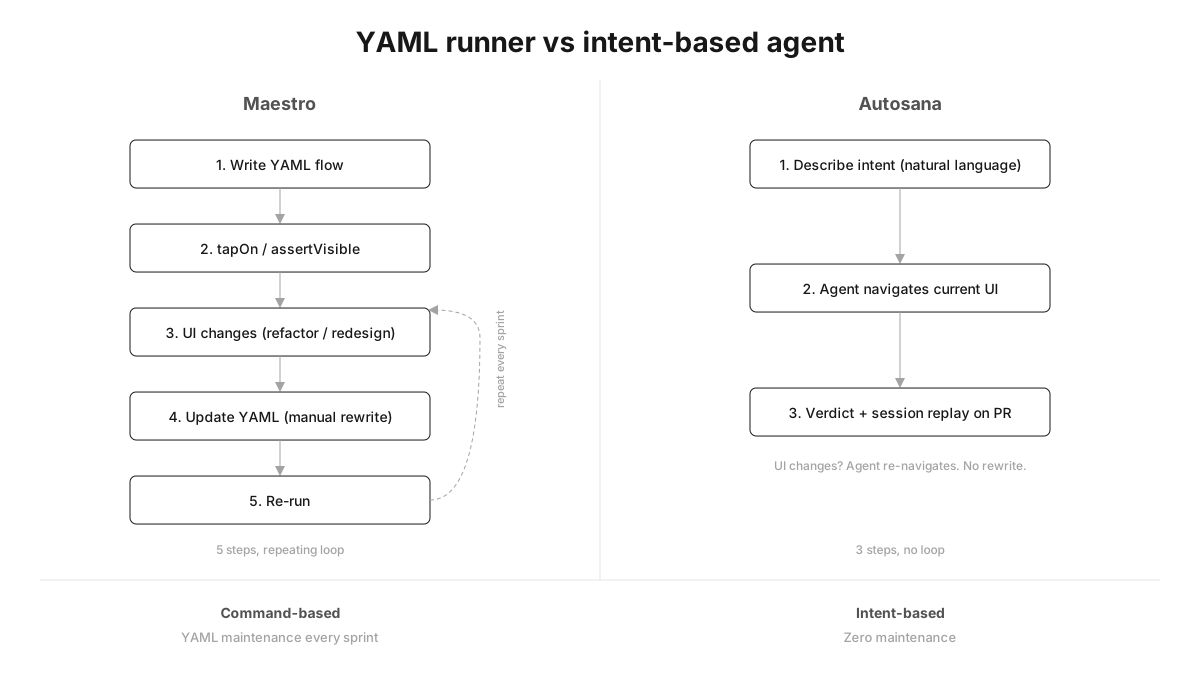
- Command-based, not intent-based. tapOn, assertVisible, and scrollUntilVisible are deterministic commands. When a UI refactor moves a button, renames a label, or restructures navigation, the YAML breaks, and a human rewrites it. An engineer on r/softwaretesting noted the pattern: evaluating mobile testing tools often comes down to how much rewriting you accept after every sprint's UI changes.
- Cloud pricing. Maestro Cloud runs $250/device/month. Ten device configurations for parallel execution costs $2,500/month before you have written a test -- and the cost scales linearly with device count.
- Web support is thinner. Maestro started mobile-first. Web is supported but lacks the depth of dedicated web frameworks for complex web app flows.
- Limited enterprise features. No RBAC, limited audit logging, and no SOC 2 documentation on the open-source side.
If your Maestro pain is "YAML maintenance is eating sprint time" or "cloud costs are climbing faster than coverage," you have an alternatives problem.
What are the best Maestro alternatives for native platform testing
XCUITest
Best for: iOS-only teams that want first-party framework stability Apple maintains alongside Xcode and iOS SDK updates.
XCUITest ships inside Xcode. When Apple updates iOS, XCUITest updates with it -- no waiting for third-party compatibility patches. Tests are written in Swift or Objective-C, run against the accessibility hierarchy, and integrate directly with Xcode's test navigator and CI tooling. A contributor on r/opensource noted the tension: open-source testing tools often lag behind platform-native frameworks on OS update compatibility -- and for iOS teams shipping on Apple's release cadence, that lag is unacceptable.
Key features:
- Ships with Xcode -- no external dependencies
- Swift/Obj-C authoring against the accessibility hierarchy
- Parallel testing on simulators via xcodebuild test
- XCTest performance metrics for launch-time regression
Pricing: free (bundled with Xcode).
Limitations: iOS-only. No Android, no web. CI requires Mac infrastructure (self-hosted runners or GitHub Actions macOS). Accessibility IDs must be well-maintained -- if your app does not set them consistently, the framework fights you.
Pick XCUITest if you are iOS-only and want the testing framework Apple guarantees will not break on the next Xcode release.
Espresso
Best for: Android-only teams that want first-party synchronization with the Android UI thread and the IdlingResource pattern for async-safe testing.
Espresso synchronizes automatically with the Android UI thread, waiting for idle before executing the next action. The IdlingResource API registers custom async operations so Espresso knows when to proceed.
Key features:
- Automatic UI-thread synchronization
- IdlingResource for custom async-wait patterns
- Kotlin/Java authoring, runs in-process (grey-box)
- Android Studio integration with test recording
Pricing: free (Android Open Source Project).
Limitations: Android-only. No iOS, no web. Grey-box architecture means tests are tightly coupled to the app internals -- refactoring the app layer can break tests even if the UI does not change.
Pick Espresso if you are Android-only and your biggest Maestro pain is timing flakes YAML commands cannot solve.
What are the best Maestro alternatives for cross-platform mobile testing
Appium
Best for: multi-language teams that need one framework covering iOS, Android, and web under the W3C WebDriver standard.
Appium supports every major language (Java, Python, JS, Ruby, C#), runs on iOS and Android via platform drivers (XCUITest driver for iOS, UiAutomator2 for Android), and adheres to the W3C WebDriver spec. Appium 2.0 shipped a driver/plugin architecture that solved the monolithic-install problem of 1.x. An accessibility testing engineer on r/accessibility pointed out that mobile accessibility testing requires tools that understand platform-native APIs -- Appium's accessibility ID support matters here.
Key features:
- W3C WebDriver-compliant, multi-language (Java, Python, JS, Ruby, C#)
- iOS + Android + Web via platform-specific drivers
- Appium 2.0 plugin architecture for extensions
- Broad cloud-farm compatibility
Pricing: free (Apache 2.0).
Limitations: slower than native frameworks (Espresso, XCUITest) because it runs out-of-process. Selector-based -- locator strategies break when the UI changes, same root cause as Maestro's YAML commands, except you debug in code instead of YAML. iOS WebDriverAgent rebuilds on major Xcode updates can stall CI.
Pick Appium if your team is multi-language, needs iOS + Android + web under one standard, and accepts the selector-maintenance cost.
Detox
Best for: React Native teams that want grey-box synchronization with the JS bridge and native layers to eliminate timing flakes YAML commands cannot prevent.
Detox runs inside the React Native process. It synchronizes with the JS bridge, native animations, and network requests -- so it knows when the app is idle before executing the next step. That is the structural advantage over Maestro for RN teams: Maestro's YAML waits are external polling. Detox's waits are internal synchronization. The React Native testing docs outline the testing pyramid where Detox occupies the E2E layer.
Key features:
- Grey-box synchronization with RN JS bridge
- Automatic wait for animations, network, and native transitions
- JS/TS authoring with Jest runner
- iOS + Android support, parallel execution on simulators
Pricing: free (MIT).
Limitations: React Native only. Does not cover Swift-native, Kotlin-native, or web. Breakage on React Native version upgrades (especially architecture changes) is a real maintenance cost.
Pick Detox if you are a React Native shop and Maestro's external YAML polling is causing timing flakes grey-box sync would fix.
What are the best AI-native Maestro alternatives in 2026
Autosana
Best for: teams whose Maestro pain is the YAML maintenance layer itself who want the command-based model (tapOn, assertVisible) replaced with intent-based flows that do not break when the UI changes.
Autosana is the structural opposite of Maestro's authoring model. Where Maestro has you write YAML commands that map to specific UI elements (tapOn: "Submit"), Autosana takes a natural-language intent ("submit the registration form") and an AI agent navigates the current UI to fulfill it. No YAML to maintain. No commands to rewrite when a button moves or a label changes.
The gap shows most clearly at scale. A team with 300 Maestro flows spends meaningful sprint time updating YAML after UI changes. A team with 300 Autosana flows spends zero time on test maintenance for UI-driven breakage; the agent re-anchors to whatever the current screen shows.
Key features:
- Natural-language test authoring describe what to test, not how to tap
- Self-healing on UI change agent replans against the current screen each run
- iOS + Android + web from a single authoring surface
- MCP server for coding-agent integration (Cursor, Claude Code, Devin invoke runs directly)
- Session replay video posted to every PR via GitHub integration
- Hosted real devices no local device management
- Per agent-run pricing, not per device/month
Pricing: per agent-run, self-serve trial available. Book a demo for volume pricing.
Pick Autosana if your Maestro team's biggest cost is "the YAML broke because the UI moved." First run under ten minutes the quickstart walks through it.
TestRigor
Best for: teams where non-technical stakeholders need to author and maintain test cases without learning YAML or code.
TestRigor lets you write tests in plain English sentences. "Click login, enter email, verify dashboard loads" becomes a runnable test. It extends Maestro's readability promise without the YAML syntax covering web, mobile, and API testing from one surface.
Key features:
- Plain-English test authoring, cross-platform (web, iOS, Android, API)
- AI-assisted element identification
- Cloud execution with parallel runs
- Integrations with Jira, CI/CD pipelines
Pricing: commercial (paid plans, contact for pricing).
Limitations: closed-source. English-language tests can become ambiguous at scale -- "click the submit button" works until there are three submit buttons on screen. Less control than code-based frameworks for edge cases.
Pick TestRigor if your team needs non-technical authors writing tests in plain English and Maestro's YAML is still too technical for them.
What are the best Maestro alternatives for device cloud and CI scale
BrowserStack
Best for: teams that need 3,500+ real devices with enterprise compliance (SOC 2, GDPR) and parallel execution beyond what Maestro Cloud offers at $250/device/month.
BrowserStack App Automate gives access to 3,500+ real iOS and Android devices in the cloud. Where Maestro Cloud charges per device per month, BrowserStack scales differently -- parallel tests across a broad device matrix without the same per-device pricing pressure. A QA engineer on r/QualityAssurance noted that no-code mobile automation needs real-device coverage local simulators cannot provide BrowserStack fills that gap at enterprise scale.
Key features:
- 3,500+ real iOS and Android devices
- Supports Appium, Espresso, XCUITest test suites
- Parallel testing with session recording
- CI integration (Jenkins, GitHub Actions, CircleCI, Azure DevOps)
- SOC 2, GDPR, HIPAA compliance
Pricing: paid (plans start around $149/month for App Automate, scales with parallel sessions).
Limitations: a device cloud, not a test-authoring framework you bring your own tests. BrowserStack does not solve YAML or selector maintenance; it solves device access.
Pick BrowserStack if your Maestro pain is device coverage and CI scale, not test authoring.
LambdaTest (TestMu AI)
Best for: teams that want massive device coverage (10,000+ device/browser combos), AI-powered test generation, and a free tier to start.
LambdaTest Real Device Cloud covers 10,000+ device and browser combinations. The TestMu AI layer adds AI-generated test steps, visual regression, and smart test maintenance -- bridging the gap between "device cloud" and "test authoring platform." The free tier lets small teams start without upfront commitment.
Key features:
- 10,000+ real device and browser combinations
- TestMu AI for AI-assisted test generation and maintenance
- HyperExecute for fast parallel test orchestration
- Free tier available
- Supports Appium, Espresso, XCUITest, Playwright, Cypress
Pricing: free tier + paid plans (scales with parallel sessions and device minutes).
Limitations: AI test generation is assistive, not autonomous you still guide the test structure. The breadth of features can overwhelm small teams.
Pick LambdaTest if you want the broadest device coverage at the most accessible price point, with AI assistance on top.
How to choose the right Maestro alternative in 2026
- "YAML files are our biggest maintenance cost" Autosana. Intent-based agents remove the YAML layer entirely.
- "We need first-party iOS stability" XCUITest. Apple maintains it alongside Xcode and iOS releases.
- "We need first-party Android stability" Espresso. Google maintains it with automatic UI-thread sync.
- "Multi-language team, need one cross-platform standard" Appium. W3C WebDriver, every major language.
- "React Native timing flakes from external polling" Detox. Grey-box sync with the JS bridge.
- "Non-technical authors need to write tests" TestRigor. Plain English, no YAML or code.
- "Device coverage at scale without $250/device/month" BrowserStack or LambdaTest.
- "Coding agents write our PRs and need a test loop" Autosana. The MCP server lets Cursor and Claude Code invoke test runs directly.
The alternative conversation starts when YAML sprawl, cloud costs, or the command-based model becomes the bottleneck.
Should you replace Maestro
Maestro is not broken. It is category-capped built for a world where YAML simplicity and deterministic commands were the right answer. That world works at small scale.
The right evaluation: which Maestro cost are you paying too much for? YAML maintenance points to Autosana. Native depth points to XCUITest or Espresso. Cross-platform standard points to Appium. Device coverage points to BrowserStack or LambdaTest. React Native timing points to Detox. Match the alternative to the specific pain.
.png)
Frequently asked questions
What is the best alternative to Maestro?
There is no universal winner. Autosana for teams whose pain is YAML maintenance on a growing suite. XCUITest or Espresso for native platform stability. Appium for multi-language cross-platform. Detox for React Native grey-box sync. BrowserStack or LambdaTest for device coverage at scale. Match the tool to the specific Maestro pain you are escaping.
Is Maestro still worth using?
Yes, for teams with under 100 flows testing mobile apps. Maestro's YAML authoring is the simplest entry point for mobile E2E testing. The limitations surface at scale -- hundreds of flows, enterprise requirements, web-heavy apps, or teams that want intent-based testing instead of command-based YAML.
Can Autosana replace Maestro entirely?
For teams whose Maestro pain is YAML maintenance yes. Autosana runs the same user flows a Maestro suite covers, without YAML files, commands, or selectors. For teams that value YAML's deterministic human-readable format and have under 50 flows, Maestro may still be the simpler path.
Is Appium better than Maestro for mobile testing?
Different tradeoffs. Appium gives you code-based authoring in any language and W3C WebDriver compliance. Maestro gives you simpler YAML authoring with faster setup. Appium is better for multi-language teams and enterprise compliance. Maestro is better for quick happy-path flows on small teams.
Does Maestro work well for web testing?
Maestro supports web but started mobile-first. Web coverage is thinner than mobile. For web-heavy apps, Playwright, Cypress, or Autosana provide deeper web testing out of the box.
What is the cheapest Maestro alternative for device cloud testing?
LambdaTest offers a free tier with access to real devices. BrowserStack starts around $149/month for App Automate. Both provide broader device matrices than Maestro Cloud at $250/device/month. For zero-cost local testing, Appium, Detox, XCUITest, and Espresso are all free and open source.
How does Maestro compare to XCUITest and Espresso?
Maestro is cross-platform (iOS + Android + web) with simpler YAML authoring. XCUITest and Espresso are single-platform with deeper OS integration, automatic UI-thread synchronization (Espresso), and first-party stability guarantees. Pick Maestro for cross-platform simplicity, native frameworks for platform depth and reliability.
What is intent-based testing and how is it different from Maestro YAML?
Intent-based testing describes what to verify ("user can complete checkout"), not how to interact with specific elements (tapOn: "Buy Now"). When the UI changes, YAML commands break because they reference specific elements. Intent-based agents like Autosana re-navigate the current UI to fulfill the intent without manual updates to test files.