
8 Best BrowserStack Alternatives for Cross-Browser Testing in 2026
BrowserStack bundles 30+ SKUs but most teams use only three to five. This guide maps which alternative replaces which product: Playwright and Cypress for web automation, Autosana for Appium-free mobile testing, LambdaTest and Sauce Labs for full-platform migrations.
Yuvan Sundrani · 17 min read
autosana.ai
.png)
The best BrowserStack alternatives in 2026 depend on which of BrowserStack's 30+ SKUs your team actually uses. Most teams run three to five products, then pay for the rest. Playwright and Cypress replace Automate for web E2E at zero license cost. Autosana replaces App Automate with intent-based flows and no Appium. LambdaTest and Sauce Labs match the full-platform breadth. Mabl and TestRigor fill the Low-Code Automation gap. This guide maps each alternative to the specific BrowserStack product line it replaces.
Key Takeaways
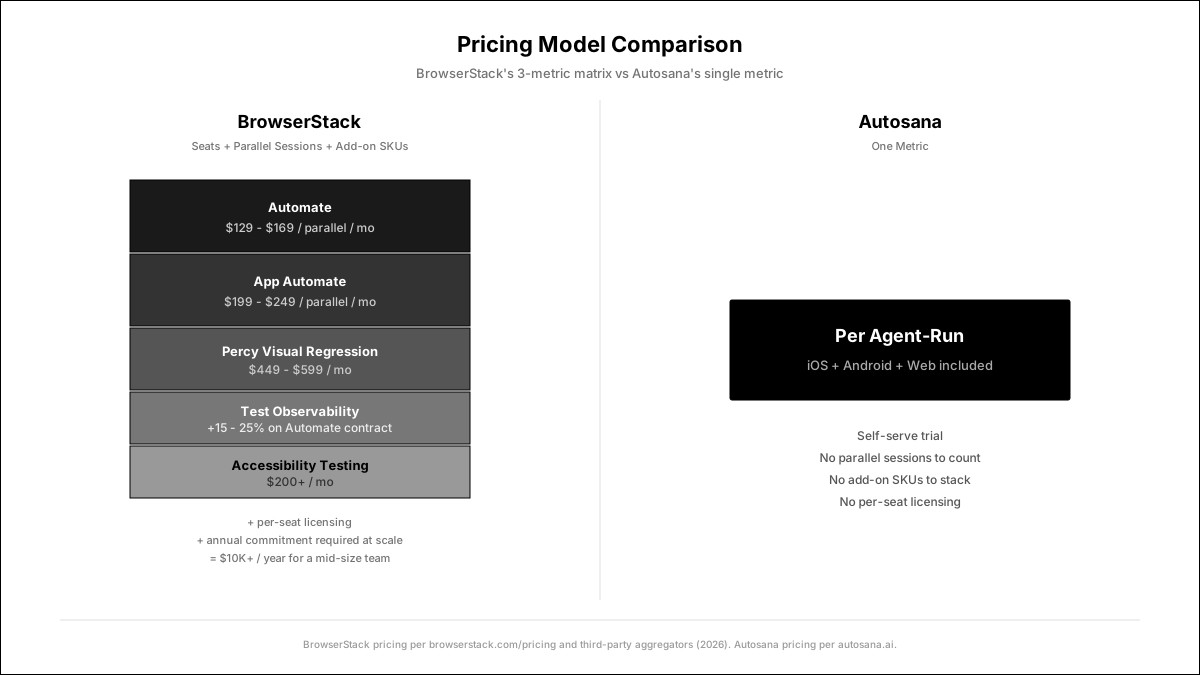
- BrowserStack's 30+ SKU catalog means most teams pay for products they never open, with per-parallel pricing scaling past $10K/year once you stack Automate ($169/parallel/mo), App Automate ($249/parallel/mo), Percy ($449+/mo), and Test Observability (+15-25%).
- Playwright and Cypress replace BrowserStack Automate for web E2E at zero license cost, with auto-waiting and native parallel execution built in.
- LambdaTest (now TestMu AI) and Sauce Labs match BrowserStack's full-platform breadth while bundling AI features like KaneAI and AURA instead of billing them as separate add-ons.
- TestRigor and Mabl cover the codeless testing gap for teams that used BrowserStack's Low-Code Automation but want plain-English or visual-builder alternatives with self-healing included.
- Autosana replaces the App Automate and Automate slice with a single AI agent that runs by intent, self-heals on every run, and ships an MCP server that closes the loop with coding agents on every PR.
How do the best BrowserStack alternatives compare in 2026
| Tool | Category | Replaces BrowserStack… | Pricing | Best For |
|---|---|---|---|---|
| Autosana | AI-native agent | Automate + App Automate | Per agent-run, self-serve trial | Intent-based web + iOS + Android testing without scripts |
| LambdaTest (TestMu AI) | Full testing cloud + AI | Full platform (14+ products) | From $15/mo; Enterprise custom | BrowserStack-scale breadth with KaneAI bundled |
| Sauce Labs | Full testing cloud | Full platform | From $49/mo; Enterprise custom | 10,000+ real devices, AURA AI, enterprise compliance |
| Playwright | OSS web framework | Automate | Free (Apache 2.0) | Code-first teams, 5 languages, auto-waiting |
| Cypress | OSS frontend framework | Automate | Free (MIT) + Cloud paid | JS/TS teams, time-travel debugging, SPA testing |
| Kobiton | Mobile device cloud | App Automate + App Live | Enterprise pricing, free trial | 7,000+ real devices, on-prem lab option |
| Mabl | Low-code AI testing | Low-Code Automation | Commercial (contact sales) | Non-technical QA, ML-based self-healing selectors |
| TestRigor | Plain-English testing | Low-Code Automation | From $300/mo | Tests authored in plain English, zero selectors |
Why are teams looking for BrowserStack alternatives in 2026
BrowserStack bills itself as "the most reliable app and cross-browser testing platform" with 3,500+ browser/OS combinations, 2,000+ real devices, and customers including Google, Microsoft, Amazon, and Zoom. The product is polished. The 2026 problem is the bill, and the 30-SKU catalog that generates it.
BrowserStack's pricing runs on three metrics: user seats, parallel execution sessions, and modular add-ons. Automate costs roughly $129-$169 per parallel session per month. App Automate runs $199-$249 per parallel per month. Percy visual regression adds $449-$599/month. Test Observability layers another 15-25% on top of your Automate contract. Accessibility Testing starts at $200+/month as a separate product. A mid-size team stacking four or five SKUs clears $10K/year before touching half the platform surface.
A QA lead on r/QualityAssurance pinpointed the ongoing concern in a thread titled "Cheaper (but still good) Browserstack alternatives" that has stayed active for years: the per-parallel math at scale is the recurring pain, even when the product itself is solid.
The 2026 AI push adds surface without simplifying the bill. Low-Code Automation ships AI agents that generate test scripts from natural-language prompts. Test Observability claims 75% failure-triage-time reduction. Percy AI handles visual regression. But these features live in separate SKUs with separate pricing. MCP, Claude, and Cursor appear on BrowserStack's integrations page, but the dedicated MCP documentation URL returns 404 as of this writing.
A small web team on r/webdevelopment described the practical side: the switching cost feels high until you map your actual SKU usage and realize you are funding a 30-product platform to solve a three-tool problem.
The contrarian reframe: most teams do not need to replace BrowserStack. They need to stop paying for 30 SKUs when their team uses three.
What are the best alternatives to BrowserStack App Automate for mobile testing
BrowserStack App Automate runs Appium, Espresso, or XCTest scripts on 2,000+ real iOS and Android devices. Teams replacing it either want a different device cloud or a fundamentally different testing model.
A commenter on r/QualityAssurance put the trade directly: "BrowserStack is the best tool for device automation if you don't want to use your own devices." The device infrastructure is the strength. The question is whether you also need to bring Appium scripts to it.
Autosana
Best for: teams whose App Automate pain is maintaining Appium scripts across iOS and Android releases, not the device infrastructure itself.
Autosana is an AI-native E2E testing agent for iOS, Android, and web. Describe a flow in natural language. The agent opens the app, navigates by intent, and confirms the outcome. No Appium. No selectors. No capability tuning. When the UI changes between OS versions or after a refactor, the agent re-plans against the current screen rather than breaking on a stale locator. That single mechanism is what separates Autosana structurally from BrowserStack's Automate and App Automate products: it runs by intent rather than by pinned selector.
Autosana ships hosted real device testing included with the trial. The MCP server lets coding agents (Cursor, Claude Code, Devin) invoke a test run end-to-end on a PR. Session replay posts video and verdict back to the PR via GitHub integration, closing the loop between the coding agent that wrote the PR and the testing agent that validates it.
Pricing: per agent-run. Self-serve trial. Book a demo for volume pricing.
Pick Autosana if your App Automate cost is mostly Appium script maintenance, not device breadth. First run is under ten minutes via the quickstart.
Kobiton
Best for: mobile-first teams that need a large real device cloud with on-prem options, without paying for BrowserStack's web testing SKU overhead.
Kobiton focuses on mobile testing with access to 7,000+ real iOS and Android devices, including on-prem lab management for compliance-heavy teams. Scriptless automation and AI-driven self-healing sit alongside standard Appium integration for teams that want both. The device catalog is the value proposition, not the test authoring model.
Pricing: enterprise pricing with a free trial. Contact sales for quotes.
Limitations: web testing is secondary to the mobile device cloud. Pricing is opaque until you engage sales. Smaller ecosystem of integrations and community compared to BrowserStack.
Pick Kobiton if your BrowserStack usage is almost entirely App Automate and App Live, and you want a mobile-specialized vendor with on-prem device lab options.
What are the best alternatives to BrowserStack Automate for web testing
If your BrowserStack spend is concentrated on Automate (running Selenium, Playwright, or Cypress scripts on BrowserStack's cloud grid), the free alternatives below replace that slice without a per-parallel license.
Playwright
Best for: code-first teams that want auto-waiting, cross-browser coverage (Chromium + Firefox + WebKit), and native parallelism at zero cost.
Playwright connects to browser internals via the DevTools protocol rather than the HTTP WebDriver path. Five language bindings (JS/TS, Python, Java, C#, .NET). Auto-waiting for elements to be visible, stable, and enabled. Built-in test runner with sharding, network interception, and a codegen recorder that turns interactions into runnable test code.
Pricing: free (Apache 2.0). No paid tier for the core framework.
Limitations: no native mobile testing (viewport emulation only). Still selector-based at the core, so renamed components require manual locator updates. Community depth is newer than Selenium's Stack Overflow archive.
Pick Playwright if you want the most direct BrowserStack Automate replacement at zero license cost, with better mechanics than raw Selenium.
Cypress
Best for: JS/TS frontend teams building SPAs where time-travel debugging and a tight local developer feedback loop matter more than polyglot language support.
Cypress runs inside the browser's event loop, which unlocks DOM snapshots at every step and automatic waiting for XHR/fetch completion. Strong plugin ecosystem including cypress-axe for accessibility scanning and cypress-testing-library for component-level queries.
Pricing: free (MIT). Cypress Cloud for parallel execution and dashboards is paid.
Limitations: JS/TS only. Cannot automate cross-tab or cross-origin flows cleanly. WebKit/Safari desktop coverage is limited. Parallel execution requires the paid Cypress Cloud tier.
Pick Cypress if your team is 100% JavaScript, testing single-origin apps, and values time-travel debugging during local development.
What replaces the full BrowserStack testing cloud
Some teams use BrowserStack across the board: Live, Automate, App Automate, Percy, Test Observability, maybe Accessibility. For those teams, only full-platform alternatives provide a clean one-vendor migration path.
LambdaTest (TestMu AI)
Best for: teams that want BrowserStack-scale device and browser breadth with AI features bundled rather than billed as add-ons.
LambdaTest, now rebranding under TestMu AI, matches BrowserStack's catalog with 14+ products including KaneAI (natural-language test generation), HyperExecute (high-speed cloud grid), and a real device cloud. A user on r/QualityAssurance noted that LambdaTest surfaces regularly as the go-to BrowserStack alternative, particularly on price. Generally 20-30% below BrowserStack's published rates at comparable parallel counts.
Pricing: starts at $15/month for Live. Automation scales per parallel session. Enterprise custom.
Limitations: KaneAI is newer than BrowserStack's Low-Code Automation ecosystem. Some enterprise features (SSO, dedicated support) require higher tiers. Ecosystem maturity still catching up in niche areas.
Pick LambdaTest if you want the closest one-for-one BrowserStack replacement at a lower per-parallel price, with AI test generation bundled.
Sauce Labs
Best for: enterprise teams that need the largest real device cloud (10,000+ devices), established compliance certifications, and AI-assisted failure analysis at scale.
Sauce Labs runs over 10,000 real and virtual devices with AURA AI for root-cause analysis and automated test fixing. Long enterprise track record with SOC 2 and ISO certifications. Deep integrations with Jenkins, GitHub Actions, and GitLab CI.
Pricing: from $49/month for the starter tier. Enterprise custom pricing at higher volumes.
Limitations: pricing at enterprise scale is comparable to BrowserStack, not meaningfully cheaper. The UI has historically lagged behind BrowserStack's polish. Visual testing is less mature than Percy.
Pick Sauce Labs if you need the largest device matrix available, enterprise compliance certifications, and AURA AI for failure analysis across a large QA org.
What are the best AI-assisted alternatives to BrowserStack Low-Code Automation
BrowserStack's Low-Code Automation ships an AI recorder that translates natural-language prompts into executable test scripts with AI self-healing for locator flakiness. Teams that adopted it for codeless testing have dedicated alternatives in the low-code and plain-English categories.
Mabl
Best for: enterprise QA teams where non-technical stakeholders author tests and ML-based self-healing on cosmetic UI changes is a hard requirement.
Mabl is a commercial low-code platform with a visual test builder, ML-based selector healing, and a cloud-managed grid for cross-browser execution. When a class name changes or a layout shifts, Mabl's heuristic re-identifies the element by behavioral properties rather than the literal locator. Reporting dashboards and CI integrations round out the enterprise surface.
A tester on r/accessibility described the add-on frustration with BrowserStack alternatives: accessibility testing runs as a separate BrowserStack SKU at $200+/month, while platforms like Mabl bundle accessibility checks into the core product.
Pricing: commercial, contact sales. Enterprise-priced.
Limitations: closed-source. Self-healing is heuristic, not intent-based, so deep component refactors still break tests. Cost curve rises with test volume.
Pick Mabl if you want a low-code platform where non-engineers author and maintain tests with ML-assisted self-healing baked in.
TestRigor
Best for: teams that want to write and maintain tests in plain English, with zero selector knowledge required from anyone on the team.
TestRigor lets you author tests as plain-English sentences ("click Login, enter email, verify dashboard loads"). The platform translates to execution under the hood. For teams whose BrowserStack Low-Code Automation pain is that the recorder still generates scripts requiring technical review, TestRigor removes that intermediate step entirely.
Pricing: from $300/month. Enterprise tiers available.
Limitations: plain-English abstraction limits control over edge-case scenarios. Complex conditional logic is harder to express than in code. Smaller community footprint than Playwright or Cypress.
Pick TestRigor if your testing bottleneck is that only engineers can write and maintain tests, and you want plain English as the authoring surface.
How do you decide which BrowserStack product to keep and which to replace
The honest answer: most teams should not replace all of BrowserStack. They should audit which three to five SKUs they actually use and find the right-shaped tool for each slice. That is the real alternative to BrowserStack in 2026: not a single replacement product, but the right three.
- Using only Automate for web E2E? Playwright or Cypress replaces it at zero cost. You were paying for a cloud grid you may not need if your CI runs browsers natively.
- Using only App Automate for mobile? Autosana replaces the Appium-script-on-cloud pattern with intent-based agent runs. Kobiton replaces the device cloud specifically.
- Using Automate + App Automate + Percy + Test Observability? LambdaTest or Sauce Labs is the full-platform migration. You swap one vendor for another with AI features bundled rather than billed as add-ons.
- Using Low-Code Automation for codeless? Mabl or TestRigor replaces the recorder-plus-AI-heal workflow, depending on whether you want visual low-code or plain-English authoring.
- Using Custom Device Lab (on-prem)? Keep BrowserStack or migrate to Kobiton. Most alternatives are public-cloud-only.
- Using Percy for visual regression? Percy is hard to replace cleanly. Applitools is the direct competitor. This may be the one BrowserStack SKU worth keeping.
Start with your last 90 days of BrowserStack usage data. Sort by SKU. The products with zero runs are the ones you stop paying for tomorrow.
What is the best BrowserStack alternative in 2026
There is no universal best. BrowserStack is a 30-SKU platform where most teams use three to five products. The right alternative depends on which slice you are actually replacing.
If the pain is web automation cost, Playwright and Cypress are free and stronger. If the pain is Appium script maintenance on mobile, Autosana removes the script entirely. If you need one vendor to replace the whole platform, LambdaTest or Sauce Labs matches the breadth at lower or comparable cost. If the pain is that only engineers can write tests, Mabl and TestRigor cover codeless authoring.
The bigger 2026 shift is testing bifurcating between infrastructure vendors that keep adding AI features on top and agent products that build AI into the runtime itself. BrowserStack is firmly in the first category. Autosana is in the second. Both are legitimate shapes. Pick by which one fits your team's actual testing bottleneck, not by which one has more products in the catalog.
.png)
Frequently asked questions
Is BrowserStack worth the price in 2026?
For teams using five or more SKUs at scale, BrowserStack's bundled platform saves integration overhead. For teams using two to three products, the per-parallel pricing often exceeds the cost of purpose-built alternatives. Audit your actual SKU usage before renewing.
What is the cheapest BrowserStack alternative for web testing?
Playwright and Cypress are both free and open source. If you only use BrowserStack Automate for web E2E, either framework replaces it at zero license cost with your own CI providing the compute.
Can you replace BrowserStack App Automate without Appium?
Yes. Autosana runs iOS and Android tests by intent without Appium scripts or selectors. TestRigor runs mobile tests in plain English. Both eliminate the Appium maintenance layer that App Automate requires.
Does LambdaTest have all the same products as BrowserStack?
LambdaTest (TestMu AI) covers 14+ products including live testing, automation, real devices, visual regression, and KaneAI for AI-native test generation. Niche SKUs like Test Companion and Requestly are not matched, but core testing workflows are covered.
What BrowserStack product is hardest to replace?
Percy for visual regression and Custom Device Lab for on-premise device access. Both serve narrow use cases where few alternatives offer direct feature parity. Teams often keep these SKUs active while replacing Automate and App Automate with purpose-built tools.
Is Sauce Labs better than BrowserStack?
Sauce Labs offers a larger device matrix (10,000+ vs 2,000+), AURA AI for failure analysis, and strong compliance certifications. BrowserStack offers broader SKU coverage (30+), more polished UX, and Percy for visual regression. Neither is universally better. Pick by device count vs product breadth.
Can Autosana replace BrowserStack for mobile and web?
Autosana covers iOS, Android, and web E2E flows with hosted real device testing, MCP integration, and session replay on every PR. It does not target Percy visual regression, Custom Device Lab on-prem, or BrowserStack's 3,500-browser matrix for legacy coverage.
How long does it take to migrate from BrowserStack to an alternative?
For a mid-size suite (200-400 tests), plan one quarter: two sprints evaluating the new tool in parallel, one sprint migrating critical flows, two sprints on regression coverage, one sprint decommissioning the overlapping BrowserStack scope.