7 Best Appium Alternatives in 2026 (Compared and Ranked for Mobile E2E Teams)
Ranks 7 Appium alternatives for teams tired of selector churn and the SDET maintenance tax. Autosana leads as the AI-native pick, followed by Maestro, Detox, Espresso, XCUITest, Patrol, and WebdriverIO + Appium 2.0. Includes a stack-based decision tree and a 6-step migration playbook.
YS
Yuvan Sundrani · 19 min read
autosana.ai
Key Takeaways
Autosana is an agent runs your app by intent (not selectors), self-heals when UI changes, and closes the loop with coding agents.
The Reddit consensus in 2026 is unambiguous: teams leaving Appium want selector maintenance cost gone, not just a nicer UI on top of the same WebDriver stack.
Migrating a live Appium suite is a project, not a swap. Run a new parallel tool for one sprint, audit Tier A / B / C flows, and then decommission Appium on a set date.
Autosana handles this natively: an AI agent runs flow across iOS, Android, and web, self-heals on UI change, records session, and posts result back to PR without a test author touching selectors.
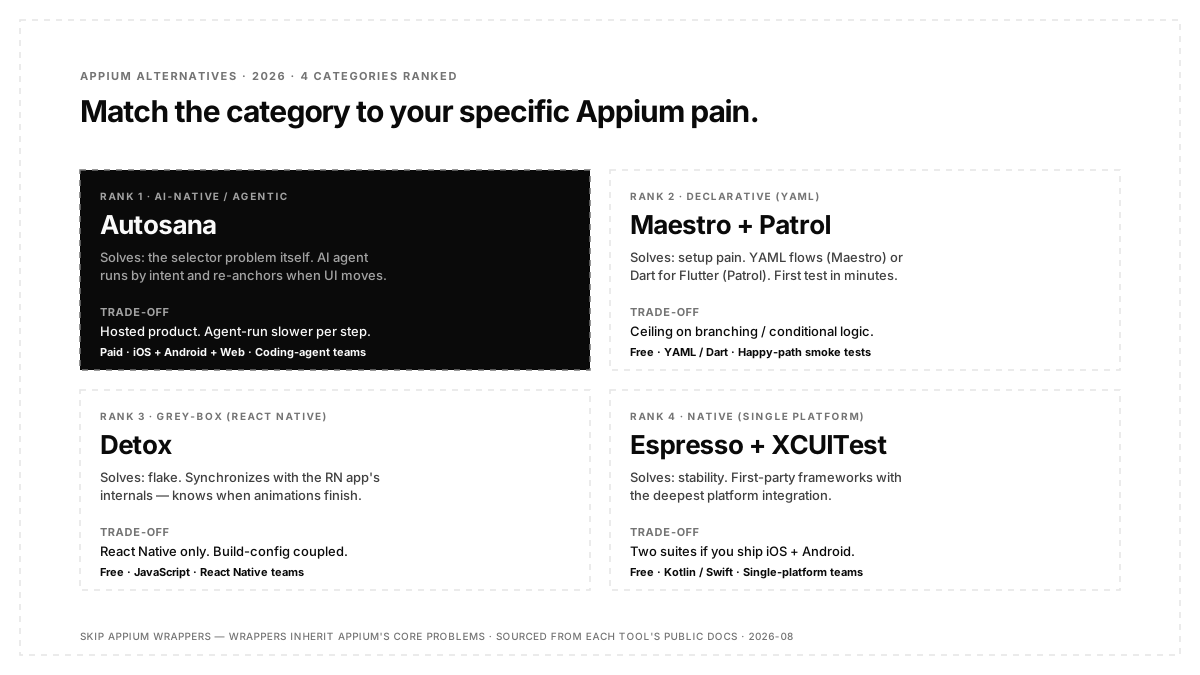
Quick comparison of 7 alternatives ranked
Rank
Tool
Category
Platforms
Pricing Plans
When to Pick
1
Autosana
AI-native / agentic
iOS + Android + Web
Paid
You ship weekly, coding agents write PRs, selector maintenance is the bottleneck
Before you pick a replacement, name the specific Appium pain you're trying to escape and answer the changes shortlist. From the r/softwaretestingr/softwaretesting thread started by an SDET this year: "Maintenance overhead is just absurd; every Android version bump requires selector rewrites, test runs take forever on CI, and half the team refuses to touch the suite because setup is so fragile." That's an honest pattern of five separate frustrations that different alternatives solve differently.
Selector rewrites on every Android version bump. OS updates shift the accessibility tree; every uiautomator, XPath, and testID reference has to be audited.
iOS Xcode / WebDriverAgent churn. Every major iOS release means a WebDriverAgent rebuild, capability re-tuning, and provisioning-profile management.
Setup fragility: Appium 2.0 helped, but bootstrapping a new engineer onto an existing suite is still a day-long yak shave.
CI runtime. Full suite runs stretch into hours; parallel execution is a paid-cloud problem (Sauce Labs, BrowserStack, Kobiton).
Test-author bottleneck. Coding agents open PRs multiple times a day; a human-written Appium script is now slow lane.
Sheer scale of maintenance. A Kobiton employee (with disclosed bias) in that same thread noted: "One customer has 10 out of their 64 SDETs dedicated to Appium script maintenance." That's 15% of an SDET headcount spent maintaining scripts, not building coverage.
1. Autosana
Best for: Mobile-first teams shipping weekly across iOS, Android, and web, especially those where Cursor or Claude Code are writing PRs and you need something to test them.
Autosana is a cloud-hosted AI agent that tests iOS, Android, and web apps way a real user would. You describe a flow in natural language or hand agent a code diff, and it opens your build, navigates by intent, and confirms outcome. There are no selectors to write, no locators to update, and no capability tuning. When UI changes, agent re-anchors to whatever button now says "Continue" instead of "Next." That single design decision running by intent rather than by pinned selector is what makes Autosana structurally different from every other alternative in this list.
Key features:
Natural-language test authoring; no code, no YAML
Self-healing on UI change: the agent replans against the current screen, not a stored selector
iOS + Android + Web parity from day one under a single test authoring surface
Cloud-hosted device layer: no WebDriverAgent, no capabilities, no provisioning
Session replay video posted to every PR
MCP server for coding-agent integration (Cursor / Claude Code can invoke a run)
Framework-agnostic: React Native (Old + New Architecture), Flutter, Swift, Kotlin, mobile web, desktop web
Pricing: On request via Book a Demo. The paid unit is agent-run, not per-seat, so the curve flattens as engineering headcount grows.
Pick Autosana if the selector-maintenance tax is what you're trying to escape, not just Appium's setup, but fundamental fact that every UI change breaks a locator somewhere. This is only alternative on list that solves that problem structurally rather than with a wrapper.
2. Maestro
Best for: Small teams that want happy-path smoke tests running in an afternoon, without a dedicated automation engineer.
Maestro is an open-source mobile testing framework by Mobile.dev. Instead of code, you write flows in YAML, one line per user action, one binary to install, iOS + Android from a single file. Setup that took Appium a full week takes Maestro under an hour. That single fact explains most of Maestro's adoption momentum in 2026. But YAML is a floor and a ceiling a practitioner on r/Everything_QA put honest trade cleanly: "Maestro shines for happy paths and core journeys, but once you get into very dynamic UI or complex conditional logic, you can feel boxed in compared to full code based frameworks."
Cross-platform (iOS + Android) with same flow file
Growing agentic tooling and MCP server per Mobile.dev
Free open source + Maestro Cloud paid tier for hosted runs
Pricing: Free open source. Maestro Cloud pricing is on request via maestro.dev.
Limitations: A Redditor on r/QualityAssurance captured scale ceiling: "Maestro is easiest to get started with, but I quickly found that I was having to write repetitive code due to size of test suite and way tests are written." And on very specific interactions, another practitioner on r/Everything_QA explained they were "stuck on something for days, trying to QA test an app using Maestro, but unable to click on icons like settings icon and also unable to scroll horizontally on different rows." Selectors and test IDs still exist under the YAML ceiling is real.
Pick Maestro if your primary pain is Appium's setup and time-to-first-test, not its selector churn, and your test suite is small enough that YAML repetition won't crush you.
3. Detox
Best for: React Native teams where flake is your #1 complaint and you own build config.
Detox is a grey-box E2E testing library built by Wix specifically for React Native. Grey-box means Detox reaches inside your app and knows when animations finish, when bridges idle, and when async requests resolve, so tests fire at the right moment automatically instead of firing on brittle timeouts. That single design decision eliminates the largest single source of mobile test flake. A Redditor on r/softwaretesting captured why teams pick it: "Detox is probably your strongest bet for non-flaky requirements specifically. It looks into apps' internals so it knows when animations and async stuff finish… which is like 80% of why mobile tests end up flaky in the first place."
Key features:
Grey-box synchronization eliminates most timing-based flake
iOS + Android from one test file, JavaScript / TypeScript
Tightly integrated with React Native's build system
Free and open source (Apache 2.0)
Pricing: Free.
Limitations: React Native only. Set up couples tightly to your native build configuration; onboarding a repo is not a ten-minute job. Reanimated worklets and Fabric-architecture edge cases occasionally trip Detox's synchronization heuristics. Selectors still exist at JS layer Detox reduces flake from timing, not from selector churn.
Pick Detox if you're on React Native and your Appium suite's flake comes from bad synchronization rather than bad selectors.
4. Espresso
Best for: Native Android teams with strong developer ownership of the test suite.
Espresso is Google's official UI testing framework for Android. It runs in-process with the app under test, which gives it direct access to view hierarchy and near-zero synchronization overhead via IdlingResource. Bundled with Android Studio, first-class support in Kotlin, and the foundation Google itself uses. The consensus on r/QualityAssurance is simple: "If you only have to do Android, I think it's espresso." On r/softwaretesting same first-principles answer appears: "I prefer native automation using XCUITest for iOS and Espresso for Android."
Key features:
Runs in-process with no separate driver, no server, no capability tuning
Automatic UI synchronization via IdlingResource
Deep integration with Android Studio (recorder + debugger)
Kotlin-first with Compose testing support via Compose Testing APIs
Pricing: Free (Apache 2.0, bundled with Android SDK).
Limitations: Android only; nothing about Espresso helps you on iOS. In-process design makes cross-app flows (deep-linking to another app) require hybrid setup. Espresso doesn't self-heal. One Android developer on r/androiddev captured an honest maintenance load: "UI testing libraries work at a layer that is constantly changing (UI tree), and it makes it incredibly flaky." Compose testing has its own API surface; teams migrating from view-based tests retool.
Pick Espresso if you're Android-only, developers own a test suite, and you accept the maintenance profile that comes with native selector-based tests.
5. XCUITest
Best for: Native iOS teams that own their Xcode setup and want the most Apple-native stack.
XCUITest is Apple's UI automation framework for iOS, tvOS, and macOS apps. It runs on top of the accessibility layer, integrates directly into Xcode, and is authored in Swift. First-class Xcode Cloud CI support. The most stable option for pure iOS testing and, importantly, the underlying layer that Appium's iOS driver actually calls. So when you pick XCUITest over Appium, you're removing the WebDriver layer and calling XCUITest directly. Same for platform advice on r/QualityAssurance: "If you're only testing iOS/iPadOS, then you're probably better off using Apple's Xcode-based test tool XCUITest."
Key features:
Native Swift authoring inside Xcode
Accessibility-layer-based element identification
First-party CI support via Xcode Cloud + xcodebuild
Runs against simulators or real devices via xcrun / Xcode
Pricing: Free (bundled with Xcode).
Limitations: IOS only, Swift-only. The learning-resource ecosystem is genuinely thin, one experienced XCUITest author on r/QualityAssurance noted "Most courses I've found either cover Appium instead, are built for outdated Xcode, or only scratch surface in under 2 hours." Xcode/OS version churn hits your suite on every major iOS release.
Pick XCUITest if You're iOS-only, comfortable with Swift, and want Xcode Cloud-native CI.
6. Patrol
Best for: Flutter teams that want deeper native interaction than default integration_test.
Patrol is a Flutter native testing framework by LeanCode. Where Flutter's built-in integration_test handles widget-level testing well, Patrol adds native interaction permission dialogs, notifications, and native UI elements while keeping you in Dart. If your app is Flutter, Patrol is a more natural fit than routing through Appium's WebDriver layer.
Handles native UI (permissions, notifications) that Flutter's integration_test doesn't
Runs on iOS + Android simulators, emulators, and real devices
Open source + paid Patrol Cloud for hosted runs
Pricing: Free open source + Patrol Cloud on request via patrol.leancode.co.
Limitations: Flutter-only. The ecosystem is younger than Detox/Maestro, with less Stack Overflow depth.
Pick Patrol if You're on Flutter and want to stay in Dart while getting deeper native access.
7. WebdriverIO + Appium 2.0
Best for: Teams with a large existing Appium suite who want to modernize within the Appium ecosystem rather than migrate out.
Not a true escape from Appium, WebdriverIO wraps Appium 2.0's decoupled driver architecture and offers a cleaner author-side experience (better matchers, async/await support, richer reporting). If your Appium pain is authoring ergonomics rather than the underlying WebDriver mechanism, this is the least disruptive move. If your pain is selectors and CI runtime, this doesn't solve either.
Key features:
Modular driver architecture from Appium 2.0
Rich plugin ecosystem and community
Familiar for teams already fluent in Selenium / WebDriver
Pricing: Free (open source).
Limitations: You still own selectors, capabilities, and WebDriverAgent. Not an escape from category a nicer authoring layer on top of it.
Pick WebdriverIO + Appium 2.0 if Your team's blocking issue is authoring ergonomics, not runtime cost or selector maintenance.
Which Appium alternative should you actually pick decision by app stack
Cross-platform, mobile-first team shipping weekly with coding agents → Autosana.
Native Android only → Espresso.
Native iOS only → XCUITest.
React Native, flake is #1 pain → Detox.
Flutter → Patrol first, plus Flutter's integration_test for widget tests.
YAML happy paths → Maestro.
Enterprise Appium suite with dedicated SDETs and you can't fully migrate → WebdriverIO + Appium 2.0 as an incremental upgrade, then evaluate Autosana for highest-cost flows.
If your Reddit-reflected complaint about Appium is "every Android version bump requires selector rewrites" (OP's frame from r/softwaretesting), only one category on this list actually solves it AI-native one. Maestro doesn't fix it (testIDs still change). Native doesn't fix it (in-code selectors still change). WebdriverIO doesn't fix it (WebDriverIO wraps same selector layer). Only an intent-based agent does.
How to actually leave Appium
Migrating a live Appium suite is a project, not a swap. Here's honest sequencing.
Audit Appium suite by tier.
Tier A critical business flows (log-in, checkout, payments, onboarding). Migrate first with parallel runs on both old Appium and new tool for one release cycle.
Tier B regression coverage (heavy but rarely-changing paths). Move in second wave.
Tier C long-tail edge cases. Many teams delete these outright and rebuild only what production traffic proves necessary.
Pick escape category by stack. From decision tree above. Don't mix categories commit to one.
Run both suites in parallel for one full sprint. Compare flake rate, run time, and engineer-hours per week. If new tool doesn't beat Appium on all three, you migrated wrong.
Draw "dead selector" line. After migration, if a test still requires you to author a selector, ask whether that's new tool's real limit or a legacy Appium pattern that should die.
Rewire CI. Appium's per-node license (Sauce Labs / BrowserStack / Kobiton) can be turned down as new tool's coverage ramps. Don't pay for both indefinitely.
Kill Appium suite intentionally. Set a date. Announce it. Make last Appium run a party. Passive Appium graveyards eat future engineer time.
Conclusion
Appium isn't broken. It's expensive in engineer-hours per release, and cost curve is climbing as apps ship faster and coding agents open more PRs than humans can author tests for.
The right way to think about an Appium alternative in 2026 is to ask which of Appium's five costs you're actually paying too much for. If it's selector churn, only an AI-native tool like Autosana eliminates underlying mechanism everything else on this list still authors selectors, they just author them in a nicer language.
If you want to see what agentic path actually looks like on your real app bring a build, we'll run it across iOS, Android, and web in 30 minutes and you can compare directly against your current Appium suite before you make a call.
Frequently asked questions
What is best alternative to Appium in 2026?
There's no universal winner. Autosana for coding-agent-in-the-loop mobile teams that want selector-maintenance problem gone entirely. Espresso and XCUITest for single-platform native. Detox for React Native. Maestro for cross-platform YAML happy-paths. Patrol for Flutter. Match tool to specific Appium pain you're escaping that's correct answer, not a leaderboard.
Is Maestro a full Appium replacement?
For happy-path smoke tests, yes. For complex conditional logic, dynamic UI, and dependent test steps, no YAML flattens fast. A practitioner on r/Everything_QA put it precisely: "Maestro shines for happy path and core journeys, but once you get into very dynamic UI or complex conditional logic, you can feel boxed in."
Should I move to Espresso and XCUITest from Appium?
If you're single-platform and you have dedicated engineers who can absorb two separate stacks over time, yes. If you're cross-platform and your team is small, running two native suites doubles your surface area. Small teams should reach for Maestro (if YAML fits), Detox (if RN), or Autosana (if AI-native fits their workflow) first.
What about Patrol for Flutter?
Patrol is strongest Flutter-native answer. It keeps you in Dart and gives you deeper native access than default integration_test. Pair with integration_test for widget-level coverage.
Can Autosana replace Appium entirely?
For UI-driven mobile E2E flows yes. Autosana authors and runs same flows an Appium suite covers, without selectors or capabilities. For heavy backend chaining tests (API + database + login integration), keep whatever code-first stack you already run. Rule of thumb: if 60%+ of your Appium suite is user-facing UI flows, Autosana replaces it. If it's 60%+ backend chaining, keep a code-first API testing tool.
Do Appium wrappers with AI actually solve anything?
Occasionally, and honestly. Kobiton, Sauce Labs, and BrowserStack have added AI-assisted selector generation and self-healing on top of Appium. These help but underlying category is still selector-based, so you inherit Appium's fundamental UI-change failure mode. AI-native alternatives (agentic, vision-based) sit in a different category and solve it structurally.
How long does an Appium migration actually take?
For a mid-size suite (200–400 flows), plan for one quarter end-to-end: two sprints of parallel-run evaluation, one sprint of Tier A migration, two sprints of Tier B, and one sprint of decommissioning. Teams that try to swap in a single sprint usually end up running both suites for six months by accident.