
LambdaTest Alternatives in 2026: 8 Tools Compared by What They Replace
LambdaTest alternatives compared: BrowserStack, Playwright, Autosana, Sauce Labs, Cypress, Kobiton, testRigor and Mabl. Pricing, which SKU each replaces, and the free options.
- Written by
- Yuvan Sundrani
- Read time
- 16 min read
- Published
TL;DR
- BrowserStack is the closest like-for-like swap for the device cloud and the cross-browser grid.
- Playwright removes the script execution layer entirely for web, free and open source.
- Autosana is the one to look at when KaneAI's credit-metered authoring is the actual pain.
- Sauce Labs carries the largest device scale and the compliance paperwork that goes with it.
- Cypress is the front-end pick where debugging experience outranks browser breadth.
- Kobiton suits regulated teams who need the device lab inside their own perimeter.
- testRigor writes tests in plain English for teams with non-technical authors.
- Mabl covers the low-code slot with machine-learning selector healing.
LambdaTest, branded TestMu AI since January 2026, now ships fourteen distinct products under one platform: KaneAI, Kane CLI, HyperExecute, Test Manager, Test Analytics, Live Testing, Real Device Cloud, Web Automation, App Automation, API Testing, Smart UI, Accessibility, Agent Testing and Performance Testing.
Each carries its own tier, credit system and setup flow. For a team that adopted the platform to do one job, that catalogue turns renewal into a procurement conversation about products nobody asked for.
So the useful question is narrower than the search term suggests. Work out which two or three products you genuinely use, then replace only those.
Why move off LambdaTest?
Credit budgets are the first pressure. KaneAI Starter ships 2,000 credits at $17 a month, Pro 12,000 at $89, Max 25,000 at $179, which creates a capacity ceiling separate from headcount. A r/softwaretesting thread from a lead told to automate 5,000 test cases quickly drew 81 votes and 84 comments on exactly that arithmetic.
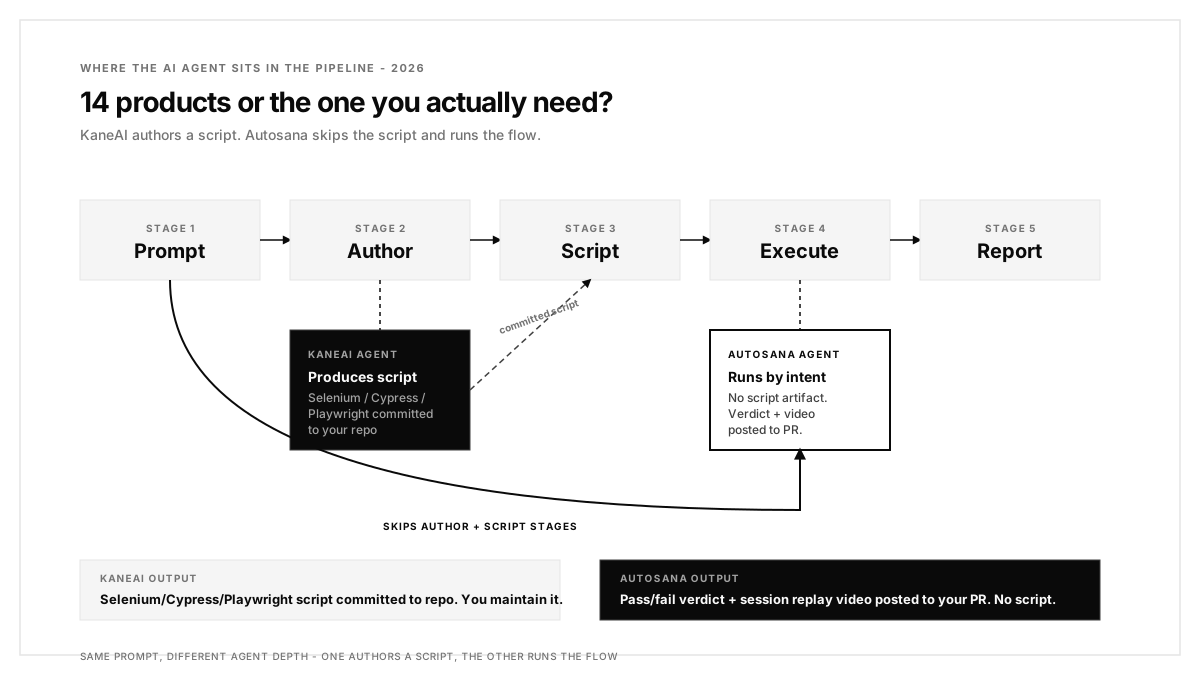
The second is what KaneAI actually produces. It translates plain English into Selenium, Cypress or Playwright scripts committed to your repo, so the authoring is AI-assisted while the maintenance stays human. Every generated script inherits the maintenance profile of the framework it targets, and scepticism about that trade runs deep: a r/softwaretesting thread titled "AI is a nightmare for QA" holds 174 votes and 108 comments.
The third is the platform shape itself. A r/opensource thread asking "Why is everything a SaaS nowadays?" pulled 249 votes and 85 comments, and the fourteen-SKU bundle is a clean example of what people mean.
Here is the reframe worth holding onto: fourteen products force you to buy a platform when you needed a tool.
| Tool | What it tests | Pricing | Best for |
|---|---|---|---|
| BrowserStack | Web and mobile, 3,500+ real devices | From $29/mo | Broadest device and browser lab |
| Playwright | Web (Chromium, Firefox, WebKit) | Free, Apache 2.0 | Dropping the execution cloud outright |
| Autosana | Native iOS and Android, plus web | Per agent-run, self-serve trial | Teams replacing KaneAI authoring |
| Sauce Labs | Web and mobile, 10,000+ devices | Custom enterprise | Largest scale plus FedRAMP compliance |
| Cypress | Web (Chromium-based, Firefox) | Free runner, Cloud paid | Front-end teams who debug in the browser |
| Kobiton | Native iOS and Android | Custom, cloud or on-prem | Private device labs and regulated teams |
| testRigor | Web, mobile and API | Published on request | Non-technical authors writing plain English |
| Mabl | Web, with mobile via responsive | Contact sales | Low-code authoring with ML healing |
1. Is BrowserStack a good LambdaTest alternative?
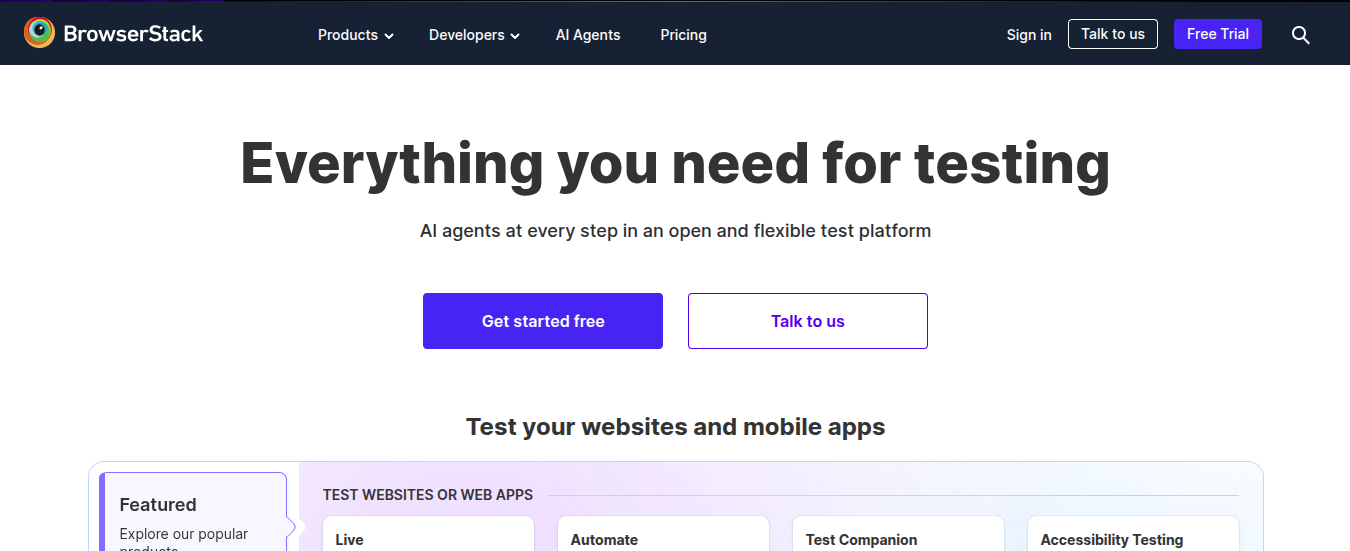
BrowserStack is the most widely adopted cloud device lab. It runs 3,000 browser and OS combinations alongside 3,500 real iOS and Android devices. Automate handles web script execution, App Automate handles mobile, Percy handles visual regression, and Observability covers flaky test detection. It is infrastructure for running the scripts you already have rather than an authoring agent.
Teams comparing the two directly are easy to find. A r/QualityAssurance thread asking whether LambdaTest is the real deal collected 15 votes and 32 comments of first-hand accounts from people running both, and the split lands on device inventory and support responsiveness rather than on feature lists.
That distinction matters when you are leaving LambdaTest. Swapping the Real Device Cloud for BrowserStack changes where your tests run and leaves the authoring question exactly where it was. Our BrowserStack alternatives guide walks the same comparison from the other direction.
Pros: 3,000 browsers and 3,500 real devices, Percy bundled for visual regression, mature Selenium, Appium, Playwright and Cypress support. Cons: no authoring agent comparable to KaneAI, self-healing is absent, and plans scale on parallel sessions.
Pricing: Automate from $29 a month, App Automate from $49, scaling with concurrency.
Best for: teams who want the widest matrix and keep their existing scripts.
2. Can Playwright replace LambdaTest for web testing?
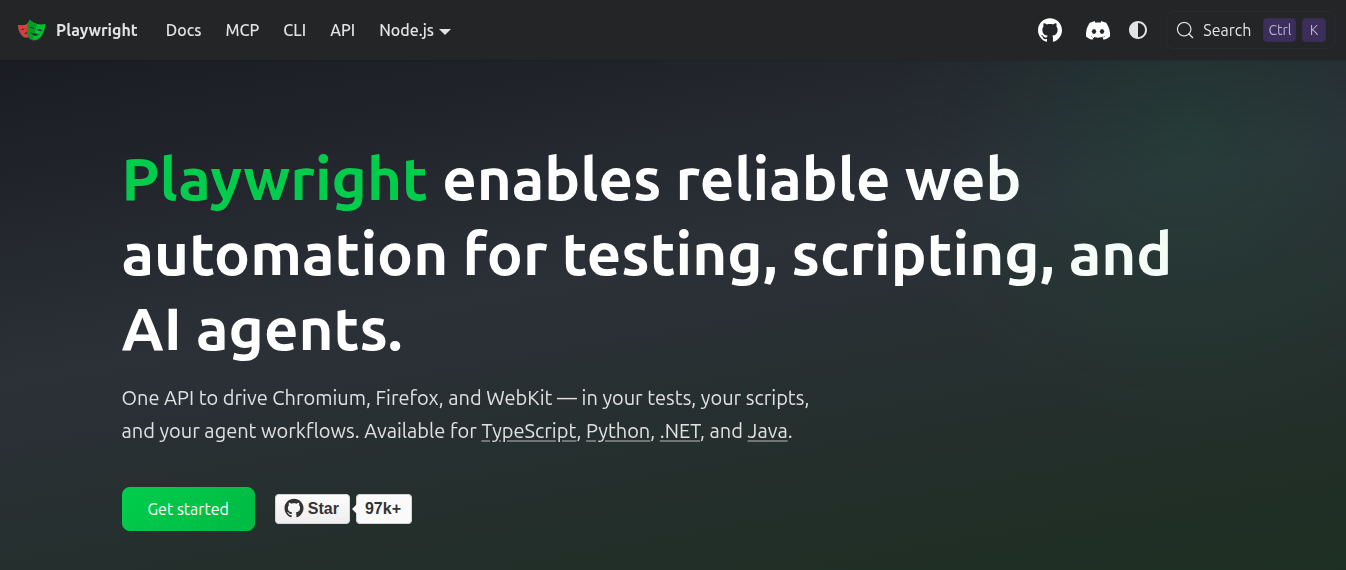
Playwright is Microsoft's open-source framework, connecting directly to browser internals through the DevTools protocol. One API covers Chromium, Firefox and WebKit, with auto-waiting, network interception and parallel execution built in, plus bindings for JavaScript, TypeScript, Python, Java and C#.
Where your LambdaTest usage is mostly running Playwright or Selenium scripts on their grid, running Playwright directly in CI removes the subscription outright. Codegen records interactions into runnable tests, which covers most of what the recorder in a paid platform offers.
The honest limit is mobile. Playwright emulates a viewport rather than driving a handset, so a team shipping a native iOS or Android app covers the web half here and still needs a second answer for the rest.
Pros: free, genuinely cross-browser, five language bindings, and auto-waiting removes a whole class of flake.
Cons: selector-based underneath, so a renamed button still breaks the test. Viewport emulation rather than real mobile devices, and the CI infrastructure becomes yours.
Pricing: free, Apache 2.0.
Best for: code-first web teams leaving the grid behind.
3. Is Autosana a LambdaTest alternative to KaneAI?
Here is the honest pivot. If your LambdaTest spend is the Real Device Cloud, BrowserStack or Sauce Labs replaces it more directly than anything else here, and you should take one of those. A different group is leaving because KaneAI meters authoring by credit and still hands back a script to maintain, and that needs a structural answer.
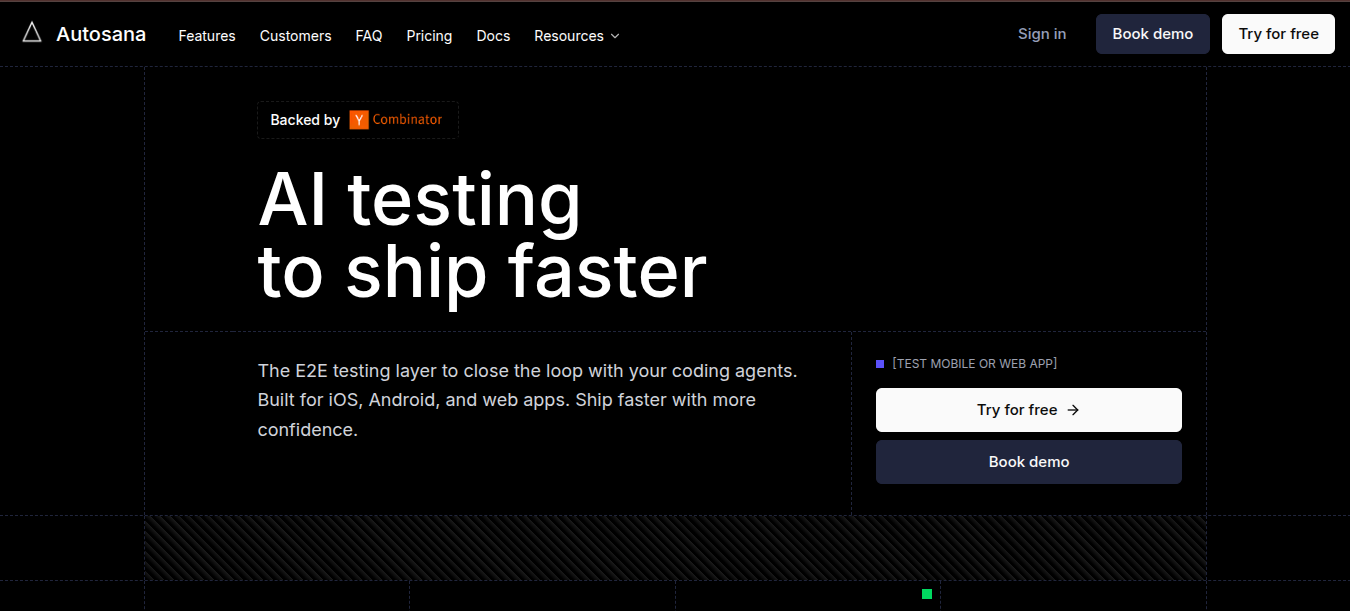
Autosana is an AI-native E2E testing agent for iOS, Android and web. You describe a flow in natural language or hand the agent a code diff, and it runs the flow by intent against the current UI rather than replaying a stored script. When the UI changes, the agent re-plans against whatever is on screen. There is no Selenium file, no Cypress spec and no selector to break.
The contrast with KaneAI is structural rather than incremental. KaneAI generates an artifact you then own; Autosana never produces one. It runs iOS and Android builds and web from a single surface on virtual and physical iOS and Android devices, ships an MCP server that lets Claude Code, Cursor, Codex or Devin list and run flows from the IDE, while the GitHub Bot analyses a pull request, runs the relevant flows and posts the results with video.
Pros: no script artifact to maintain, intent survives UI refactors, per-run pricing with no credit tiers or seat licences, MCP support documented for Claude Code, Cursor, Codex and Devin, and a self-serve trial.
Cons: no API testing module, no accessibility scoring product, and sub-frame visual diffing belongs to Percy or Applitools. Offline-first apps with no backend fixture story fit poorly.
Pricing: per agent-run, with no credits and no per-seat licensing.
Best for: teams whose KaneAI bill is credits plus the maintenance that follows the generated script.
4. Is Sauce Labs better than LambdaTest for enterprise teams?
Sauce Labs operates 10,000 real and virtual device combinations and ships AURA, its AI engine for root-cause analysis and automated failure classification. The enterprise side carries FedRAMP authorisation, SSO and on-premises deployment options, which is the specific reason it survives security review at organisations where other vendors stall.
Where it costs you is the entry path. There is no self-serve tier to trial over a weekend, so evaluating Sauce Labs means a sales conversation before you see the product against your own app. For a team under time pressure, that alone pushes the decision toward BrowserStack.
Pros: the largest device scale on this list, AURA for flake analysis, FedRAMP authorisation, and support across Selenium, Appium, Cypress, Playwright, Espresso and XCUITest.
Cons: an enterprise sales cycle with no public self-serve tier, opaque pricing next to BrowserStack's published rates, and no authoring agent.
Pricing: custom enterprise contracts.
Best for: regulated organisations where compliance decides the vendor.
5. Can Cypress replace LambdaTest for front-end testing?
Cypress runs inside the browser event loop, which is what enables its time-travel debugging with a DOM snapshot at every step. Where your LambdaTest usage is running Cypress specs on HyperExecute, cypress run in your own CI is the free equivalent, and the plugin ecosystem around cypress-axe and cypress-testing-library comes with it.
Pros: the best debugging experience in the category, automatic waiting for DOM stability, first-class TypeScript support.
Cons: JavaScript and TypeScript alone, cross-origin and multi-tab flows stay awkward, WebKit support trails, and parallel runs need the paid Cloud tier.
Pricing: free runner under MIT, with Cypress Cloud paid.
Best for: front-end teams who debug in the browser.
6. Is Kobiton a LambdaTest alternative for private device labs?
Kobiton concentrates on mobile device testing with both cloud and on-premises deployment. Healthcare, financial services and government teams use the on-premises lab to keep test data inside their own network, and scriptless capture gives a manual tester a route into automated coverage.
Whether to host your own hardware remains a live argument, and the regulated teams tend to settle it on data residency rather than cost. Our Kobiton alternatives guide covers the field for teams already running it.
Pros: cloud and on-premises hybrid deployment, scriptless execution, real device access with device-level logs.
Cons: narrower browser coverage than BrowserStack or Sauce Labs, and the mobile-first positioning means web automation is a secondary surface.
Pricing: custom, based on device count and deployment model.
Best for: mobile-first teams with data residency requirements.
7. Is testRigor a LambdaTest alternative to KaneAI authoring?
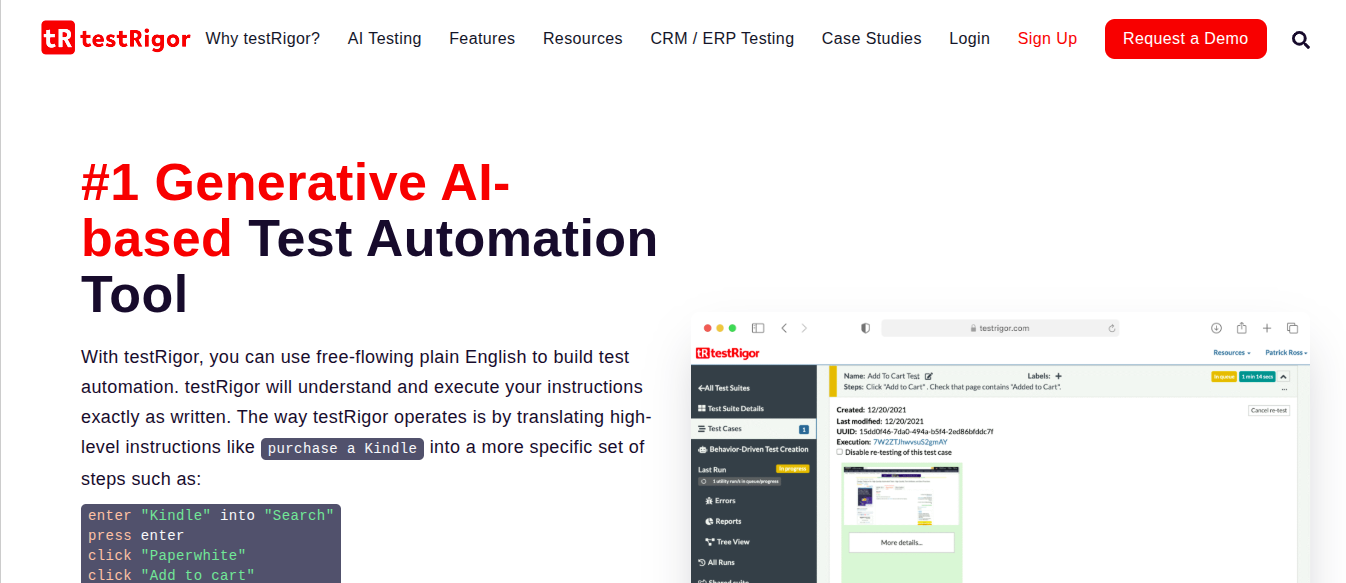
testRigor takes the same plain-English authoring approach as KaneAI and stops short of generating framework-specific code. Tests live inside testRigor's own runtime, which sidesteps the maintenance-of-generated-code problem and introduces platform dependency in its place: your tests run where testRigor runs.
The lock-in deserves a clear-eyed look rather than a reflex. Where a QA team has no engineers and no appetite to acquire any, a proprietary runtime is a reasonable trade, since the alternative is tests nobody can write. Where engineers exist, the calculation flips quickly.
Pros: plain-English authoring with no code output, cross-browser and mobile execution, built-in CI integrations, and email, SMS and API steps inside a flow.
Cons: tests are locked to a proprietary runtime with no open-source fallback, pricing is quoted rather than published, and the community ecosystem is small.
Pricing: testRigor's pricing page lists no public figures, so the number comes from a conversation.
Best for: non-technical QA teams who prefer no generated scripts even at the cost of lock-in.
8. Is Mabl a low-code LambdaTest alternative?
Mabl is a commercial low-code platform that identifies elements by behavioural properties rather than literal selectors. When a developer renames a class or restructures a component, Mabl attempts to re-identify the element without breaking the test, which is a genuine cushion for cosmetic change.
The honest caveat is that structural refactors still break things, since the healing is heuristic rather than semantic.
Pros: visual builder for non-technical authors, ML-based selector healing, cloud execution grid with dashboards, API and accessibility checks inside flows.
Cons: closed-source, healing works better on cosmetic shifts than structural ones, the cost curve rises with test volume, and there is no MCP server.
Pricing: commercial, contact sales.
Best for: enterprise QA orgs shipping self-healing tests that non-engineers maintain.
Which LambdaTest product should you keep?
The question is rarely whether to leave. It is which of the fourteen products you genuinely use, and whether each is the best available at that job.
Verify the claims against your own matrix rather than the marketing page, since the gap between the two has been noticed. A r/QualityAssurance thread on LambdaTest's advertising sits at 97 votes and 28 comments, which is a reminder to trial the device coverage you specifically need before signing.
- You use KaneAI for test authoring and want to keep the generated-script model - stay on KaneAI, or switch to TestRigor for plain-English authoring without generated scripts.
- You use KaneAI but the credit budget and script maintenance are the pain - Autosana. One agent, per-run pricing, no script artifact to maintain. The GitHub Bot analyses the pull request and runs the relevant flows, and the MCP server covers flow management from Cursor or Claude Code.
- You use Real Device Cloud for device breadth - BrowserStack (3,500+ devices, Percy included) or Sauce Labs (10,000+ devices, AURA AI, FedRAMP). Kobiton if you need on-prem.
- You use HyperExecute for script orchestration but run Playwright or Cypress scripts - run those scripts directly in CI for free. HyperExecute adds value only when you need cross-OS parallel execution at scale beyond what GitHub Actions or GitLab CI provide natively.
- You use Smart UI for visual regression - Percy (BrowserStack) or Applitools. Both are purpose-built for visual testing.
- You use Agent Testing for AI-agent QA - this is a LambdaTest-unique product in 2026. No direct alternative covers the same "test your AI chatbot" surface. Keep it if you need it.
- You use API Testing or Performance Testing - Postman, REST-assured, k6, or Locust are category leaders. LambdaTest's API and performance modules are add-ons, not best-in-class.
Most teams land in the middle: keep one or two products where LambdaTest is genuinely best in class, and buy the rest from tools built to do one job well.
Conclusion
LambdaTest rarely loses on capability. It loses on shape, since fourteen products under one brand bill for surface that most teams never open, and KaneAI meters the authoring by credit while still handing back a script someone has to maintain.
Audit which products you actually use before you shop. The exit is usually smaller than it looks: one device cloud, one runner, and an honest answer about whether the generated script was ever the thing you wanted. Run that audit first and the shortlist tends to write itself.
Frequently asked questions
What is the best LambdaTest alternative in 2026?
It depends on which LambdaTest product you are replacing. For KaneAI test authoring without scripts, Autosana. For the device cloud, BrowserStack or Sauce Labs. For script execution, Playwright is free and cross-browser. For codeless enterprise testing, Mabl. No single tool replaces all 14 SKUs.
Is LambdaTest still called LambdaTest?
LambdaTest rebranded to TestMu AI in January 2026. The lambdatest.com domain 301-redirects to testmuai.com. Products including KaneAI, HyperExecute, and Real Device Cloud continue under the TestMu AI name. Enterprise contracts transition to the new brand.
Can Autosana replace LambdaTest entirely?
For iOS, Android, and web E2E flows, yes. Autosana covers the KaneAI authoring + HyperExecute execution surface with a single agent, no script artifact, and per-run pricing. For API testing, Smart UI, Accessibility scoring, Agent Testing, and Performance Testing, LambdaTest covers surfaces Autosana does not target.
Is Playwright a good LambdaTest alternative?
Playwright replaces LambdaTest's Web Automation product for teams running Playwright or Selenium scripts. It is free, cross-browser, and runs in CI without a cloud subscription. It does not replace the real device cloud, KaneAI authoring, or any of the platform-layer products.
How much does LambdaTest cost in 2026?
KaneAI: $17/mo Starter (2,000 credits), $89/mo Pro (12,000 credits), $179/mo Max (25,000 credits). HyperExecute: $159/mo. Web Automation: $29-$199/mo. Smart UI: $199/mo. Live Testing: $15-$39/mo. Each product bills separately. Enterprise pricing is custom.
Does LambdaTest have an MCP server?
Yes. TestMu AI ships 4 MCP tool suites: HyperExecute MCP, Automation MCP, SmartUI MCP, and Accessibility MCP. These help coding agents configure, debug, and audit tests. Autosana splits the two jobs: the MCP server handles flow management from the IDE, and the GitHub Bot analyses the pull request, runs the relevant flows and posts the results with video.
What happened to KaneAI after the TestMu AI rebrand?
KaneAI continues as the flagship AI test-authoring agent under TestMu AI. Same product, same credit tiers, same plain-English-to-script workflow. The KaneAI name persists alongside the TestMu AI parent brand.
Should I replace all of LambdaTest or just specific products?
Replace specific products. Most teams use 2-3 of the 14 SKUs. Identify which products carry genuine value (often Real Device Cloud or Agent Testing) and which are bundled overhead. Replace the overhead with best-in-class single-purpose tools. Keep what works.