
8 Best Kobiton Alternatives for Real Device Testing in 2026
Kobiton is mobile-only with minute-based pricing and Appium script maintenance. This guide maps eight alternatives: BrowserStack and Sauce Labs to keep Appium with faster infrastructure, Playwright and Cypress for web testing, and intent-based agents to leave Appium behind entirely.
Yuvan Sundrani · 16 min read
autosana.ai
%20(1).png)
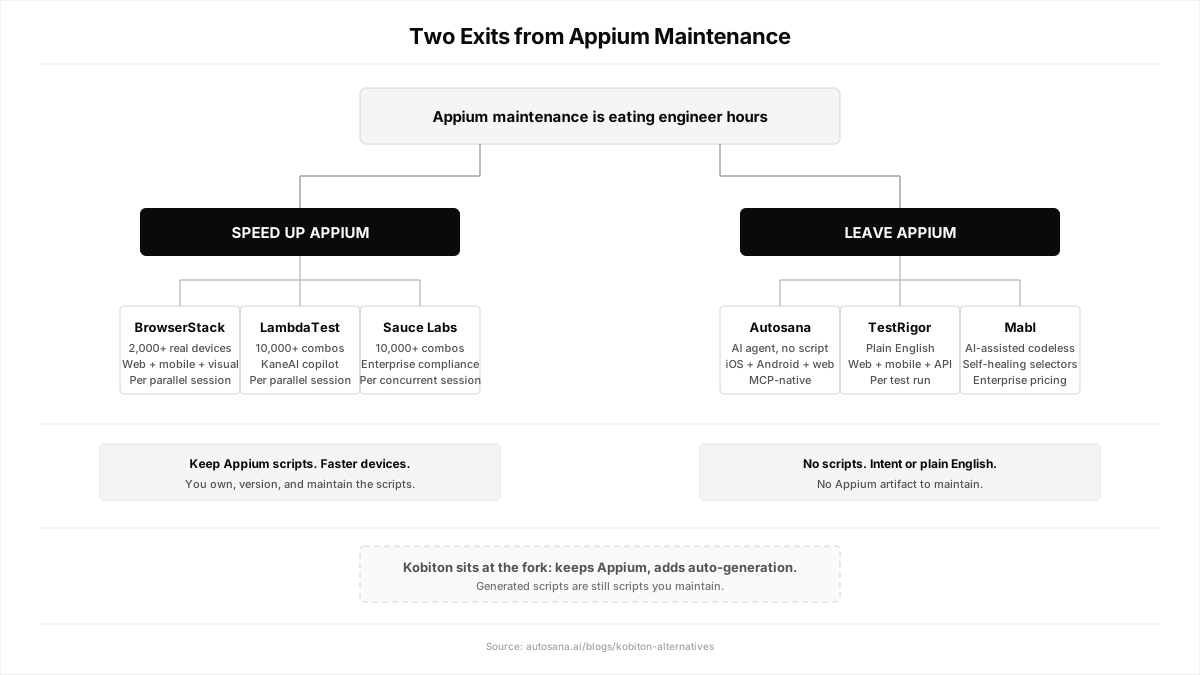
The best Kobiton alternatives in 2026 split along a single decision: do you want to keep Appium and run it on faster infrastructure (BrowserStack, LambdaTest/TestMu AI, Sauce Labs), or leave Appium behind for intent-based or plain-English execution (Autosana, TestRigor, Mabl)? If the pain is that Kobiton is mobile-only and your product ships web too, Playwright and Cypress fill the gap at zero cost. This guide ranks 8 alternatives and maps each one to the specific Kobiton limitation it solves.
Key Takeaways
- Kobiton's exit triggers in 2026 are minute-based pricing caps, mobile-only coverage (no web, no desktop, no API), and Appium script maintenance even with AI-assisted generation.
- BrowserStack (2,000+ real devices), LambdaTest/TestMu AI (KaneAI copilot + 10,000+ device combos), and Sauce Labs (enterprise compliance + 10,000+ combos) all keep Appium but add faster parallel infrastructure and web parity.
- TestRigor (plain English, broad coverage) and Mabl (AI-assisted codeless, enterprise) remove Appium scripting but still author stored test artifacts the team maintains.
- Playwright and Cypress are free, code-first web testing frameworks for the surface Kobiton does not cover at all.
- Autosana leaves Appium behind entirely, running iOS, Android, and web flows by intent, self-healing every run by re-planning against the current UI, with an MCP server that coding agents invoke on every PR.
Quick comparison of Kobiton alternatives in 2026
| Tool | Category | Mobile | Web | Appium? | Pricing Model | When to Pick |
|---|---|---|---|---|---|---|
| Autosana | AI-native agent | iOS + Android | Yes | No | Per agent-run | Appium maintenance is the pain and you want it gone entirely |
| BrowserStack | Device cloud + automation | iOS + Android | Yes | Yes (App Automate) | Per parallel, per session | Keep Appium, need 2,000+ real devices + web parity |
| LambdaTest (TestMu AI) | Device cloud + AI copilot | iOS + Android | Yes | Yes | Per parallel, per session | Keep Appium, want KaneAI copilot + massive device grid |
| Sauce Labs | Enterprise cloud | iOS + Android | Yes | Yes | Per concurrent session | Keep Appium, need enterprise compliance + 10,000+ combos |
| Playwright | Code-first web framework | Emulation only | Yes | No | Free (Apache 2.0) | Web testing Kobiton does not cover, cross-browser |
| TestRigor | Plain-English codeless | iOS + Android | Yes | No | Per test run | Leave Appium, want plain English, broad platform coverage |
| Mabl | AI-assisted codeless | Limited | Yes | No | Enterprise (contact sales) | Leave Appium, non-technical QA authors, self-healing |
| Cypress | Code-first web framework | No | Yes | No | Free (MIT) + paid cloud | JS/TS-first web testing, time-travel debugging |
Why are teams looking for Kobiton alternatives in 2026
Kobiton is a legitimate mobile testing platform. The device layer is deep: 7,000+ real iOS and Android devices, BYOD private cloud, on-prem and air-gapped deployment for compliance-heavy teams. The AI-augmented testing surface turns manual sessions into production Appium scripts and self-heals element lookups across 80M+ trained tests. G2 rating sits at 4.3/5. Customers include Nike, Blizzard, Delta, AT&T, and Home Depot.
The exit triggers are specific:
- Minute-based pricing caps. Kobiton Startup gives you 500 minutes at $83/month. Accelerate bumps to 3,000 minutes at $399/month. Larger teams hit Scale at $9,000/year or Enterprise custom pricing. A team on r/softwaretesting evaluating device farms for cross-browser accessibility testing captured the underlying tension: budget-per-minute forces hard tradeoffs on which devices actually get exercised each cycle.
- Mobile-only coverage. Kobiton does not test web apps, desktop apps, or APIs. If your product ships web alongside iOS and Android, you need a second tool for the web surface and a second maintenance budget.
- Appium script maintenance lives on. Kobiton's AI generates Appium scripts from manual sessions and claims 90% manual coding reduction. The trade: generated scripts are still scripts. You own, version, and maintain them. Self-healing patches element lookups, but the Appium artifact remains yours to babysit when flows reshape after a product sprint.
- Coding-agent support claimed but undocumented. Kobiton's homepage advertises support for Claude, Copilot, Cursor, Gemini, and Codex. As of September 2026, no MCP server documentation, no setup guide, and no GitHub integration reference is published on the public site.
Here is the contrarian reframe: Kobiton auto-generates Appium scripts to save you time writing them. The real cost was never writing the script. It was maintaining it sprint after sprint as the app changed beneath it. Auto-generation solves authoring speed. It does not solve ownership cost. Every generated script is a new liability in your repo that will break the next time a flow changes and need an engineer to fix it.
Which Kobiton alternatives leave Appium behind entirely
If your team's Kobiton pain is the Appium layer itself, not the device cloud beneath it, these three tools remove scripted automation from the workflow.
Autosana as a Kobiton alternative
Autosana is an AI-native testing agent that runs iOS, Android, and web apps by intent. You describe a flow ("open cart, tap checkout, enter test card, confirm order") and the agent navigates the current UI without selectors, scripts, or Appium. When the UI changes, the agent re-plans against whatever is on screen. There is no stored script to patch, no element-lookup table to heal.
The structural difference from Kobiton: Kobiton generates and maintains an Appium script artifact. Autosana generates nothing. The intent is the test. Hosted real device testing is included in the trial. The MCP server lets coding agents (Cursor, Claude Code, Devin) invoke a test run on every PR, and session replay posts back to the PR via GitHub integration. That is the coding-agent-native QA loop Kobiton's homepage markets but does not yet ship with published docs.
- Best for: teams whose Kobiton pain is the Appium maintenance tax, not the device layer, and who want documented MCP support for coding-agent workflows
- Pricing: per agent-run, self-serve trial. The quickstart walks through first run in under ten minutes
- Limitation: public cloud only. No on-prem or air-gapped deployment. Sub-100ms visual regression, GPU-shader validation, and heavy performance profiling are out of scope
TestRigor as a Kobiton alternative
TestRigor lets QA teams write tests in plain English without code, selectors, or Appium. The platform covers web, mobile (iOS + Android), desktop, and API testing. Test stability claims reach 99.5% per their marketing. TestRigor is the broadest-coverage codeless alternative for teams that want human-readable test definitions without learning a scripting language or maintaining Appium artifacts.
- Best for: QA-heavy orgs that want plain-English test authoring across web, mobile, desktop, and API
- Pricing: per test run, enterprise plans available
- Limitation: tests are still stored artifacts. Structural UI changes can require test rewrites. Not agent-native
Mabl as a Kobiton alternative
Mabl is a low-code testing platform with ML-based self-healing selectors and a visual test builder. It targets enterprise QA teams where non-technical stakeholders author and maintain tests. Mabl's self-healing patches element lookups when the UI shifts, similar in concept to Kobiton's mechanism but without the Appium layer underneath.
- Best for: enterprise QA orgs where non-technical authors need a codeless builder with self-healing
- Pricing: commercial, enterprise-priced (contact sales)
- Limitation: closed-source. Self-healing is heuristic, breaks on deep refactors. Mobile coverage is limited compared to Kobiton's device depth. Cost curve rises sharply with volume
The category difference between these three is the test artifact. TestRigor stores plain-English test steps you review and update. Mabl stores a visual test recording the builder created. Autosana stores nothing between the intent and the outcome. The agent re-plans every run. If your Kobiton exit is driven by "we want zero test artifacts to maintain," only the agent-native path delivers that.
Which Kobiton alternatives keep Appium and speed it up
If your team wants to keep Appium as the test runtime but needs faster infrastructure, broader device coverage, or web parity Kobiton does not offer, these three are the direct replacement category.
BrowserStack as a Kobiton alternative
BrowserStack App Automate runs Appium scripts on 2,000+ real iOS and Android devices in the cloud, with parallel execution and auto-scaling. Unlike Kobiton, BrowserStack also covers web testing (Automate, Live, Percy visual testing) and observability dashboards under one billing relationship. A QA lead on r/QualityAssurance evaluating mobile test automation platforms listed BrowserStack alongside Kobiton, Headspin, Sauce Labs, and Perfecto as the standard evaluation set for teams shopping in this category.
- Best for: teams that want Appium on real devices plus web, visual, and observability under a single vendor
- Pricing: per parallel session, per minute. Enterprise quotes on volume
- Limitation: Appium scripts are still yours to maintain. No intent-based or scriptless alternative built in
LambdaTest (TestMu AI) as a Kobiton alternative
LambdaTest rebranded to TestMu AI and added KaneAI, an AI copilot for test authoring. The device cloud covers 10,000+ real device and browser combinations for web and mobile. Appium runs natively, and KaneAI layers natural-language test generation on top. An engineer on r/androiddev searching for real-device farms supporting Samsung Galaxy captured the pain that drives the evaluation: finding a farm with the exact device coverage your users actually run on matters more than feature counts on a marketing page.
- Best for: teams that want Appium infrastructure at scale plus an AI copilot for faster test authoring
- Pricing: per parallel session. Free tier for manual testing; paid for automation
- Limitation: KaneAI generates scripts you still own. The underlying mental model is scripted, not agentic
Sauce Labs as a Kobiton alternative
Sauce Labs runs Appium and Selenium on 10,000+ real device and browser combinations, with enterprise-grade compliance (SOC 2, ISO 27001, FedRAMP). If your Kobiton exit is driven by compliance requirements beyond Kobiton's on-prem tier, or by needing web parity alongside mobile, Sauce Labs is the enterprise incumbent. A thread on r/PerformanceTesting about vendors supporting true private setups confirmed that Sauce Labs, BrowserStack, and Kobiton are the three names that surface in private-cloud and on-prem conversations.
- Best for: enterprise teams that need compliance certifications, massive device breadth, and Appium + Selenium under one cloud
- Pricing: per concurrent session, enterprise custom. Higher than BrowserStack for most mid-market teams
- Limitation: expensive at scale. Still Appium underneath. No intent-based execution
Which Kobiton alternatives cover web testing it does not
Kobiton is mobile-only. If your product ships a web app, you need a web testing tool regardless of which mobile path you choose.
Playwright as a Kobiton web testing alternative
Playwright is the modern code-first web testing framework from Microsoft. Cross-browser (Chromium, Firefox, WebKit), auto-waiting, multi-language (JS/TS, Python, Java, C#), and free under Apache 2.0. It does not do native mobile, but for the web surface Kobiton cannot touch, Playwright is the community default. A QA lead on r/QualityAssurance naming favorite testing tools confirmed the shift: Playwright has replaced Selenium as the first-reach web automation framework for teams shipping modern frontends.
- Best for: web testing Kobiton does not cover, code-first teams that want cross-browser parity
- Pricing: free (Apache 2.0)
- Limitation: web only. No native mobile. Still selector-based at the core
Cypress as a Kobiton web testing alternative
Cypress is the frontend developer experience champion for JS/TS teams. Time-travel debugging, DOM snapshots per step, and a strong plugin ecosystem make it a natural fit for single-origin SPAs. Free under MIT with a paid cloud tier for parallel execution and dashboards. Where Playwright covers multi-browser and multi-language, Cypress goes deeper on JS/TS DX with real-time reloading, request stubbing, and a component testing mode that bridges unit and E2E.
- Best for: JS/TS-first web teams that value local debugging experience and fast feedback loops
- Pricing: free (MIT) + Cypress Cloud paid for parallelization
- Limitation: web only. JS/TS only. No cross-origin, no WebKit/Safari desktop, no native mobile
Should you keep Appium or leave it behind when replacing Kobiton
This is the fork every Kobiton user faces. The decision is not about tools. It is about what you want to own.
- "We have 200+ Appium scripts and they work. We just need faster infrastructure." Keep Appium. Pick BrowserStack, LambdaTest, or Sauce Labs based on device count, compliance needs, and budget.
- "We hate writing Appium scripts but Kobiton's auto-generation made it bearable." Notice what happened: you automated the creation of the artifact that causes the maintenance. The scripts still exist and still break when flows change. Consider leaving Appium.
- "Coding agents are opening PRs faster than QA can script." Leave Appium. Autosana's MCP server closes the loop: coding agent opens a PR, Autosana runs the flow by intent, posts session replay to the PR via GitHub integration. No script artifact sits in the middle.
- "Our product ships web alongside mobile and Kobiton only covers mobile." Add Playwright or Cypress for web. Or pick a tool that covers both surfaces natively: Autosana, TestRigor, or LambdaTest.
- "We need air-gapped or on-prem device labs for compliance." Stay with Kobiton or move to Sauce Labs. Most alternatives on this list are cloud-only.
The honest answer: many teams leaving Kobiton are not leaving because Kobiton is bad at what it does. They are leaving because what it does (accelerating Appium on real devices) is no longer the problem they need solved. The problem moved from "we need more devices" to "we need fewer scripts."
The bigger 2026 shift is that coding agents (Cursor, Claude Code, Devin, Copilot) are shipping PRs faster than any human can review and script a test for. If your coding agent opens a PR and your test pipeline requires an Appium script to validate it, you have a bottleneck that no device cloud solves. The loop only closes when the testing surface is also agent-native, which is where Autosana's MCP server fits: the coding agent triggers the test, Autosana runs it by intent, and the PR gets a session replay verdict without a human touching a script.
.png)
Frequently asked questions
What is the best alternative to Kobiton in 2026?
It depends on why you are leaving. BrowserStack or Sauce Labs if you want to keep Appium with better infrastructure. Autosana if you want to leave Appium behind and run tests by intent across iOS, Android, and web. Playwright or Cypress for web testing Kobiton does not cover.
Is Kobiton free?
Kobiton offers a free trial on the Startup tier. Paid plans start at $83/month (500 minutes), $399/month (3,000 minutes), $9,000/year (Scale), and custom Enterprise pricing. Minute-based caps apply to all tiers below Enterprise.
Does Kobiton support web testing?
No. Kobiton is mobile-only: iOS and Android, native and mobile web browser. It does not test desktop web apps, APIs, or desktop applications. Teams shipping web alongside mobile need a second tool.
Can Autosana replace Kobiton entirely?
For iOS, Android, and web E2E flows on public cloud, yes. Autosana covers all three surfaces with intent-based execution and self-healing. For air-gapped labs, BYOD private fleets, and Appium-legacy suites worth accelerating rather than replacing, Kobiton covers surfaces Autosana does not target.
Does Kobiton integrate with coding agents like Cursor or Claude Code?
Kobiton's homepage claims support for Claude, Copilot, Cursor, Gemini, and Codex. No MCP server docs, setup guide, or GitHub integration reference is published on the public site. Autosana ships MCP with documented setup and PR-level execution today.
How does Kobiton pricing compare to BrowserStack and Sauce Labs?
Kobiton is generally cheaper at entry (Startup $83/month). It uses minute-based caps; BrowserStack and Sauce Labs price by concurrent sessions. At enterprise scale, all three move to custom quotes. Kobiton's BYOD and on-prem tiers differentiate on deployment flexibility, not just price.
What is the cheapest Kobiton alternative for mobile testing?
Playwright (free) and Cypress (free) cover web only. For mobile, Autosana offers a self-serve trial with per-agent-run pricing. LambdaTest offers a free manual testing tier. BrowserStack and Sauce Labs require paid plans for mobile automation.
Should you migrate from Kobiton to an AI testing tool?
If more than half your testing time goes to maintaining Appium scripts after UI changes, the ROI on migration is clear. If your Appium suite is stable and your need is device breadth or on-prem compliance, Kobiton is still the right shape. The Autosana quickstart supports a one-sprint parallel evaluation.