
8 Best Functionize Alternatives for AI Testing in 2026
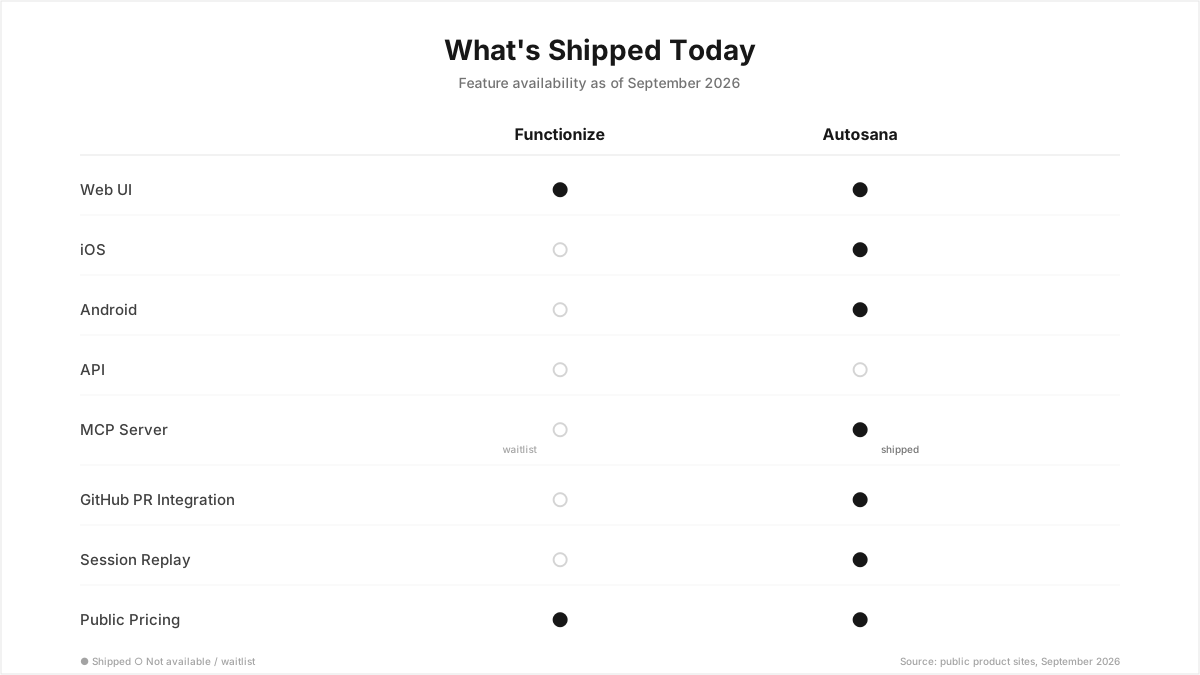
Functionize is web-only, its MCP integration sits on a waitlist, and credit-based pricing gets complex at scale. This guide maps eight alternatives by the gap they close: mobile coverage, code-first control, or shipped MCP for PR-level testing.
Yuvan Sundrani · 18 min read
autosana.ai
.png)
The best Functionize alternatives in 2026 split along one axis: web-only depth or cross-platform coverage. Functionize covers web UI only, its MCP integration sits on a waitlist, and credit-based pricing gets complex at team scale. The 8 alternatives below organize by which gap teams hit first: mobile coverage (Autosana, Mabl, BrowserStack), web-only testing with a different approach (Playwright, Cypress), code-free intent-based authoring (TestRigor, Katalon), or the full device cloud (Sauce Labs).
Key Takeaways
- Functionize is web-only per its public site, MCP sits on a waitlist, and the integrations page reads "Coming Soon" with no CI/CD or issue-tracking connections published.
- Playwright and Cypress cover the same web scope for free but trade intent-based authoring for code-first control across 5 languages (Playwright) or a JS/TS developer experience with time-travel debugging (Cypress).
- Mabl adds web plus mobile plus API plus accessibility under a managed platform, while BrowserStack provides the raw device matrix with 3,500+ browser/OS combos and 2,000+ real devices.
- TestRigor and Katalon both offer code-free paths: TestRigor via plain English across web, mobile, API, and desktop; Katalon via a GUI IDE on top of Selenium and Appium.
- Autosana covers iOS, Android, and web from a single intent-based agent, ships MCP with documented PR-level execution today, and prices per agent-run rather than per credit or per seat.
Quick comparison: 8 Functionize alternatives ranked
| Tool | Category | Platform Coverage | Authoring | Free Tier? | When to Pick over Functionize |
|---|---|---|---|---|---|
| Autosana | AI-native agent | iOS + Android + Web | Intent-based, natural language | Trial + paid | You ship mobile, need MCP today, want per-run pricing |
| Playwright | Modern code-first | Web (cross-browser) | JS, TS, Python, Java, C# | Yes (Apache 2.0) | You want free, code-first, cross-browser with auto-waiting |
| Cypress | Frontend DX | Web (Chromium + Firefox + WebKit) | JS / TS | Yes (MIT) + paid cloud | JS/TS team, time-travel debugging, component testing |
| Mabl | Managed AI platform | Web + Mobile + API + A11y | Low-code visual + AI | Paid | You need managed web + mobile + API under one platform |
| TestRigor | Plain-English codeless | Web + Mobile + API + Desktop | Plain English | Paid | Non-technical authors need broad coverage in natural language |
| BrowserStack | Device cloud + automation | Web + Mobile (3,500+ combos) | Selenium, Playwright, Cypress, Appium | Free trial + paid | You need the raw device matrix across 2,000+ real devices |
| Sauce Labs | Enterprise device cloud | Web + Mobile (10,000+ combos) | Selenium, Appium, Playwright, Cypress | Free trial + paid | Compliance certs (SOC 2, ISO), AURA AI, enterprise scale |
| Katalon | Low-code IDE | Web + Mobile + API + Desktop | GUI recorder + Groovy | Free + paid | Mixed-skill QA team, existing Selenium/Appium ecosystem |
Why teams are looking for Functionize alternatives in 2026
Functionize positions itself as "The Agentic Quality Platform" with the 2026 tagline "Agents write the code. Studio proves it works." The pitch is specific: verify that AI-written code works on the web. The single product, Functionize Studio, handles web UI test creation, self-healing, and assertion through purpose-built ML trained on 8 years of testing data. Named customers include McAfee, Conduent, ServiceNow, Uponor, Banjo Health, and Norstella.
The gap shows up in four places.
Web-only scope. Functionize describes "an independent testing agent for your full web UI workflow." iOS, Android, API, and desktop are not published as first-class surfaces. For teams shipping mobile alongside web, the coverage question hits before anything else. A QA lead on r/QualityAssurance noted that AI QA tool evaluations in 2025 consistently surfaced platform coverage as the first filter when teams compared tools: which surfaces does the product actually test under one authoring model?
MCP on a waitlist. Functionize's integrations page reads "Coming Soon." No Claude Code integration, no Cursor integration, no IDE integration is documented as shipped. For teams using coding agents to open PRs daily, a verification layer that cannot be invoked by the coding agent is a manual step in an automated workflow.
Credit-based pricing at scale. Pricing is public (rare in this segment): Free at $0/mo with 200 credits, Pro at $20/mo with 400 credits, Max at $100/mo with 2,000 credits, Growth at $40/user/mo, Scale at $200/user/mo, and Enterprise custom with a 12-month minimum. Credits are predictable per test but compound with regression volume. A developer on r/webdevelopment described the challenge small web teams face when evaluating testing tools: balancing per-test pricing transparency against the actual cost curve as CI pipelines grow.
No published integrations. CI/CD, issue tracking, and test management connections are not documented on the Functionize public site. For teams that need the testing agent wired into an existing pipeline, the integration gap is the second question after platform coverage.
Here is the contrarian reframe: Functionize proves web code works. Autosana proves the whole app works, across every platform you ship.
Which Functionize alternatives add mobile coverage?
Autosana: AI-native agent for iOS, Android, and web
Best for: teams whose Functionize pain is the web-only scope gap, and who need MCP shipped today rather than on a waitlist.
Autosana is a cloud-hosted AI agent that tests iOS, Android, and web apps by intent. You describe a flow in natural language or hand the agent a code diff. The agent opens the build, navigates by intent, and confirms the outcome. There are no selectors to author, no scripts to maintain. When the UI changes, the agent re-plans against the current screen every run. That re-planning mechanism is the structural difference from Functionize: Studio heals a stored test artifact through its Create, Heal, Assert pillars. Autosana skips the stored test entirely.
Key features:
- Intent-based flows across iOS + Android + web from a single authoring surface
- Self-healing by re-planning against the current UI every run
- MCP server for coding-agent integration: Cursor, Claude Code, or Devin invokes the run on a PR
- Session replay posted to every PR via GitHub integration
- Hosted real device testing included in trial
- Per agent-run pricing, self-serve trial
Pick Autosana if you ship iOS, Android, or web (or a mix), your coding agents are opening PRs faster than a waitlist can move, and you want one agent that runs the proof end-to-end. First run is under ten minutes via the quickstart.
Mabl: managed platform for web, mobile, API, and accessibility
Best for: enterprise QA teams that want managed web plus mobile plus API plus accessibility testing under one platform with built-in analytics.
Mabl is a commercial low-code platform that covers web, mobile, API, and accessibility testing. Its AI layer adds self-healing selector logic and auto-generated tests from user behavior data. Mabl runs on a managed cloud grid and produces unified reporting dashboards. The platform is broader than Functionize in coverage (adding mobile, API, and accessibility) but shares the stored-test-artifact model where heals get applied to persisted tests.
Key features:
- Web + mobile + API + accessibility in one platform
- ML-based self-healing and auto-generated test recommendations
- Cloud grid with reporting dashboards and analytics
- Integrations with CI/CD, Jira, Slack
Pricing: commercial (contact sales). Enterprise-priced.
Limitations: closed-source. Self-healing is heuristic and works better on cosmetic UI shifts than deep refactors. Cost curve rises with volume and seats. No public free tier.
BrowserStack: the raw device matrix at scale
Best for: teams that need the widest possible browser/OS/device combination coverage for cross-browser and cross-device testing.
BrowserStack provides 3,500+ browser/OS combinations and 2,000+ real devices for manual and automated testing. It supports Selenium, Playwright, Cypress, and Appium as the automation layer running on its device cloud. BrowserStack is a device farm: it provides hardware and the runtime environment, not the test-authoring intelligence. For teams leaving Functionize, BrowserStack answers the "where do tests run" question while requiring a separate tool or framework for "how tests are authored."
Key features:
- 3,500+ browser/OS combos, 2,000+ real mobile devices
- Supports Selenium, Playwright, Cypress, Appium
- Automate (web), App Automate (mobile), Live (manual)
- Visual testing, accessibility testing, performance dashboards
Pricing: paid plans starting at $29/mo for manual testing. Automate Pro at $249/mo. Enterprise custom. Free trial available.
Limitations: device farm, not a test-authoring agent. You still write and maintain tests in Selenium, Playwright, Cypress, or Appium. Cost scales with parallel sessions and device concurrency.
Which Functionize alternatives focus on web-only testing with a different approach?
Playwright: free, code-first, cross-browser
Best for: teams that want to stay in a code-first mental model and escape Functionize's credit-based pricing with a free, open-source framework.
Playwright is Microsoft's browser automation framework, connecting directly to browser internals via the DevTools protocol. It supports Chromium, Firefox, and WebKit under one API, ships auto-waiting, and offers 5 language bindings (JS/TS, Python, Java, C#). An engineer on r/softwaretesting noted during a tools evaluation thread that Playwright's cross-browser support and free licensing consistently make it the first alternative teams evaluate when moving off commercial platforms.
Key features:
- Auto-waiting for actionable state (visible, stable, enabled)
- Multi-browser (Chromium + Firefox + WebKit) under one API
- Multi-language: JS/TS, Python, Java, C#
- Native parallel execution, network interception, codegen
- API testing built in
Pricing: free (Apache 2.0).
Limitations: still selector-based at the core. Auto-waiting solves timing but not "the button was renamed" scenarios. No native mobile (viewport emulation only). No intent-based authoring. Requires engineers to write and maintain tests.
Cypress: JS/TS developer experience with component testing
Best for: JS/TS-first frontend teams that value time-travel debugging and component-level testing alongside E2E flows.
Cypress runs inside the browser's own event loop, unlocking time-travel debugging with DOM snapshots per step. It is the default choice for frontend teams that want the tightest possible feedback loop during local development. Cypress also supports component testing for React, Vue, Svelte, and Angular, giving teams both E2E and component coverage from one tool.
Key features:
- Time-travel debugging with DOM snapshots per step
- Automatic waiting for DOM stability and XHR/fetch
- Component testing for React, Vue, Svelte, Angular
- First-class TypeScript support
- Plugin ecosystem (cypress-axe, cypress-visual-regression)
Pricing: free (MIT) + Cypress Cloud paid tier for parallel execution and dashboards.
Limitations: JS/TS-only authoring. No cross-tab or cross-origin flows. WebKit/Safari desktop not first-class. Parallel execution requires paid Cypress Cloud. Still selector-based.
Which Functionize alternatives offer code-free intent-based testing?
TestRigor: plain English across web, mobile, API, and desktop
Best for: teams where non-technical stakeholders author tests and need broad platform coverage without writing code or maintaining selectors.
TestRigor lets teams write tests in plain English sentences. Coverage spans web, mobile (native and hybrid), API, and desktop. The platform translates English instructions into test steps and handles element identification without selectors. For teams evaluating Functionize's intent-based approach but needing mobile, API, and desktop coverage, TestRigor is the closest codeless alternative in total scope. A thread on r/QualityAssurance asking for AI-based testing tool recommendations surfaced TestRigor alongside Functionize as teams compared plain-English authoring models across platforms.
Key features:
- Plain English test authoring (no selectors, no code)
- Web + mobile + API + desktop coverage
- AI-driven element identification
- Built-in integrations with CI/CD, Jira, test management tools
Pricing: paid (contact sales). Volume-based pricing.
Limitations: proprietary execution engine. Debugging failures requires understanding the platform's interpretation of English instructions. Enterprise pricing not transparent.
Katalon: platform IDE with codeless and scripted paths
Best for: mixed-skill QA teams that want a GUI recorder for non-technical testers and Groovy scripting for developers, on top of Selenium and Appium.
Katalon Studio is a Java-based desktop IDE built on Selenium (web) and Appium (mobile). Authors can record, use a keyword library, or write Groovy scripts. The platform covers web, mobile, API, and Windows desktop. Katalon sits closer to Functionize in philosophy (platform-managed testing) but extends deeper into the traditional automation stack with its bundled Selenium and Appium engines.
Key features:
- GUI recorder + Object Spy + Groovy scripting
- Bundled Selenium + Appium engines
- Katalon TestOps for reporting + TestCloud for hosted grid
- Web + mobile + API + Windows desktop coverage
Pricing: free Katalon Studio + paid Runtime Engine ($1,749/yr per license) + paid TestCloud packs.
Limitations: inherits Selenium's selector fragility on refactors. Free tier lacks parallel execution. iOS Object Spy is notoriously unreliable across Xcode versions.
Which Functionize alternative covers the full device cloud?
Sauce Labs: 10,000+ device combos with AURA AI and compliance certs
Best for: enterprise teams that need the broadest device cloud, compliance certifications (SOC 2, ISO 27001), and AI-assisted test debugging at scale.
Sauce Labs provides 10,000+ browser/OS/device combinations, supporting Selenium, Appium, Playwright, and Cypress as the automation frameworks running on its infrastructure. AURA, its AI engine, adds failure analysis and suggested fixes. For teams in regulated industries, Sauce Labs' compliance certifications (SOC 2 Type II, ISO 27001) are often the procurement gate that decides the shortlist.
Key features:
- 10,000+ browser/OS/device combos (real devices and emulators)
- AURA AI engine for failure analysis and test suggestions
- SOC 2 Type II, ISO 27001, HIPAA-eligible
- Supports Selenium, Appium, Playwright, Cypress, Espresso, XCUITest
- Error reporting, visual testing, performance monitoring
Pricing: paid plans. Free trial available. Enterprise custom with annual contracts.
Limitations: device cloud, not a test-authoring agent. Tests are authored and maintained in your chosen framework. Cost scales with concurrency and device hours. Premium tier required for AURA AI features.
How to choose between web-only depth and cross-platform coverage
The decision maps to which Functionize gap your team hits first.
- "We ship iOS and Android alongside web" and need one testing surface across all three: Autosana. The agent runs the same intent across platforms with MCP shipped today.
- "We want free, code-first web testing and will maintain our own tests": Playwright for multi-language cross-browser, Cypress for JS/TS developer experience.
- "We want a managed platform with web + mobile + API under one roof": Mabl.
- "Non-technical team members need to author tests in plain English": TestRigor for the broadest codeless coverage, Katalon for teams already invested in Selenium/Appium.
- "We need the widest device matrix with compliance certs": Sauce Labs for 10,000+ combos and SOC 2. BrowserStack for 3,500+ combos with broader framework support.
- "Our coding agents open PRs and need a testing agent to verify them": Autosana. MCP is shipped and documented. Functionize's MCP is on the waitlist.
A thread on r/QualityAssurance asking for opinions on AI testing tools surfaced the same trade-off: teams weighing credit-limited plans against per-run pricing models and asking which tools integrate with their CI pipeline today versus which still promise it.
If your team's Functionize complaint is the web-only scope, only tools that add iOS and Android as first-class surfaces actually close the gap. If the complaint is MCP and coding-agent integration, only shipped MCP counts. If the complaint is credit complexity at scale, Playwright and Cypress are free and Autosana's per-run model flattens the cost curve as team size grows.
.png)
Frequently asked questions
Is Functionize free in 2026?
Functionize offers a Free Individual plan at $0/month with 200 credits/mo and 5 parallel runs. SMS testing, MFA/OTP, email testing, and multi-team workspaces are excluded. Beyond that: Pro at $20/mo, Max at $100/mo, Growth at $40/user/mo, Scale at $200/user/mo, and Enterprise custom with a 12-month minimum.
Does Functionize support mobile testing?
Functionize's public site does not list iOS or Android as first-class surfaces. The product targets the full web UI workflow. For mobile coverage, alternatives like Autosana (iOS + Android + web under one agent), BrowserStack (2,000+ real devices), and Sauce Labs (10,000+ combos) cover native and hybrid mobile testing.
What is the best free Functionize alternative?
Playwright for code-first web testing: free, open-source, cross-browser, 5 language bindings. Cypress for JS/TS teams that value time-travel debugging and component testing. Both cover the same web scope as Functionize for $0 but require engineers to write and maintain tests in code.
Does Functionize have an MCP server for coding agents?
Not yet. Functionize lists MCP on a waitlist, and the integrations page reads "Coming Soon." No Claude Code, Cursor, or IDE integration is documented as shipped. Autosana ships MCP today with documented setup, PR-level execution, and session replay posted via GitHub integration.
Can Autosana replace Functionize for web testing?
Yes. Autosana runs web apps by intent with the same no-selector, no-script approach. It adds iOS and Android as first-class surfaces, ships MCP for coding-agent integration, and prices per agent-run. For web-only teams that specifically want Functionize's purpose-built ML trained on 8 years of testing data, Functionize remains defensible.
How does Functionize pricing compare to Playwright or Cypress?
Functionize starts free but scales via credits: 400 credits at $20/mo (Pro), 2,000 at $100/mo (Max), team plans at $40 to $200/user/mo. Playwright and Cypress are free and open-source. The trade-off: free tools require engineering time to author and maintain tests; Functionize's intent-based model reduces that overhead at the cost of credits.
Which Functionize alternative is best for enterprise compliance?
Sauce Labs. SOC 2 Type II, ISO 27001, and HIPAA-eligible certifications make Sauce Labs the default for teams in regulated industries where compliance gates procurement. BrowserStack also offers enterprise security features. Autosana provides hosted device infrastructure with session replay, suitable for teams that need audit trails on every PR.
How long does it take to migrate from Functionize to another tool?
For a mid-size suite (200 to 400 flows): plan for one quarter. Two sprints of parallel-run evaluation on the new tool, one sprint of Tier A (critical flows) migration, two sprints of Tier B (regression), one sprint of decommissioning. Autosana's intent-based model simplifies migration since there is no stored test artifact to port or translate.