
8 Best Ranorex Alternatives for UI Test Automation in 2026
Ranorex's Windows-only IDE and RanoreXPath Object Repository create a selector maintenance burden that scales poorly for web and mobile. This guide sorts eight alternatives into code-first frameworks, AI-native agents, IDE replacements, and device clouds.
Yuvan Sundrani · 17 min read
autosana.ai
.png)
The best Ranorex alternatives in 2026 are split into four categories. Code-first open-source frameworks (Playwright, Cypress) for teams that want free, modern web testing without a proprietary IDE. AI-native agents (Autosana) and plain-English codeless tools (TestRigor) for teams that want to drop the Object Repository model entirely. Platform IDE replacements (Katalon, Mabl) for teams that want a similar GUI workflow with better pricing or AI assistance. And enterprise device clouds (BrowserStack, Sauce Labs) for teams whose Ranorex pain is device coverage, not test authoring. Which one fits depends on whether the problem is the Windows IDE, the per-seat licensing, or the selector-and-object-repository maintenance burden a QA lead on r/QualityAssurance called out when asking for non-coder-friendly alternatives.
Key Takeaways
- Ranorex's desktop automation strength (WPF, WinForms, Win32) is genuine, but its Windows-centric IDE and RanoreXPath Object Repository create a maintenance model that scales poorly for modern web and mobile testing.
- Playwright and Cypress are the free, open-source replacements for Ranorex's web testing surface. Playwright covers 5 languages and cross-browser; Cypress wins on the JS/TS developer experience.
- Katalon is the closest structural replacement for Ranorex's IDE model, with a free tier, Groovy scripting, and built-in Selenium/Appium engines.
- BrowserStack and Sauce Labs replace Ranorex's device cloud gap with hosted real devices and parallel execution at enterprise scale.
- Autosana replaces the Object Repository model entirely. An AI agent runs flows by intent, replans when the UI changes, and posts session replay to the PR without a test author touching RanoreXPath or any selector.
Quick comparison of the best Ranorex alternatives in 2026
| # | Tool | Category | Authoring Model | Free? | When to Pick |
|---|---|---|---|---|---|
| 1 | Autosana | AI-native agent | Natural language / intent | Trial + paid | Object Repository maintenance is the pain and you want selectors gone entirely |
| 2 | Playwright | Code-first open-source | JS, TS, Python, Java, C# | Yes | Direct web testing replacement, auto-waiting, cross-browser, 5 languages |
| 3 | Cypress | Code-first open-source | JS / TS | Yes + paid cloud | JS-first team, single-origin SPA, time-travel debugging |
| 4 | Katalon | Platform IDE | GUI recorder + Groovy | Free + paid | Closest to Ranorex's IDE model, mixed-skill QA team |
| 5 | TestRigor | Codeless / plain English | English sentences | Paid | Non-technical testers, no code, no selectors |
| 6 | Mabl | Low-code + AI | Visual builder | Paid | Enterprise QA, non-technical authors, ML-based self-healing |
| 7 | BrowserStack | Device cloud + CI | Any framework | Paid tiers | Hosted real devices, parallel execution, 3,000+ device/browser combos |
| 8 | Sauce Labs | Device cloud + CI | Any framework | Paid tiers | Enterprise device matrix, VDC + RDC, deep CI/CD integration |
Why teams look for Ranorex alternatives in 2026
Ranorex Studio is a capable tool for its core use case: automating Windows desktop apps (WPF, WinForms, Win32) and legacy .NET surfaces with C# scripting and RanoreXPath selectors. Teams leave for specific reasons:
- Windows IDE lock-in. Ranorex Studio runs on Windows. It is not a VS Code extension, not an IntelliJ plugin, and not a CLI you can invoke from a Mac or Linux CI runner. Teams building on macOS or running Linux-based CI hit a wall immediately. An engineer on r/softwaretesting raised this directly when comparing IDE-based testing tools: proprietary IDEs limit where and how you run tests.
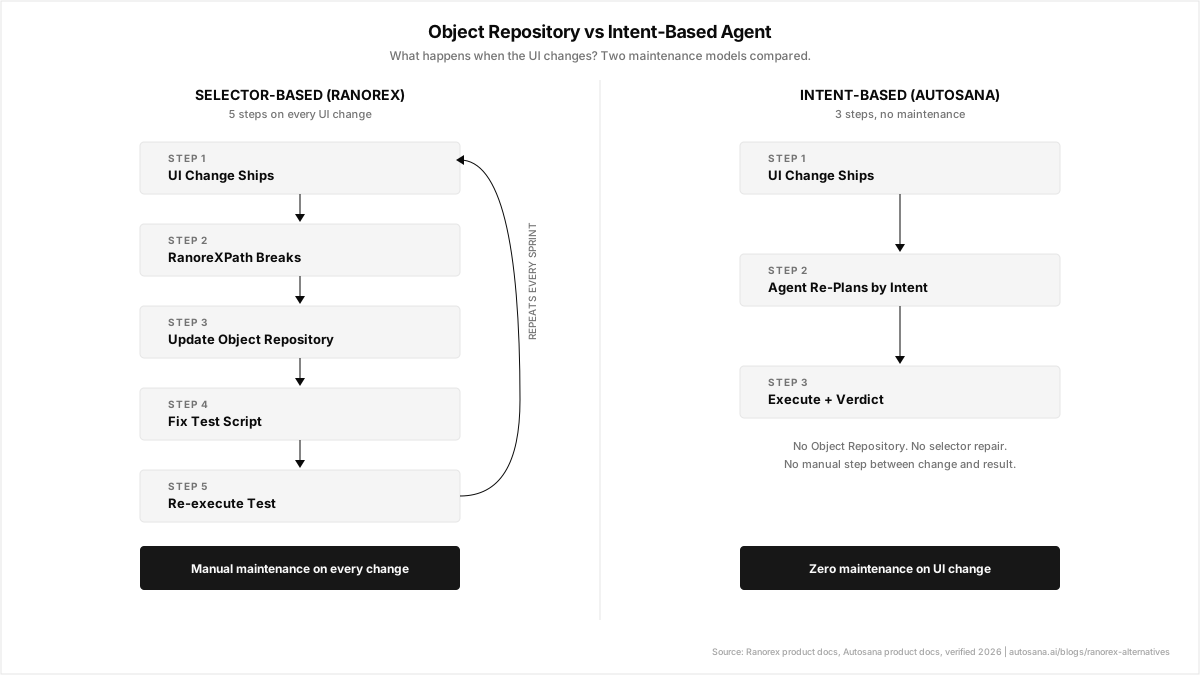
- RanoreXPath Object Repository maintenance. Every UI element gets identified in the Object Repository via RanoreXPath. When developers rename a component, restructure a layout, or ship a new navigation flow, RanoreXPath entries break, and the repository needs manual updates. Ranorex added machine-trained recognition and self-healing with Sembi IQ, but the fundamental model is still selector-based: find the element, store its path, and re-find it each run.
- Per-seat request pricing. Ranorex Studio Enterprise and Studio Runtime do not publish prices. Teams request quotes. At scale, per-seat licensing compounds quickly, and a tester on r/softwaretesting noted that commercial IDE tools create budget pressure that open-source alternatives avoid entirely.
- Desktop-first, web-second. Ranorex added web and mobile automation, and the Selenium WebDriver integration works. But the mental model, the Object Repository, and the IDE are all built around desktop. Teams whose primary surface is now web or mobile feel the architectural mismatch.
- No coding-agent integration. Ranorex has no MCP server, no CLI that a coding agent (Cursor, Claude Code) can invoke. For teams using AI-assisted development, the testing loop stays manual.
Self-healing inside a selector model fixes individual breaks. But the maintenance model itself, where every element needs a stored path in a shared repository, is what compounds over time. That is the honest 2026 gap.
What are the best Ranorex alternatives for web-first testing?
Playwright
Best for: teams that want to replace Ranorex's web testing with a free, open-source, code-first framework that runs on any OS and any CI.
Playwright is Microsoft's answer to the WebDriver-era tools. It connects to browsers via the DevTools protocol, ships auto-waiting for elements to be actionable, and supports Chromium, Firefox, and WebKit under a single API. Five languages (JS/TS, Python, Java, C#) mean Ranorex teams writing C# can port to Playwright with no language switch. A developer on r/programming pointed out the shift directly: modern testing tools need to work with dynamic frontends natively, and protocol-level browser control is where the reliability gains come from.
Key features:
- Auto-waiting for an actionable state (visible, stable, enabled)
- Cross-browser (Chromium + Firefox + WebKit) under one API
- Multi-language: JS/TS, Python, Java, C#
- Native parallel execution and network interception
- Codegen recorder that generates runnable test code
- Runs on macOS, Linux, and Windows (no IDE lock-in)
Pricing: free (Apache 2.0).
Limitations: no native mobile (viewport emulation only). Still selector-based at core. Smaller Stack Overflow depth than Selenium for obscure edge cases. No built-in object repository concept, though many teams consider that a feature.
Pick Playwright if you want the most capable free replacement for Ranorex's web testing, especially if your team already writes C#.
Cypress
Best for: JS/TS-first frontend teams building single-origin SPAs where local debugging speed and developer experience matter most.
Cypress runs inside the browser's event loop, enabling time-travel debugging with DOM snapshots at every step.
Key features:
- Time-travel debugging with per-step DOM snapshots
- Automatic waiting for DOM stability and XHR/fetch
- Strong plugin ecosystem (cypress-axe, cypress-visual-regression, cypress-testing-library)
- First-class TypeScript support
Pricing: free (MIT) + Cypress Cloud paid tier for parallel execution and dashboard.
Limitations: JS/TS only. Cannot automate cross-tab or cross-origin flows cleanly. WebKit/Safari is not first-class. No mobile. Parallel execution requires paid Cypress Cloud.
Pick Cypress if you are 100% JS/TS and value in-browser developer experience over cross-browser or cross-platform coverage.
What are the best Ranorex alternatives for intent-based and codeless testing?
Autosana
Best for: teams whose Ranorex pain is the Object Repository maintenance model itself and who want selectors gone entirely rather than healed.
Autosana is an AI-native E2E testing agent for web, iOS, and Android. Instead of storing element paths in an object repository and refinding them each run, Autosana runs flows by intent. You describe what the test should do, and the agent navigates the live app, identifies elements by visual and semantic context, and confirms outcomes. When the UI changes, the agent replans against whatever the current screen shows. There is no Object Repository to update, no RanoreXPath to maintain, and no selector to heal.
Self-healing fixes broken selectors. Autosana never authored selectors in the first place.
Key features:
- Natural-language test authoring with no selectors or Object Repository
- Self-healing by replanning against the current UI each run
- Web + iOS + Android from a single authoring surface
- Cloud-hosted real device testing with no driver install
- Session replay posted to every PR via GitHub integration
- MCP server for coding-agent integration (Cursor, Claude Code, and Devin invoke test runs directly)
- Per agent-run pricing, not per seat
Pricing: self-serve trial available. Per agent-run pricing on request via Book a Demo.
Pick Autosana if your team is spending more time maintaining RanoreXPath entries and the Object Repository than writing new tests. First run takes under ten minutes via the quickstart.
TestRigor
Best for: non-technical testers and business analysts who need to write tests in plain English without any code or selectors.
TestRigor lets you author tests as English sentences: "click on the login button," "enter 'john@example.com' into the email field." The tool resolves elements using AI-driven recognition rather than traditional selectors. For QA teams leaving Ranorex's Visual Test Recorder because they want something even simpler, TestRigor is the closest codeless alternative with genuine language-level abstraction.
Key features:
- Plain English test authoring
- AI-driven element recognition (no selectors)
- Cross-browser and mobile support
- Email, SMS, and 2FA testing support
Pricing: commercial (contact sales). Not free.
Limitations: English parsing can misinterpret ambiguous instructions. No MCP server. Enterprise-priced.
Pick TestRigor if your QA team is non-technical and Ranorex's Visual Test Recorder was the primary authoring mode.
What are the best Ranorex alternatives for platform IDE replacement?
Katalon
Best for: mixed-skill QA teams that want a GUI IDE similar to Ranorex with a free entry point and built-in Selenium/Appium engines.
Katalon Studio is the closest structural replacement for Ranorex Studio. It is a Java-based desktop IDE with a GUI recorder, Object Spy, and Groovy scripting fallback. Under the hood, it runs Selenium (web) and Appium (mobile). Non-coders record, developers script. Teams on r/developersIndia evaluating testing tools frequently name Katalon as the first commercial IDE they try after leaving a per-seat-licensed platform.
Key features:
- GUI recorder + Object Spy + Groovy scripting
- Built-in Selenium + Appium engines
- Cross-platform: web + mobile + API + Windows desktop
- Free Katalon Studio tier + paid Runtime Engine and TestCloud
- Katalon TestOps for reporting and analytics
Pricing: free Katalon Studio + paid Runtime Engine ($1,749/yr per license) + paid TestCloud packs.
Limitations: still selector-based at core. Free tier lacks parallel execution. iOS Object Spy is unreliable across Xcode versions. Groovy-only scripting (no C# like Ranorex).
Pick Katalon if you want the closest free equivalent to Ranorex's IDE model and accept that the underlying selector maintenance profile stays the same.
Mabl
Best for: enterprise QA teams where non-technical stakeholders author tests and ML-based self-healing is a hard requirement.
Mabl is a commercial low-code platform that applies ML-based selector healing on top of a WebDriver-style engine. When a class name changes, Mabl re-identifies elements by behavioral properties rather than the literal locator.
Key features:
- Visual test builder for non-technical authors
- ML-based self-healing selector wrappers
- Cloud-hosted grid + reporting dashboards
- Cross-browser via managed grid
- API testing and performance monitoring
Pricing: commercial (contact sales). Enterprise-priced. mabl.com
Limitations: closed-source. Self-healing works better on surface-level UI changes than deep refactors. The cost curve rises with volume. No desktop automation (WPF, WinForms).
Pick Mabl if you are an enterprise QA org where budget matters less than giving non-engineers a visual, self-healing test builder.
What are the best Ranorex alternatives for enterprise device cloud testing?
BrowserStack
Best for: teams whose Ranorex pain is device coverage, not test authoring, and who need hosted real devices at scale.
BrowserStack provides a cloud device grid with 3,000+ real device and browser combinations. You bring your own test framework (Selenium, Appium, Playwright, Cypress) and run it against BrowserStack's infrastructure.
Key features:
- 3,000+ real device and browser combinations
- Parallel execution across the grid
- Visual logs, video recordings, and network logs
- CI/CD integrations (Jenkins, GitHub Actions, Azure DevOps, CircleCI)
Pricing: paid tiers. Automate Pro starts at $249/month (public pricing). Enterprise plans on request. browserstack.com
Limitations: BrowserStack is infrastructure, not test authoring. You still write and maintain your own tests and selectors. No intent-based testing, no AI test generation.
Pick BrowserStack if your bottleneck is device coverage and infrastructure, not test authoring or maintenance.
Sauce Labs
Best for: enterprise teams that need a Virtual Device Cloud (VDC) and Real Device Cloud (RDC) with deep CI/CD integration and compliance certifications.
Sauce Labs offers a Virtual Device Cloud (VDC) for speed and a Real Device Cloud (RDC) for fidelity, with enterprise-grade compliance and failure analytics.
Key features:
- VDC (virtual devices for speed) + RDC (real devices for fidelity)
- Detailed failure analytics and error classification
- Deep CI/CD pipeline integration
- SOC 2 compliance and enterprise security features
- Supports Selenium, Appium, Playwright, Cypress, Espresso, XCUITest
Pricing: paid tiers. Enterprise plans on request. saucelabs.com
Limitations: like BrowserStack, Sauce Labs is infrastructure. You still author and maintain tests elsewhere. Pricing at enterprise scale can be significant. No test authoring or intent-based capabilities.
Pick Sauce Labs if you need enterprise-grade device infrastructure with compliance certifications and deep failure analytics.
How to choose the right Ranorex alternative for your team
The decision is not "which tool is better than Ranorex." It is "which specific Ranorex cost are you paying too much for."
- "RanoreXPath breaks every sprint and the Object Repository is a bottleneck." Autosana. The only tool on this list that eliminates selectors and the Object Repository model structurally. Intent-based authoring means no paths to maintain.
- "We want free, code-first web testing without a proprietary IDE." Playwright. Same C# language support as Ranorex, zero license cost, runs on any OS.
- "JS/TS shop, love the in-browser debugging." Cypress.
- "We want an IDE like Ranorex but with a free tier and broader ecosystem." Katalon.
- "Our testers are non-technical and the recorder was the main authoring mode." TestRigor or Mabl.
- "Our problem is device coverage, not test authoring." BrowserStack or Sauce Labs.
- "We use coding agents and need the testing loop to close automatically." Autosana's MCP server lets Cursor, Claude Code, and Devin invoke test runs and get structured results back.
The answer depends on how much of the Ranorex model you want to keep. Katalon keeps the IDE. Playwright keeps code-first. Autosana drops selectors entirely.
The honest answer to which Ranorex alternative wins in 2026
Ranorex is not outdated. It is category-specific: built for Windows desktop automation with a shared Object Repository that made sense when a small team maintained a stable UI. For that use case, Ranorex with Sembi IQ remains competitive.
Most teams leaving in 2026 have a test surface that outgrew the IDE. The Object Repository is the maintenance bottleneck compounding sprint after sprint. The fix depends on how much of the model you want to keep. Katalon keeps the IDE. Playwright keeps code-first. Autosana drops the selector model entirely, runs by intent, and posts session replay to the PR.
Self-healing fixes selectors. Autosana removes selectors. That is the structural difference.
.png)
Frequently asked questions
What is the best free alternative to Ranorex Studio?
Playwright for web testing (Apache 2.0, 5 languages including C#, cross-browser) and Katalon Studio free tier for a closest-match IDE experience. Both are genuinely free for individual and team use. Cypress is free for JS/TS teams. None of these replace Ranorex's Windows desktop automation (WPF, WinForms) at zero cost.
Can Playwright replace Ranorex for web testing?
Yes for web. Playwright supports C# (same as Ranorex), ships auto-waiting, handles cross-browser natively, and runs on macOS, Linux, and Windows. It does not replace Ranorex's desktop automation (WPF, WinForms, Win32) or its shared Object Repository model. You write selectors in code instead.
Is Ranorex still worth using in 2026?
For Windows desktop automation (WPF, WinForms, Win32, legacy .NET), Ranorex with Sembi IQ remains one of the strongest tools available. The question is whether your primary test surface is still desktop. If it has shifted to web and mobile, a modern alternative likely fits better and costs less per year.
Does Autosana work for desktop application testing?
Autosana covers web, iOS, and Android. It does not automate Windows desktop applications (WPF, WinForms, Win32). For teams whose test surface is primarily web and mobile, Autosana replaces the RanoreXPath and Object Repository maintenance model with intent-based testing. For desktop-only surfaces, consider Katalon or WinAppDriver.
What is the cheapest Ranorex alternative for small teams?
Playwright (free, open-source) for web. Katalon Studio free tier for a GUI IDE. Cypress (free, MIT) for JS/TS teams. All three cost zero to start. Autosana offers a self-serve trial with per agent-run pricing that avoids Ranorex's per-seat minimums.
How does Ranorex compare to Katalon Studio?
Both are GUI IDEs with recorders, object repositories, and scripting fallbacks. Ranorex uses C# and RanoreXPath; Katalon uses Groovy and built-in Selenium/Appium. Ranorex excels at Windows desktop; Katalon has a free tier and broader web/mobile ecosystem. Katalon replaces the IDE model. Neither removes the selector model.
Can coding agents like Cursor or Claude Code run Ranorex tests?
Not directly. Ranorex does not offer an MCP server or a CLI designed for coding-agent invocation. Autosana ships an MCP server that lets coding agents invoke test runs, receive structured pass/fail results, and iterate on failures automatically.
What replaced Ranorex's Object Repository in modern testing?
Code-first tools (Playwright, Cypress) skip the shared object repository and embed selectors directly in test code. AI-native tools like Autosana skip selectors entirely and use intent-based element resolution. The shared object repository solved a real problem (centralized selector management) but created a new one (centralized maintenance bottleneck at scale).