
QA Outsourcing Services in 2026: In-House vs. Outsourced QA
QA outsourcing services cost more than the rate card shows. A breakdown of engagement models, the real loaded cost per tester, SOW clauses that matter, and what never to outsource.
Yuvan Sundrani · 19 min read
autosana.ai
QA outsourcing services supply external testers, test management, and sometimes automation engineering, usually through staff augmentation, a managed offshore pod, or crowdtesting. Rate cards run roughly $18 to $55 per hour offshore and $60 to $120 nearshore, but loaded cost lands 40 to 70 percent above the invoice once coordination, ramp, and rework are counted. The work that actually gets sent out is regression, and regression is the layer that no longer needs a human pod.
Key Takeaways
- Most teams buy QA outsourcing as a cost decision, then discover it was a capacity and coverage decision. The invoice is the smallest part of the bill.
- 70 percent of executives have selectively insourced work they previously outsourced, per the Deloitte Global Outsourcing Survey 2024. Reversal is the norm, not the exception.
- Exploratory testing, domain judgment, and release sign-off transfer badly. Regression execution, device matrix coverage, and localization sweeps transfer well.
- The contract decides the outcome more than the vendor does. Test artifact ownership, automation IP, data processing terms, and exit handover are the four clauses that get skipped.
- Autosana covers the regression layer teams usually outsource by running an AI E2E testing agent against every pull request on iOS, Android, and web, so the offshore pod is not the only way to get overnight coverage.
Which QA outsourcing model fits which problem?
| Model | One-Line Position | Verdict |
|---|---|---|
| Staff augmentation | Individual contract testers embedded in your team, your process, your tooling | Best when you know exactly what you want tested and just lack hands. Worst value when you expect the contractor to define strategy. |
| Managed QA pod (offshore agency) | A vendor-managed team of 4 to 10 with its own lead, reporting into your release cycle | Real leverage on large regression suites. Coordination cost rises fast when your product changes weekly. |
| Crowdtesting | A distributed tester network running scripted passes on real devices. Applause, Global App Testing, Ubertesters | Strong for device and geography breadth in a single burst. Weak for anything needing product context. |
| QA as a service (QAaaS) | Retained vendor owning a defined scope, priced per cycle or per release | Predictable cost. Only works if your scope is genuinely stable. |
| In-house QA hire | One senior QA engineer owning strategy, tooling, and sign-off | Highest fixed cost, highest retained context. Does not scale to a 40-device matrix alone. |
| Autosana | AI E2E testing agent that authors and self-heals flows across iOS, Android, and web, and runs them on every PR | Covers the regression layer teams usually buy a pod for. Not a substitute for exploratory testing or domain sign-off. |
What are QA outsourcing services and what do they actually cover?
The category name hides a wide spread. A vendor selling "QA outsourcing services" may be selling contract testers by the hour, a managed pod with its own delivery lead, a crowdtesting network, or an automation engineering retainer. These are four different purchases with four different failure modes, and the pricing page rarely distinguishes them.
What nearly every engagement includes: functional test case execution, regression passes before a release, defect logging against your tracker, device and browser matrix coverage, and a status report. What is usually excluded unless negotiated: test strategy, release sign-off authority, production incident triage, and ownership of the automation code that gets written along the way.
The trigger for buying is almost always the same. A founder on r/startups put the shape of it plainly while shipping a hybrid mobile app to both stores, saying that with the variety of devices and user skill levels out there, two people could not reasonably provide enough testing, and that friends-and-family testing has known problems. That thread's shortlist ran through Applause, Global App Testing, Ubertesters, and usertesting.com, which is roughly the same shortlist a pre-launch team builds today.
The device matrix is the honest driver. Android's compatibility guidance exists because screen sizes, API levels, and OEM skins diverge in ways no small team can cover manually. On iOS the constraint is different but still real, since TestFlight caps external testers and build availability windows. Outsourcing is one way to buy coverage across that surface. Running the same flows on a real device cloud is another. It is not the only one.
How much do QA outsourcing services cost?
Rate cards are public and misleading. The number that matters is loaded cost per effective tester-hour, and it includes four line items that never appear on the invoice.
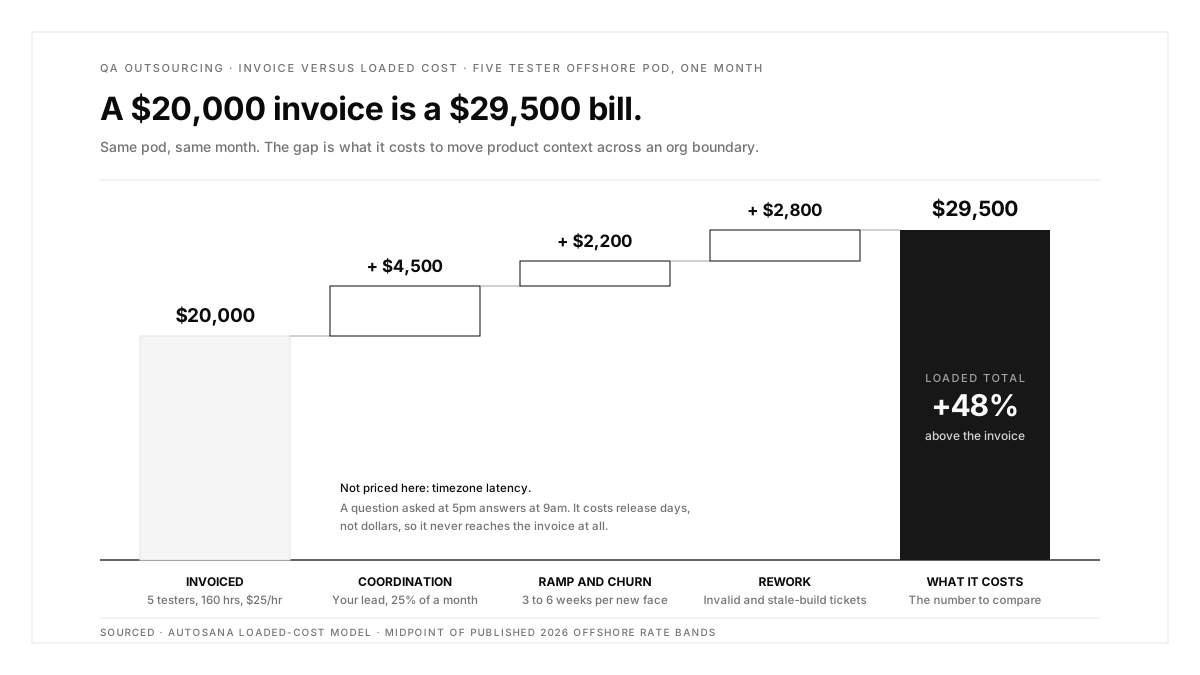
The loaded cost model. For a managed offshore pod of five testers billed at $25 per hour, 160 hours per month each:
| Cost Line | What It Is | Typical Monthly Load |
|---|---|---|
| Invoiced rate | 5 testers × 160 hrs × $25 | $20,000 |
| Coordination overhead | Your eng manager or QA lead spending 20 to 30 percent of their time on specs, triage, and clarifications | $3,500 to $5,500 |
| Timezone latency | A question asked at 5 pm answers at 9 am. Cost shows up as blocked release days, not hours | 1 to 3 release-days per month |
| Ramp and churn | Every vendor roster change costs 3 to 6 weeks of product context | 8 to 15 percent of annual spend |
| Rework | Defects filed against stale builds, duplicate reports, false positives | 10 to 20 percent of filed tickets |
| Loaded total | $28,000 to $34,000 for a $20,000 invoice |
That is a 40 to 70 percent gap between the quoted number and the real one. It is not vendor dishonesty. It is the structural cost of moving product context across an org boundary, and it is the number to compare against any alternative.
Rate bands as of 2026, for orientation: offshore roughly $18 to $55 per hour depending on seniority and whether automation is included, nearshore roughly $45 to $80, onshore contract roughly $60 to $120. Crowdtesting is usually priced per test cycle or per bug rather than hourly.
Worth noting what the buying motive actually is now. The Deloitte survey of more than 500 executives found 80 percent planning to maintain or increase third-party investment, while only 25 percent reported seeing reductions in vendor service cost or improvement in service quality from AI-enabled outsourcing. The spend is growing. The measured return is not keeping pace.
What should you outsource to a QA vendor and what should you never outsource?
The split is not about seniority. It is about whether the work depends on context that lives inside your team.
Transfers well:
- Regression execution against a written suite
- Device and OS matrix sweeps
- Localization and currency formatting passes
- Accessibility audits against a published checklist such as WCAG 2.2
- Compatibility testing on legacy OS versions
- Load and volume test execution from a defined plan
Transfers badly:
- Exploratory testing, which depends on knowing what normally happens
- Release sign-off, because accountability cannot be invoiced
- Defect severity triage, which is a product judgment call
- Test strategy for a product the vendor has used for six weeks
- Anything touching production data without a processing agreement in place
That last point is a legal boundary, not a preference. Handing a vendor production-like data makes them a processor under GDPR Article 28, which requires a written contract specifying subject matter, duration, nature and purpose of processing, and the categories of data subjects. Plenty of QA engagements run on lightly masked production dumps with none of that paperwork in place.
The pattern that shows up over and over in practitioner threads is the full-function handover rather than the capacity top-up. A QA lead on r/QualityAssurance described managing a team of ten before the entire QA department was declared obsolete and outsourced. That is not a capacity decision. That is a transfer of judgment, and judgment is the part that does not survive the move.
Why do QA outsourcing engagements fail?
Four failure modes account for most of it, and only one of them is about tester skill.
QA was classified as a cost center. A practitioner on r/softwaretesting framed the cycle precisely, noting that this is a never-ending loop driven by cost reduction, particularly where testing is treated as a cost center rather than a value add, and that some teams manage it effectively while for others the jobs come back. The Deloitte finding that 70 percent of executives have selectively insourced previously outsourced work is the same observation with a sample size.
Nobody owns the consequence of a miss. The top comment on a r/softwaretesting thread about cutting QA spend made the uncomfortable point that there is usually no penalty on companies for these failures, because customers have little recourse beyond complaining or opening a ticket, so nothing hits the bottom line unless the failure is large enough to make the news. When the downside is diffuse, the cheapest QA option wins by default.
The suite the vendor inherits is already the problem. Outsourcing a flaky selector-based regression suite exports the flake along with the work. The pod then spends its hours re-running failures and filing tickets that are not bugs, which is exactly the rework line in the cost model above. Fixing suite quality before the handover is worth more than picking a better vendor. That is also why regression testing strategy belongs to your team even when execution does not.
Second-hop offshoring. The cost floor keeps moving. One engineer on r/softwaretesting described an entire Philippines-based team, developers and QA together, being cut when the company moved to a cheaper country and an AI-first pipeline. If the engagement was won on price alone, it can be lost on price alone, and your product context leaves with it.
What should be in a QA outsourcing contract?
This is the part that gets skipped, and it decides the outcome more than vendor selection does. Nine clauses, in the order they cause trouble.
- Test artifact ownership. Cases, plans, and results are yours on day one, in a documented structure. ISO/IEC/IEEE 29119-1:2022 is the reference standard for what that documentation should contain, and naming it in the SOW removes the argument later.
- Automation IP. If the vendor writes automation, specify that the code, the fixtures, and the CI configuration are work for hire and delivered in your repository, not theirs.
- Data processing terms. A GDPR Article 28 processor agreement, plus an explicit rule on whether production data may enter test environments and in what masked form.
- Defect SLA with severity definitions you wrote. Not the vendor's severity ladder. Yours.
- Device matrix ownership. Who decides the matrix, who pays when it changes, and what happens when a new flagship device ships mid-contract.
- Roster stability and named leads. A minimum tenure commitment and notice period on the delivery lead. Roster churn is the ramp cost line.
- Environment and build access. Which environments, which build channel, and the turnaround commitment when a build is broken.
- Escalation path with a human name. Not a shared inbox.
- Exit handover. What you receive on termination, in what format, within how many days. Without this clause, leaving a vendor costs a quarter.
If a vendor resists clause 1, 2, or 9, that is the answer to the evaluation.
Should you outsource QA or automate the regression layer?
Use this as a branching decision rather than a preference.
Use staff augmentation if your test strategy is settled, your suite is stable, and you need two to four more pairs of hands for a fixed period. Keep strategy and sign-off in-house.
Use a managed offshore pod if you run a large manual regression suite, release on a monthly or slower cadence, and can fund a named QA lead on your side to own the relationship. Expect the loaded cost, not the invoice.
Use crowdtesting if your bottleneck is device and geography breadth in a short window, typically a pre-launch sweep or a seasonal event. Do not expect product context.
Use QA as a service if your scope genuinely does not change between releases. Most product teams shipping weekly discover it does.
Hire in-house if the work requiring judgment (exploratory testing, severity calls, release decisions) is what is missing. That is not purchasable by the hour.
Automate the regression layer if what you are actually buying is overnight coverage of flows you already know. This is the case more often than teams expect, because the regression pass is both the largest line in the pod's hours and the most mechanical.
A QA engineer on r/QualityAssurance described exactly that shift, moving from writing test plans and manually executing them over days to generating and running the pass against a PR, with manual coverage reserved for the rare gap. The same thread's top comment set the honest boundary: it does the heavy lifting, but it cannot be left alone and still needs exploratory testing alongside it. Both halves of that are true.
Autosana sits on the automation side of that fork. An AI E2E testing agent authors flows as intent rather than selectors, re-anchors them when the UI changes, and runs them against iOS, Android, and web on every pull request through CI integration, returning session replay in the PR comment. The Ziina case study covers what that looks like on a fintech mobile app. For teams still running a human pass, the manual mobile app testing guide covers what belongs in it.
Where does Autosana not fit in a QA outsourcing decision?
Honest limits, because these are the cases where a vendor is genuinely the right purchase.
- Exploratory testing and domain judgment. An agent executes intent. It does not develop a suspicion that a number looks wrong for a Tuesday.
- Compliance attestation requiring a named human signatory. Some regulated release processes need a person to sign. That is a role, not a test.
- Hardware-in-the-loop and physical peripherals. Card readers, scanners, IoT pairing rigs, and anything needing a hand on a device.
- Usability and UX research. Crowdtesting and moderated research answer questions an E2E agent cannot ask.
- Game engine internals and GPU shader validation. Rendering correctness at the frame level is a different discipline.
- Manual localization judgment. An agent can check that a string fits. It cannot tell you the translation is subtly insulting.
Teams that get the most out of both usually split it this way: the agent owns regression and the device matrix, a small in-house QA function owns strategy and sign-off, and a vendor is retained for burst exploratory and usability work rather than for the weekly pass.
Conclusion
QA outsourcing services solve a capacity problem and are usually bought as a cost problem, which is why the reversal rate is so high. Split the work by whether it depends on internal context: send out what is written down, keep what requires judgment, and write the contract clauses for artifact ownership, automation IP, and exit handover before you compare rate cards. If the honest answer is that you are buying overnight coverage of flows you already know, that is an automation purchase wearing a services invoice.
Frequently asked questions
What are QA outsourcing services?
External providers supplying software testing capacity, delivered as contract testers embedded in your team, a vendor-managed offshore pod, a crowdtesting network, or a retained per-release service. Scope typically covers functional execution, regression passes, device coverage, and defect logging. Strategy and release sign-off are usually excluded unless negotiated explicitly.
How much does it cost to outsource QA?
Offshore rate cards run roughly $18 to $55 per hour, nearshore $45 to $80, onshore contract $60 to $120. Loaded cost lands 40 to 70 percent higher once coordination time, timezone latency, roster ramp, and rework on invalid defects are included. Budget against the loaded figure.
Is outsourcing QA a good idea for a startup?
For a burst need such as a pre-launch device sweep, yes. For ongoing weekly release coverage, the coordination overhead usually exceeds the saving at small team sizes. Startups shipping weekly tend to get more from automating the regression layer and retaining one in-house QA owner.
What should you never outsource to a QA vendor?
Exploratory testing, defect severity triage, release sign-off, and test strategy. All four depend on context that lives inside your team. Also avoid sending production data to any vendor without a GDPR Article 28 processor agreement and a documented masking rule.
Can Autosana replace an outsourced QA team?
It replaces the regression layer most pods spend their hours on. Autosana's agent runs authored flows across iOS, Android, and web on every pull request and self-heals when the UI changes, so overnight coverage does not require a night-shift pod. Exploratory testing and sign-off still need people.
How do you measure whether QA outsourcing is working?
Track critical defects caught before release, escaped defect rate by severity, valid-to-invalid ticket ratio, and release days blocked on vendor turnaround. The ratio of valid to invalid tickets is the earliest signal that context transfer has failed.
What is the difference between managed QA services and staff augmentation?
Staff augmentation places individuals under your management, your process, and your tooling. Managed QA services place a vendor-led team that owns its own delivery process and reports outcomes. Augmentation keeps control and coordination cost with you. Managed services move both, which is why scope clarity matters more.
How long does it take to onboard a QA outsourcing vendor?
Three to six weeks before output is trustworthy on a product of moderate complexity, and the same cost repeats on every roster change. Factoring ramp into the annual number is what separates a realistic comparison from a rate-card comparison.