
8 Best mabl Alternatives for AI Test Automation in 2026
mabl's AI heals stored test artifacts, with contact-sales pricing and credit limits that bite at scale. This guide sorts eight alternatives by what the AI actually operates on: the test artifact or the app itself.
Yuvan Sundrani · 17 min read
autosana.ai
The best mabl alternatives in 2026 split along one axis most comparison pages miss: what the AI agent actually operates on. Some alternatives (Katalon, TestRigor, Functionize) mirror mabl's shape and use AI on the test artifact. One (Autosana) removes the artifact entirely and uses AI on the app itself. Two (Playwright, Cypress) skip AI authoring and give you code-first control at zero license cost. Two more (BrowserStack, Sauce Labs) add the full device cloud mabl does not include. This guide ranks all 8 by that split and helps you pick the right definition of "agentic" for your pipeline.
Key Takeaways
- mabl's "agentic" means AI that creates, heals, and manages stored tests. The team still owns the test artifact and the credit spend that scales with cloud runs (~$450/mo entry, 500 cloud credits).
- Katalon, TestRigor, and Functionize follow the same shape: AI assists test authoring, but a stored test remains the unit of work the team maintains.
- Playwright and Cypress skip AI authoring entirely, giving you code-first control at zero license cost across five languages or JS/TS.
- BrowserStack and Sauce Labs solve the device-coverage gap with thousands of real browsers and devices, not the authoring gap.
- Autosana takes the other definition of agentic: the agent reads the PR diff, runs the flow by intent with no stored test, self-heals in-run, and posts the verdict back to the PR via MCP.
Quick comparison: 8 mabl alternatives ranked
| Tool | Category | AI Authoring | Pricing Model | Best For |
|---|---|---|---|---|
| Autosana | AI-native agent (works on the app) | Intent-based, no test artifact | Per agent-run, self-serve trial | Teams that want zero test maintenance on every PR |
| Playwright | Code-first framework | None (codegen recorder only) | Free (Apache 2.0) | Direct code-first upgrade, 5 languages, cross-browser |
| Cypress | Code-first framework | None | Free (MIT) + paid Cloud | JS/TS teams, time-travel debugging, SPA testing |
| TestRigor | AI on the test (plain English) | Plain English test steps | Per-run, free trial | Non-technical authors, broad coverage in plain English |
| BrowserStack | Device cloud + automation | Percy visual AI | Contact sales, free trial | Cross-browser and device matrix at enterprise scale |
| Sauce Labs | Device cloud + automation | AURA AI assistant | Contact sales, free trial | 10,000+ device combos, regulated industries |
| Functionize | AI on the test (ML-driven) | ML intent recognition | Contact sales | Enterprise web UI teams wanting ML-based authoring |
| Katalon | Low-code platform + AI | AI-assisted codeless + Groovy | Free Studio + paid ($1,749/yr) | Mixed-skill QA teams on existing Selenium/Appium stacks |
Why are teams looking for MABL alternatives in 2026
- Contact sales for pricing with credit limits. No public tiers on the pricing page. Aggregators report entry around $450/month bundling 500 cloud test-run credits. Local runs and concurrency are unlimited, but cloud credits are the constraint that bites at scale. One team on r/QualityAssurance raised the authoring-surface question directly: how do teams keep tests coherent as the suite grows inside a credit-gated cloud?
- Trainer desktop app overhead. mabl's point-and-click Trainer records tests locally before pushing them to the cloud. For engineering teams already shipping PRs through Cursor or Claude Code, installing a desktop recorder to author tests is a step backward in the workflow.
- Credit overages at scale. 500 cloud credits per month works for adoption. Teams running 50+ flows on every PR against staging, preview, and production burn credits fast. The cost curve bends in ways that are hard to predict without a sales conversation.
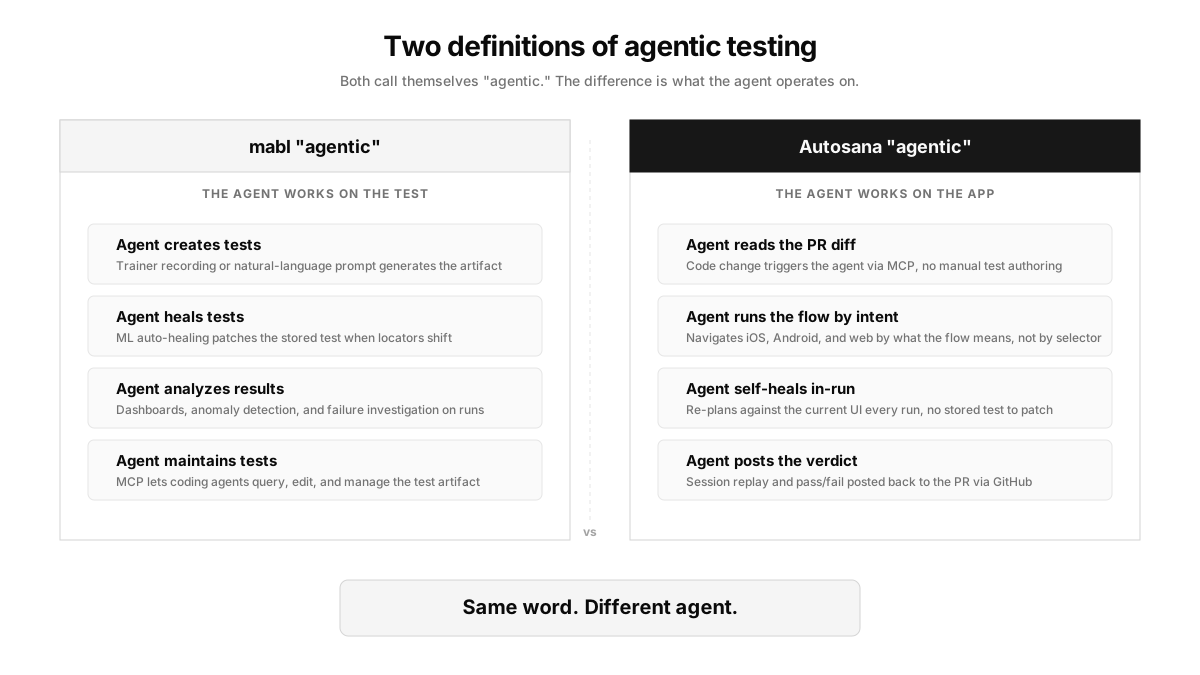
- "Agentic" means the test artifact, not the app. mabl's agents autonomously create, run, analyze, and maintain tests. Every verb's object is the stored test. The team owns that artifact, approves heal-patches, and manages the workflow around it. A thread on r/QualityAssurance captured the community actively sorting through what "agentic" means in practice for QA.
None of these are quality complaints. The alternative search starts when the team's shape no longer matches mabl's pricing model, authoring surface, or definition of "agentic."
Which mabl alternative uses AI on the app instead of the test
This is where the structural split matters. Everything above this section follows mabl's model: AI works on the stored test artifact. Here is the category where AI works on the app itself.
The contrarian reframe: mabl heals the test. Autosana removes the test.
Autosana
Best for: teams shipping iOS, Android, or web weekly or faster, where the bottleneck is human-in-the-loop test authoring and the goal is zero test artifact between the PR and the verdict.
Autosana is a cloud-hosted AI agent that tests apps the way a user would. Describe a flow in natural language or hand the agent a code diff. No test artifact exists between the intent and the execution. When the UI changes, the agent re-anchors to whatever element matches the intent at runtime.
The MCP server is the load-bearing difference. mabl's MCP server connects coding agents (Claude, Cursor, Copilot, Windsurf, Rovo) to the test artifact: query results, investigate failures, author and edit tests. Autosana's MCP server connects coding agents to the app itself: PR opens, agent reads the diff, runs the flow by intent across iOS, Android, and web, and posts a video plus verdict back via GitHub integration. Both ship documented MCP servers in 2026. Same protocol, different job.
- Intent-based flows, no selectors, no scripts, no stored test
- Self-healing by re-planning against the current UI every run
- Hosted real device testing for iOS and Android included in trial
- Session replay posted to every PR via GitHub integration
- Per agent-run pricing, self-serve trial
Pricing: per agent-run with a self-serve trial. The cost scales with PR volume, not editor seats or credits. Book a demo for a per-run quote against your pipeline.
Pick Autosana if your mabl complaint is the artifact itself. If maintaining, healing, and managing stored tests is the cost you want gone, removing the artifact is the structural fix. The quickstart walks through first run in under 10 minutes.
Which mabl alternatives use AI on the test artifact
These three follow mabl's fundamental model: AI assists the authoring, healing, and management of stored tests. The team still owns a test artifact. The agent works on the test, not on the app.
Katalon
Best for: mixed-skill QA teams with existing Selenium and Appium investments that want a GUI plus AI layer without abandoning their ecosystem.
Katalon Studio is a Java-based desktop IDE built on Selenium (web) and Appium (mobile). Author by recording, keyword library, or Groovy script. AI assists via StudioAssist (2026), but the underlying engine remains WebDriver. Katalon inherits Selenium's core failure modes, especially selector fragility on refactors, with a more accessible wrapper on top.
- Bundled Selenium + Appium engines with GUI recorder and Object Spy
- Katalon TestOps for reporting and TestCloud for hosted grid
- Cross-platform: web, mobile, API, Windows desktop
- AI-assisted authoring via StudioAssist
Pricing: free Katalon Studio + paid Runtime Engine ($1,749/yr per license) + paid TestCloud packs.
Limitations: still selector-based underneath. Free tier lacks parallel execution. iOS Object Spy has known compatibility issues across Xcode versions.
TestRigor
Best for: teams where plain English test authoring is the priority and coverage must span web, mobile, API, and desktop under one surface.
TestRigor lets non-technical team members write tests in plain English sentences that the platform interprets into executable steps. A contributor on r/Everything_QA listed TestRigor among the tools leading the shift to AI-driven testing. The authoring surface differs from mabl's Trainer, but the output is the same: a stored test the team manages.
- Plain English test authoring with no code and no selectors in the authoring layer
- Web, mobile (native + hybrid), API, and desktop coverage
- Self-healing via NLP-based element identification
- Email and SMS testing built in
Pricing: per-run pricing with a free trial. Contact sales for enterprise volume.
Limitations: stored tests still require maintenance when business logic changes. English-language dependency means non-English UIs need workarounds. Advanced conditional logic can push against the plain-English model.
Functionize
Best for: enterprise web UI teams that want ML-driven intent recognition for test creation and adaptive self-healing.
Functionize brands itself the "Agentic Quality Platform" and uses machine learning to create tests from user demonstrations. The platform identifies user intent and builds tests that adapt when the UI shifts. The output is a managed test artifact, but the authoring leans more on observed behavior than point-and-click recording.
- ML-driven test creation from observed interactions
- Visual testing and performance monitoring bundled
- NLP-based test authoring
- Self-healing via intent recognition
Pricing: contact sales. Enterprise-priced.
Limitations: primarily web UI focus. Mobile and API coverage is narrower than mabl or TestRigor. Smaller community footprint. Pricing transparency is limited.
Which mabl alternatives skip AI authoring entirely
Not every team wants AI in the test-authoring loop. Some want full code-level control, zero license cost, and a framework they own end to end. These two are the standard answers for teams leaving mabl for a code-first path.
Playwright
Best for: teams that want a code-first, cross-browser framework with auto-waiting, DevTools protocol speed, and five-language support at zero cost.
Playwright is Microsoft's answer to Selenium. It connects to browser internals via the DevTools protocol, ships auto-waiting for elements to be actionable, and supports Chromium, Firefox, and WebKit under a single API. A team on r/Playwright documented migrating 500+ mabl tests to Playwright, noting that the biggest challenge was not translating individual test steps but preserving test coherence during the artifact migration. mabl documents a Playwright migration path on its own site, which tells you how common this exit is.
- Auto-waiting for actionable state (visible, stable, enabled)
- Multi-browser: Chromium + Firefox + WebKit under one API
- Multi-language: JS/TS, Python, Java, C#
- Native parallel execution, network interception, codegen recorder
- Free (Apache 2.0)
Pricing: free.
Limitations: still selector-based at the core. Auto-waiting solves timing but not "the button was renamed." No native mobile testing (viewport emulation only). Smaller Stack Overflow depth than Selenium for edge cases.
Cypress
Best for: JS/TS-first frontend teams building single-origin SPAs where local debugging speed and developer experience matter more than cross-browser reach.
Cypress runs inside the browser's event loop, which unlocks its time-travel debugging with DOM snapshots per step. A tool-evaluation thread on r/softwaretesting includes Cypress as a recurring recommendation for teams prioritizing developer experience and fast local feedback loops over enterprise feature breadth.
- Time-travel debugging with DOM snapshots at every step
- Automatic waiting for DOM stability and XHR/fetch requests
- Strong plugin ecosystem (cypress-axe, cypress-visual-regression, cypress-testing-library)
- First-class TypeScript support out of the box
Pricing: free (MIT) + Cypress Cloud paid tier for parallel execution and dashboard.
Limitations: JS/TS only. Cannot automate cross-tab or cross-origin flows cleanly. WebKit/Safari desktop testing is not first-class. Parallel execution requires paid Cypress Cloud.
[CTA BANNER #2 · INSERT SVG HERE] Headline: "Two 'agentic' tools. Different agents." Body: "mabl's agents work on the test. Autosana's agent works on the app." Button: Book a Walkthrough linking to https://autosana.ai/book-a-demo
Which mabl alternatives include a full device cloud
mabl runs cloud tests on its own infrastructure, but it is not a device farm. If your bottleneck is coverage across thousands of browser and OS combinations or real-device mobile testing at enterprise scale, these two sit in a different category entirely.
BrowserStack
Best for: teams that need cross-browser and cross-device coverage at scale, with visual testing (Percy) and test observability under one vendor.
BrowserStack provides 2,000+ real device and browser combinations. Percy handles visual regression. The Observability product surfaces flake patterns and failure analytics. BrowserStack is infrastructure: bring your own framework (Selenium, Playwright, Cypress, Appium) and run it on their grid.
- 2,000+ real browsers and devices
- Percy visual AI for screenshot regression
- Test Observability for flake analytics and failure patterns
- Integrations with Selenium, Playwright, Cypress, Appium
Pricing: contact sales. Free trial available. Plans scale by parallel sessions and device access.
Limitations: you own all test authoring and maintenance. BrowserStack provides the devices, not the intelligence. Percy and Observability are add-on products. Cost scales with parallelism.
Sauce Labs
Best for: regulated industries and large QA organizations that need the widest device coverage (10,000+ combinations), error reporting, and compliance documentation.
Sauce Labs offers 10,000+ browser, OS, and real device combinations. AURA helps with test insights and failure triage. Natively supports Selenium, Playwright, Cypress, Appium, Espresso, and XCUITest.
- 10,000+ browser, OS, and device combinations
- AURA AI assistant for failure insights and triage
- Error Reporting for production crash correlation
- Supports Selenium, Playwright, Cypress, Appium, Espresso, XCUITest
Pricing: contact sales. Free trial available.
Limitations: enterprise pricing curve. Like BrowserStack, Sauce Labs provides infrastructure, not test authoring. Your team still writes, heals, and maintains the tests that run on the grid.
How do you choose between test-artifact agentic and app-execution agentic
The decision maps to where your team's time actually goes:
- "We spend most of our time writing and healing tests" and you want AI to do that faster on a stored artifact: Katalon, TestRigor, Functionize, or stay with mabl.
- "We spend most of our time writing and healing tests" and you want to eliminate the artifact entirely: Autosana. The agent runs by intent, no test to heal.
- "We want full code-level control and zero vendor lock-in" on test authoring: Playwright (5 languages, cross-browser) or Cypress (JS/TS, time-travel debugging).
- "Our bottleneck is device and browser coverage, not authoring": BrowserStack (2,000+ combos, Percy) or Sauce Labs (10,000+ combos, AURA).
- "We run coding agents (Cursor, Claude Code, Devin) and need tests that close the loop on PRs": Autosana's MCP server runs tests end-to-end when a PR opens. mabl's MCP helps the coding agent author and manage the test artifact. Different loop, different value.
If your team ships weekly or faster and already uses coding agents, the question is not "which tool helps us write tests faster." It is "do we need a test artifact at all." mabl answers yes. Autosana answers no. Both are legitimate. Pick by which "agentic" fits.
.png)
Frequently asked questions
Is mabl free in 2026?
mabl offers a 14-day free trial on paid tiers. Beyond the trial, pricing is contact-sales and credits-based. Every tier includes unlimited local runs, unlimited user licenses, and unlimited cloud concurrency. Aggregators report entry around $450/month for 500 cloud test-run credits. No self-serve signup exists for paid plans.
What is the best free alternative to mabl?
Playwright. Free under Apache 2.0, cross-browser (Chromium + Firefox + WebKit), five-language support, auto-waiting, and the largest modern testing community outside Selenium. No license cost, no credit limits, no contact-sales friction. The tradeoff is that you own all test authoring and maintenance yourself.
Can Autosana replace mabl for web and mobile testing?
For UI-driven web and mobile flows, yes. Autosana runs iOS, Android, and web by intent with no stored test artifact and no credit-based pricing. For dedicated accessibility scoring, performance benchmarking, and AI application testing, mabl covers scope Autosana does not target. If 60%+ of your mabl suite is UI flows, Autosana replaces it.
Does mabl support native mobile app testing?
Yes. Mobile app testing is one of six products under the mabl platform, covering iOS and Android via the Trainer authoring surface and cloud execution. Mobile runs consume the same cloud credits as browser tests. Coverage depth is narrower than dedicated mobile testing tools.
What does agentic testing mean in mabl compared to Autosana?
In mabl, agents autonomously create, run, analyze, and maintain tests. Every verb's object is the test artifact. In Autosana, the agent reads the PR diff, runs the flow by intent, self-heals in-run, and posts the verdict. Every verb's object is the app. Same word, different subject.
How long does a mabl migration typically take?
For a mid-size UI scope (200 to 400 flows), plan one quarter: two sprints of parallel evaluation, one sprint of critical-flow migration, two sprints of regression migration, one sprint of decommissioning. Accessibility and performance suites tend to stay on mabl during the transition.
Which mabl alternative works best with coding agents like Cursor or Claude Code?
Autosana. Its MCP server connects directly to coding agents and runs tests end-to-end when a PR opens. mabl also ships an MCP server, but it connects coding agents to the test artifact (query, author, edit) rather than running the test against the live app.
Where does Autosana not fit as a mabl replacement?
Dedicated accessibility scoring, performance benchmarking, API-only test suites, AI application testing (LLM output validation), and offline-only apps with no backend fixture story. For these scopes, mabl or specialized tools (axe for accessibility, k6 for load, Postman for API) remain the better answer.