
8 Best HeadSpin Alternatives for Mobile Testing in 2026
HeadSpin is analytics-first with 130+ KPIs, but most teams leaving it just need to know if the flow passes. This guide maps eight alternatives across functional testing, device clouds, and mobile-focused coverage.
Yuvan Sundrani · 17 min read
autosana.ai
.png)
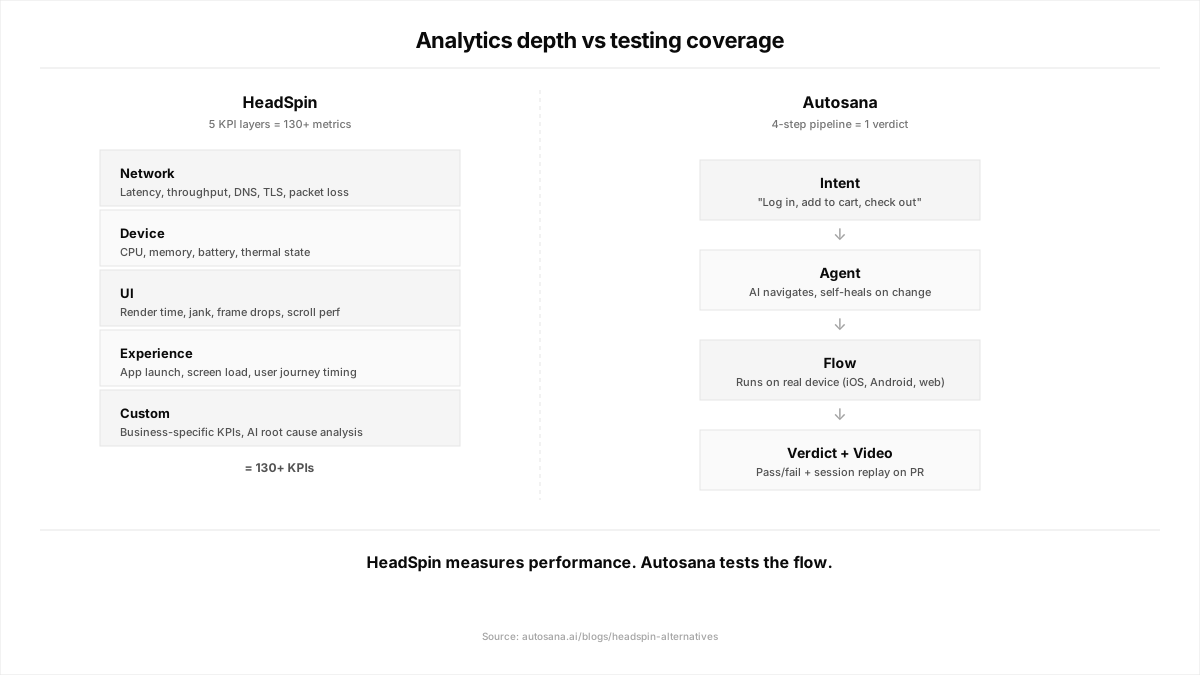
The best HeadSpin alternatives in 2026 split along a line most teams discover too late: performance analytics depth vs. functional testing coverage. HeadSpin tracks 130+ KPIs across network, device, UI, and experience layers on SIM-enabled real devices in 50+ global locations. That depth is genuinely differentiated. But most teams leaving HeadSpin are not leaving because the analytics are bad. They are leaving because they need to know whether the flow passes, not how fast the network response came back.
A QA lead on r/QualityAssurance asked the question directly: "Alternatives to HeadSpin," and the replies split between teams wanting cheaper device access and teams wanting functional E2E coverage the platform never prioritized. This guide ranks 8 alternatives across three categories and tells you which HeadSpin pain each one actually solves.
Key Takeaways
- HeadSpin is analytics-first: 130+ KPIs, AI-powered root cause analysis, Waterfall UI, and SIM-enabled devices in 50+ locations. Teams leave when analytics depth exceeds functional needs, add-on pricing stacks up, or the Lite tier (40 hrs/mo, 1 user) runs out by week two.
- BrowserStack, LambdaTest (TestMu AI), and Sauce Labs replace the device cloud with stronger functional testing infrastructure at lower cost.
- Kobiton and Perfecto cover mobile-focused teams needing on-prem device management, compliance, or accessibility testing from one vendor.
- TestRigor and Mabl provide testing-first authoring (plain English and low-code) that HeadSpin never built into its platform.
- Autosana fills the functional gap with an AI agent that runs E2E flows by intent on real devices, self-heals on UI changes, and ships an MCP server for coding-agent integration; no analytics add-ons are required.
Why teams look for HeadSpin alternatives in 2026
HeadSpin is not broken. It is a performance analytics platform that happens to offer device access. The mismatch shows up when testing teams buy it expecting a testing platform.
Analytics depth exceeds functional needs. HeadSpin's Waterfall UI, AI-powered root cause analysis, and 130+ KPIs spanning network, device, UI, experience, and custom layers are built for performance engineering. If your primary job is validating that the login flow works, the checkout completes, and the notification lands, 130 KPIs are overhead you never open. A tester on r/softwaretesting described the pattern: teams buy HeadSpin for real devices and end up paying for performance analytics they barely touch.
Add-on pricing stacks up. HeadSpin's base tiers (CloudTest Lite at $39/mo, Go at $83/mo, and Pro on custom pricing) look reasonable until you need Automation+, Experience+, Performance+, Media+, or Monitoring+. Each add-on unlocks a capability most device clouds bundle by default. The compounding cost shows up on the invoice before it shows up in the dashboard.
Base tier limitations hit fast. CloudTest Lite includes 1 user, 40 hours per month, and 17 locations. For a QA team of three running daily smoke suites, 40 hours runs dry by sprint midpoint. CloudTest Go removes the usage cap but still requires add-ons for automation features most competitors include.
No MCP, no coding-agent integration. HeadSpin supports 60+ automation frameworks but has no MCP server and no path from "coding agent ships a PR" to "HeadSpin validates it." A developer on r/reactnative described the gap: the device infrastructure exists, but the intelligent authoring layer to drive it is missing.
The contrarian reframe: HeadSpin measures how the app performs. Most teams need to know if the flow passes. Those are different problems, and they need different tools.
Quick comparison: the 8 HeadSpin alternatives ranked
| # | Tool | Category | What It Replaces | Pricing | When to Pick |
|---|---|---|---|---|---|
| 1 | Autosana | AI-native agent | Functional E2E testing gap | Per agent-run | Flow validation on real devices, MCP integration |
| 2 | BrowserStack | Device cloud | Device access + functional testing | From $29/mo | Broadest device fleet, Percy visual regression |
| 3 | LambdaTest (TestMu AI) | Device cloud + AI | Device access at lower cost | Free tier + paid | Budget-conscious, 10,000+ combos |
| 4 | Sauce Labs | Device cloud + analytics | Enterprise device cloud | Contact sales | Enterprise compliance, error analytics |
| 5 | Kobiton | Mobile-focused cloud | On-prem real devices | Contact sales | On-prem device lab, 7,000+ devices |
| 6 | Perfecto | Mobile-focused cloud | Enterprise mobile + desktop | Enterprise licensing | Regulated industries, accessibility testing |
| 7 | TestRigor | Plain English testing | Test authoring layer | From $300/mo | Non-technical authors, plain English |
| 8 | Mabl | Low-code + AI | Test authoring + self-healing | Contact sales | Enterprise QA, low-code authoring |
Best HeadSpin alternatives for functional E2E testing
HeadSpin's functional testing layer is thin by design. It runs your Appium or Espresso scripts on real devices, but it does not author, maintain, or heal the tests. These three tools do.
1. Autosana AI-native E2E testing on real devices
Best for: teams whose HeadSpin pain is functional testing coverage, not performance analytics depth.
Autosana is an AI E2E testing agent that runs flows by intent on hosted real devices. You describe the flow ("log in, add item to cart, check out with a saved card"), and the agent navigates the live app the way a user would. When the UI changes, a button moves, a modal appears, a label renames, the agent re-anchors to the current screen without anyone rewriting the test.
That mechanism is what separates Autosana structurally from HeadSpin's testing surface. HeadSpin gives you real devices and expects you to bring the test. Autosana provides the testing intelligence and runs it on real devices.
Key features:
- Intent-based flow authoring: no selectors, no Appium scripts
- Self-healing on UI change across runs
- iOS, Android, and web from one authoring surface
- Session replay posted to every PR via GitHub integration
- MCP server for Cursor, Claude Code, and Devin integration
- Per agent-run pricing with no add-on tiers
Pricing: per agent run. Self-serve trial available. Book a Demo.
Pick Autosana if you need the functional testing layer; HeadSpin never prioritized it. The first run takes under ten minutes via the quickstart.
2. TestRigor
Best for: teams that want human-readable test steps without writing code or maintaining selectors.
TestRigor lets non-technical team members author tests in plain English ("Click Sign In, enter email, and verify the dashboard loads"). The platform translates those steps into executable automation. It is testing-first, whereas HeadSpin is analytics-first, and the authoring model means QA analysts who could never write Appium scripts can contribute test coverage directly.
Key features:
- Plain English test authoring
- Cross-browser and mobile execution
- Self-healing element identification
- CI/CD pipeline integration
Pricing: from $300/mo.
Limitations: plain English translation can misinterpret complex conditional flows. Less control than code-first frameworks for edge-case testing. Mobile device coverage is narrower than dedicated device clouds.
Pick TestRigor if your QA team includes non-technical authors and your HeadSpin exit is about authoring tests, not just running them on devices.
3. Mabl
Best for: enterprise QA teams that need visual test authoring plus AI-powered maintenance without HeadSpin's analytics overhead.
Mabl offers a visual test builder with ML-based self-healing for selector changes. It sits closer to HeadSpin's enterprise audience but focuses on functional testing instead of performance analytics. When developers rename a class or restructure a component, Mabl attempts to re-identify the element based on behavioral properties rather than the literal locator.
Key features:
- Visual test builder for non-technical authors
- ML-based self-healing on selector changes
- Cloud test execution and reporting dashboards
- API testing alongside UI testing
Pricing: contact sales. Enterprise-priced.
Limitations: closed-source. Self-healing is heuristic deep refactors can still break tests. Mobile device coverage is less extensive than dedicated device clouds.
Pick Mabl if you want enterprise-grade functional testing with low-code authoring and your HeadSpin exit is about the testing layer, not the device cloud.
Best HeadSpin alternatives for device cloud testing
If the exit reason is "HeadSpin's device cloud is overpriced for what we use," these three platforms provide equivalent or broader device coverage with functional testing as the focus.
4. BrowserStack
Best for: teams that need the largest device fleet for functional testing without HeadSpin's analytics premium.
BrowserStack runs Selenium, Appium, Cypress, Playwright, and Espresso tests across 3,500+ real devices and browsers. Percy handles visual regression. No performance analytics layer means no analytics premium stacked on top of device access pricing.
Key features:
- 3,500+ real devices and browsers
- Percy visual regression testing
- Multi-framework support (Selenium, Appium, Cypress, Playwright, Espresso)
- CI/CD integrations with GitHub Actions, Jenkins, CircleCI
Pricing: Live from $29/mo; Automate from $149/mo; App Automate from $199/mo.
Limitations: functional testing only; no network-level performance analytics; no AI-powered root cause analysis. Visual regression limited to Percy's pixel-diff approach.
Pick BrowserStack if you are leaving HeadSpin because you need device coverage for functional testing, not performance profiling.
5. LambdaTest (TestMu AI)
Best for: budget-conscious teams that need broad device coverage and want to explore AI-augmented testing.
LambdaTest provides 10,000+ browser and OS combinations with HyperExecute for fast parallel test runs. TestMu AI, their AI layer, adds test generation and intelligent test orchestration. A practitioner on r/devsecops described the value: broader coverage at a fraction of per-minute device cost compared to premium platforms.
Key features:
- 10,000+ browser/OS combinations
- HyperExecute for sub-minute parallel execution
- TestMu AI for AI-augmented testing and test generation
- SmartUI for visual regression
- Free tier available
Pricing: free tier; paid from $15/mo.
Limitations: AI features are newer and less mature than HeadSpin's analytics AI. Device lab depth on specific OEM models may be thinner than HeadSpin's curated fleet of SIM-enabled devices.
Pick LambdaTest if cost is the primary exit reason and you need functional testing infrastructure at the lowest price point.
6. Sauce Labs
Best for: enterprise teams that want error analytics alongside broader functional testing, without paying for HeadSpin's full performance stack.
Sauce Labs provides real devices, virtual machines, error analytics, and AI-powered failure categorization. It sits between HeadSpin (analytics-deep) and BrowserStack (analytics-light). Teams on r/QualityAssurance compared both during evaluation cycles: Sauce Labs provides enough analytics for most functional testing teams without HeadSpin's pricing.
Key features:
- Real devices + virtual cloud
- Error analytics and failure categorization
- Enterprise compliance (SOC 2, ISO 27001)
- Multi-framework support
- Visual testing
Pricing: contact sales.
Limitations: analytics depth is lighter than HeadSpin's 130+ KPIs. Pricing is still enterprise-level. Interface can feel dated compared to newer platforms.
Pick Sauce Labs if you need enterprise compliance and error analytics without HeadSpin's full performance analytics stack.
Best HeadSpin alternatives for mobile focused testing
HeadSpin's mobile focus on SIM-enabled devices, OTT platforms, and smart TVs is harder to replace. These two platforms come closest for teams where mobile-first infrastructure is the priority.
7. Kobiton
Best for: teams that need on-premises device lab management or private cloud deployment for mobile testing.
Kobiton provides 7,000+ real devices with the option to manage an on-premises lab. Its scriptless automation generates Appium scripts from manual sessions, bridging the gap for teams migrating from manual testing to automation without a full rewrite.
Key features:
- 7,000+ real devices
- On-prem Device Lab Management
- Scriptless automation (generates Appium scripts from manual sessions)
- AI-powered visual validation
- SOC 2 compliant
Pricing: contact sales.
Limitations: smaller global location footprint than HeadSpin's 50+ locations. No SIM-enabled network condition testing. Scriptless automation is entry-level compared to intent-based AI agents.
Pick Kobiton if you need on-prem device lab management or are migrating from manual to automated mobile testing and want to keep Appium as the underlying framework.
8. Perfecto
Best for: regulated industries that need mobile, desktop, and accessibility testing from one vendor with compliance-grade infrastructure.
Perfecto provides 10,000+ real device and desktop browser combinations with SOC 2, HIPAA-eligible, and FedRAMP-eligible compliance. Its accessibility testing module differentiates it from other device clouds and fills a gap HeadSpin does not address.
Key features:
- 10,000+ real devices + desktop browsers
- Private cloud and on-prem deployment options
- Accessibility testing built in
- AI-powered test analysis and reporting
- Enterprise compliance (SOC 2, HIPAA-eligible, FedRAMP-eligible)
Pricing: enterprise licensing.
Limitations: pricing is enterprise-only with no self-serve option. Setup complexity is closer to HeadSpin's than to BrowserStack's. Desktop testing is the differentiator, not mobile analytics depth.
Pick Perfecto if compliance, accessibility testing, and combined desktop + mobile coverage under one contract matter more than price.
How to choose the right HeadSpin alternative in 2026
The decision turns on which part of HeadSpin you are actually replacing.
- "We need the flow to pass, not 130 KPIs" Autosana. Intent-based AI agent runs functional E2E flows on real devices. No analytics overhead, no add-on pricing.
- "We need the device cloud at a lower price" BrowserStack (broadest fleet), LambdaTest (lowest cost), or Sauce Labs (enterprise analytics included).
- "We need on-prem device management" Kobiton. On-prem lab management plus scriptless-to-Appium bridge.
- "We need compliance-grade mobile + desktop" Perfecto. SOC 2, HIPAA-eligible, FedRAMP-eligible, with accessibility testing built in.
- "We need tests authored in plain English" TestRigor. Non-technical authors, plain English steps, no code.
- "We need low-code testing with self-healing" Mabl. Visual builder, ML-based healing, enterprise pricing.
- "We need performance analytics on real devices" Stay on HeadSpin. None of the alternatives here match its 130+ KPI depth. That is the honest answer.
- "Coding agents ship PRs and nobody tests them" Autosana. Its MCP server lets Cursor, Claude Code, and Devin trigger E2E validation runs directly from the development loop.
If your HeadSpin usage is split -- some performance analytics, some functional testing: separate the concerns. Keep performance profiling on HeadSpin's CloudTest Go tier (unlimited usage for analytics you actually use) and move functional testing to a purpose-built tool. When you tried to get one platform to do both, you ended up paying for 130 KPIs to answer one question: does the flow pass?
The honest answer to "what is the best HeadSpin alternative in 2026"
HeadSpin is an analytics platform with testing bolted on. The alternative you pick depends on which side you actually use.
If your team reads the AI root cause analysis and acts on the 130+ KPI layers every sprint, stay on HeadSpin. No alternative here matches that analytics depth.
If your team runs Appium scripts on real devices and barely touches the analytics dashboard, you are paying for 130 KPIs to answer one question: does the flow pass? Autosana answers it with an AI agent that runs flows by intent. BrowserStack answers it with the broadest device fleet. LambdaTest answers it at the lowest price. Pick the side you actually need.
.png)
Frequently asked questions
What is HeadSpin used for in 2026?
HeadSpin is a real-device testing platform focused on performance analytics. It measures 130+ KPIs across network, device, UI, and experience layers on SIM-enabled real devices in 50+ global locations. Products include the HeadSpin Platform, ACE, and CloudTest tiers (Lite, Go, Pro).
What is the cheapest HeadSpin alternative?
LambdaTest (free tier) for device access. BrowserStack (from $29/mo) for functional testing infrastructure. HeadSpin's own CloudTest Lite starts at $39/mo but caps at 1 user and 40 hours per month.
Can Autosana replace HeadSpin for functional testing?
For functional E2E testing on real devices, yes. Autosana runs flows by intent, self-heals on UI changes, and posts session replay to the PR. It does not replace HeadSpin's performance analytics layer (network profiling, 130+ KPI dashboards, AI-powered root cause analysis).
Is BrowserStack better than HeadSpin for functional testing?
For functional testing, generally yes. BrowserStack has a larger device fleet (3,500+), lower pricing, and deeper framework support for test execution. HeadSpin is better for performance analytics and network-level profiling on real carrier networks.
Does HeadSpin support MCP or coding-agent integration?
No. HeadSpin supports 60+ automation frameworks (Appium, Selenium, Espresso, XCUITest) but ships no MCP server and no coding-agent integration. Autosana ships an MCP server that lets coding agents invoke E2E runs directly.
What is the difference between HeadSpin and Sauce Labs?
HeadSpin is performance-analytics-first with 130+ KPIs across five layers. Sauce Labs is functional-testing-first with lighter error analytics. HeadSpin goes deeper on performance. Sauce Labs goes broader on testing infrastructure and framework support.
Which HeadSpin alternative is best for mobile app testing?
Depends on the need. Autosana for AI-native functional testing on real devices. Kobiton for on-prem real device labs. Perfecto for compliance-grade mobile + desktop. BrowserStack for the largest device fleet with multi-framework support.
Is HeadSpin worth the price in 2026?
For teams whose primary need is real-device performance analytics -- streaming apps, gaming, fintech apps sensitive to network conditions and rendering performance, yes. For teams primarily needing functional E2E testing, HeadSpin's analytics premium and add-on pricing make it more expensive than alternatives built for the testing layer.