
Bitrise Alternatives: 7 Mobile CI/CD Platforms Compared
Seven Bitrise alternatives compared by pricing, platform support, build speed and mobile-specific features. Covers Codemagic, GitHub Actions, CircleCI, GitLab CI, Xcode Cloud, Azure Pipelines and Fastlane.
Gautam · 14 min read
autosana.ai
Bitrise is a CI/CD platform built specifically for mobile app development, offering preconfigured build steps, managed macOS and Linux infrastructure, and integrations for iOS, Android, React Native and Flutter. Teams looking for alternatives typically want one of three things: a lower price for small projects, deeper integration with a platform they already use (GitHub, GitLab, Azure DevOps), or more control over the build environment.
Bitrise pricing starts at $89 per month (Starter plan, billed annually) after a limited free Hobby tier. The Pro plan starts at $200 per month. For teams whose CI/CD needs are simpler than what Bitrise's mobile-specific features justify, or whose stack is already tied to another platform, several alternatives offer comparable build capabilities at different price points.
This guide compares seven alternatives by pricing, platform support, mobile-specific features and the type of team each one fits.
Key Takeaways
- Bitrise's strength is mobile-specific workflow steps (code signing, device testing, distribution) preconfigured and maintained by the platform. Alternatives trade that convenience for lower cost, broader platform integration, or more infrastructure control.
- Codemagic is the closest direct alternative: mobile-first CI/CD with Flutter emphasis, pay-as-you-go pricing starting at $0.095 per minute for macOS M2.
- GitHub Actions and GitLab CI are the lowest-cost options for teams already on those platforms. Both include free tiers for public repositories and generous minutes for private ones.
- Xcode Cloud is Apple's first-party CI/CD for iOS and macOS, included with the Apple Developer Program at 25 compute hours per month. It does not support Android.
- Fastlane remains the standard open-source automation layer for mobile builds. It is not a CI/CD platform but runs inside any platform, making it a complement rather than a replacement.
- The right alternative depends on which cost matters more: the dollar price of the platform or the engineering time spent configuring mobile-specific steps that Bitrise provides out of the box.
How do Bitrise alternatives compare?
| Tool | Free Tier | Starting Price | Mobile Focus | Managed macOS |
|---|---|---|---|---|
| Bitrise | Hobby (limited credits, 1 user) | $89/mo (Starter) | Mobile-first | Yes (M2) |
| Codemagic | 500 min/mo (1 user) | $0.095/min (PAYG) | Mobile-first (Flutter emphasis) | Yes (M2, M4) |
| GitHub Actions | 2,000 min/mo (Linux) | $0.008/min (Linux) | General with mobile workflows | Yes (via larger runners) |
| GitLab CI | 400 min/mo | $0 (free tier) | General with mobile templates | Via self-hosted or SaaS |
| CircleCI | 6,000 credits/mo | Usage-based | General with mobile orbs | Yes |
| Xcode Cloud | 25 hrs/mo (with dev program) | $99/yr (developer program) | iOS/macOS only | Yes (Apple managed) |
| Azure Pipelines | 1,800 min/mo (1 parallel job) | $40/parallel job | General | Yes |
| Fastlane | Free (open source) | $0 | Mobile automation layer | Runs on any CI |
Codemagic
What it is: A CI/CD platform built for mobile, with particular strength in Flutter. Codemagic started as the official CI/CD partner for the Flutter ecosystem and expanded to support native iOS, Android, React Native and KMM (Kotlin Multiplatform Mobile) projects.
What it costs: Pay-as-you-go pricing at $0.095 per minute on Mac mini M2, $0.114/min on Mac mini M4, and $0.045/min on Linux. A fixed-price plan at $3,990/year includes 3 concurrent builds on M2 hardware. The individual tier provides 500 free macOS M2 minutes per month.
How it differs from Bitrise: Codemagic is the most similar alternative in scope: both are mobile-first, both manage macOS infrastructure, both handle code signing. Codemagic's Flutter integration is deeper (build detection, automatic iOS signing, Flutter-specific caching), while Bitrise's step library is broader for native projects. Codemagic's pay-as-you-go pricing makes it cheaper for teams that build infrequently. Bitrise's flat monthly rate is more predictable for teams building constantly.
Best for: Flutter teams and mobile teams that want pay-as-you-go pricing without committing to a monthly subscription.
GitHub Actions
What it is: GitHub's built-in CI/CD, running workflows defined in YAML files directly inside the repository. Mobile builds use community-maintained actions for code signing, Fastlane integration, simulator testing and app distribution.
What it costs: Free for public repositories with unlimited minutes. Private repositories get 2,000 free minutes per month on Linux and 200 minutes on macOS. Additional minutes cost $0.008/min (Linux) and $0.08/min (macOS). Larger macOS runners (M1) are available as paid add-ons.
How it differs from Bitrise: GitHub Actions is a general-purpose CI/CD system, not a mobile-specific one. There are no preconfigured mobile workflow steps maintained by the platform. Teams assemble their mobile pipeline from community actions and custom scripts. The tradeoff: lower cost and no platform lock-in, but more upfront configuration work and ongoing maintenance of the build pipeline.
Best for: Teams whose code already lives on GitHub and whose mobile build complexity is manageable with Fastlane scripts and community actions. The free tier for public repositories makes it the obvious choice for open-source mobile projects.
GitLab CI
What it is: GitLab's integrated CI/CD, configured through .gitlab-ci.yml files in the repository. GitLab provides shared runners for Linux and the option to register self-hosted runners, including macOS machines for iOS builds.
What it costs: 400 free CI/CD minutes per month on the Free tier. The Premium plan (29/user/month,billedannually)includes10,000minutes.TheUltimateplan(99/user/month) includes 50,000 minutes. Self-hosted runners have no minute limits.
How it differs from Bitrise: GitLab CI is a general-purpose CI/CD with no managed macOS runners on the SaaS platform. iOS builds require a self-hosted macOS runner, which adds hardware and maintenance cost. Android builds on Linux runners work out of the box. For teams that already self-host macOS build machines, GitLab CI offers a capable pipeline with no per-minute macOS charges.
Best for: Teams using GitLab for source control and project management that prefer a single platform. The self-hosted runner model suits teams with existing macOS infrastructure.
CircleCI
What it is: A CI/CD platform with strong support for Docker-based builds and macOS environments. Mobile builds run on managed macOS and Linux machines with configuration through YAML files.
What it costs: The Free plan includes 6,000 credits per month (approximately 150 minutes on a macOS Medium machine). Paid plans scale with credit usage. macOS resources consume credits at higher rates than Linux.
How it differs from Bitrise: CircleCI provides managed macOS runners (including Apple Silicon) but is not mobile-specific. Mobile workflows are assembled from orbs (reusable configuration packages) maintained by the community and CircleCI. The credit-based pricing model makes costs variable depending on build time and machine type. Bitrise's flat monthly rate is simpler to budget for.
Best for: Teams running mixed workloads (web, backend and mobile) on a single CI/CD platform. CircleCI's Docker-layer caching and parallelism features serve complex build pipelines well.
Xcode Cloud
What it is: Apple's first-party CI/CD service, integrated into Xcode and App Store Connect. It builds, tests and distributes iOS, macOS, watchOS and tvOS apps using Apple-managed infrastructure.
What it costs: 25 compute hours per month are included with the Apple Developer Program ($99/year). Additional compute hours are available in paid tiers.
How it differs from Bitrise: Xcode Cloud is iOS and Apple platform only. It does not build Android apps. The integration with Xcode is seamless: build configurations are part of the Xcode project, test results appear in Xcode, and distribution to TestFlight is built in. For teams shipping exclusively on Apple platforms, the workflow is simpler than any third-party tool. For cross-platform teams, it covers only half the pipeline.
Best for: iOS-only teams that want the simplest possible CI/CD setup with native Xcode integration and TestFlight distribution. Not suitable for teams building Android or cross-platform apps.
Azure Pipelines
What it is: Microsoft's CI/CD service within Azure DevOps, supporting Windows, Linux and macOS build agents. Mobile builds run on Microsoft-hosted or self-hosted agents.
What it costs: One free parallel job with 1,800 minutes per month for public projects. Private projects get one free parallel job (limited to 60 minutes per pipeline). Additional parallel jobs cost $40/month each. Self-hosted agents run at no additional charge beyond the infrastructure cost.
How it differs from Bitrise: Azure Pipelines is a general-purpose CI/CD with strong Windows and .NET support. Mobile builds work but require manual configuration. The platform is the natural choice for teams using Azure DevOps for work tracking, repos and artifacts. For mobile-only teams without Azure ties, the configuration overhead is higher than Bitrise or Codemagic.
Best for: Enterprise teams already using Azure DevOps for project management and backend deployments that need mobile CI/CD within the same platform.
Fastlane
What it is: An open-source automation tool for iOS and Android app builds, testing and distribution. Fastlane is not a CI/CD platform. It is a task runner that automates the steps a developer would perform manually: code signing, building, running tests, uploading to TestFlight or Play Store.
What it costs: Free and open source, maintained by Google.
How it differs from Bitrise: Fastlane automates mobile build tasks. Bitrise provides infrastructure and orchestration. Fastlane runs inside Bitrise, GitHub Actions, CircleCI, or any other CI platform. It is a tool, not a service. Teams switching from Bitrise to another CI platform often keep their Fastlane configuration intact and only change the infrastructure it runs on.
Best for: Every mobile team. Fastlane is not an alternative to Bitrise in the either/or sense. It is the automation layer that makes any CI/CD platform capable of mobile builds. Teams that invest in Fastlane configuration are less locked into any one platform.
How to choose a Bitrise alternative
The decision comes down to three factors.
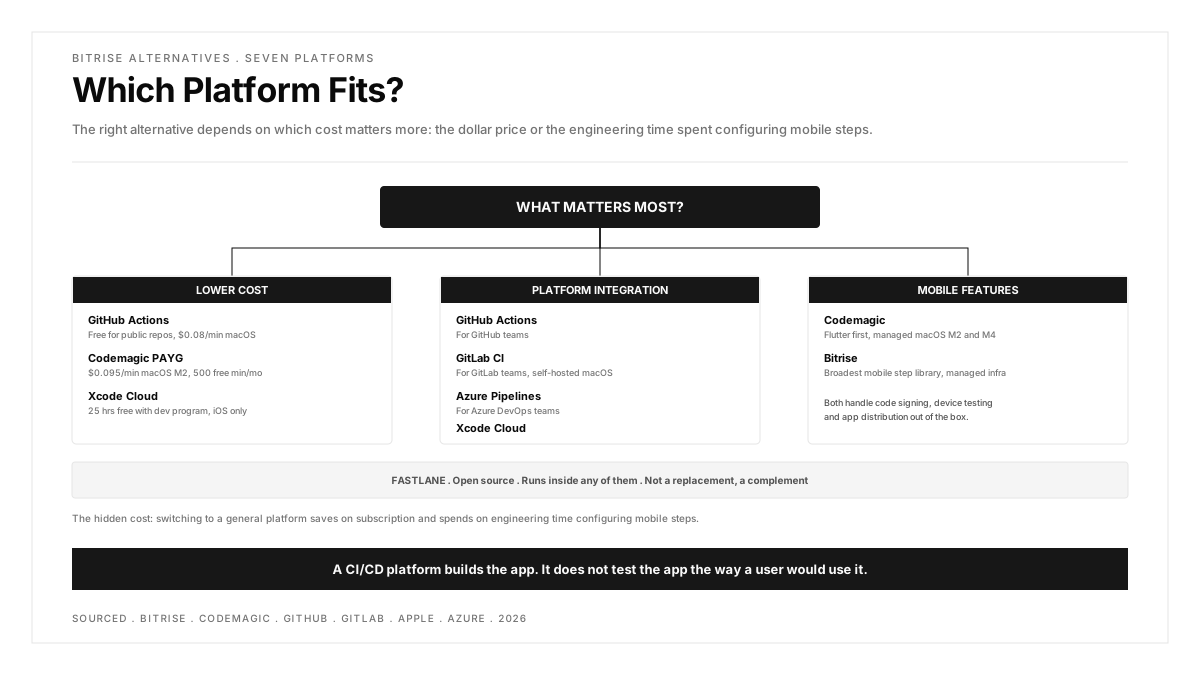
If cost is the primary driver: GitHub Actions for teams on GitHub (free for public repos, cheap for private). Codemagic pay-as-you-go for teams that build infrequently. Xcode Cloud for iOS-only teams (25 free hours with the developer program).
If platform integration matters most: GitHub Actions for GitHub, GitLab CI for GitLab, Azure Pipelines for Azure DevOps, Xcode Cloud for Xcode. Using the CI/CD built into your source platform eliminates one tool from the stack.
If mobile-specific features matter most: Codemagic is the closest feature match to Bitrise, with managed macOS, code signing, device testing and distribution. Bitrise's step library is broader for native projects. Codemagic's Flutter support is deeper.
The hidden cost in every comparison: Bitrise's value is not just infrastructure. It is the maintained workflow steps for code signing, provisioning profile management, device testing and app distribution. Switching to a general-purpose CI saves money on the platform and spends it on engineering time configuring and maintaining those steps. Factor that maintenance cost into the comparison.
Where testing fits in the CI/CD pipeline
A CI/CD platform builds and distributes the app. It does not test the app the way a user would use it. Build-time tests (unit tests, static analysis, lint checks) run inside the pipeline. End-to-end testing that validates user flows across screens, devices and OS versions runs as a stage in the pipeline or as a post-build step.
Teams running mobile test automation alongside their CI/CD pipeline catch regressions before the build reaches distribution. The CI platform handles the build. The test automation platform handles the verification. The two are complements.
For a deeper look at designing pipelines that include mobile testing without slowing down delivery, see the guide on CI/CD pipeline design.
FAQs
Is Bitrise worth the price?
Bitrise is worth the price when the mobile-specific features (managed code signing, step library, device testing integration) save more engineering time than the subscription costs. For teams building multiple mobile apps with complex signing requirements, the automation pays for itself. For teams with one app and simple builds, GitHub Actions or Codemagic pay-as-you-go achieves the same result at lower cost.
Can GitHub Actions build iOS apps?
Yes. GitHub Actions supports macOS runners that can build iOS apps with Xcode. Runners with Apple Silicon (M1) are available as larger runners. Code signing requires uploading certificates and provisioning profiles as repository secrets and configuring them in the workflow file. The setup is manual rather than guided, which takes more time initially but works reliably once configured.
What is the cheapest CI/CD for mobile?
For iOS-only teams: Xcode Cloud, included with the $99/year Apple Developer Program at 25 compute hours per month. For cross-platform teams: GitHub Actions, free for public repositories and $0.08/min for macOS on private repositories. For Flutter teams: Codemagic individual tier, with 500 free macOS minutes per month.
Does Codemagic support native iOS and Android?
Yes. Codemagic started with Flutter but supports native iOS (Xcode), native Android (Gradle), React Native, Kotlin Multiplatform and Ionic projects. The Flutter integration is the deepest (automatic build detection, iOS signing, caching), but native projects work with standard YAML configuration.
Can I use Fastlane with any CI/CD platform?
Yes. Fastlane is a command-line tool that runs inside any environment with Ruby installed. It works with Bitrise, Codemagic, GitHub Actions, GitLab CI, CircleCI, Azure Pipelines, Jenkins and any other CI platform. Many teams write their build and distribution logic in Fastlane and use the CI platform only for triggering and infrastructure. This approach makes switching CI platforms straightforward because the build logic stays in the Fastlane configuration.
How do I migrate from Bitrise to another platform?
Export your Bitrise workflow steps as a reference document. Identify which steps have equivalents in the target platform (most do) and which require custom scripting. Set up code signing on the new platform first, since it is the step most likely to block progress. Run both platforms in parallel for two to four weeks to verify the new pipeline produces identical artifacts. Once confident, switch the trigger from Bitrise to the new platform and decommission the old workflows.