
Appium vs XCTest vs Visual AI: Where Mobile Test Maintenance Goes
The three approaches differ in what breaks them. Appium breaks on accessibility tree shifts, native breaks when two codebases drift, and visual agents break when the journey changes.
Yuvan Sundrani · 17 min read
autosana.ai
TL;DR
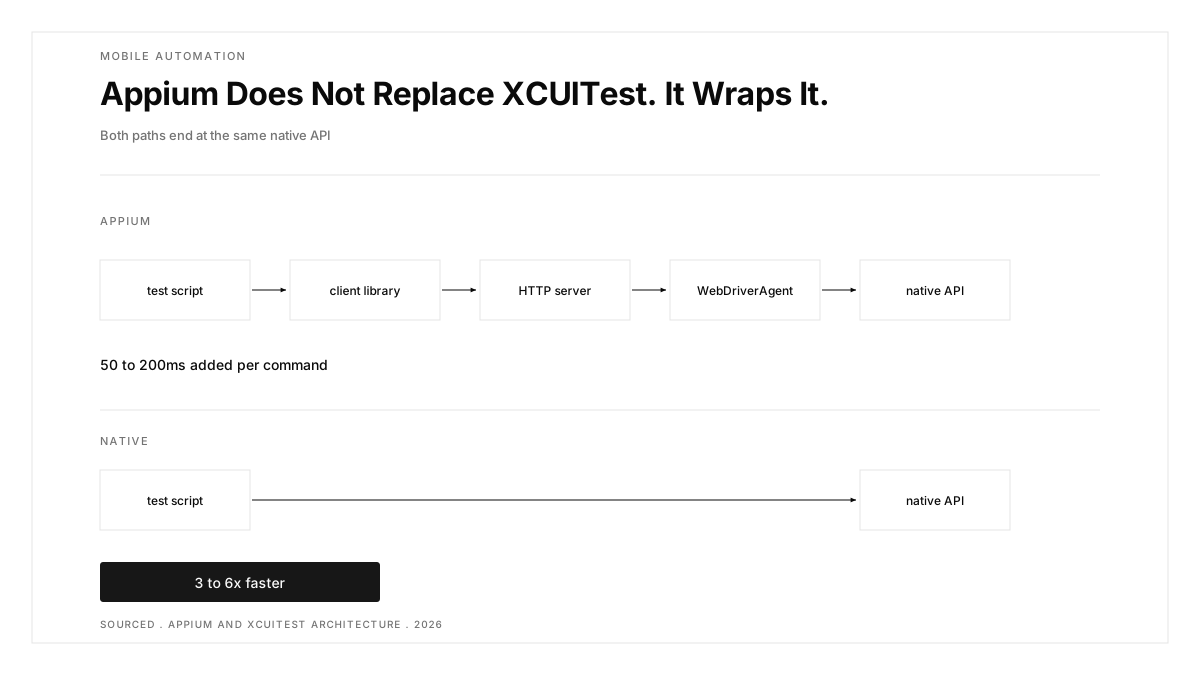
- Appium wraps XCUITest rather than replacing it, so every command crosses a client library, an HTTP server, and WebDriverAgent before reaching the same native API a native test calls directly.
- That translation adds roughly 50 to 200 milliseconds per command, and published comparisons put native at three to six times faster, with 100 tests landing at 30 to 60 minutes against 5 to 15.
- Native frameworks solve speed and hand back a headcount problem, since two codebases in two languages mean each feature gets written, reviewed, and debugged twice.
- Maintenance cost tracks the breakage trigger rather than the execution model, so the useful question concerns what each approach binds to.
- Autosana reads the rendered screen rather than the accessibility hierarchy, so flows survive the tree changes and platform divergence that generate most cross-platform repair work.
What each of the three approaches actually is
One correction belongs at the front, because a surprising share of tooling arguments rest on it.
Appium does not replace XCUITest. It wraps it. A tap in an Appium script travels over HTTP to the Appium server, gets translated into an XCUITest or UIAutomator2 instruction, crosses to the device, executes, and returns up the same chain. Every command passes a client library, an HTTP server and WebDriverAgent before arriving at the native API a native test would have called directly.
Native means XCTest with XCUITest on iOS and Espresso on Android. The test compiles into the application's own instrumentation build and runs inside the same process.
Visual, or agent-based, means automation that reads the rendered screen and identifies controls by what appears rather than by how the operating system structured its accessibility hierarchy. No driver sits between the test and the device.
| Appium | Native XCTest and Espresso | Visual Agent | |
|---|---|---|---|
| Relationship to the OS driver | Wraps it over HTTP | Compiles inside the app process | Works above it |
| Per-command overhead | 50 to 200ms translation | Minimal, in process | Minimal, reads the screen |
| Codebases to maintain | One, plus platform branches | Two, in two languages | One |
| Who can author | Engineers | Engineers, two skill sets | Anyone describing the journey |
| Breaks when | The accessibility tree shifts | Either codebase drifts | The journey actually changes |
| Suite of 100 tests | 30 to 60 minutes | 5 to 15 minutes | Depends on device supply |
The final two rows carry the maintenance argument, and they deserve the rest of this article.
Why does Appium accumulate platform branches?
Appium reads operating system accessibility trees, while iOS and Android construct those trees differently. The same button surfaces with different attributes, different nesting and occasionally different presence.
So the single unified script accumulates conditionals. One platform check for a permission dialog, another for a navigation pattern, a third for a control that merges into its parent on one platform while staying separate on the other. Each addition looks reasonable in isolation, and the file ends up as two scripts sharing one filename.
The maintenance consequence follows directly. A change to either platform's accessibility behavior breaks one branch while leaving the other passing, which produces a failure that looks platform-specific because it is. Diagnosing it requires someone who understands both trees, and that person is rarer than either specialist alone.
There is a second effect worth naming. Because Appium sits outside the application process, it holds no view of the main thread, so it infers readiness rather than observing it. Espresso compiles into the instrumentation build and watches the message queue directly, idling automatically before each action. That architectural gap produces a meaningful share of mobile flakiness, and flakiness converts into triage hours, which is maintenance under a different name.
A developer on r/androiddev described the familiar version of this, where a flow behaves impeccably against an emulator and falls over the first time a real device does something ordinary, which is the shape of a readiness problem rather than a logic problem.
What does the native route actually cost?
Speed improves immediately and dramatically. The published comparison puts native frameworks at three to six times faster, with a hundred-test suite landing around 5 to 15 minutes against 30 to 60 on Appium.
What arrives alongside is a second codebase.
Two languages, Swift and Kotlin. Two sets of idioms. Two review queues. Two debugging contexts. Every product feature now needs its test written twice, reviewed twice and debugged twice before shipping, usually by different people whose skills overlap partially at best.
That converts a latency tax into a headcount tax, and headcount is the more expensive of the two by a wide margin. The latency tax shows up on a CI invoice where someone can see it, whereas the headcount tax distributes across sprint capacity, where it reads as the team being slower than expected.
Worth stating plainly, because the usual framing runs too absolute: where you ship one platform, or where one platform carries nearly all your revenue, native drivers are an excellent answer and the dual-codebase objection mostly evaporates. The objection applies to teams genuinely shipping both.
An engineer on r/QualityAssurance made the adjacent point that metrics reassure the people reading dashboards more than the people carrying pagers, and dual-codebase coverage behaves similarly, since the coverage number looks healthy while the cost sits in calendar time rather than in any reported figure.
Where does the infrastructure bill come from?
Maintenance and infrastructure interact, so the numbers belong here even though cost is the secondary argument.
GitHub charges $0.062 per minute for a 3-core Apple Silicon macOS runner, $0.077 for the 12-core Intel image and $0.102 for the 5-core xlarge. Linux costs roughly a tenth. Where your plan includes minutes rather than billing cash, macOS carries a 10x multiplier against that allowance, so one macOS minute spends ten.
Then boot time, which is billed time. A cold iOS simulator on a hosted runner typically consumes 1.5 to 2.5 minutes before the first test executes, and one team measured 2 minutes 45 seconds falling to 17 seconds purely by moving to dedicated hardware.
Multiply that across parallelism. Thirty runners each burning two boot minutes amounts to an hour of billed macOS time per pipeline execution, spent entirely reaching the starting line.
The device farm route trades that for latency, since the runner sits in one region while the handset sits in another, so every tap crosses a network hop. Work completing in well under a minute on a tethered device locally stretches to several minutes across that link, billed per device minute throughout.
A practitioner on r/brdev framed the general principle, observing that each component behaves correctly against its own contract while the expense lives in the handoffs between them, which describes mobile CI precisely.
How does maintenance cost actually accrue?
Three distinct mechanisms, and separating them clarifies which approach suits which team.
Repair from interface change. Someone renames a test identifier, extracts a component, or ships a design system. Appium repairs because its locator referenced the old structure, and native repairs twice because the change usually lands on both platforms. A visual agent continues, since the journey stayed constant while its rendering moved.
Repair from platform change. An OS update alters accessibility tree construction, or a targetSdkVersion bump changes runtime behavior. Appium feels this most sharply because it consumes the tree directly. Native frameworks track their own platform closely, so each absorbs its own change while the other stays unaffected.
Triage from inferred readiness. Appium infers rather than observes, so a proportion of failures reflect timing instead of defects. Each one consumes diagnosis time, and the cost per incident depends on available evidence, which is why a recording resolves in a minute what a stack trace resolves in forty.
Ranking the three approaches against these mechanisms produces a clearer answer than ranking them on speed.
| Mechanism | Appium | Native | Visual Agent |
|---|---|---|---|
| Interface change | Repairs once, plus branches | Repairs twice | Continues |
| Platform change | Feels it most | Each absorbs its own | Minor |
| Inferred-readiness triage | Significant | Minimal, observes directly | Moderate, verification needed |
What does a hybrid stack look like in practice?
Few teams run one approach exclusively, and the combinations that work share a logic worth stating.
Native beneath, visual above. Espresso and XCUITest own component and integration work, where in-process access catches defect classes quickly and runs in milliseconds. A visual agent owns the end-to-end band, where the assertion concerns a product promise rather than a function. This split follows the pyramid honestly, since the layer changing most frequently gets the approach binding least tightly.
Appium retained for a specific capability. Some teams keep a small Appium suite for scenarios where an established driver integration already works, particularly where a device cloud contract and existing tooling are in place. Shrinking that suite rather than replacing it wholesale avoids a coverage gap.
Platform-specific native where one platform dominates. Where iOS carries most revenue, a deep XCUITest suite on iOS alongside lighter cross-platform coverage on Android allocates effort toward where failure costs most.
The combination that reliably disappoints is running Appium and native in parallel at the same layer, which produces three codebases covering identical journeys and triples the repair surface for no coverage gain.
Migrating away from a large Appium suite
Sequence matters more than speed, and the pattern mirrors any suite migration.
Start by counting platform conditionals per file, since that number identifies which flows have already drifted furthest from the single-script promise. Those files carry the highest repair cost and make the most persuasive first candidates.
Author replacements for the ten highest-churn journeys while the Appium suite keeps running. Both execute for two sprints, and agreement across that window establishes trust on evidence. Retire the Appium originals afterwards, archiving rather than deleting so restoration takes minutes.
Leave the rest alone until someone has reason to touch it. A flow passing reliably and requiring no repair costs little to keep, so migrating it buys nothing immediate.
A tester on r/QualityAssurance described the failure pattern for tooling transitions generally, where teams commit to a wholesale replacement, hit the first scenario the new approach handles poorly, then abandon the programme rather than scoping it. Running both during the transition is what prevents that outcome, since the comparison stays available.
One scheduling caution. Run the migration during ordinary feature work rather than alongside a redesign, because a redesign breaks the Appium originals across the board and removes your ability to compare the two suites against each other at precisely the moment you need that comparison.
How should a team choose?
Four questions settle it faster than a feature comparison.
Do you ship one platform or two? One platform removes the dual-codebase objection entirely, which makes native the strong default.
Who needs to author tests? Engineers only points toward native or Appium. Where product knowledge sits with people outside engineering, an approach requiring neither Swift nor Kotlin widens participation.
How often does your interface change? Frequent redesign work favours an approach binding to journeys, since repair volume tracks interface churn multiplied by locator density.
Where is your CI budget going? Pull the macOS line, divide by pipeline runs, then estimate the share consumed by boot rather than execution, which any run log reveals by comparing job start against the first assertion timestamp. Where most of the spend sits in machines booting operating systems, test code rewriting will leave it untouched.
A developer on r/webdev observed that abstractions promising to remove code eventually surface the complexity they concealed, which applies to every option here and argues for choosing by failure mode rather than by promise.
How does Autosana sit against these three?
Autosana is an AI-native E2E testing agent for iOS, Android and web, and it occupies the third column above.
Flows state intent, and the agent identifies controls from the rendered screen alongside visual context rather than from the accessibility hierarchy. That removes the tree-divergence problem producing Appium's platform branches, since the agent observes what a user observes and both platforms render the same button recognisably.
It also removes the dual-codebase tax, because one stated flow covers iOS and Android, so a feature gets described once rather than implemented twice in two languages.
On infrastructure, runs execute on hosted real devices from a warm pool, which addresses the boot tax specifically. Results return through the GitHub integration with session replay attached, which compresses the triage mechanism described above, and flows are invocable over MCP. The documentation covers binary upload and flow execution.
The limits deserve equal clarity. Per-interaction overhead exceeds a compiled in-process framework, so teams running thousands of highly predictable interactions inside a tight window against one runtime remain better served by Espresso or XCUITest. Agents decide rather than merely follow, which makes verification necessary and introduces a failure mode native frameworks lack. And unit and component testing belongs beneath this layer regardless of what runs above it.
For readers weighing frameworks before committing, what Appium is and whether it remains the right choice covers the single-tool question, while Espresso versus UiAutomator covers the Android split and multi-device testing covers matrix execution.
Where to start
Open your largest cross-platform test file and count the platform conditionals. That number estimates how far the single unified script drifted toward two scripts, and most teams find it higher than they expected.
Then pull last month's macOS CI line, divide by pipeline runs, and compare job start against the first assertion timestamp on any run. The split between booting and testing is usually the first thing anyone has measured, and it determines whether your next improvement belongs in test code or in infrastructure.
.png)
FAQ
Is Appium an alternative to XCUITest?
Appium wraps XCUITest rather than replacing it. Commands travel through a client library, an HTTP server and WebDriverAgent before reaching the same native API a native test calls directly, which is where the translation overhead originates.
How much slower is Appium than native frameworks?
Published comparisons put native at three to six times faster, with a hundred-test suite landing around 30 to 60 minutes on Appium against 5 to 15 minutes on Espresso or XCUITest. Per command the translation adds roughly 50 to 200 milliseconds.
Why is Appium flakier than Espresso?
Espresso compiles into the application process and watches the main thread message queue, so it observes readiness. Appium runs outside the process with no view of that queue, so it infers readiness instead, and the gap produces timing failures.
Should we drop Appium for XCTest and Espresso?
Where you ship one platform, yes, since the dual-codebase objection disappears. Where you ship both, you exchange a latency tax for a headcount tax, as each feature then gets written, reviewed and debugged twice in two languages.
What does a cold iOS simulator cost in CI?
Typically 1.5 to 2.5 billed minutes before the first assertion. GitHub macOS runners run roughly ten times the Linux rate, and included-minute plans apply the same multiplier, so boot time consumes premium minutes.
What breaks a visual or agent-based mobile test?
A genuine change to the journey. Renamed identifiers, extracted components and design-system migrations leave it intact, since the flow names what the user achieves rather than which element they touched.
Can one test suite genuinely cover iOS and Android?
With an approach that reads the rendered screen, yes, since both platforms render the same control recognisably. Approaches consuming accessibility trees inherit the structural divergence between platforms, which is what produces platform conditionals.
Does Autosana replace Espresso and XCUITest?
At the end-to-end layer it covers both platforms from one flow. Unit and component testing belongs beneath it, where in-process access catches defect classes quickly, so a healthy stack runs both.