
8 Best Tricentis Alternatives for Enterprise Testing in 2026
Tricentis bundles five products, but most teams evaluating it only need one or two. This guide sorts eight alternatives into AI-native agents, code-first frameworks, IDE replacements, and device clouds.
Yuvan Sundrani · 15 min read
autosana.ai
The best Tricentis alternatives in 2026 split into four lanes: AI-native agents that replace model-based test design with intent-based flows (Autosana, TestRigor), code-first frameworks that deliver open-source web automation without enterprise procurement (Playwright, Cypress), platform IDEs that mirror Tosca's model-based approach at a lower entry point (Katalon, Mabl), and enterprise device clouds for teams that only need the infrastructure layer (BrowserStack, Sauce Labs). Which one fits depends on why you're leaving Tricentis: most teams don't need five products spanning test automation, test management, performance testing, quality intelligence, and an AI control plane. They need one tool that ships a test that passes. This guide ranks the 8 alternatives and maps each one to the specific Tricentis exit reason it solves.
Key Takeaways
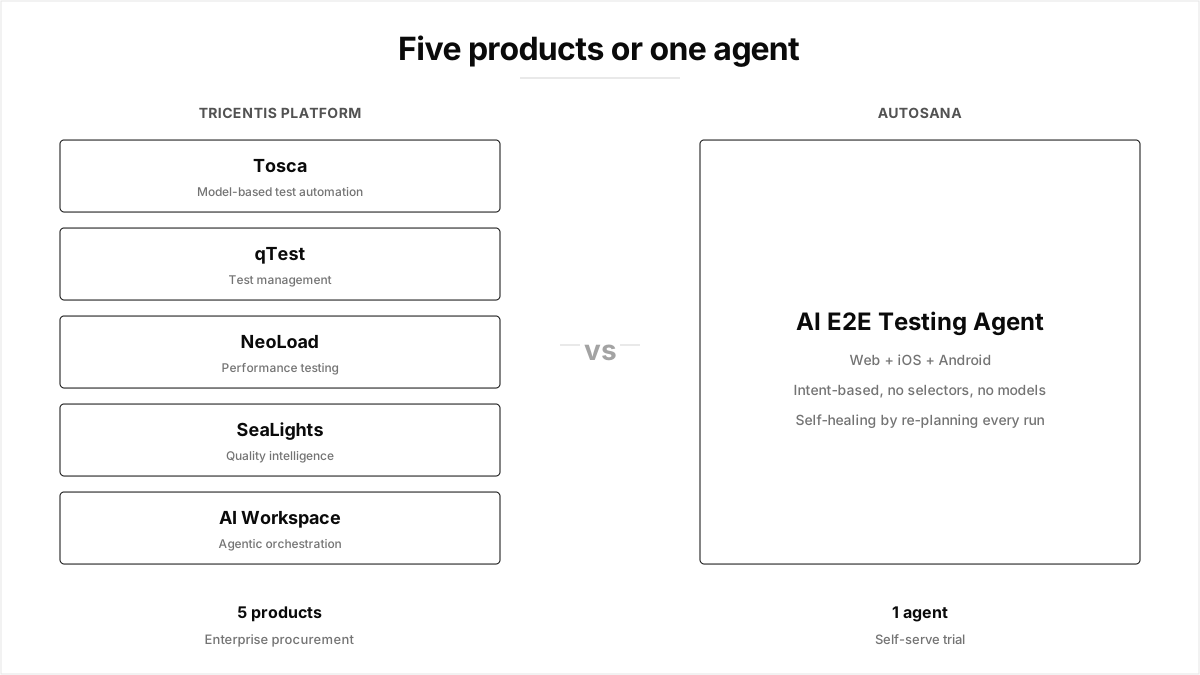
- Tricentis sells an agentic quality engineering platform with 5+ products (Tosca, qTest, NeoLoad, SeaLights, and AI Workspace), most teams leaving only need one or two of those capabilities, usually test automation.
- Playwright and Cypress are the go-to free, open-source alternatives for code-first web testing without enterprise procurement cycles or multi-product licensing.
- Katalon is the closest architectural match to Tosca's model-based approach, with a free tier and Groovy scripting fallback for mixed-skill QA teams.
- BrowserStack and Sauce Labs solve the device-cloud and infrastructure layer; pick them when the gap is device coverage, not test authoring.
- Autosana removes both the model-based design overhead and the selector layer entirely: an AI agent runs E2E flows by intent across web, iOS, and Android, self-heals when the UI changes, and posts session replay to every PR.
Quick comparison: 8 Tricentis alternatives for 2026
| # | Tool | Category | Authoring Model | Free Tier? | When to Pick |
|---|---|---|---|---|---|
| 1 | Autosana | AI-native agent | Natural language / intent | Trial + paid | Test automation without selectors, models, or enterprise procurement |
| 2 | Playwright | Code-first framework | JS, TS, Python, Java, C# | Yes (Apache 2.0) | Direct web automation, open-source, cross-browser, 5 languages |
| 3 | Cypress | Code-first framework | JS / TS | Yes (MIT) + paid cloud | JS-first team, time-travel debugging, single-origin SPA |
| 4 | Katalon | Platform IDE | GUI + Groovy | Free + paid | Closest to Tosca model-based, mixed-skill QA, web + mobile + API |
| 5 | TestRigor | AI-native / codeless | Plain English | Paid | Non-technical stakeholders authoring in plain language |
| 6 | Mabl | Low-code + ML healing | Visual builder | Paid | Enterprise low-code with ML-based self-healing |
| 7 | BrowserStack | Device cloud + automation | Multiple frameworks | Free trial + paid | 3,500+ real devices, infrastructure-layer coverage |
| 8 | Sauce Labs | Device cloud + compliance | Multiple frameworks | Free trial + paid | Enterprise compliance requirements, managed cloud grid |
What are the best code-first alternatives to Tricentis for web testing?
If you're leaving Tricentis because you want open-source, code-first web automation without procurement cycles, Playwright and Cypress are the two direct answers.
Playwright
Best for teams that want cross-browser, multi-language web automation with auto-waiting and network interception out of the box.
Microsoft's Playwright connects to browsers via the DevTools protocol, ships auto-waiting for element actionability, and supports Chromium, Firefox, and WebKit under a single API. Five language bindings: JavaScript, TypeScript, Python, Java, and C#, which matters for teams migrating from Tosca where the existing QA skill set is C# or Java rather than JavaScript. A DevOps engineer on r/devops highlighted Playwright's CI integration as the deciding factor over enterprise tools: tests run in headless containers, no license server required, parallel execution is built in, and the total infrastructure cost is zero.
Key features: auto-waiting, multi-browser (Chromium + Firefox + WebKit), codegen recorder, API testing, trace viewer for debugging, and network interception.
Pricing: free (playwright.dev, Apache 2.0).
Limitations: still selector-based auto-waiting solves timing but not "the button was renamed. " No native mobile testing. No built-in test management layer (you bring your own).
Cypress
Best for JS/TS-first frontend teams building single-origin SPAs where time-travel debugging matters more than cross-browser or multi-language reach.
Cypress runs inside the browser's own event loop, which gives it DOM snapshots at every step and real-time reloading during development. TypeScript-first authoring, a strong plugin ecosystem (cypress-axe, cypress-testing-library), and a paid cloud tier for parallel execution and dashboard analytics.
Key features: time-travel debugging with DOM snapshots, automatic waiting, first-class TypeScript, plugin ecosystem, and Cypress Cloud for CI analytics.
Pricing: free (cypress.io, MIT) + Cypress Cloud paid tier for parallel execution and dashboard.
Limitations: JS/TS only: no Python, Java, or C#. Cannot automate cross-tab or cross-origin flows cleanly. WebKit/Safari desktop testing is experimental. Parallel execution requires the paid cloud tier.
What AI-native testing tools replace Tricentis Tosca
If your Tricentis pain is the model-based authoring layer itself the manual model creation, the element mapping, the constant remapping after every UI change- AI-native tools remove that mechanism entirely.
Autosana
Best for teams that want E2E test automation across web, iOS, and Android without selectors, without model-based design, and without enterprise procurement.
Autosana is an AI E2E testing agent. You describe a flow by intent: "log in, add an item to the cart, check out," and the agent opens the build, navigates the current UI, and confirms the outcome. No CSS selectors. No Tosca-style model modules. No XPath. When the frontend changes between runs, the agent re-plans against whatever the screen shows now rather than failing because a mapped element moved. That re-planning-per-run behavior is what separates intent-based testing from both Tosca's model-based approach and traditional selector-based frameworks.
Autosana ships an MCP server so coding agents (Cursor, Claude Code, Devin) invoke test runs programmatically. Cloud-hosted real device testing for iOS and Android, session replay on every PR, and a quickstart that ships the first test in under ten minutes.
Pricing: per agent-run, self-serve trial via Book a Demo.
TestRigor
Best for non-technical stakeholders -- product managers, manual QA, business analysts -- who need to author tests in plain English without learning a framework or a model-based IDE.
TestRigor lets you write tests as plain-English instructions. "Click login, enter email, verify the dashboard loads." It maps those instructions to UI actions at runtime. For teams where the bottleneck is test authoring capacity across non-technical team members, the plain-language approach removes the skill barrier that both Tosca's model-based IDE and code-first frameworks impose.
Key features: plain-English test authoring, cross-browser execution, email/SMS/2FA testing built in, visual test management.
Pricing: paid (contact sales, testrigor.com).
Limitations: less control than code-first frameworks for edge-case scenarios. Plain-English parsing can misinterpret ambiguous instructions on complex flows. Debugging a failed plain-English step is harder than debugging a failed line of Playwright code with a stack trace.
What platform IDEs replace Tricentis Tosca for test automation
If your team wants a model-based or low-code IDE similar to Tosca but without the full five-product Tricentis platform -- Katalon and Mabl are the two closest replacements.
Katalon
Best for mixed-skill QA teams that want a GUI recorder, keyword-driven testing, and a scripting fallback -- the closest architectural match to Tosca's model-based approach at a fraction of the cost.
Katalon Studio is a Java-based desktop IDE built on Selenium (web) and Appium (mobile). You author by recording, by keyword library, or by Groovy script. It covers the same "non-coders record, developers script" workflow Tosca targets. A tester on r/QualityAssurance noted Katalon as the go-to recommendation for teams that want a Tosca-like experience without Tricentis procurement -- it hits 80% of the model-based workflow at a fraction of the price, with a genuine free tier for individual use. Katalon TestOps adds reporting and analytics; Katalon TestCloud adds hosted cloud execution.
Key features: GUI recorder + Object Spy + Groovy scripting, web + mobile + API + desktop automation, built-in Selenium and Appium engines, free tier for individual use.
Pricing: free Katalon Studio + paid Runtime Engine ($1,749/yr per license) + paid TestCloud.
Limitations: still selector-based underneath Selenium and Appium. Free tier lacks parallel execution. Groovy is a niche language outside the Katalon ecosystem.
Mabl
Best for enterprise QA teams that need low-code authoring with ML-based self-healing and don't want to manage browser infrastructure.
Mabl adds machine-learning-based selector healing on top of a managed cloud execution grid. When a class name changes or a component restructures, Mabl attempts to re-identify the element by behavioral properties rather than the literal locator. That's the same self-healing concept Tricentis now bundles into AI Workspace, but Mabl delivers it as a standalone product without requiring the rest of the platform.
Key features: visual test builder, ML-based self-healing, cloud execution grid, API testing, accessibility checks, performance monitoring.
Pricing: commercial (contact sales, mabl.com).
Limitations: closed-source. Self-healing is heuristic -- deep structural refactors can still break tests. Enterprise-priced with no free tier.
What device clouds replace Tricentis for cross-browser and mobile testing
If your Tricentis usage is primarily NeoLoad's performance infrastructure or Tosca's cloud execution layer -- BrowserStack and Sauce Labs provide the device cloud without the test-authoring platform attached.
BrowserStack
Best for teams that need the widest real-device coverage and want to run their existing framework (Playwright, Cypress, Selenium, Appium) on 3,500+ device and browser combinations.
BrowserStack is a hosted real-device cloud. You bring your test framework; BrowserStack provides the infrastructure with 3,500+ real devices and browsers across global data center locations. It's the infrastructure-layer alternative: if your Tricentis pain is device coverage and cloud execution rather than test authoring, BrowserStack solves that gap without requiring you to change your test framework or buy into a platform.
Key features: 3,500+ real devices, live and automated testing, Selenium/Playwright/Cypress/Appium integration, visual testing, and accessibility testing.
Pricing: paid tiers starting at team plans.
Limitations: test authoring is still your responsibility. BrowserStack runs your tests, doesn't write them. No built-in self-healing. Cost scales with device minutes and parallelization.
Sauce Labs
Best for enterprise teams with strict compliance requirements (SOC 2, HIPAA-eligible) that need a managed testing cloud with audit trails and access controls.
Sauce Labs offers a managed cloud grid with enterprise compliance certifications. A tester evaluating platforms on r/softwaretesting noted that Sauce Labs consistently wins in regulated industries where compliance paperwork matters as much as test results. For teams leaving Tricentis's governance-heavy posture but still needing audit trails and role-based access controls, Sauce Labs carries that compliance layer without the five-product overhead.
Key features: SOC 2 Type II compliance, managed Selenium/Appium grid, real devices + emulators/simulators, error reporting, CI/CD integrations.
Pricing: paid tiers (contact sales, saucelabs.com).
Limitations: infrastructure layer only, not test authoring. Enterprise-priced. No AI-native test generation or self-healing.
How to choose the right Tricentis alternative for your team
Start with the exit reason, not the product comparison.
- "We just need web test automation, open-source, no procurement" Playwright (multi-language, cross-browser) or Cypress (JS/TS, time-travel debugging).
- "We want test automation without selectors or model-based design" -- Autosana (intent-based AI agent, web + iOS + Android) or TestRigor (plain English, non-technical authors).
- "We want a Tosca-like IDE experience but cheaper" -- Katalon (free tier, GUI recorder, Groovy scripting).
- "We need self-healing without buying a platform" -- Mabl (ML-based healing, standalone product).
- "We need device cloud and cross-browser infrastructure" -- BrowserStack (widest device coverage) or Sauce Labs (enterprise compliance).
- "We need the full platform -- test management, performance testing, quality intelligence, AI orchestration across 190+ technologies" -- Stay on Tricentis. No single tool on this list replaces all five products.
The decision tree is simple: how many of Tricentis's five products do you actually use? If the answer is one or two, you're overpaying for a platform. Pick the specialist that solves the gap you actually have.
Conclusion
Tricentis isn't outdated. It's over-scoped for most teams evaluating it. Five products, 190+ connectors, and enterprise governance are the right answer for large enterprises running SAP and Salesforce at regulatory scale. That's a real market and Tricentis leads it.
But most teams that evaluate Tricentis realize mid-procurement they need one tool, not five. Autosana removes both model-based design and selectors. Playwright is free and ships today. Katalon has a free tier. BrowserStack has 3,500+ devices. Match the alternative to the specific Tricentis product you're replacing.
.png)
Frequently asked questions about Tricentis alternatives
What is the best alternative to Tricentis in 2026?
It depends on which Tricentis product you're replacing. For test automation (Tosca): Playwright for code-first, Autosana for AI native, Katalon for a similar IDE. For performance testing (NeoLoad): k6 or Gatling. For test management (qTest): TestRail or Zephyr. Match the alternative to the specific product, not the platform.
Is Tricentis Tosca still worth using in 2026?
For SAP, Oracle, and Salesforce testing with 190+ technology connectors and enterprise governance, yes. Tosca's depth in enterprise ERP testing is hard to match. For modern React/Next.js/Vue frontends where the UI changes every sprint, the model-based approach requires constant remapping. Most teams leaving Tosca fall into the second category.
Can Playwright replace Tricentis Tosca for web testing?
For web test automation on modern frontends, yes. Playwright is free, open-source, supports 5 languages, and handles dynamic UIs better than Tosca's model-based engine. You lose Tosca's SAP/Oracle connectors, built-in test management (qTest), performance testing (NeoLoad), and enterprise governance features.
Does Autosana replace Tricentis for mobile testing?
For E2E mobile testing on iOS and Android, yes. Autosana runs flows by intent on hosted real devices without model-based design or selectors. For SAP Fiori mobile testing, protocol-level Oracle Forms automation, or 190+ enterprise technology connectors, Tosca has no direct single-tool replacement.
Is Katalon a good replacement for Tricentis Tosca?
Katalon is the closest architectural match both use model-based IDEs with GUI recording and scripting fallbacks. Katalon costs significantly less (free tier + $1,749/yr Runtime Engine vs. Tricentis enterprise pricing). The tradeoff: Katalon lacks Tosca's SAP/Oracle depth and doesn't include test management, performance testing, or quality intelligence products.
How much does Tricentis cost compared to alternatives?
Tricentis has no public pricing all engagement is sales-led. Playwright and Cypress are free. Katalon has a free tier. Autosana offers per-agent-run pricing with a self-serve trial. The cost gap between Tricentis enterprise licensing and self-serve alternatives is typically significant for teams that only need one product.
Can I migrate from Tricentis Tosca to Playwright gradually?
Yes. Run Playwright on new test cases while keeping Tosca for legacy suites. Migrate by priority tier: critical flows first, regression coverage second. Most teams complete web-only migration in one to two quarters. Tosca-specific SAP/Oracle connectors have no Playwright equivalent and may need to stay on Tosca long-term.
What Tricentis alternatives work for non-technical QA teams?
TestRigor (plain-English authoring), Mabl (visual builder with self-healing), and Katalon (GUI recorder) all support non-technical authors. Autosana uses natural-language intent; no coding or model-based design is required. For teams where the Tosca learning curve is the pain point, any of these four lowers the authoring barrier significantly.