
8 Best Perfecto Alternatives for Mobile Test Automation in 2026
Perfecto bundles 8 modules, but most teams use two. This guide maps which alternative replaces which surface: device clouds, web testing, or agentic authoring.
Yuvan Sundrani · 16 min read
autosana.ai
.png)
The best Perfecto alternatives in 2026 depend on which piece of the 8-module Perforce suite your team actually uses. For the mobile device cloud: BrowserStack, LambdaTest (TestMu AI), Kobiton. For codeless or agentic test authoring: Autosana, TestRigor, Mabl. For web testing alone: Playwright and Cypress. For the full enterprise cloud replacement: Sauce Labs. This guide ranks 8 alternatives by the specific Perfecto surface each one replaces.
Key Takeaways
- Perfecto is a Perforce product with 8+ modules, build-a-quote/contact-sales pricing (the /pricing page returns 404), and "agentic AI" branding in 2026, but no documented MCP server or coding-agent integration shipped.
- BrowserStack (2,000+ real devices), LambdaTest/TestMu AI (KaneAI + 10,000+ devices), and Kobiton (7,000+ devices with on-prem/BYOD) each replace the mobile device cloud at different price points and buying motions.
- Playwright and Cypress are free, open-source alternatives for teams whose Perfecto usage is limited to web browser testing.
- Sauce Labs is the closest full-cloud replacement: 10,000+ devices, AURA AI for failure categorization, and enterprise compliance certifications.
- Autosana replaces the test-authoring and execution layer with an AI agent that runs iOS, Android, and web flows by intent, self-heals on every UI change, and ships an MCP server for PR-level execution today.
Perfecto alternatives compared at a glance
| Tool | Category | Platform Coverage | Pricing | Best For |
|---|---|---|---|---|
| Autosana | AI-native agent | iOS + Android + Web | Per agent-run, self-serve trial | Intent-based authoring, MCP, self-healing |
| BrowserStack | Cloud device platform | Web + Mobile (2,000+ real devices) | From $29/mo (Live) | Largest real-device fleet, broad CI integrations |
| LambdaTest (TestMu AI) | Cloud + AI agent | Web + Mobile (10,000+ devices) | Free tier + paid from $15/mo | KaneAI codeless authoring + massive device breadth |
| Sauce Labs | Enterprise cloud | Web + Mobile (10,000+ devices) | Contact sales | Full enterprise replacement, AURA AI, compliance |
| Kobiton | Mobile device cloud | Mobile (7,000+ devices) | Contact sales | On-prem/BYOD device labs, scriptless mobile |
| Playwright | Open-source framework | Web (Chromium + Firefox + WebKit) | Free (Apache 2.0) | Cross-browser web testing, zero cost |
| TestRigor | Plain-English codeless | Web + Mobile | Paid (from ~$300/mo reported) | Non-technical test authors, plain English |
| Mabl | Low-code + AI | Web + Mobile | Contact sales | Low-code authoring, MCP shipped for workflows |
Why are teams looking for Perfecto alternatives in 2026
- Contact-sales pricing with no public tiers. The buying motion is build-a-quote through Perforce sales. Aggregators (G2, Capterra) report entry around $300/month billed annually, but Perforce does not confirm this publicly. A QA lead on r/QualityAssurance shared a direct switch-away story: their team moved from Perfecto to a competing cloud for mobile device emulation once the contract scope exceeded what they actually used.
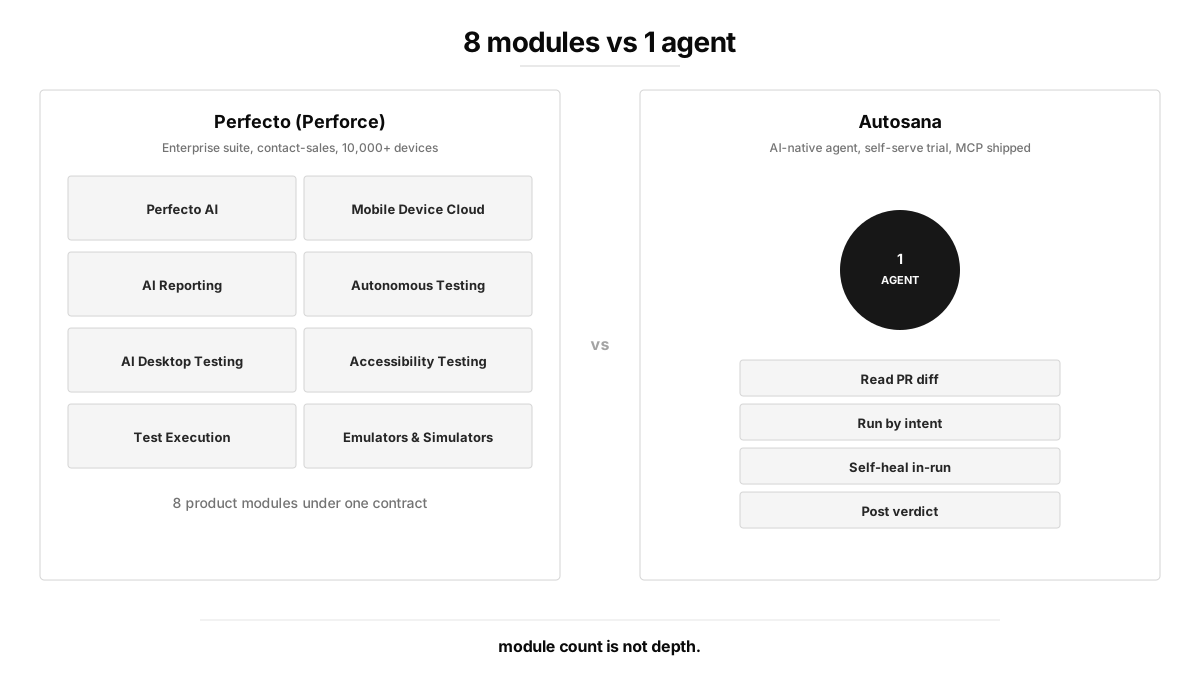
- 8-module complexity for a 2-module problem. Teams shipping a mobile app weekly rarely need AI desktop testing, dedicated accessibility testing as a standalone module, and Emulators & Simulators alongside the real-device cloud. They need the device cloud and something to run on it. The 8-module suite solves the org chart, not the testing bottleneck.
- "Agentic AI" branding without external MCP. Perfecto positions itself as an "Agentic AI Functional Testing Tool" in 2026. Its Autonomous Testing module is a natural-language chat orchestrator inside the Perfecto UI. It does not expose an MCP server for external coding agents (Cursor, Claude Code, Devin) to call from a PR. For teams whose coding agents ship PRs faster than QA can review them, that gap matters.
- Enterprise-gate buying motion. Self-serve trials, per-run pricing, and developer-first onboarding are the norm in 2026 for testing tools shipping to product-velocity teams. Perfecto routes through Perforce enterprise sales, which adds weeks to evaluation.
None of these are quality complaints. Perfecto holds a 4.7/5 on G2 and Capterra. ASDA reports 70% less manual testing and 4x device coverage using the platform. Bell Mobility and a major Australian bank are named customers. The exits happen when a team realizes it is paying for 8 modules and consistently using 2.
What are the best Perfecto alternatives for agentic and codeless test authoring
Perfecto's Autonomous Testing module and "agentic AI" branding target teams that want to author tests without writing Selenium or Appium scripts. Three alternatives take genuinely different approaches to the same goal.
Autosana: intent-based agent with no test artifact and MCP shipped today
Autosana is an AI-native testing agent for iOS, Android, and web. There is no test script between the intent description and the execution. The agent reads the current UI on every run, navigates by intent, and re-plans when the UI changes. No selectors, no stored artifact to maintain, no framework dependency.
The structural difference from Perfecto's agentic model: Autosana ships an MCP server that coding agents (Cursor, Claude Code, Devin) invoke directly from a PR. The agent reads the PR diff, runs the flow on hosted real devices, and posts a video verdict back via GitHub integration. That pipeline closes the loop between coding agents that write code and the testing layer that validates it. The quickstart puts the first run under ten minutes.
Pricing: Per agent-run with a self-serve trial. No contact-sales gate. Book a Demo for volume pricing.
TestRigor: plain English test authoring for non-technical teams
TestRigor lets non-technical users author tests in plain English sentences. The test artifact is a human-readable sentence that maps to element actions at execution time. Supports web, mobile, and API testing. For teams where QA analysts (not engineers) write the tests, TestRigor lowers the authoring bar further than Perfecto's Autonomous Testing chat interface.
Pricing: Paid, starting from roughly $300/mo per published aggregator reports. No free tier.
Limitations: Plain-English tests are still stored artifacts that can drift when the UI changes structurally. No MCP server documented for external coding-agent integration.
Mabl: low-code authoring with AI self-healing and MCP for workflows
Mabl combines a visual test builder with ML-based self-healing selector logic. When selectors break on cosmetic UI shifts, Mabl attempts to re-identify elements by behavioral properties rather than the literal locator. Mabl has also shipped an MCP integration for workflow automation, making it one of the few testing tools alongside Autosana with documented MCP support in 2026.
Pricing: Contact sales. Enterprise-priced.
Limitations: Self-healing is heuristic and works better on cosmetic shifts than deep structural refactors. Closed source. Cost curve rises with test volume.
What are the best Perfecto alternatives for the mobile device cloud
Perfecto's device cloud provides access to 10,000+ real and virtual devices across 200+ models from 14+ manufacturers. Three alternatives compete on that surface directly.
BrowserStack: 2,000+ real devices with the broadest CI integrations
BrowserStack is the most common migration target for teams leaving Perfecto's device cloud. Over 2,000 real devices (fewer than Perfecto's total count, but covering the device models most teams actually ship to), Percy for visual regression, and integrations with every major CI provider. A tester on r/softwaretesting evaluating device farms for mobile and cross-browser accessibility testing surfaced the same comparison set: BrowserStack, Sauce Labs, Perfecto, and LambdaTest evaluated head-to-head on device infrastructure.
Pricing: From $29/mo (Live), Automate from $149/mo. Self-serve signup.
Limitations: Not an agentic authoring tool. Your team still writes Selenium, Appium, Playwright, or Cypress tests and runs them on BrowserStack's grid. The device cloud is the product; what runs on it is your responsibility.
LambdaTest (now TestMu AI): KaneAI + 10,000+ real and virtual devices
LambdaTest rebranded to TestMu AI in 2026, adding KaneAI as a codeless, AI-powered test authoring layer on top of its 10,000+ device grid. The device count matches Perfecto's published claim. KaneAI lets teams author tests in natural language, bridging the gap between a pure device cloud and a codeless authoring surface. An evaluation thread on r/QualityAssurance listing Headspin alternatives included LambdaTest alongside Perfecto and BrowserStack as direct competitors in the mobile-testing evaluation cycle.
Pricing: Free tier available. Paid from $15/mo. Self-serve signup.
Limitations: KaneAI is newer than Perfecto's Autonomous Testing module. Enterprise compliance certifications are less established than Perfecto's or Sauce Labs'.
Kobiton: 7,000+ devices with on-prem and BYOD support
Kobiton differentiates on deployment flexibility. Over 7,000 real devices with on-prem, BYOD (bring your own device), and private cloud options that Perfecto's public-facing pages do not prominently feature. For teams in regulated industries where devices must stay on-premises, Kobiton is the only alternative in this list with BYOD device lab management built in. A thread on r/PerformanceTesting exploring on-premise testing vendors confirmed that truly private device setups remain a hard requirement for certain enterprise QA teams.
Pricing: Contact sales. Enterprise-priced.
Limitations: Smaller brand presence than BrowserStack or Sauce Labs. No codeless AI authoring layer comparable to KaneAI or TestRigor. The on-prem strength is narrow but deep.
What are the best Perfecto alternatives for web testing
Some teams use Perfecto primarily for cross-browser web testing on its cloud grid. Two free, open-source frameworks cover that surface without any subscription.
Playwright: free cross-browser testing with auto-waiting and DevTools protocol
Playwright connects directly to browser internals via the DevTools protocol. Chromium, Firefox, and WebKit under one API. Multi-language support (JS/TS, Python, Java, C#), auto-waiting for actionable element state, network interception, and native parallel execution out of the box. For teams whose Perfecto usage is web-only, Playwright eliminates the cloud cost entirely.
A thread on r/accessibility evaluating alternatives to BrowserStack for accessibility testing captured the same dynamic: cloud platforms add overhead and cost for teams that can self-host their browser testing matrix.
Pricing: Free (Apache 2.0).
Limitations: Web only. No native mobile testing. Still selector-based at the core, so the maintenance story on UI refactors is yours to manage.
Cypress: free JS/TS developer experience for single-origin apps
Cypress runs inside the browser's own event loop, giving JS/TS teams time-travel debugging with DOM snapshots per step. First-class TypeScript support and a strong plugin ecosystem (cypress-axe for accessibility, cypress-visual-regression). For single-origin SPAs tested by frontend engineers who value local debugging speed, Cypress remains the developer-experience winner in the category.
Pricing: Free (MIT). Cypress Cloud paid tier for parallel execution and dashboard.
Limitations: JS/TS only. No cross-tab or cross-origin flows. WebKit/Safari is not first-class. Parallel execution requires the paid Cloud tier.
What is the best Perfecto alternative for the full enterprise cloud
Sauce Labs: 10,000+ devices with AURA AI and enterprise compliance
Sauce Labs is the closest full-replacement alternative for teams that need Perfecto's enterprise breadth under a single vendor. Over 10,000 real and virtual devices, AURA (an AI-powered error-analysis and test-failure categorization engine), SOC 2 Type II compliance, and deep CI/CD integrations with Jenkins, GitHub Actions, and CircleCI. For regulated industries where compliance certifications are a procurement hard requirement, Sauce Labs competes with Perfecto on every surface except the 8-module product count.
Pricing: Contact sales. Enterprise-priced.
Limitations: Enterprise buying motion similar to Perfecto's. No intent-based agentic authoring. Runs your existing Selenium, Appium, or Playwright scripts on its grid rather than eliminating the scripting layer.
Should you pick an enterprise testing suite or a purpose-built stack
Here is the contrarian take: Perfecto's 8-module suite is organized around what an enterprise QA org needs on an org chart (one vendor, one contract, one compliance story). A purpose-built stack is organized around what the engineering team actually runs on each PR. Module count is not depth.
Use this decision framework:
- "We need one vendor covering web, mobile, desktop, and accessibility under one contract." Stay with Perfecto, or evaluate Sauce Labs as the comparable enterprise alternative.
- "We use the device cloud but not the codeless authoring." BrowserStack (broadest CI integrations), LambdaTest/TestMu AI (largest device count + KaneAI), or Kobiton (on-prem/BYOD).
- "Coding agents ship PRs faster than our test suite keeps up." Autosana. Its MCP server is the integration surface a coding agent calls from the PR. Perfecto's Autonomous Testing is an internal orchestrator, not an external MCP endpoint.
- "Non-technical QA analysts write our tests." TestRigor (plain English) or Mabl (low-code visual builder with self-healing).
- "Our Perfecto usage is just web browser testing." Playwright or Cypress. Free, open source, no subscription.
- "Devices must stay on our premises." Kobiton with BYOD device lab management.
- "Enterprise compliance is required but not at Perfecto's price." Sauce Labs (SOC 2 Type II) or LambdaTest (SOC 2).
If your team uses 2 of Perfecto's 8 modules, you are paying for 6 modules of overhead. The purpose-built tool that covers the 2 you actually use is the right alternative.
The honest answer on Perfecto alternatives in 2026
Perfecto is not outdated. It is enterprise-scaled: eight modules, 10,000+ devices, Fortune 100 penetration, case studies from ASDA and Bell Mobility. The product works. The question for most teams is whether they need the whole suite or two surfaces from it.
If multi-module enterprise breadth under one Perforce contract is a requirement, Perfecto or Sauce Labs are the defensible picks. If you need a purpose-built replacement for the specific Perfecto surface causing friction, the answer is narrower: BrowserStack or LambdaTest for the device cloud, Autosana or TestRigor for agentic/codeless authoring, Playwright or Cypress for web-only testing, Kobiton for on-prem device labs.
The bigger 2026 shift: coding agents open PRs faster than authored test suites validate them. Perfecto's Autonomous Testing is an internal chat orchestrator. Autosana's MCP server is the external integration surface a coding agent calls directly from the PR. That difference matters most when the bottleneck moves from "how do we test" to "how do we keep up with the code being shipped."
Bring a build. Autosana will run it end-to-end across iOS, Android, and web in under 30 minutes, and you can compare directly against your current Perfecto scope before making a call.
Frequently asked questions
Is Perfecto free in 2026?
No. Perfecto does not publish a free tier on perforce.com/products/perfecto. Pricing runs through a build-a-quote/contact-sales motion. Aggregators (G2, Capterra) report entry around $300/month billed annually, but Perforce does not confirm this number publicly.
What happened to perfecto.io after the Perforce acquisition?
Perforce acquired Perfecto in 2019. The standalone perfecto.io domain now returns a 403 Cloudflare block. All Perfecto product pages and marketing live under perforce.com/products/perfecto.
Does Perfecto have an MCP server for coding agents in 2026?
Perfecto does not document MCP, Claude Code, or Cursor integration on its product pages. Autonomous Testing is a natural-language chat orchestrator inside the suite, not an external MCP server coding agents call from a PR.
Can Autosana replace Perfecto for mobile and web testing?
For iOS, Android, and web E2E flows, yes. Autosana covers those surfaces with intent-based execution, self-healing on every run, and MCP-based PR-level testing. For desktop-app testing, accessibility scoring, and 10,000-device breadth under one enterprise contract, Perfecto covers surfaces Autosana does not target.
What is the cheapest Perfecto alternative for mobile testing?
LambdaTest/TestMu AI offers a free tier and paid plans from $15/month with 10,000+ devices. BrowserStack starts at $29/month for Live testing and $149/month for Automate. Playwright is free but web only, not native mobile.
Which Perfecto alternative supports on-premise device labs?
Kobiton. It ships BYOD device lab management and on-prem deployment alongside its 7,000+ cloud device fleet. No other alternative in this list offers comparable on-prem device support.
Is Playwright a real alternative to Perfecto?
For web-only testing, yes. Playwright is free, covers Chromium + Firefox + WebKit, and eliminates cloud subscription costs entirely. It does not cover native mobile, real device clouds, or codeless test authoring.
How long does it take to migrate from Perfecto to another tool?
Plan one quarter for a mid-size suite (200 to 400 tests): two sprints of parallel evaluation, one sprint of critical-flow migration, two sprints of regression coverage, one sprint of decommissioning. The Autosana quickstart documents a parallel-run setup for teams migrating in.