
Manual vs AI-Automated Testing: Where the Cost Curves Cross
The two options differ in shape rather than in total. Manual scales linearly with release cycles while automated runs flat after setup, so the crossover date is calculable in advance.
Yuvan Sundrani · 20 min read
autosana.ai
TL;DR
- Manual testing cost scales with cycles, since every regression pass re-executes the same labor, so a weekly cadence pays that labor 52 times a year.
- Automated cost loads at the front through authoring, integration, and enablement, then flattens, because the tenth execution costs roughly what the eleventh costs.
- Release cadence moves the crossover further than team size or license price, as cadence determines how many units of per-cycle labor the investment amortizes across.
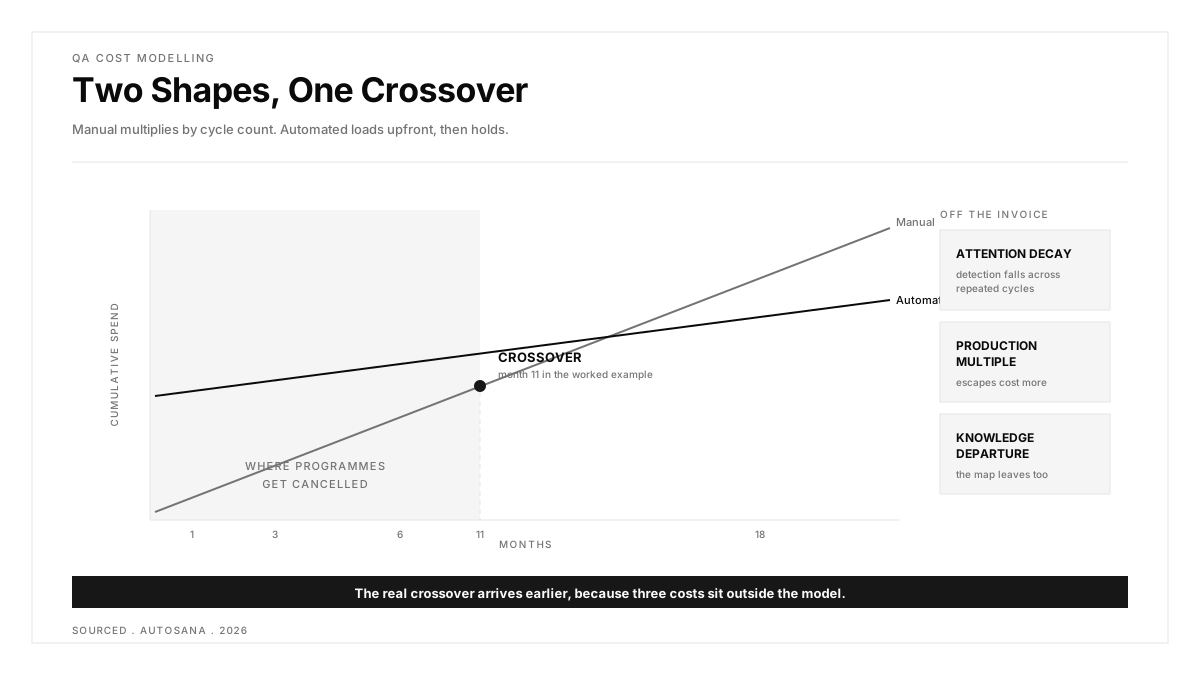
- Three manual costs stay off the invoice: attention decay across repeated cycles, the multiple on defects reaching production, and institutional knowledge departing with a senior tester.
- Autosana removes specific enumerable line items, covering per-cycle tester hours, a separate device-grid contract, and framework onboarding, while leaving judgement work where it belongs.
Why does the usual comparison mislead?
Because it compares positions on a date rather than trajectories over a period.
Ask what testing costs today, and manual frequently wins, particularly for a small suite on a slow cadence, where a tester covering the regression pass in two days every six weeks represents modest spend against any platform fee.
Ask what testing costs across eighteen months at a weekly cadence, and the answer inverts, since the manual figure multiplies by cycle count while the automated figure stops multiplying after setup.
Neither answer is wrong, and they answer separate questions. The decision needs the trajectory, which means modelling both curves rather than quoting both totals.
A practitioner on r/QualityAssurance captured the skepticism this topic attracts, where automation returns get asserted confidently and substantiated rarely, which is fair criticism of how the case usually gets made. The response is arithmetic rather than assertion.
What makes the manual curve linear?
Manual regression is labor, and labor recurs per cycle.
A tester opens the application, executes a case, records the outcome, updates documentation, and proceeds to the next. Cost per cycle equals suite duration multiplied by the fully loaded hourly rate, and that cost repeats with every cycle. A fortnightly cadence produces 26 repetitions a year, weekly produces 52, continuous deployment produces hundreds.
Nothing about the tenth execution costs less than the first, which is the defining property.
Three costs that stay off the invoice
Attention decay. Human attention degrades across repetitive execution, so defect detection on the third consecutive regression pass falls below detection on the first. The suite nominally ran, while its effective coverage declined, and the difference surfaces later as an escaped defect.
The production is multiple. A defect reaching production costs materially more than the same defect caught during testing, because production carries incident response, customer communication, an expedited release, and frequently a postmortem. Each escape converts into engineering hours that appear under incident response rather than under QA.
Knowledge departure. When a senior manual tester resigns, the map of edge cases, known regressions, and environment quirks leaves with them. Rebuilding that map consumes months, and it rarely appears in any transition plan.
A tester on r/softwaretesting described the adjacent pattern where assumptions surviving every test still fail in one specific environment, and institutional knowledge is what usually stands between a team and that class of failure.
The manual line therefore rises linearly with a compounding tail.
What makes the automated curve flat?
Automation removes the per-cycle labor rather than the work.
Once a flow exists, executing it is a machine operation, so the marginal cost of one more run is compute and device minutes rather than tester hours. That is precisely why the recurring portion flattens, since the team stops paying for the tenth regression pass at first-pass prices.
The spend concentrates upfront instead:
| Upfront Item | Typical Shape |
|---|---|
| Flow authoring | Proportional to suite size, front-loaded |
| CI integration | One-off, measured in days |
| Verification configuration | One-off, with periodic revisiting |
| Team enablement | One-off per person, recurring per hire |
That upfront figure is what the flat line amortizes. The crossover arrives when cumulative automated spend falls beneath cumulative manual spend, and it keeps widening afterwards because one line continues climbing while the other mostly holds.
How do you calculate your own crossover?
Automation ROI calculation needs four inputs to produce a date, and most teams hold all four already.
| Input | Where to Find It |
|---|---|
| Hours per regression cycle | Ask whoever runs it |
| Fully loaded hourly rate | Finance, including benefits and overhead |
| Cycles per year | Release cadence multiplied by 52, 26 or 12 |
| Upfront automation estimate | Authoring plus integration plus enablement |
Annual manual cost equals hours multiplied by rate multiplied by cycles. Annual automated cost equals platform and device spend plus residual human time for authoring new flows and judging failures. Crossover arrives where cumulative automated spend, including the upfront figure, falls beneath cumulative manual spend.
Worked illustratively: a suite taking 24 hours per cycle, at a fully loaded rate of 60, run weekly, produces 24 × 60 × 52, which is 74,880 a year in direct labour before counting any of the three off-invoice costs. Move the same suite to fortnightly, and the figure halves to 37,440, which demonstrates how sharply cadence drives the result.
Run the same arithmetic against your own four numbers before evaluating any tool, because the output determines whether the conversation is worth having at all.
Why does release cadence move the crossover most?
Because cadence sets how many units of per-cycle labour the upfront investment amortises across, and that dominates the other variables.
A team running regression twice yearly holds almost no per-cycle labour to remove, so the manual line stays low while the automation investment amortises across two cycles annually, which pushes the crossover years out.
A team running regression on every pull request holds hundreds of units of per-cycle labour, so the identical investment amortises across hundreds of cycles and the crossover arrives within months.
Team size moves the result less than people expect, since doubling the team doubles both the manual cost and the value of removing it. Licence price moves it less still, because licence spend is usually small beside the labour it displaces.
The team gaining most is the one with the shortest release cycle and the largest regression suite, which is also the team feeling the most pain, so the intuition and the arithmetic agree here.
A founder on r/startups made the general version of the point that teams instrument the steps convenient to measure rather than the steps carrying the cost, and QA budgets behave identically, since the tester salary is visible while the cycle multiplier stays implicit.
A worked scenario across eighteen months
Numbers make the shape visible, so trace one team through a year and a half. The figures below are illustrative rather than benchmarks, and the arithmetic matters more than the inputs.
A team runs a 24-hour regression pass, at a fully loaded rate of 60 per hour, on a weekly cadence. Manual cost per cycle is 1,440, which accumulates at 6,240 monthly.
Automation carries 40,000 upfront, covering authoring, CI integration and enablement, then 2,500 monthly in platform and device spend plus residual human time.
| Month | Cumulative Manual | Cumulative Automated | Position |
|---|---|---|---|
| 1 | 6,240 | 42,500 | Manual ahead by 36,260 |
| 3 | 18,720 | 47,500 | Manual ahead by 28,780 |
| 6 | 37,440 | 55,000 | Manual ahead by 17,560 |
| 9 | 56,160 | 62,500 | Manual ahead by 6,340 |
| 11 | 68,640 | 67,500 | Crossover |
| 18 | 112,320 | 85,000 | Automated ahead by 27,320 |
Crossover lands around month eleven, and the gap then widens at roughly 3,740 monthly because one line keeps climbing while the other mostly holds.
Two observations deserve attention more than the crossover date itself.
The first ten months look like a mistake. Anyone reviewing the program at month four sees automation costing substantially more and concludes the investment failed. Setting the expectation in advance, with the crossover month stated before the work begins, is what prevents cancellation during the expensive stretch.
The three off-invoice costs sit outside this table entirely. Attention decay, the production multiple, and knowledge departure all load onto the manual column and appear nowhere in it, which means the real crossover arrives earlier than the arithmetic shows. Modelling without them produces a conservative answer, which is the right direction for a business case to err.
Halve the cadence to fortnightly and the manual column halves while the automated column barely moves, pushing crossover past month twenty-four. That single change matters more than any other variable, which is why cadence belongs at the front of the model.
How do you build the case internally?
Finance asks three questions, and preparing them shortens the conversation considerably.
What stops being spent, specifically? Vague efficiency claims attract skepticism correctly. Name the line items: tester hours against the regression cycle, the device-grid contract, the onboarding ramp recurring per hire. Each carries a current figure somebody owns.
What happens to the people? The honest answer rarely involves reduction, since manual testers move toward exploratory work, test design, and judging agent output, all of which carry higher value than repeating a regression pass. Framing the change as reallocation rather than removal is both more accurate and considerably easier to approve.
What happens if it fails? Describe the exit. Flows authored in natural language and stored in a repository remain readable artifacts, the existing manual process continues during the parallel period, and the commitment is a quarter rather than a transformation program.
One practical suggestion. Present the cumulative table rather than the annual totals, because the table shows the shape while the totals hide it, and the shape is the argument.
When is manual stay cheaper?
Four cases, stated plainly, because the automation case gets oversold routinely.
Low cadence with a small suite. Quarterly releases against a short regression pass leave little per-cycle labor to remove, so the arithmetic favors leaving it alone.
Exploratory and usability work. Judging whether a flow feels confusing, whether copy reads clearly, or whether an interaction surprises someone requires a human, and automating it would miss the point. Autosana's own breakdown of what should stay manual covers that scope question directly.
Genuinely one-off verification. Checking something once carries no cycle multiplier, so authoring a flow costs more than performing the check.
Pre-stability products. Where the interface changes weekly because the product is still finding its shape, flow authoring competes with product discovery and usually loses.
A QA lead on r/QualityAssurance noted that tooling decisions frequently get made for the team the organisation expects to become rather than the team it currently is, which applies in both directions here and argues for deciding on present numbers.
Which line items actually leave the budget?
Specific and enumerable, which matters for building a case internally.
Per-cycle tester hours for regression. Scheduled flows execute and report without a person in the loop, which removes the largest recurring item.
A separate device-grid contract. Flows run against hosted real devices, folding grid cost into one bill rather than a second procurement line.
Per-cycle CI triage. Results arrive through the GitHub integration with session replay attached, so pass or fail signal needs no manual reconstruction.
Framework onboarding. Flows written in natural language remove the two-to-four-week ramp that arrives with a conventional automation framework, and that item recurs with every hire.
What stays is the judgement work. Deciding which flows matter, supplying representative data, and determining whether a result is genuinely correct remain human, and they should.
What to measure once the programme starts
Three figures keep the model honest after month one.
Actual hours removed from the regression cycle, captured monthly rather than estimated once. Teams frequently discover that a portion of the manual pass survives because it covers something the flows missed, and that residue belongs in the model.
Repair hours spent on the automated suite. This is the figure determining whether the flat line stays flat, and tracking it from the beginning gives you an early signal rather than a surprise at month fourteen.
Escaped defects by month. Where escapes hold steady while hours fall, the programme is working. Where escapes rise, coverage moved rather than improved, and the model needs revisiting before the crossover arrives.
How does Autosana change the shape?
Autosana is an AI-native E2E testing agent for iOS, Android and web, and its effect on the curve operates in two places.
It lowers the upfront segment, since flows state intent in natural language rather than requiring framework fluency, so authoring begins immediately and enablement shrinks toward zero. Teams reach the flat portion sooner because the hill is shorter.
It also flattens the recurring segment further, because flows carry no stored selector, so the interface changes that generate repair work across a mature suite leave them intact. Repair labour is the mechanism that quietly tilts a nominally flat automated line back upward, and removing the binding removes the tilt. Runs execute on hosted real devices, and flows are invocable over MCP.
The limits apply as stated elsewhere. Per-interaction overhead exceeds a compiled in-process framework, so high-volume deterministic interaction inside tight windows remains better served by Espresso or XCUITest. Agents decide rather than resolve, which makes verification necessary. And the four cases above where manual stays cheaper remain true regardless of which platform sits on the other side.
Where to start
Collect the four inputs before evaluating any tool. Hours per regression cycle, fully loaded hourly rate, cycles per year, and a rough upfront estimate. The first three take one conversation each, and the fourth needs only an order of magnitude.
Then run the multiplication and look at the annual figure beside your current tooling budget. Most teams have never seen the cycle multiplier applied, and seeing it changes the discussion from preference to arithmetic, which is a considerably shorter discussion.
.png)
FAQ
Is automated testing cheaper than manual testing?
Past a cadence-dependent crossover point, yes. Manual cost multiplies by cycle count while automated cost concentrates upfront and then flattens, so the answer depends on how many cycles the investment amortises across.
How do you calculate automation ROI?
Multiply hours per regression cycle by fully loaded hourly rate by cycles per year for the manual figure. Compare cumulative automated spend, including upfront authoring and integration, and the crossover falls where the second drops beneath the first.
What is the break-even point for test automation?
It varies with release cadence rather than with team size. Continuous deployment reaches it within months because hundreds of cycles amortise the investment, while quarterly releases push it years out.
Which manual testing costs are usually missed?
Attention decay across repeated cycles, the multiple on defects reaching production rather than being caught in test, and the institutional knowledge departing when a senior tester leaves. None appears on the QA invoice.
Does team size change the automation business case?
Less than expected, because doubling the team doubles both the manual cost and the value of removing it. Release cadence moves the crossover considerably further than headcount or licence price.
When should testing stay manual?
Low cadence with a small suite, exploratory and usability work requiring human judgement, genuinely one-off verification carrying no cycle multiplier, and pre-stability products where the interface changes faster than flows can be authored.
Why does an automated cost line drift upward over time?
Repair labour. A suite bound to selectors accumulates maintenance as the interface changes, which tilts a nominally flat line back up, so binding determines whether the flat portion stays flat.
What does Autosana remove from a QA budget?
Per-cycle regression tester hours, a separate device-grid contract, per-cycle CI triage, and framework onboarding that recurs with every hire. Judgement work stays, covering which flows matter and whether a result is correct.