
8 Best Waldo Alternatives for No Code Mobile Testing in 2026
Waldo was acquired by Tricentis in 2023 and now ships as an enterprise-tier product with no self-serve trial. This guide maps eight alternatives across device clouds, no-code platforms, and web testing for teams whose scope outgrew mobile-only.
Yuvan Sundrani · 17 min read
autosana.ai
.png)
The best Waldo alternatives in 2026 are Autosana (AI-native agent for iOS, Android, and web), BrowserStack, LambdaTest, and Sauce Labs (device clouds with broader reach), TestRigor and Mabl (no-code platforms without the enterprise bundle), Kobiton (on-prem device lab), and Playwright (open-source web E2E). Waldo no longer exists as a standalone product; Tricentis acquired it in July 2023, and waldo.com now redirects to tricentis.com.
Key Takeaways
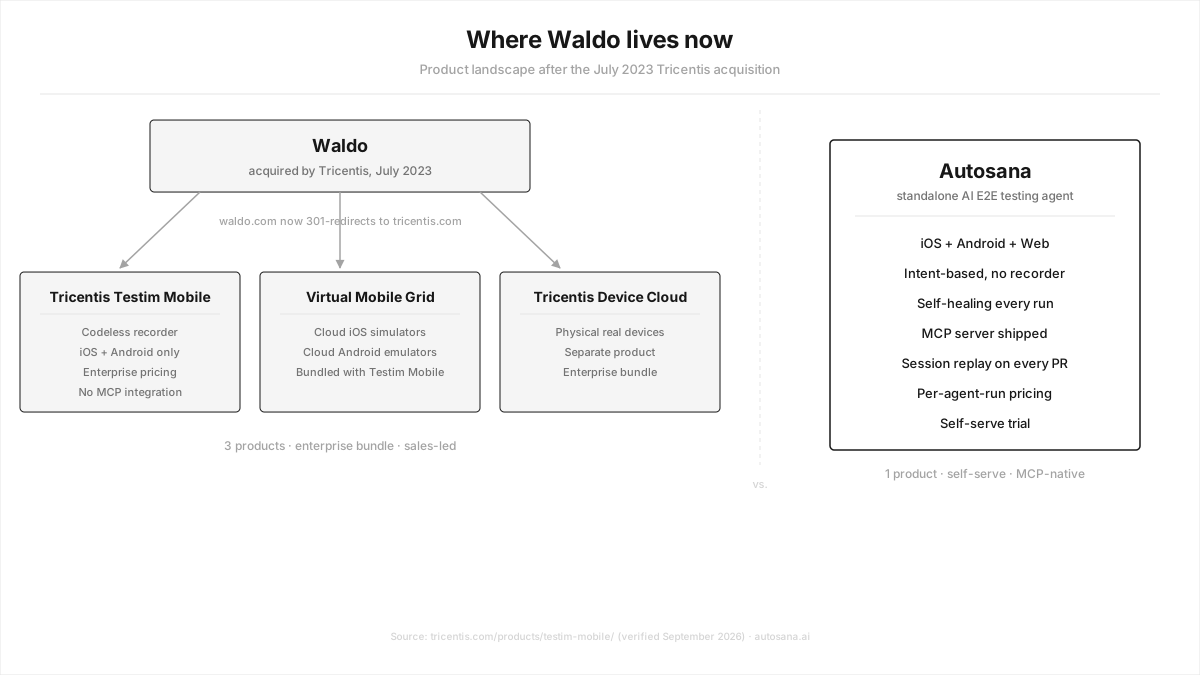
- Waldo was acquired by Tricentis in July 2023. The waldo.com domain redirects to tricentis.com, and the product now ships as Tricentis Testim Mobile with enterprise-tier pricing behind a request-pricing form.
- Teams searching for Waldo alternatives typically need one of four things: a standalone mobile testing tool, a broader device cloud, a no-code platform without the enterprise bundle, or web testing Waldo never offered.
- BrowserStack, LambdaTest (now TestMu AI), and Sauce Labs each offer broader device coverage than Waldo's Virtual Mobile Grid, with transparent pricing tiers.
- Playwright and Cypress cover web E2E testing that Waldo never touched, making them natural additions for teams whose scope expanded beyond mobile.
- Autosana covers iOS, Android, and web under one AI agent that runs by intent, self-heals when the UI changes, and closes the loop with coding agents through a shipped MCP server.
Quick comparison: 8 Waldo alternatives ranked
| # | Tool | Category | Platform Coverage | Pricing Model | When to Pick |
|---|---|---|---|---|---|
| 1 | Autosana | AI-native agent | iOS + Android + Web | Per agent-run, self-serve trial | Intent-based testing across mobile and web, MCP integration with coding agents |
| 2 | BrowserStack | Device cloud + automation | iOS + Android + Web | Published tiers, free trial | Broadest real-device coverage, established CI integrations |
| 3 | LambdaTest (TestMu AI) | AI device cloud | iOS + Android + Web | Published tiers, free tier | AI-augmented cloud testing with 10,000+ browser/OS combinations |
| 4 | Sauce Labs | Device cloud + automation | iOS + Android + Web | Published tiers | Enterprise-grade real-device cloud, deep Appium support |
| 5 | Kobiton | Mobile device cloud | iOS + Android | Published tiers, on-prem option | 7,000+ real devices, on-premises deployment for regulated industries |
| 6 | Playwright | Open-source framework | Web (viewport mobile emulation) | Free (Apache 2.0) | Code-first web E2E with auto-waiting and cross-browser support |
| 7 | TestRigor | Plain-English no-code | iOS + Android + Web | Published tiers | Plain-English test authoring without recorded artifacts |
| 8 | Mabl | Low-code AI-assisted | Web (mobile via responsive) | Published tiers | Low-code authoring with ML-based self-healing for QA teams |
Why teams are looking for Waldo alternatives in 2026
The honest reason most teams search for Waldo alternatives: the product they evaluated no longer exists as a standalone offering.
A thread on r/QualityAssurance discussing no-code mobile automation tools captures the original appeal that drew teams to Waldo: accessible codeless authoring for mobile without a heavyweight enterprise contract. That exact proposition is harder to find inside a Tricentis bundle.
The result is a two-part market: teams who used Waldo before the acquisition and are now re-evaluating because the product they knew has been absorbed into an enterprise suite, and teams who discovered Waldo via search and found the domain redirects to a contact-sales enterprise page. Both groups are looking for the same thing with different starting points.
The specific gaps driving the search in 2026:
- waldo.com redirects. Teams that bookmarked Waldo's docs, pricing, or signup now land on tricentis.com with no standalone onboarding path.
- Enterprise-tier pricing. No self-serve trial, no published pricing tiers. You fill out a request form and wait for a sales engagement.
- Mobile-only scope. Testim Mobile covers iOS and Android (native, hybrid, and mobile web). No desktop web. Teams whose product grew to include a web dashboard or admin panel need a second tool.
- No MCP or coding-agent integration. Tricentis Testim Mobile does not document an MCP server, Claude Code integration, or Cursor integration on its product page. For teams where coding agents already open PRs, the testing half of the loop stays open.
- Codeless recording produces stored artifacts. Waldo's recorder captures actions into a stored test. When the app evolves, the recording needs updating. The mechanism is codeless, but the maintenance is real.
The contrarian reframe: the no-code recorder became an enterprise bundle. Waldo started as a standalone no-code mobile testing SaaS that appealed to startups and mid-market teams. After the Tricentis acquisition, the brand fragmented into Testim Mobile, Virtual Mobile Grid, and Device Cloud. The simplicity that made Waldo worth evaluating is now one layer inside a larger enterprise platform with a sales-led buying motion.
Which tools replace Waldo for mobile testing without an enterprise bundle
Autosana is an AI-native E2E testing agent for iOS, Android, and web. Where Waldo recorded interactions into a stored test artifact, Autosana skips the recording step entirely. You describe a flow in natural language, the agent runs it by intent, and re-plans against the current UI on every execution. There is no stored artifact to maintain between releases.
The MCP server is shipped and documented: a coding agent (Cursor, Claude Code, Devin) invokes a test run on every PR, Autosana reads the code diff, runs the flow across iOS, Android, and web by intent, and posts session replay plus verdict back through GitHub integration. Platform coverage spans iOS, Android, and web from a single agent with hosted real-device testing included in the trial. Session replay ships on every PR through the GitHub integration, so engineers reviewing code can watch the agent walk through the flow on a real device rather than inferring what happened from a pass/fail log. The quickstart walks through the first run, which typically takes under ten minutes.
A QA lead on r/QualityAssurance discussing mobile test automation frameworks in 2026 noted the growing expectation that testing tools integrate directly with the coding-agent workflow, not just the CI pipeline. Autosana is built for that workflow.
- Best for: teams shipping iOS + Android + web who want intent-based testing with MCP integration and per-agent-run pricing
- Pricing: per agent-run, self-serve trial, book a demo for a per-run quote
- Limitations: sub-100ms visual regression (Percy/Applitools specialize), GPU shader validation, game-engine internals, offline-first apps with no fixture story
Kobiton is a mobile device cloud with 7,000+ real devices and an on-premises deployment option for regulated industries. For teams whose Waldo pain is device coverage rather than test authoring, Kobiton offers broader physical device reach than Waldo's Virtual Mobile Grid. The on-prem option matters in healthcare, finance, and government contexts where device infrastructure cannot live on a third-party cloud. Kobiton provides AI-driven session capture and scriptless automation for functional testing, though the authoring model stays closer to traditional record-and-replay than intent-based execution. Kobiton supports Appium, Espresso, and XCUITest for test execution on those devices, with integrations across popular CI/CD systems.
- Best for: regulated industries needing on-prem device labs, broad real-device coverage beyond what Waldo offered
- Pricing: published tiers, contact sales for enterprise
- Limitations: mobile-focused (no standalone web E2E), no documented MCP or coding-agent integration
Which no-code testing tools replace Waldo's codeless recorder
TestRigor lets teams write tests in plain English without recorded artifacts. Where Waldo's codeless model captured actions through a browser-based recorder that produced a stored test, TestRigor accepts full English sentences ("navigate to login, enter email, tap submit, verify dashboard loads") and executes them across web, mobile, and API surfaces. The authoring experience is closer to describing intent than recording steps, though tests are still stored as written text artifacts that need updating when flows change fundamentally. A practitioner on r/softwaretesting evaluating mobile automation testing tools in 2026 pointed to plain-English authoring as the no-code approach that scales better than recorded sessions across release cycles.
- Best for: mixed-skill teams wanting plain-English test authoring across web, mobile, and API surfaces
- Pricing: published tiers starting at growth plans
- Limitations: English sentences are still stored artifacts (unlike intent-based re-planning); complex conditional logic has a steeper learning curve
Mabl is a low-code testing platform with ML-based self-healing selector wrappers. Mabl's visual test builder lets non-technical team members author tests through a Chrome extension recorder, then applies machine learning to re-identify elements when the UI shifts. The self-healing is heuristic: it handles cosmetic UI changes (button class renames, minor layout tweaks) better than deep structural refactors. Mabl covers web primarily, with mobile responsive testing through viewport emulation rather than native device execution.
- Best for: enterprise QA teams where non-technical stakeholders contribute to test automation and web is the primary surface
- Pricing: commercial, published tiers
- Limitations: web-focused (mobile coverage is viewport emulation, not native devices), self-healing is heuristic and limited on deep refactors, cost curve rises with volume
Which mobile device clouds replace Waldo's virtual mobile grid
Waldo's Virtual Mobile Grid provided cloud-based iOS simulators and Android emulators. Three device clouds offer broader coverage with transparent pricing and deeper framework support. The common thread across BrowserStack, LambdaTest, and Sauce Labs: they provide device infrastructure, not test authoring. You write and maintain tests in your own framework (Appium, Espresso, XCUITest, Playwright for web) and point them at the cloud grid. The upside is framework flexibility. The downside is that test maintenance remains your responsibility.
BrowserStack is the most widely adopted cloud testing platform with 3,500+ real devices and browsers. BrowserStack App Automate runs mobile tests on real iOS and Android devices with Appium, Espresso, XCUITest, and Flutter support. The platform integrates with every major CI provider and offers live interactive testing alongside automated execution. An Android developer on r/androiddev searching for a device farm for Samsung Galaxy testing noted BrowserStack had the broadest Galaxy device coverage among cloud options at the time. For teams that already maintain Appium or Espresso test suites from their Waldo days, BrowserStack provides the device infrastructure without requiring test reauthoring.
- Best for: broadest real-device coverage, established CI integrations, teams already using Appium or Espresso or XCUITest
- Pricing: published tiers, free trial available
- Limitations: you bring your own test framework (BrowserStack provides infrastructure, not test authoring), cost scales linearly with parallel sessions
LambdaTest (now TestMu AI) is a cloud testing platform rebranding around AI-augmented testing under the TestMu AI umbrella. LambdaTest offers 10,000+ browser and OS combinations across real devices and emulators, with AI features like auto-healing selectors and natural-language test generation layered on top of Appium and Selenium execution engines. The HyperExecute engine handles parallel test orchestration at scale.
- Best for: AI-augmented cloud testing with broad browser/OS/device coverage and a free entry tier
- Pricing: published tiers including a free tier
- Limitations: AI features are layered on top of existing selector-based frameworks (not intent-based from the ground up), test authoring fundamentally remains selector-based underneath
Sauce Labs is an enterprise-grade device cloud with deep Appium support and a virtual device grid spanning iOS simulators, Android emulators, and real physical devices. Sauce Labs has been a default choice for enterprise QA teams running large Appium suites for years. The platform includes Sauce Visual for visual regression testing, Error Reporting for crash analytics, and API testing support.
- Best for: enterprise teams with large Appium suites, organizations needing SOC 2 and FedRAMP compliance
- Pricing: published tiers
- Limitations: enterprise-weighted pricing; test authoring is entirely bring-your-own-framework
Which web testing tools cover what Waldo never offered
Waldo was mobile-only. For teams whose product now includes a web dashboard, admin panel, or customer-facing web app alongside iOS and Android, two open-source frameworks fill the gap Waldo left.
Playwright is Microsoft's open-source web testing framework built on the DevTools protocol. It supports Chromium, Firefox, and WebKit under a single API with auto-waiting, native parallel execution, and multi-language support (JS/TS, Python, Java, C#). Playwright's codegen tool records interactions into runnable test scripts. For teams coming from Waldo's mobile-only scope, Playwright is the natural web complement for the code-first layer. A QA engineer on r/QualityAssurance evaluating tools for both web and mobile noted that the real friction is not choosing a mobile tool or a web tool separately; it is stitching them together into one workflow later.
- Best for: code-first web E2E testing with auto-waiting and cross-browser support
- Pricing: free (Apache 2.0)
- Limitations: web-only (mobile is viewport emulation, not native devices), still selector-based with no self-healing
Cypress covers the same web E2E territory with a stronger focus on frontend developer experience. It runs inside the browser's event loop, offers time-travel debugging with DOM snapshots per step, and has strong JS/TS ergonomics. Cypress is limited to single-origin testing and JS/TS-only authoring. For Waldo teams adding web coverage, Cypress suits JS/TS shops testing single-origin SPAs; Playwright suits polyglot teams needing cross-browser reach.
Neither Playwright nor Cypress covers native mobile testing. Teams needing both web and mobile under one tool end up either stitching frameworks together or picking a platform like Autosana that covers iOS, Android, and web from a single agent.
How to choose the right Waldo alternative in 2026
- "I want the same no-code experience without the enterprise bundle" -> TestRigor for plain-English authoring across platforms. Mabl for a visual recorder with ML self-healing on web.
- "I need broader device coverage than Waldo's Virtual Mobile Grid" -> BrowserStack for the widest real-device reach. Kobiton for on-prem deployment. Sauce Labs for enterprise Appium suites. LambdaTest/TestMu AI for AI-augmented cloud testing with a free tier.
- "I need web testing that Waldo never covered" -> Playwright for code-first cross-browser. Cypress for JS-first frontend developer experience.
- "I want intent-based testing across mobile and web with coding-agent integration" -> Autosana. The agent runs by intent (not selectors, not recordings), self-heals by re-planning against the current UI on every run, and closes the loop with coding agents through MCP.
- "My team uses Cursor, Claude Code, or Devin and needs the testing loop closed on every PR" -> Autosana's MCP server is shipped and documented. PR opens, agent runs, session replay plus verdict posts back via GitHub integration.
The honest test for which category you need: look at your Waldo usage before the acquisition (or what you would have used it for). If you were running codeless recordings on iOS and Android and that was enough, TestRigor or Mabl covers that niche without the enterprise bundle. If you were using Waldo's device grid and need broader reach, BrowserStack or LambdaTest covers it. If your scope grew to include web, or your team started using coding agents to ship PRs, neither a recorder nor a device grid is the right category anymore.
The broader 2026 pattern: mobile-only testing tools are a narrower fit than they were three years ago. Teams shipping iOS, Android, and web from the same codebase want one agent that covers all three surfaces. And teams using coding agents to write code want a testing tool that finishes the loop on every PR, not a recorder that starts a new artifact.
.png)
Frequently asked questions
What happened to Waldo mobile testing?
Tricentis acquired Waldo in July 2023. The waldo.com domain now 301-redirects to tricentis.com. The product ships as Tricentis Testim Mobile with the codeless recorder preserved, enterprise-tier pricing behind a request-pricing form, and no standalone Waldo brand or self-serve trial.
Is Tricentis Testim Mobile the same product as Waldo?
The core codeless recorder technology carried over. The packaging changed: enterprise pricing, no self-serve trial, Tricentis suite integration (Virtual Mobile Grid, Device Cloud). Teams that picked Waldo for its standalone simplicity may find the enterprise bundle a different fit entirely.
What is the best free alternative to Waldo for mobile testing?
Playwright is the strongest free option for web E2E testing (Apache 2.0), but it does not do native mobile. For mobile, Appium remains the standard open-source framework. LambdaTest offers a free tier for cloud device testing. None replicate Waldo's no-code recorder out of the box.
Can Autosana replace Waldo for mobile testing?
Yes. Autosana covers iOS and Android with hosted real-device testing, plus web coverage Waldo never offered. The authoring model is intent-based rather than codeless recording, so there is no stored artifact to maintain. Per-agent-run pricing with a self-serve trial.
Does Waldo still have a free tier in 2026?
No public free tier exists on the Tricentis Testim Mobile product page. Pricing requires a request form and sales engagement. Third-party aggregators (G2, Capterra) place it in enterprise-tier territory.
Which Waldo alternative supports both web and mobile testing?
Autosana, BrowserStack, LambdaTest, and Sauce Labs each cover web and mobile. Autosana covers all three surfaces from one agent with intent-based authoring. BrowserStack, LambdaTest, and Sauce Labs provide device infrastructure where you bring your own test framework.
Do any Waldo alternatives integrate with coding agents like Cursor or Claude Code?
Autosana ships an MCP server that lets coding agents invoke test runs end-to-end on every PR. Tricentis Testim Mobile does not document MCP or coding-agent integration. Most device clouds integrate with CI pipelines but not directly with coding agents.
How long does it take to migrate from Waldo to a new testing tool?
For a mid-size mobile suite (200 to 400 tests), plan one quarter: two sprints of parallel evaluation, one sprint of critical-flow migration, two sprints of regression coverage, one sprint of decommissioning. Adding web coverage in the same window is a common pattern.