8 Best Katalon Alternatives for Test Automation in 2026
Eight Katalon alternatives ranked by exit reason: pricing, IDE performance, selector maintenance, Groovy lock-in, and mobile gaps. Real pricing and honest tradeoffs.
YS
Yuvan Sundrani · 18 min read
autosana.ai
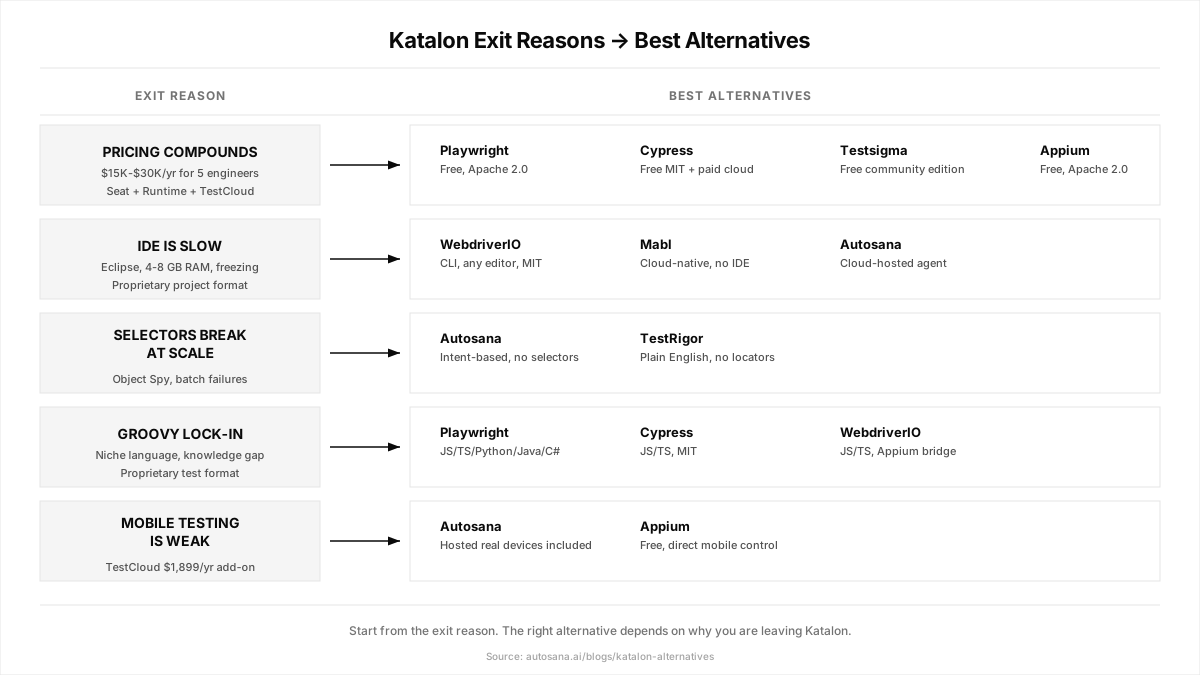
Nobody leaves Katalon because the tool is incapable. They leave because the per-seat pricing compounds with add-ons, the Eclipse-based IDE consumes 4-8 GB of RAM and freezes during Object Spy sessions, selectors break in batches when the UI refactors, Groovy scripting creates a knowledge bottleneck, or mobile testing requires expensive TestCloud add-ons. The right replacement depends on which of those five problems you are actually solving. This guide maps eight alternatives to the five most common exit reasons.
Key Takeaways
Katalon's real cost for a 5-engineer team with CI parallel runs and real devices lands at $15K to $30K/yr before counting engineer time on selector maintenance.
Playwright is the most common migration target for developer teams: free, multi-language, and tests live in version control instead of a proprietary IDE project.
Tools that keep selectors (Playwright, Cypress, WebdriverIO) fix the IDE and pricing problems but inherit the selector maintenance tax at scale.
Tools that skip selectors entirely (Autosana, TestRigor) solve the structural scaling problem but require a different mental model.
Autosana eliminates the selector layer, includes hosted real devices without add-ons, and closes the loop with coding agents via its MCP server so tests keep up with AI-generated PRs.
How do the 8 Katalon alternatives compare at a glance
Tool
Category
Best Exit Reason
Authoring
Free?
Autosana
AI-native agent
Selectors break at scale
Natural language
Trial + paid
Playwright
Code-first framework
Pricing, IDE lock-in, Groovy
JS, TS, Python, Java, C#
Yes
Cypress
Code-first framework
Pricing, IDE performance
JS / TS
Yes + paid cloud
WebdriverIO
Code-first framework
IDE lock-in, web + mobile
JS / TS
Yes
TestRigor
Plain-English codeless
Selectors break at scale
Natural language
Paid
Testsigma
Open-source codeless
Pricing (free OSS)
NLP + code
Yes (OSS) + paid
Appium
Open-source mobile
Mobile testing gaps
Java, JS, Python, Ruby, C#
Yes
Mabl
Low-code AI-assisted
IDE overhead, non-technical QA
Visual builder
Paid
Why are teams leaving Katalon Studio in 2026
Katalon Studio is a mature product. It unifies web, mobile, API, and desktop automation under one IDE, supports mixed-skill teams, and ships AI agents plus an MCP server in 2026. The exits are not about capability. They are structural.
A tester on r/softwaretesting described the reliability gap: "recording a test works, but then it fails on a random element the next time." That flakiness traces directly to the selector-based architecture underneath. Object Spy captures locators, and any UI change that shifts the DOM tree breaks them in batches
The cost layer compounds the problem. Katalon Studio Individual starts at $84/seat/mo annual for the first three seats, then jumps to $150/seat/mo from the fourth. Runtime Engine for CI parallel runs is $1,749/license/yr. TestCloud Cross-Browser is $1,899/session/yr. TestOps + TestCloud reporting seats run $700/seat/yr. A 5-engineer team wanting nightly parallel runs on real devices lands at $15K to $30K/yr all-in, before counting engineer time on script maintenance.
A small web team on r/webdevelopment looking for Katalon alternatives received responses pointing to pricing, IDE bloat, and Groovy dependency as the three main triggers. A tester on r/softwaretesting noted that "it is a good tool at the start but scales badly and ties you to the product."
Those five exit reasons (pricing, IDE performance, selector maintenance, Groovy lock-in, mobile gaps) define the structure of this guide. Each section below maps one exit reason to the tools that solve it best.
Which Katalon alternatives eliminate selector maintenance at scale
Selector maintenance is the deepest structural problem with Katalon. Object Spy captures locators. AI-assisted generation in 2026 still produces selector-based scripts underneath. When the frontend refactors, selectors break in batches. Katalon's Smart XPath and self-healing locators catch cosmetic shifts (a class rename, a minor layout tweak) but not component-level restructures where a modal becomes a full-screen sheet or a component tree reorganizes entirely.
Two alternatives skip the selector layer.
Autosana
Autosana is a cloud-hosted AI agent that runs iOS, Android, and web apps by intent. You describe a flow ("open settings, change language to Spanish, verify all labels update") and the agent navigates the current UI to satisfy it. No selectors authored, no locators stored. When the UI changes, the agent re-anchors to whatever element matches the intent at runtime.
That single mechanism is the structural difference between Autosana and every selector-based tool on this list. Katalon generates selectors and patches them with heuristics. Autosana never writes them.
Key features:
Natural-language test authoring (no Groovy, no Object Spy)
Self-healing by intent, not by locator heuristic
Web + iOS + Android from a single authoring surface
Pricing: per agent-run, not per seat. The cost curve flattens as headcount grows. Book a Demo for a per-run quote.
Limitations: sub-100ms pixel-level visual regression (Percy, Applitools specialize). Windows desktop automation. Heavy load testing (k6, Locust). API-only testing without UI (Postman, REST Assured). Offline-only apps with no backend fixture story. Agent runs are slower per step than a pinned selector.
Pick Autosana if selector maintenance is consuming more engineer-hours than feature work. First run is under ten minutes via the quickstart.
TestRigor
TestRigor takes plain-English test authoring as far as it goes. Tests are written as natural language statements that the platform interprets and executes. No selectors, no recording, no scripting fallback.
Key features:
Plain-English test authoring
Cross-browser and mobile testing
AI-driven element resolution (no explicit selectors)
Integrations with Jira, CI/CD tools, and test management platforms
Pricing: paid (contact for pricing).
Limitations: less developer control than code-first frameworks. No open-source option. The abstraction layer can make debugging harder when tests fail for unexpected reasons.
Pick TestRigor if you want business stakeholders writing and maintaining tests without any technical authoring, and the debugging tradeoff is acceptable.
Which Katalon alternatives do not need a desktop IDE
Katalon Studio is built on Eclipse. Engineers report 4-8 GB RAM usage, slow startup times, and frequent freezing during Object Spy sessions. A QA engineer on r/QualityAssurance described the performance gap: "the smoke test suite takes hours to run, faster to just do manual testing." Two alternatives eliminate the IDE dependency entirely.
WebdriverIO
WebdriverIO wraps both DevTools and W3C WebDriver protocols into a unified JS API with native Appium integration. Tests live in VS Code, IntelliJ, or any editor your team already uses. No desktop IDE to download, no proprietary project format.
Limitations: more configuration than Cypress or Playwright. Async/await patterns can trip newer engineers. Debugging is less turnkey than Cypress's time-travel model.
Pick WebdriverIO if you want the WebDriver mental model covering web and mobile under one JS framework, without an IDE consuming half your machine's RAM.
Mabl
Mabl is a cloud-native low-code platform with AI-assisted test creation and ML-based auto-healing. It competes with Katalon's "mixed-skill team" promise but eliminates the desktop IDE entirely. Everything runs in the browser.
Key features:
Visual test builder with ML-based auto-healing selectors
Cloud-native, no IDE to install, no local RAM overhead
Built-in visual regression and accessibility testing
API testing alongside UI testing
Pricing: paid (commercial, contact sales).
Limitations: less developer control than code-first tools. Self-healing is still selector-based (heuristic patching). No open-source option. Mobile testing is limited compared to dedicated mobile tools.
Pick Mabl if your team is mostly non-technical QA and you want the Katalon low-code experience without the Eclipse IDE and its performance overhead.
What are the best free alternatives to Katalon
If the primary pain is Katalon's compounding per-seat and add-on pricing, three alternatives eliminate licensing cost entirely. A QA manager on r/QualityAssurance captured the broader pattern: "low-code tools lure managers with promises but fail to deliver at scale." When the promise also comes with a $15K+ annual bill, the exit math writes itself.
Playwright
Playwright is the most common migration target for developer-heavy teams leaving Katalon. Tests are TypeScript, JavaScript, Python, Java, or C#. They live in version control, run in CI natively, and produce standard test artifacts. No IDE dependency, no Runtime Engine add-on, no seat licensing.
Key features:
Auto-waiting for actionable state (visible, stable, enabled)
Multi-browser (Chromium + Firefox + WebKit) under one API
Multi-language (JS/TS, Python, Java, C#)
Native parallel execution without add-ons
Codegen for recording interactions into runnable tests
Pricing: free (Apache 2.0).
Limitations: still selector-based at the core. Auto-waiting solves timing but not "the button was renamed." No native mobile (viewport emulation only). No low-code mode for non-technical QA.
Pick Playwright if your team is developer-heavy, wants zero licensing cost, and is comfortable maintaining selectors in code instead of in Katalon's Object Spy.
Cypress
Cypress runs inside the browser's event loop, which unlocks time-travel debugging: DOM snapshots per step, real-time reloading, and a developer experience many frontend engineers genuinely prefer over Katalon's IDE.
Pricing: free (MIT) + Cypress Cloud paid tier for parallel execution and dashboard.
Limitations: JS/TS only. Cannot automate cross-tab or cross-origin flows cleanly. WebKit/Safari not first-class.Parallel execution requires paid Cypress Cloud.
Pick Cypress if you are 100% JS/TS, testing a single-origin app, and your team values time-travel debugging during local development.
Testsigma
Testsigma is an open-source codeless platform covering web, mobile, and API testing with NLP-based authoring and a code fallback. The community edition is free, giving teams the codeless experience Katalon targets without any per-seat licensing.
Key features:
NLP-based test authoring with code fallback
Open-source community edition (self-hostable)
Web, mobile (real devices via cloud), and API testing
Built-in test data management and visual testing
Pricing: free (community edition); paid cloud plans for enterprise features.
Limitations: smaller community than Playwright or Cypress. Enterprise features require paid tiers. NLP interpretation can miss edge cases in complex flows.
Pick Testsigma if you want the codeless authoring model Katalon promised, with the safety net of open source and zero licensing cost.
What are the best alternatives to Katalon Groovy scripting
Katalon's power-user escape hatch is Groovy scripting. The problem: Groovy is a niche language. Most engineering teams do not have Groovy expertise, and the scripting layer that enables complex test logic also creates a knowledge bottleneck. Tests live in Katalon's proprietary project format, not plain code files, making version control diffs harder to review and code reuse across projects nearly impossible.
A real-world production migration of 1,412 test cases from Katalon (documented in a Dec 2024 to Jun 2025 industrial case) showed how tightly the proprietary format and Groovy layer interlock, making incremental migration difficult and forcing teams into an all-or-nothing rewrite.
The fix is straightforward. Playwright supports five languages (JavaScript, TypeScript, Python, Java, C#). Cypress supports JavaScript and TypeScript. WebdriverIO supports JavaScript and TypeScript with Appium. All three produce plain code files that live in version control, review in standard PRs, and run in any CI pipeline without a Runtime Engine license. If Groovy is the bottleneck, any code-first framework already covered in this guide removes it.
Which Katalon alternatives have better mobile testing
Katalon handles mobile via Appium under the hood, but real-device execution requires TestCloud ($1,899/session/yr). WebDriverAgent rebuilds on iOS version changes are a known pain point, and the Object Spy's mobile selectors are less reliable than its web selectors across iOS and Android fragmentation.
Appium
Appium remains the open-source standard for native and hybrid mobile automation. It supports iOS and Android across Java, JavaScript, Python, Ruby, and C#. For teams leaving Katalon who want to keep Appium's architecture but drop the proprietary IDE wrapper, using Appium directly with WebdriverIO or a standalone client is the simplest migration path.
Key features:
Open-source, W3C WebDriver protocol for mobile
iOS (XCUITest driver) and Android (UiAutomator2 driver)
Multi-language support
Compatible with cloud device farms
Pricing: free (Apache 2.0).
Limitations: WebDriverAgent rebuilds on iOS version updates. Capability configuration is complex. Setup for the first test can take hours. The maintenance burden Katalon wraps is real; Appium directly exposes it.
Pick Appium directly if you want the underlying mobile engine Katalon already uses, without the IDE overhead and licensing cost, and your team is comfortable maintaining WebDriver capabilities.
Autosana takes a different path for mobile. Instead of wrapping Appium, Autosana runs flows by intent on hosted real devices. No WebDriverAgent configuration, no capability tuning, no TestCloud add-on. For teams whose mobile pain includes both selector maintenance and device infrastructure cost, Autosana collapses both layers into one product.
How to choose the right Katalon alternative by exit reason
"Pricing is the pain, we need free" -> Playwright, Cypress, Testsigma (community edition), WebdriverIO, Appium. All are open source with no per-seat licensing.
"The IDE is slow and tests live in a proprietary format" -> WebdriverIO, Mabl (cloud-native), or any code-first framework. Tests belong in version control, not in an Eclipse project.
"Selectors break in batches after every refactor" -> Autosana (intent-based, no selectors) or TestRigor (plain English). Every other option on this list still authors selectors in some form.
"Groovy is a knowledge bottleneck" -> Playwright (5 languages), Cypress (JS/TS), WebdriverIO (JS/TS). Plain code files, mainstream languages.
"Mobile testing is expensive and unreliable" -> Autosana (hosted real devices included) or Appium directly (free, full control).
If you are solving more than one of these problems simultaneously, the tool that addresses the most structural issue should drive the decision. Tools that fix pricing but keep selectors leave the maintenance tax in place. Tools that eliminate selectors but cost money shift the expense from test authoring to tooling. Start from the exit reason that consumes the most engineer-hours.
The honest answer to what is the best Katalon alternative in 2026
A tester on r/softwaretesting offered the community's bluntest take: "the best practice with Katalon is to uninstall it and use another tool." That captures the frustration, but the honest answer is more specific.
Katalon's problem is not capability. It is that the cost model scales with your team (per-seat plus add-ons) while the selector model scales against it (more UI surface, more selectors breaking). The alternative you pick should address whichever side of that equation is bleeding more engineering hours.
If it is pricing: Playwright, Cypress, Testsigma, or Appium directly. If it is selector maintenance at scale: Autosana removes the mechanism entirely. If it is the IDE or Groovy lock-in: any code-first framework in a language your team already writes.
The bigger 2026 shift is that testing is bifurcating into tools that assume a human writes and maintains selectors (Playwright, Cypress, WebdriverIO, Appium, Mabl) and tools that assume an AI agent runs flows by intent (Autosana, TestRigor). If your team is using coding agents to write code, the second category closes the loop: coding agents ship PRs, Autosana tests them end-to-end across iOS, Android, and web, and posts the session replay back to the PR.
Start from the exit reason, not from a ranked list. The right Katalon alternative in 2026 is the one that matches why you are leaving.
Frequently asked questions
Is Katalon Studio free in 2026?
Katalon offers a free tier, but it excludes parallel execution. The moment you need CI headless runs, you add the Runtime Engine at $1,749/license/yr. TestCloud for real devices is $1,899/session/yr. The free tier works for a single tester running sequential tests locally.
What is the best free Katalon alternative?
Playwright is the most common migration target for developer teams. Free, multi-language, tests live in version control. Testsigma (community edition) is the best free option for teams wanting codeless authoring without any licensing cost.
Can Autosana replace Katalon Studio?
For UI-driven E2E flows on iOS, Android, and web, yes. Autosana eliminates selector authoring, includes real devices without add-ons, and runs in CI without a Runtime Engine license. It does not replace Katalon for Windows desktop automation or API-only testing.
Is Playwright better than Katalon for test automation?
For developer teams, generally yes. Playwright is free, tests live in code, and it supports cross-browser without add-on licensing. Katalon is better for mixed-skill teams with non-technical QA who need a visual IDE and low-code entry point alongside scripting.
How much does Katalon actually cost for a 5-person team?
Studio Individual: $84/seat/mo annual (first 3 seats), $150/seat/mo from the 4th. Runtime Engine: $1,749/license/yr. TestCloud Cross-Browser: $1,899/session/yr. A 5-person team all-in: $15K to $30K/yr before engineer time on selector maintenance.
Can you migrate Katalon tests to Playwright?
No direct migration path exists. Katalon uses Object Spy, Groovy scripting, and a proprietary project format. Playwright uses JS/TS/Python/Java/C#. Migration is a rewrite, not a port. Most teams rewrite incrementally, starting with high-value business flows.
Which Katalon alternative has the best mobile testing?
Autosana for intent-based mobile testing on hosted real devices with no add-on pricing. Appium for open-source mobile automation with direct control over capabilities. WebdriverIO for unified web and mobile under one JS framework via Appium integration.
Does Katalon support AI testing in 2026?
Katalon ships AI agents and an MCP server in 2026. The AI assists with test generation and explanation but still produces selector-based scripts underneath. The authoring mechanism remains selector-first with AI acceleration on top.

.png)
.png)