
8 Best Testsigma Alternatives for No-Code Testing in 2026
Testsigma's custom-quote pricing, approve-once heal overhead, and Studio lock-in push teams toward eight alternatives: from code-first frameworks like Playwright and Cypress to intent-based agents like Autosana that eliminate the test artifact entirely.
Yuvan Sundrani · 16 min read
autosana.ai
Key Takeaways
- Testsigma's paid tiers (Pro and Enterprise) are both custom-quote only, with no published price points. Teams evaluating alternatives often cite pricing opacity and budget unpredictability as the trigger.
- The approve-once self-heal workflow creates a stored-patch maintenance loop. Every UI change still requires a human to approve the fix Atto proposes before the patch is stored.
- Code-first alternatives (Playwright, Cypress, WebdriverIO) trade Testsigma's low-code authoring for full developer control, open-source flexibility, and zero vendor lock-in.
- Katalon preserves Testsigma's broad platform coverage (web, mobile, API, desktop) with a GUI recorder plus scripting fallback for mixed-skill teams.
- Autosana eliminates the test artifact entirely: an AI agent runs the flow by intent, re-plans against the current UI every run, and posts session replay to the PR via MCP, with per-agent-run pricing and a self-serve trial.
How do the top Testsigma alternatives compare in 2026?
| Tool | Category | Authoring Model | Self-Healing | Platform Coverage | Pricing |
|---|---|---|---|---|---|
| Autosana | AI-native agent | Natural language / code diff, run by agent | Re-plans against current UI every run | iOS, Android, Web | Per agent-run (self-serve trial) |
| Playwright | Code-first framework | JS/TS, Python, Java, C# | None (auto-waiting only) | Web (viewport mobile emulation) | Free (Apache 2.0) |
| Cypress | Frontend dev experience | JS/TS | None | Web (single-origin focus) | Free + paid Cloud |
| TestRigor | AI-assisted authoring | Plain English | AI-based element re-identification | Web, Mobile, API, Desktop | Per-run pricing |
| Katalon | Low-code IDE | GUI recorder + Groovy | Keyword-based smart locators | Web, Mobile, API, Desktop | Free + paid tiers |
| Mabl | Low-code AI-assisted | Visual builder | ML-based selector healing | Web | Paid (contact sales) |
| WebdriverIO | Modern WebDriver | JS/TS | None | Web + Appium mobile | Free (MIT) |
| Appium | Mobile-first framework | Any W3C WebDriver client | None | iOS, Android, Windows | Free (Apache 2.0) |
Why are teams looking for Testsigma alternatives in 2026?
Testsigma is not a bad product. It is a product whose specific tradeoffs hit a wall for certain team shapes. The pain points surfacing in 2026 cluster around five issues.
Pricing opacity. Both paid tiers (Pro and Enterprise) are custom-quote only. No published number, no self-serve signup for the paid product. The cost drivers per Testsigma's own FAQ are parallel-execution slots, user seats, and deployment method. One QA lead on r/QualityAssurance captured the broader frustration: QA tools are getting too expensive, and teams are actively searching for budget alternatives they can actually forecast.
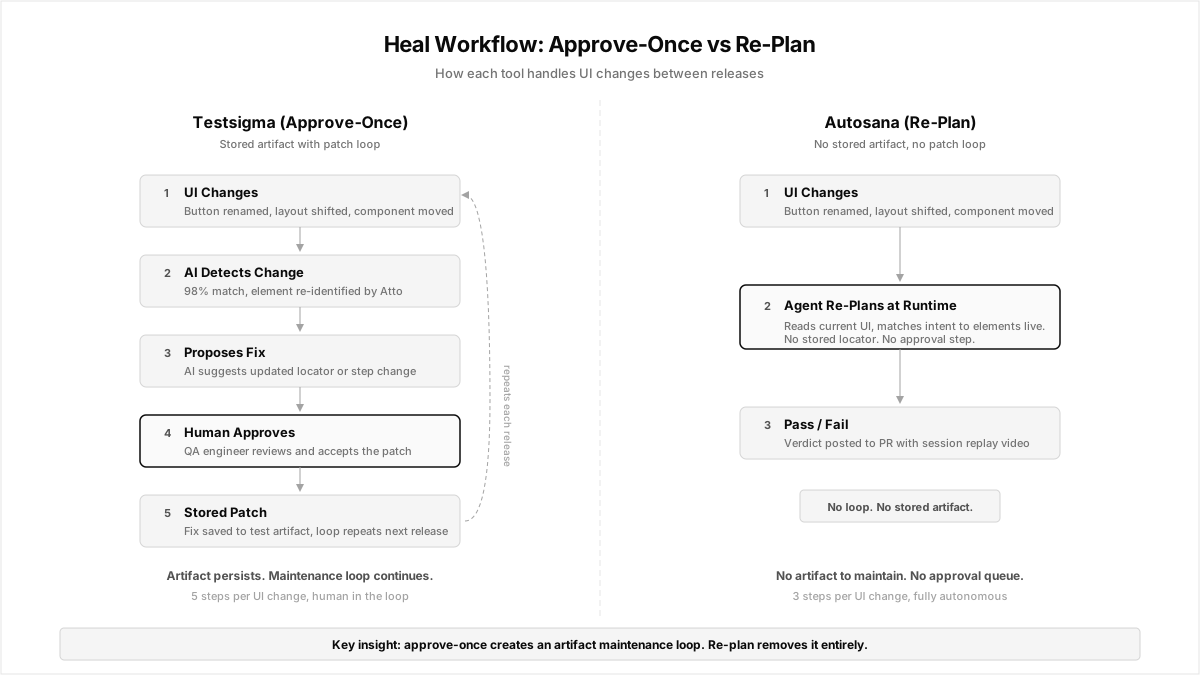
Approve-once heal overhead. Testsigma's self-heal detects UI changes and proposes a fix. The product page shows a "98% match, auto-healed, approved once" example. The mechanism reduces maintenance compared to raw selector repair, but it creates its own artifact loop: detect, propose, approve, store the patch. Teams shipping weekly accumulate dozens of approve-once patches per release cycle.
Atto authoring lock-in. Atto converts Jira stories, Figma designs, and prompts into Studio test steps. The output lives in Testsigma's proprietary authoring surface. A developer on r/programming noted the structural concern: "the risk of vendor lock-in with low-code platforms limits flexibility long-term." G2 reviewers flag the same issue: exporting tests to open-source frameworks is not straightforward.
MCP that authors but does not execute. Testsigma ships MCP. Its /ai-agents page references MCP and Cursor extensively. But the integration is authoring-side: a coding agent writes tests into Studio. It does not run them end-to-end on your PR and post results back. For teams where Cursor or Claude Code already opens PRs faster than a human can review them, the bottleneck is execution, not authoring.
"Autonomous Testing (Upcoming)" is not shipped. The Enterprise tier lists it as a future feature. Teams evaluating today cannot buy it.
The contrarian reframe: you are not leaving Testsigma because the AI is bad. You are leaving because the test artifact itself, the Studio script that gets authored, healed, approved, and stored, is the maintenance cost. Tools that eliminate the artifact entirely solve a different problem than tools that make the artifact easier to maintain.
Which Testsigma alternatives keep the agentic authoring promise?
Is TestRigor a good Testsigma alternative for plain-English test authoring?
Best for: teams that want Testsigma's "write tests in plain English" promise without Studio lock-in.
TestRigor lets you author tests in plain English and runs them across web, mobile, API, and desktop. Like Testsigma, it converts natural-language instructions into executable steps. Unlike Testsigma, the authoring surface is not a proprietary IDE. Tests read as English sentences that map directly to actions.
TestRigor's AI re-identifies elements when the UI shifts, similar in spirit to Testsigma's healing but without requiring human approval for every fix. One user on r/QualityAssurance relayed a manager's pitch: "testsigma is better if we 1. Get a faster result 2. Faster creation." TestRigor competes directly on that axis with per-run pricing instead of custom quotes.
Limitations: still produces a stored test artifact. Tests are plain English but they are still scripts that need updating when business logic changes.
Pick TestRigor if you want Testsigma's authoring philosophy without Studio lock-in and with a clearer pricing conversation.
Is Mabl a good Testsigma alternative for AI-assisted testing?
Best for: enterprise QA teams where non-technical stakeholders author tests and ML-based self-healing is a hard requirement.
Mabl adds machine-learning-based selector healing on top of a visual test builder. When developers rename a class or restructure a component, Mabl re-identifies the element based on behavioral properties rather than the literal locator. It covers web testing with a managed cloud grid and built-in reporting dashboards.
Mabl's self-healing is heuristic. It works better on cosmetic UI shifts than deep structural refactors. The tradeoff compared to Testsigma: narrower platform coverage (web-focused, no native mobile depth), but a more polished visual authoring experience for non-technical authors.
Limitations: closed-source, enterprise-priced (contact sales). Web-focused. No native mobile testing depth.
Pick Mabl if your QA org needs visual, self-healing tests that business analysts can author, and web is the primary surface.
Which Testsigma alternatives give you code-first developer control?
Is Playwright a good Testsigma alternative for code-first web testing?
Best for: engineering teams that want full control over test logic with auto-waiting, cross-browser support, and the DevTools protocol.
Playwright connects directly to browser internals via DevTools protocol. It supports Chromium, Firefox, and WebKit under a single API, ships auto-waiting for elements to be actionable, and offers native parallel execution. Multi-language support (JS/TS, Python, Java, C#) means any engineering team can adopt without a language constraint.
The tradeoff against Testsigma is stark: you get full control and zero vendor lock-in, but you write and maintain every test yourself. No AI authoring, no self-healing, no visual builder. When the UI refactors, selectors break and engineers fix them manually.
Pricing: free (Apache 2.0).
Limitations: selector-based at the core. No native mobile (viewport emulation only). No built-in self-healing. Requires engineering skill to author and maintain.
Pick Playwright if you want the most capable open-source web testing framework with zero vendor dependency.
Is Cypress a good Testsigma alternative for frontend JavaScript teams?
Best for: JS/TS-first frontend teams building SPAs where time-travel debugging and local development speed matter most.
Cypress runs inside the browser's event loop, which enables its signature time-travel debugging: DOM snapshots per step, real-time reloading, and a developer experience frontend engineers genuinely enjoy. Strong plugin ecosystem and first-class TypeScript support come out of the box.
Pricing: free (MIT) + Cypress Cloud paid tier for parallel execution and dashboard.
Limitations: single-origin focus. Cannot automate cross-tab or cross-origin flows cleanly. WebKit/Safari testing is not first-class. JS/TS only. Parallel execution requires paid Cypress Cloud.
Pick Cypress if you are 100% JS/TS, testing a single-origin app, and your engineers rely on time-travel debugging during local development.
Is WebdriverIO a good Testsigma alternative for web and mobile?
Best for: teams that want one JS framework covering web and Appium-based mobile automation with the WebDriver mental model.
WebdriverIO wraps both modern DevTools protocols and traditional W3C WebDriver into a unified JS API. It bridges web and native mobile testing via native Appium integration, which Testsigma also covers but through its proprietary Studio surface. Rich plugin ecosystem with Mocha, Jasmine, and Cucumber runners.
Pricing: free (MIT).
Limitations: more configuration than Cypress or Playwright. Async/await patterns can trip newer engineers. Still selector-based.
Pick WebdriverIO if you want a modern open-source WebDriver framework covering web and mobile under one API.
Which Testsigma alternative keeps broad platform coverage?
Is Katalon a good Testsigma alternative for mixed-skill QA teams?
Best for: enterprise QA teams that need web, mobile, API, and desktop coverage under a GUI recorder with scripting fallback.
Katalon Studio is a Java-based IDE built on Selenium (web) and Appium (mobile). You author by recording, by keyword library, or by Groovy script. The platform coverage mirrors Testsigma's breadth: web, mobile, API, and Windows desktop. Mixed-skill teams where non-coders record and developers script can coexist in one tool.
Katalon TestOps handles reporting, and Katalon TestCloud provides a hosted execution grid. The free tier is generous for small teams. One thread on r/softwaretesting reviewing Testsigma captured how teams weigh platform breadth against ease of maintenance, the same axis where Katalon competes.
Pricing: free Katalon Studio + paid Runtime Engine + paid TestCloud packs.
Limitations: still selector-based. Inherits Selenium and Appium failure modes. Free tier lacks parallel execution. Groovy scripting has a learning curve.
Pick Katalon if you need Testsigma's breadth (web, mobile, API, desktop) with an open scripting fallback and a free entry point.
Which Testsigma alternative eliminates the test artifact entirely?
How does Autosana compare to Testsigma for intent-based testing?
Best for: teams whose Testsigma pain is the test artifact itself, the Studio script that gets authored, healed, approved, and stored, and who want the authoring layer gone.
Autosana is a cloud-hosted AI agent that tests iOS, Android, and web apps by intent. You describe a flow in natural language or hand the agent a code diff. There is no test script between you and the outcome. When the UI changes, the agent re-plans against whatever the current screen shows. No stored artifact, no approve-once patch, no heal workflow.
The MCP server is execution-native: PR opens, agent reads the code diff, runs the flow across platforms, and posts a video plus verdict back via GitHub integration. This is structurally different from Testsigma's MCP, which wires coding agents to Studio for authoring only.
Autosana includes hosted real device testing for iOS and Android as part of the product. Pricing is per agent-run with a self-serve trial, not per-parallel or per-seat. Framework-agnostic: React, Vue, Next, Angular, Flutter, React Native, Swift, Kotlin.
A thread on r/softwaretesting surfacing Testsigma alternatives for enterprise AI test automation confirmed the same axis: teams are evaluating whether the authoring model itself should be the thing that changes.
Limitations: sub-100ms visual regression (Percy/Applitools specialize). Salesforce and desktop surfaces that Testsigma covers. Deep API-schema testing workflows.
Pick Autosana if the test artifact is your maintenance cost and you want authoring, execution, and hosted devices collapsed into one product with per-agent-run pricing.
Which Testsigma alternative offers mobile-specific depth?
Is Appium a good Testsigma alternative for native mobile testing?
Best for: teams that need maximum native mobile automation control across iOS and Android with any W3C WebDriver client language.
Appium is the open-source standard for native mobile automation. It uses the W3C WebDriver protocol to drive XCUITest (iOS) and UiAutomator2 (Android) under a unified API. Any language with a WebDriver client (Java, Python, JS, Ruby, C#) can author Appium tests.
Compared to Testsigma's managed mobile cloud (2,000+ real devices), Appium gives you raw protocol access but requires you to manage device infrastructure yourself, either locally or through a cloud provider. Maximum flexibility and zero vendor lock-in against significant setup and maintenance overhead.
A thread on r/softwaretesting about AI testing software for scalable validation captured the broader tension: as apps embed more AI behavior, teams question whether raw protocol access or agent-based execution is the better long-term bet.
Pricing: free (Apache 2.0). Device infrastructure is your cost.
Limitations: high setup overhead (WebDriverAgent for iOS, UiAutomator2 for Android). Capability configuration is complex. No built-in self-healing. Slower than platform-native frameworks.
Pick Appium if you need maximum native mobile control with any language and your team can manage the infrastructure.
How to choose a Testsigma alternative by which promise matters most
- "We want the same plain-English authoring without Studio lock-in" -> TestRigor
- "We want full code-first control with zero vendor dependency" -> Playwright
- "We are a JS/TS shop and want the best local debugging experience" -> Cypress
- "We need one JS framework for web and Appium mobile" -> WebdriverIO
- "We need Testsigma's breadth (web, mobile, API, desktop) with an open scripting fallback" -> Katalon
- "We need visual, self-healing tests for non-technical QA authors" -> Mabl
- "We want the test artifact gone and the MCP server to execute, not just author" -> Autosana
- "We need maximum native mobile protocol control" -> Appium
The honest question most teams skip: which Testsigma promise are you actually trying to keep? If it is breadth, Katalon. If it is agentic authoring, TestRigor. If it is "make the test maintenance problem disappear entirely," only eliminating the stored artifact achieves that. That is the category Autosana occupies.
.png)
Frequently asked questions
What is the best free Testsigma alternative in 2026?
Playwright (Apache 2.0) for web-only code-first teams. Appium (Apache 2.0) for native mobile. Cypress (MIT) for JS/TS frontend teams. All three are fully open source with no usage caps. Katalon's free tier covers web, mobile, API, and desktop but limits parallel execution.
Does Testsigma have a free plan?
Testsigma offers a Community/Open Source Edition for local infrastructure use. Both paid tiers (Pro and Enterprise) are custom-quote only with no published price point or self-serve paid signup on the pricing page.
Can Autosana replace Testsigma for web and mobile testing?
For iOS, Android, and web E2E flows, yes. Autosana runs intent-based tests with hosted real devices and posts session replay to every PR. For Salesforce, desktop, and API-schema workflows, Testsigma covers surfaces Autosana does not target.
Is Playwright better than Testsigma for web testing?
Playwright gives full code-first control, cross-browser support, and zero vendor lock-in. Testsigma gives AI-assisted authoring and self-healing for mixed-skill teams. Playwright wins for engineering teams that want to own every test line. Testsigma wins for QA orgs where business analysts author alongside developers.
What is the best Testsigma alternative for mobile app testing?
Appium for raw protocol control with any language. Autosana for intent-based mobile testing with hosted real devices included. Katalon for mobile via Appium under a GUI recorder. Pick by whether you want maximum control (Appium), zero authoring (Autosana), or a visual IDE (Katalon).
How does Testsigma self-healing compare to Autosana self-healing?
Testsigma's AI detects UI changes and proposes a fix that a human approves once. The patch is stored on the test. Autosana's agent re-plans against the current UI on every run, so there is no stored script to patch and nothing to approve. Different mechanism, different maintenance profile.
Does Testsigma MCP work with coding agents like Cursor and Claude Code?
Yes. Testsigma's MCP wires Claude Code and Cursor to Studio for test authoring. The coding agent writes tests into Testsigma. Autosana's MCP server runs tests end-to-end on PRs instead. Pick by whether your bottleneck is authoring or execution.
How long does it take to migrate from Testsigma to a different testing tool?
For a mid-size suite (200 to 400 flows), plan one quarter: two sprints of parallel evaluation, one sprint of critical-flow migration, two sprints of regression migration, one sprint of decommissioning. Keep Testsigma active for surfaces the new tool does not cover.