
8 Best Sauce Labs Alternatives for Cross-Browser Testing in 2026
Sauce Labs bundles 10+ products under one enterprise contract, but most teams use only three. This guide maps which alternative replaces which SKU, from device clouds to script execution to AI authoring.
Yuvan Sundrani · 17 min read
autosana.ai
Sauce Labs ships 10+ products under one enterprise contract: AURA, Real Device Cloud, Virtual Device Cloud, Live Testing, Sauce AI Test Authoring, Sauce Visual, Error Reporting, Mobile App Distribution, and a hosted MCP server. No single alternative replaces all of them. The honest approach is to map which tool replaces which Sauce Labs SKU, then swap only what is actually costing your team. This guide ranks 8 alternatives by the specific Sauce Labs product they replace, with pricing, limitations, and the community context that sorts the trade.
Key Takeaways
- Sauce Labs pricing starts at $39/mo per parallel session for Live Testing and $199/mo for Real Device Cloud, but the per-parallel model climbs steeply at scale, with enterprise contracts commonly running $30K to $120K+ per year.
- BrowserStack and LambdaTest are the closest alternatives for the Real Device Cloud and cross-browser grid. Kobiton wins on private device lab control and compliance.
- Playwright and Cypress replace the script execution cloud entirely by running tests locally or in your own CI, with no per-parallel fees at all.
- Sauce AI Test Authoring and AURA are gated to the Enterprise tier. Teams that want AI-native authoring without an enterprise commitment need a different tool.
- Autosana replaces the AI test authoring layer with an intent-based agent that self-heals on every run, ships MCP on a self-serve trial, and prices per agent-run instead of per parallel session.
How do the 8 Sauce Labs alternatives compare in 2026?
| Tool | Category | Replaces Which Sauce Labs Product | Test Authoring | Pricing Model | Best For |
|---|---|---|---|---|---|
| Autosana | AI-native testing agent | AURA / Sauce AI Test Authoring | Intent-based, no scripts | Per agent-run, self-serve trial | Teams replacing AI authoring + MCP-based PR execution |
| BrowserStack | Cross-browser + device cloud | Real Device Cloud, Virtual Cloud, Live Testing | Framework scripts (Selenium, Appium, Playwright, Cypress) | Per parallel session, $29+/mo | Widest browser/device matrix |
| LambdaTest | Cross-browser + device cloud | Real Device Cloud, Virtual Cloud | Framework scripts + KaneAI natural language | Per parallel session, $19+/mo | Budget-conscious real device testing |
| Playwright | Open-source test framework | Script execution cloud (run locally/CI) | Code-first (JS, TS, Python, Java, C#) | Free (Apache 2.0) | Teams that want zero cloud dependency |
| Cypress | Open-source test framework | Script execution cloud (run locally/CI) | Code-first (JS/TS) | Free (MIT) + paid cloud | JS-first frontend teams |
| Kobiton | Mobile device cloud | Real Device Cloud | Framework scripts + scriptless capture | Per device minute, custom | Private device lab + compliance |
| Mabl | Low-code AI-assisted | Sauce AI (partial) | Visual builder + ML self-healing | Enterprise pricing | Non-technical QA teams needing self-healing |
| Appium | Open-source mobile automation | Real Device Cloud (execution layer) | Code-first (any language via WebDriver) | Free (Apache 2.0) | Direct device control, no vendor lock |
Why are teams looking for Sauce Labs alternatives in 2026?
Sauce Labs is not a single product. It is 10+ SKUs bundled under one enterprise contract: AURA, Live Testing, Real Device Cloud (10,000+ physical devices), Virtual Device Cloud, Sauce AI Test Authoring, Sauce AI Insights, Sauce Visual, Error Reporting (Backtrace), Mobile App Distribution, and a hosted MCP server. That product surface is a strength for enterprise QA orgs that use all of it. It becomes friction when your team uses two or three SKUs and pays for the rest.
Four pain points drive the 2026 search:
- Per-parallel pricing climbs steeply at scale. Sauce Labs prices per parallel session starting at $39/mo for Live Testing, $149/mo for Virtual Cloud, and $199/mo for Real Device Cloud. Enterprise contracts commonly run $30K to $120K+ per year at high concurrency. A QA lead on r/QualityAssurance put the market map simply: "Saucelabs and Browserstack are the two big ones." Both charge per parallel session, and at scale the bill compounds faster than most teams budget for.
- 10-SKU complexity. Teams evaluating mobile testing platforms regularly stack-rank Sauce Labs against single-purpose alternatives. On r/QualityAssurance, a poster noted they were "looking at several mobile test automation vendors, including Kobiton, Headspin, Sauce Labs, BrowserStack, and Perfecto." The evaluation itself is complex because Sauce Labs bundles surfaces that competitors sell separately, and most teams only need a subset.
- Sauce AI gated to Enterprise. The AI-powered test authoring and insights agents (AURA) ship only on Enterprise contracts. Self-serve tiers get the cloud grid but not the AI layer. Teams that want AI-native authoring without a custom enterprise commitment are looking elsewhere.
- Framework-first model while the market moves to intent-based. Sauce Labs runs your Selenium, Appium, Cypress, Playwright, Espresso, or WebdriverIO scripts on their infrastructure. That is the right model for teams with mature script suites. But a growing segment wants to skip the script entirely. An SDET on r/devsecops captured the shift bluntly: "the web moved forward and the testing technique did not." That pressure applies to every cloud that assumes a stored test artifact as the unit of execution.
The contrarian reframe: the alternative to Sauce Labs is not one tool. It is a portfolio swap. No single competitor replaces AURA + Real Device Cloud + Sauce Visual + Error Reporting + Distribution under one roof. The honest question is which SKUs justify their cost and which to swap for purpose-built alternatives.
Which Sauce Labs alternatives replace the real device cloud?
Sauce Labs's Real Device Cloud is one of the largest in the industry: 10,000+ physical iOS and Android devices, day-zero flagship access, and private device labs on Enterprise. If your team's primary Sauce Labs spend is device infrastructure, three alternatives cover the same surface.
Is BrowserStack a good replacement for Sauce Labs real device testing?
BrowserStack is the closest 1:1 replacement for Sauce Labs's Real Device Cloud and cross-browser grid. It offers 3,500+ real devices, an Automate product for running Selenium, Appium, Playwright, and Cypress scripts at scale, and a Live product for manual testing. BrowserStack also ships App Live, App Automate, and Accessibility Testing as separate products.
A thread on r/QualityAssurance about best cross-browser testing and visual regression tools for a startup weighed Sauce Labs alongside BrowserStack and several other platforms. The decision often comes down to which pricing tier fits, since both charge per parallel session with similar scaling curves.
Best for: teams that need the widest browser/device matrix with mature framework support.
Pricing: per parallel session, starting at $29/mo for Live. Automate tiers scale with concurrency.
Limitation: per-parallel pricing shares the same scaling curve as Sauce Labs. AI features (including low-code automation) are still maturing relative to Sauce Labs's AURA.
Does LambdaTest cost less than Sauce Labs for real devices?
LambdaTest covers the same device cloud surface at a lower entry price. Real Device Cloud, browser testing, and KaneAI (natural-language test authoring) ship across tiers. LambdaTest's 2026 positioning leans heavily into AI, with KaneAI generating tests from plain English and competing directly with Sauce AI Test Authoring.
Best for: budget-conscious teams that want real device infrastructure plus natural-language authoring without an enterprise gate.
Pricing: per parallel session, starting at $19/mo. Lower entry than BrowserStack or Sauce Labs.
Limitation: smaller real device inventory than Sauce Labs or BrowserStack. Enterprise support depth is thinner for regulated industries.
Is Kobiton better than Sauce Labs for private device labs?
Kobiton specializes in mobile device cloud with a focus on private device labs and compliance. Teams in regulated industries (finance, healthcare, government) choose Kobiton for on-premises device hosting, scriptless test capture, and granular device management controls.
Best for: private device lab control, compliance requirements, on-prem hosting.
Pricing: per device minute, custom contracts.
Limitation: narrower browser and web coverage than BrowserStack or LambdaTest. Primarily mobile-focused.
Which Sauce Labs alternatives replace the script execution cloud?
If your Sauce Labs spend is mostly running Selenium, Playwright, or Cypress scripts on their Virtual or Real Device Cloud, you can eliminate the cloud vendor entirely. Running the same scripts in your own CI pipeline removes the per-parallel-session fee and gives you direct control over infrastructure.
Can Playwright replace Sauce Labs for web testing?
Playwright is Microsoft's open-source test framework using the DevTools protocol. It supports Chromium, Firefox, and WebKit under a single API with auto-waiting, native parallel execution, and multi-language support (JS, TS, Python, Java, C#). Running Playwright in your own GitHub Actions or GitLab CI pipeline eliminates per-parallel-session fees entirely.
On r/QualityAssurance, a thread about BrowserStack alternatives captured the common trajectory: teams that outgrow per-parallel pricing often land on Playwright in CI as the exit, since the framework handles execution natively without a cloud middleman.
Best for: teams that want zero cloud dependency and the most modern code-first testing framework.
Pricing: free (Apache 2.0).
Limitation: still selector-based at the core. No real mobile device testing (viewport emulation only). You own the CI infrastructure, including container orchestration and browser version management.
Can Cypress replace Sauce Labs for frontend testing?
Cypress runs inside the browser's event loop, offering time-travel debugging with DOM snapshots per step. For JS/TS frontend teams, Cypress in CI replaces the Sauce Labs script execution surface. Cypress Cloud (paid) adds parallel execution, dashboards, and flake detection without needing Sauce Labs infrastructure.
Best for: JS/TS-first frontend teams that value developer debugging experience.
Pricing: free (MIT) + Cypress Cloud paid tier for parallel execution and analytics.
Limitation: JS/TS only. No native mobile. Cross-origin and multi-tab flows are limited. Parallel execution requires paid Cypress Cloud, which introduces its own per-session pricing.
Which Sauce Labs alternatives replace AI-powered test authoring?
Sauce Labs's AURA and Sauce AI Test Authoring represent the platform's 2026 bet: autonomous test generation, execution, and analysis from business intent. Per the homepage, AURA is "the only closed-loop agentic AI platform" that autonomously authors, runs, and analyzes tests with human oversight. But Sauce AI is gated to the Enterprise tier. Self-serve teams cannot access it at all. Two alternatives ship AI-powered authoring without an enterprise gate.
How does Autosana compare to Sauce Labs AURA for AI test authoring?
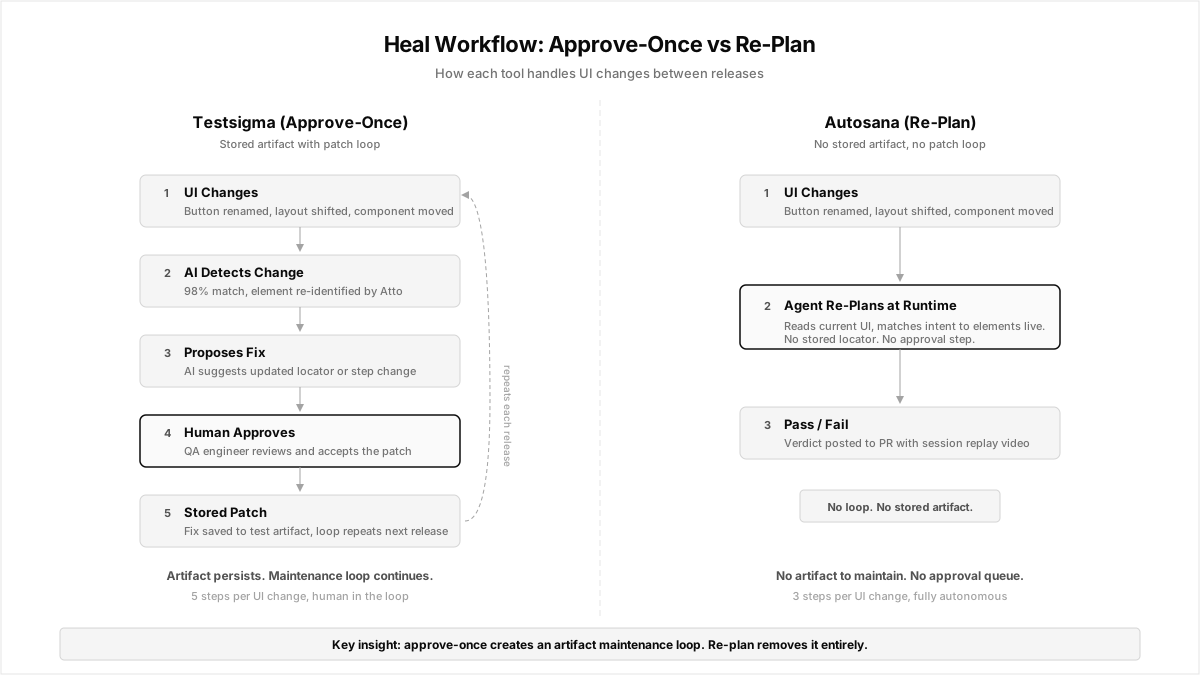
Autosana is an AI-native E2E testing agent for iOS, Android, and web. Instead of generating a script artifact from intent, Autosana's agent runs the flow directly against the current UI every time. There is no stored test to maintain or heal, because there is no stored test.
You describe the flow in natural language ("open cart, tap checkout, enter test card, confirm order") and the agent decides which element matches the intent at runtime. When the UI changes, the agent re-anchors. Structurally different from AURA, which generates and maintains an executable artifact.
Autosana ships an MCP server that runs tests end-to-end on PRs. A coding agent (Cursor, Claude Code, Devin) invokes MCP, and Autosana reads the code diff, runs the flow by intent across iOS, Android, and web on hosted real devices, and posts a video plus verdict back via GitHub integration. Framework-agnostic: React, Vue, Next, Angular, Flutter, React Native, Swift, Kotlin.
Best for: teams using coding agents that need the testing half of the loop, and teams that want AI authoring on a self-serve trial rather than an enterprise contract.
Pricing: per agent-run. No per-parallel-session fees, no seat-based licensing.
Limitation: not a device farm. Not a visual regression tool. Not a crash analytics platform. Autosana is the agent that runs the flow by intent, not the infrastructure beneath it.
Does Mabl replace Sauce Labs AI features?
Mabl is a commercial low-code platform that adds ML-based self-healing selector logic on top of a WebDriver-style engine. When developers rename a class or restructure a component, Mabl re-identifies elements by behavioral properties. The visual builder lets non-technical QA contributors author and maintain tests without writing code.
Best for: enterprise QA teams with non-technical authors who need self-healing wrappers on selector-based tests.
Pricing: enterprise pricing (contact sales).
Limitation: self-healing is heuristic and works best on cosmetic UI shifts. Deep structural refactors can still break tests. Enterprise pricing puts Mabl in a similar cost bracket as Sauce Labs.
Which Sauce Labs alternative covers mobile-specific testing?
Is Appium a free alternative to Sauce Labs for mobile testing?
Appium is the open-source mobile automation framework that Sauce Labs itself was built to run. The Sauce Labs founders built both Selenium and Appium, and the Real Device Cloud is fundamentally Appium execution at scale. Running Appium locally or in CI replaces the Sauce Labs Real Device Cloud execution layer while giving you direct control over device configuration and test orchestration.
On r/Everything_QA, a thread about moving away from enterprise testing clouds surfaced a recurring pattern: teams that outgrow the cloud pricing model return to Appium with their own device infrastructure or a lighter cloud like AWS Device Farm. The trade is control for convenience.
Best for: teams that want direct mobile automation control with no vendor dependency.
Pricing: free (Apache 2.0).
Limitation: you own the infrastructure. WebDriverAgent rebuilds on iOS updates. Capability configuration is verbose. Flake management, device provisioning, and parallel orchestration are all your responsibility.
How to choose which Sauce Labs product to keep vs replace
Not every Sauce Labs SKU needs replacing. The decision framework, mapped by product surface:
- Real Device Cloud (10,000+ devices): keep if day-zero flagship access and private device labs are requirements. Replace with BrowserStack (widest matrix), LambdaTest (lower cost), or Kobiton (private labs and compliance) if you need fewer devices at lower per-session cost. Replace with Appium + your own infrastructure if you want zero vendor dependency.
- Virtual Device Cloud: replace with Playwright or Cypress in CI if you only run emulator and simulator tests. The cloud adds convenience but not unique capability for this surface.
- Script execution (Selenium/Appium on Sauce Cloud): replace with Playwright or Cypress in your own CI pipeline to eliminate per-parallel-session fees. Keep if your team depends on Sauce Labs's artifact logging, session replay, and debugging tools for production triage.
- AI Test Authoring (AURA / Sauce AI): replace with Autosana if you want intent-based execution on a self-serve trial without an enterprise contract. Replace with Mabl if you need a visual builder with selector healing for non-technical QA teams. Keep AURA if the closed-loop autonomous workflow fits your enterprise release process and you are already on an Enterprise contract.
- Sauce Visual: keep or replace with Percy or Applitools. No alternative on this list targets visual regression specifically.
- Error Reporting (Backtrace): keep or replace with Sentry or Datadog. This is a monitoring SKU, not a testing alternative.
The honest answer for many teams: keep Sauce Labs for the surfaces that justify the cost, and swap the rest for purpose-built alternatives that do the specific job better or cheaper.
.png)
Frequently asked questions
What is the best alternative to Sauce Labs in 2026?
No single tool replaces all 10+ Sauce Labs products. BrowserStack and LambdaTest replace the device cloud. Playwright and Cypress replace script execution. Autosana replaces AI test authoring with intent-based execution and MCP-based PR runs. Appium gives you free mobile automation. Match the alternative to the specific SKU causing your pain.
Is Sauce Labs worth it for small teams in 2026?
Entry pricing starts at $39/mo for Live Testing, but most teams need Virtual ($149/mo) or Real Device ($199/mo) tiers. Sauce AI requires Enterprise contracts. For small teams running fewer than 5 parallel sessions, Playwright in CI or LambdaTest's lower tiers often deliver comparable value at lower cost.
Can Playwright replace Sauce Labs entirely?
For script execution on web browsers, yes. Playwright in CI eliminates per-parallel-session fees for web testing. For real device mobile testing, visual regression, crash analytics, AI-powered authoring, or beta distribution, Playwright does not cover those surfaces. It replaces the script execution cloud, not the full platform.
Does Sauce Labs have a free tier in 2026?
No published free tier. A free trial is available via signup. Paid plans start at $39/mo (annual) for Live Testing, $149/mo for Virtual Device Cloud, and $199/mo for Real Device Cloud. Enterprise contracts with AURA and Sauce AI are custom-priced.
What is the cheapest Sauce Labs alternative for real device testing?
LambdaTest starts at $19/mo per parallel session for real device access. Appium is free but requires your own device infrastructure. BrowserStack starts at $29/mo. All three offer lower entry than Sauce Labs's $199/mo Real Device Cloud tier.
Can Autosana replace Sauce Labs for mobile testing?
For iOS and Android E2E flows run by intent, yes. Autosana runs on hosted real devices, ships MCP for PR-level execution, and prices per agent-run. It does not replace Sauce Labs's 10,000-device private cloud, Sauce Visual, Error Reporting, or Mobile App Distribution. It replaces the AI authoring and execution layer.
Is BrowserStack better than Sauce Labs in 2026?
Both charge per parallel session and offer similar browser/device coverage. BrowserStack's entry pricing is slightly lower ($29/mo vs $39/mo for Live). Sauce Labs ships AURA and a hosted MCP server for coding-agent integration. Neither is categorically better. The choice depends on pricing tiers, and whether AURA's closed-loop AI workflow matters to your team.
What is Sauce Labs AURA and do alternatives exist?
AURA is Sauce Labs's AI-Unified Release Assurance Platform: an autonomous system that authors, runs, and analyzes tests from business intent. It is Enterprise-tier only. Alternatives for AI test authoring include Autosana (intent-based agent, self-serve trial, MCP-native) and Mabl (ML self-healing, visual builder). Both ship AI features below the Enterprise gate.