
SaaS Application Testing: Roles, Tiers, and Tenants Multiply Your Surface
A SaaS app is not one application. It is roles times subscription tiers times tenants. Why the surface multiplies, which five flows catch most failures, and how to test isolation properly.
Yuvan Sundrani · 19 min read
autosana.ai

Testing a SaaS product as though it were one application is the mistake that produces the two worst bug classes in the category: a viewer who can delete, and a customer who can see another customer's data. A multi-tenant SaaS app is not one product. It is every combination of permission role, subscription tier, and tenant, and those three dimensions multiply rather than add. The surface is larger than almost any team's suite reflects.
Key Takeaways
- Three dimensions multiply the test surface: roles, subscription tiers, and tenants. Five roles across twenty features across three operations is already 300 permission cells.
- Exhaustive coverage of that space is not achievable and is not the goal. Test the boundaries where privilege and entitlement are enforced, not every cell.
- Tenant isolation needs two assertions, not one. That a tenant sees its own data is the easy half. That it sees only its own data is the half that matters.
- Billing is a state machine with transitions nobody tests: proration on upgrade, scheduled downgrade, dunning on failed payment, and what happens to data after cancellation.
- Autosana runs the same intent across different roles, tiers, and tenants without a separate scripted suite per combination, which is what makes matrix coverage affordable.
Why does the SaaS test surface multiply instead of add?
A single-tenant application with one user type has one version of each screen. A SaaS application has as many versions as the product of its variable dimensions.
Roles control what a user may do. Owner, admin, member, viewer, billing contact. Each role changes which controls render, which API calls succeed, and which records are returned.
Subscription tiers control what the account may do. Free, pro, enterprise. Tiers gate features, set usage limits, and change the shape of the product rather than just hiding buttons.
Tenants control what data exists. Every tenant is a separate universe of records, and the boundary between them is the single most security-sensitive line in the system.
These compose. A viewer on the free tier in tenant A is a genuinely different application state from an admin on enterprise in tenant B, and testing one tells you very little about the other.
The permission dimension alone is bigger than it looks. Five roles against twenty features against three operations, meaning read, write, and delete, is 300 cells. Nobody writes 300 tests, so in practice the matrix gets sampled by whoever wrote the ticket, which means it gets sampled by what the ticket happened to be about.
A practitioner on r/QualityAssurance made the general version of this point, noting that coverage in permission-heavy systems tends to follow the feature that was last built rather than the risk that is actually carried.
The reframe this article runs on: exhaustive matrix coverage is not the goal and never was. The goal is covering the boundaries where enforcement happens. Most of those 300 cells share an enforcement path, and the ones that do not are where the bugs are.
How do you test RBAC without writing 300 tests?
Permission bugs come in two flavours and they are not equally dangerous.
A false negative blocks someone who should have access. Annoying, visible, reported within a day by the person who is blocked.
A false positive grants someone access they should not have. Silent, frequently undetected, and the one that appears in a breach notification.
So the testing priority is asymmetric, and most suites get it backwards by testing that the admin can do things. Test instead that the viewer cannot.
Four techniques make this tractable.
Test the enforcement layer, not every surface. If authorisation is checked in one middleware, prove that middleware correct exhaustively and then spot-check the surfaces. If authorisation is scattered across every endpoint, your real problem is architectural and the test matrix is a symptom.
Assert at the API, not only in the UI. A hidden button is not a permission. The classic exploit is calling the endpoint directly with a viewer's token, and a suite that only drives the interface will never attempt it.
Pick representative rather than exhaustive cells. For each feature, test the highest-privilege role that should be denied and the lowest-privilege role that should be allowed. Those two cells define the boundary, and the cells either side of it follow.
Test privilege transitions. What happens to an active session when an admin demotes a user to viewer mid-session? If the token carries stale claims, the user keeps admin rights until it expires. This is a real and commonly shipped bug, and it exists in the gap between two systems that each work.
A developer on r/learnpython described the matrix-testing instinct well, which is that generating the full combinatorial space is easy and reading the resulting failures is not, so a generated suite without a prioritisation rule produces noise rather than confidence.
Which five flows catch most critical SaaS failures?
Not all flows carry equal risk. Five account for the overwhelming majority of severity-one incidents in SaaS products.
| Flow | What Breaks | Why It Is Critical |
|---|---|---|
| Signup and provisioning | Tenant created without defaults, duplicate workspace | Blocks every new customer |
| Authentication | SSO, session expiry, MFA, password reset | Blocks every existing customer |
| Core value action | The one thing the product is bought for | Churn driver |
| Billing lifecycle | Upgrade, downgrade, dunning, cancellation | Direct revenue |
| RBAC enforcement | Over-permission across role boundaries | Security and compliance |
Signup and provisioning is tested less than it should be because it only happens once per customer. That is exactly why it is dangerous: a broken signup is invisible to existing users and blocks one hundred percent of new revenue.
Authentication is the flow most likely to break from an external change, since SSO depends on an identity provider you do not control. Test the expiry and refresh paths, not just the login path, because session expiry mid-action is where the ugly bugs live.
Core value action is product-specific and should be named explicitly. The one thing a customer would cancel over if it stopped working. Most teams can name it in a sentence and have not written it down anywhere the test suite can see.
Billing deserves its own section below.
RBAC enforcement is the one with the longest blast radius, because a failure is a disclosure rather than an outage.
How do you test the billing lifecycle properly?
Billing is a state machine, and most suites test the states while ignoring the transitions. The transitions are where the money is.
Trial to paid. Does conversion happen at the right moment, with the right amount, with access continuity? And the darker case: what happens when a trial ends and the card fails?
Upgrade with proration. A customer upgrades mid-cycle. The charge should be prorated, access should change immediately, and the next invoice should reflect the new rate. Three systems must agree about one event, and proration arithmetic is where rounding bugs hide.
Downgrade with scheduling. Downgrades usually take effect at period end rather than immediately, which means there is a window where the account is paying for one tier and entitled to another. If entitlement is evaluated from the wrong field, customers lose access they paid for. This is a support-ticket generator and it is almost never tested.
Dunning. A renewal payment fails. There is a retry schedule, a notification sequence, a grace period, and eventually a downgrade or suspension. Every step is a branch and most suites test none of them, because triggering a failed renewal in a sandbox takes deliberate setup.
Cancellation and data retention. What happens to the data? Immediate deletion, retention window, export availability. This has compliance implications in several jurisdictions, which makes it a legal question as much as an engineering one.
Seat changes. Adding and removing seats mid-cycle affects both entitlement and the next invoice, and the two are frequently computed by different services.
A tester on r/softwaretesting noted the structural reason this area stays under-tested, which is that billing flows take real time to play out, so they resist the fast deterministic tests teams prefer to write and get deferred indefinitely.
The practical approach is to use your processor's test clock, if it has one, to advance time artificially so a renewal, a dunning sequence, and a scheduled downgrade can be exercised in seconds rather than in days.
How do you test subscription tier limits and metering?
Tiers gate two different things and teams usually test only the first.
Feature gating is binary and easy. The free tier does not get the advanced report, so the control is absent and the endpoint refuses. Test the refusal at the API, for the same reason permission tests belong there.
Usage metering is continuous and much harder. A tier allows 1,000 API calls a month, or 5 seats, or 10 GB. The questions that matter are about the boundary and what happens after it: does the 1,001st call fail cleanly or silently succeed, does the counter reset at the right instant in the right timezone, and is the limit enforced per tenant rather than globally.
The boundary cases are 999, 1,000, and 1,001, and the behaviour at each should be deliberate rather than emergent. The reset case is the one that breaks in production, because a monthly counter that resets on calendar month versus billing anniversary produces different answers for every customer who did not sign up on the first.
A practitioner on r/softwaretesting made the point that limits and quotas are tested at the happy value and almost never at the boundary, which is the one place the implementation and the pricing page tend to disagree.
Worth testing explicitly: what a customer sees when they hit a limit. A hard failure with no explanation converts a successful upsell moment into a support ticket.
How do you verify tenant isolation?
This is the highest-severity category in multi-tenant SaaS, and it is tested wrong more often than any other.
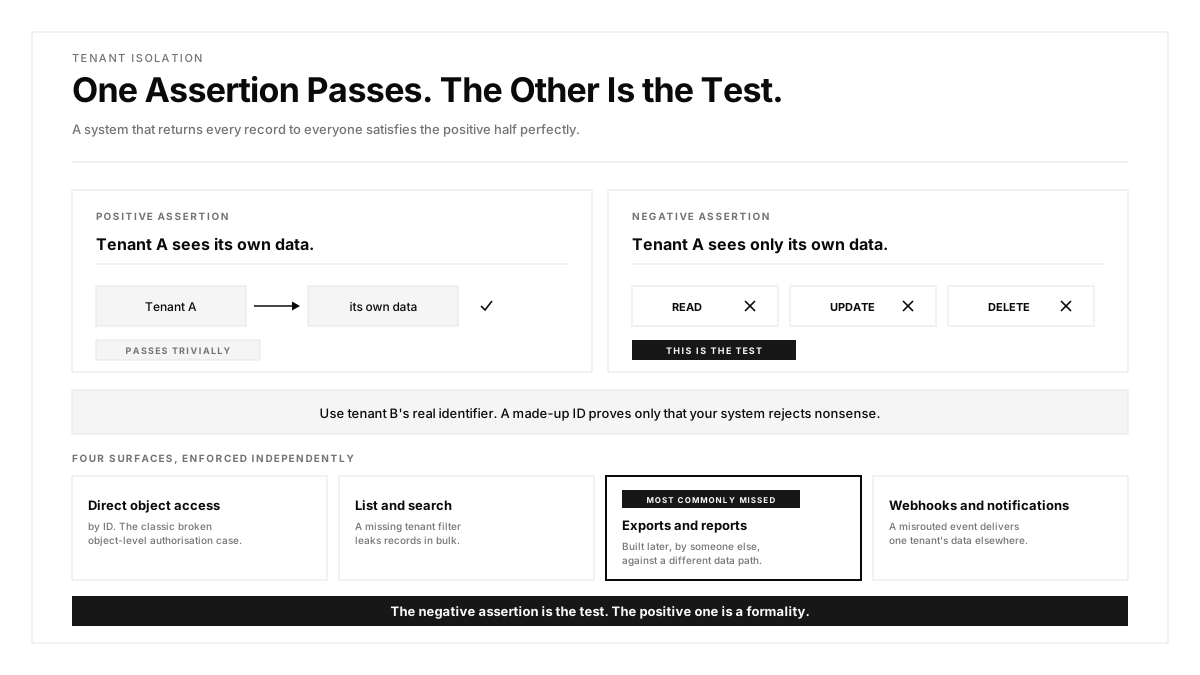
The common mistake is asserting only the positive: tenant A logs in and sees tenant A's data. That passes trivially and proves almost nothing. A system that returns every record to everyone passes that assertion perfectly.
Isolation requires both halves:
- Positive: tenant A sees its own data.
- Negative: tenant A sees only its own data, and attempts to reach tenant B's data fail.
The negative assertion is the test, and it must be made against real identifiers rather than invented ones. Create a record in tenant B, capture its actual ID, then authenticate as tenant A and attempt to read, update, and delete it by that ID. Expect a denial or a not-found on all three. Testing with a made-up ID proves only that your system rejects nonsense.
Four surfaces need this treatment independently, because they frequently have different enforcement paths:
- Direct object access by ID, the classic broken-object-level-authorisation case
- List and search endpoints, where a missing tenant filter leaks records in bulk
- Exports and reports, which are often built by a separate pipeline that reimplements filtering
- Webhooks and notifications, where a misrouted event delivers one tenant's data to another's endpoint
Exports are the most commonly missed, because they are built later, by someone else, usually against a different data access path than the main application uses.
A QA engineer on r/QualityAssurance described the recurring pattern where the main application enforces a rule correctly and an adjacent subsystem built against the same database does not, which is precisely the shape of most isolation incidents.
How should a SaaS test pipeline be structured?
Two speeds, because matrix coverage and merge velocity are in direct tension.
| Trigger | Scope | Time Budget |
|---|---|---|
| Pull request | Smoke: one role, one tier, one tenant, through the five critical flows | Under 10 min |
| Merge to main | Role matrix boundaries, tier entitlement checks, isolation negatives | Under 30 min |
| Nightly | Full billing lifecycle with test clock, cross-tenant probes, tier transitions | Unbounded |
| Pre-release | Full matrix plus a live-mode billing smoke | Unbounded |
Isolation negatives are worth promoting into the merge tier rather than leaving nightly, because an isolation regression that reaches main is a disclosure risk rather than a quality issue, and the cost asymmetry justifies the pipeline minutes.
Two fixture rules matter more here than in most domains. Seed each run with its own tenants, because shared test tenants turn isolation failures into intermittent noise that gets quarantined. And never reuse a tenant across parallel jobs, since a cross-tenant assertion failing because two jobs collided is the single most misleading failure your suite can produce.
How does Autosana fit a multi-dimensional SaaS suite?
Autosana is an AI-native E2E testing agent for iOS, Android, and web. Flows are stated as intent and the agent resolves targets at run time from on-screen context rather than from pre-registered selectors.
For a matrix problem that matters directly. The same stated flow can run as an owner and as a viewer, on free and on enterprise, in tenant A and in tenant B, without a separate scripted suite per combination. The interface differs across those states, since controls are hidden, tiers gate features, and data differs, but the intent is constant and the agent adapts to what is actually on screen. The reason teams undertest the matrix is that each cell historically cost a new script, and that is the cost that changes.
Negative assertions work the same way. "Attempt to open this record and confirm access is denied" is a stated expectation rather than a selector lookup, so it does not break when the denial surface is redesigned from an error page to a toast.
Results arrive through the GitHub integration with session replay attached, which matters for permission failures where the question is always what the user could actually see. Runs execute on hosted real devices for mobile surfaces, and flows can be triggered over MCP.
The limits, plainly. API-level authorisation testing belongs at the API layer and should not be driven through a UI agent, because the exploit you care about bypasses the interface entirely. Billing arithmetic needs an independent oracle rather than the application's own calculation. And tenant provisioning for test fixtures is your pipeline's job. Autosana makes matrix coverage affordable at the end-to-end layer. It does not replace the layers beneath it.
Where to start
Write your RBAC matrix down, even roughly. Roles across the top, features down the side. Most teams have never seen it on one page, and the exercise itself surfaces cells nobody can confidently answer for. Those cells are your first tests.
Then write one negative isolation test properly. Create a record in tenant B, capture its real ID, authenticate as tenant A, and attempt to read, update, and delete it. If all three are denied, you have a template worth replicating across your four isolation surfaces. If any succeeds, you have found the most important bug in your backlog.
.png)
FAQ
What makes SaaS testing different from testing other applications?
Three dimensions multiply the surface: permission roles, subscription tiers, and tenants. Each combination is a genuinely different application state, so testing one configuration tells you very little about the others.
How do you test RBAC without writing hundreds of tests?
Test the enforcement layer exhaustively and spot-check surfaces. For each feature, cover the highest-privilege role that should be denied and the lowest that should be allowed. Those two cells define the boundary the others sit around.
Why is a negative assertion required for tenant isolation?
Because the positive assertion passes trivially. A system returning every record to everyone still shows tenant A its own data. Only attempting to reach tenant B's records with real identifiers proves the boundary is enforced.
Which billing transitions are most commonly untested?
Downgrade scheduling and dunning. Downgrades usually apply at period end, creating a window where billing and entitlement disagree. Dunning involves retries, notifications, and grace periods that take real time, so suites skip them.
Should permission tests run through the UI or the API?
Both, with the API mattering more. A hidden button is not a permission. The realistic exploit calls the endpoint directly with a lower-privilege token, which a UI-only suite will never attempt.
What happens to permissions when a role changes mid-session?
Frequently nothing, which is the bug. If the session token carries stale claims, a demoted user keeps elevated rights until it expires. Testing privilege transitions, not just privilege states, catches this.
How do you test billing without waiting for real renewal cycles?
Use your payment processor's test clock to advance time artificially. A renewal, a failed payment, a dunning sequence, and a scheduled downgrade can then be exercised in seconds instead of across real billing periods.
Can Autosana test across roles, tiers, and tenants?
Yes. The same stated intent runs across different combinations without a separate script per cell, since the agent adapts to what is on screen. API-level authorisation and billing arithmetic still belong in layers beneath it.