
Best Tools for Automating OTP and Verification Code Testing in 2026
Automating SMS and email verification codes in tests, comparing inbox capture services with platforms that handle the whole login flow natively.
Yuvan Sundrani · 17 min read
autosana.ai

TL;DR
- Autosana receives and enters a real email or SMS code inside the flow, with no separate capture service.
- Mailosaur supplies secure inboxes and dedicated numbers built for CI.
- MailSlurp gives tests real inboxes and phone numbers through an API.
- Twilio provides programmable numbers when you want to own the plumbing.
- TestMu AI puts SIM-enabled real devices behind the test so a genuine carrier message arrives on screen.
- Provider test credentials cost nothing and skip real delivery entirely.
- Zunoy Sandbox catches the message in a hosted sandbox instead of sending it to anyone.
- A mock gateway keeps everything in-process for teams who want determinism.
Every automated login test hits the same wall sooner or later. The code your application needs arrives somewhere the test cannot reach: a phone, an inbox, some side channel deliberately placed outside the browser the test is driving.
Teams work around it in ways that quietly cause problems later. A hardcoded test code becomes a backdoor that somebody forgets to remove before launch. A shared test account becomes a race condition the moment two tests run in parallel, and the resulting failures get labelled flaky and retried rather than fixed.
The approaches below split two ways. Either you give the test a real channel of its own to read from, or you remove the channel entirely and accept what that costs in realism.
Why is OTP so hard to automate?
Because authentication is designed to resist exactly what a test needs to do. The code is deliberately short-lived, single-use and delivered out of band, which is the point of it.
That creates three practical problems, and they compound. Each test run needs its own isolated inbox or number, or parallel runs collide and read each other's codes. Each run then needs to retrieve that code programmatically and use it inside a short expiry window, which rules out any approach involving a human. And the unhappy paths, expired codes, reused codes, rate limiting and the resend flow, all need covering as well, which is where almost every suite stops.
Teams feel the cost. A r/QualityAssurance thread on paid tooling, at 16 votes and 39 comments, shows how much of a QA budget goes on infrastructure that exists only to make tests possible, and a r/softwaretesting thread on AI in QA carries 174 votes and 108 comments of scepticism about shortcuts.
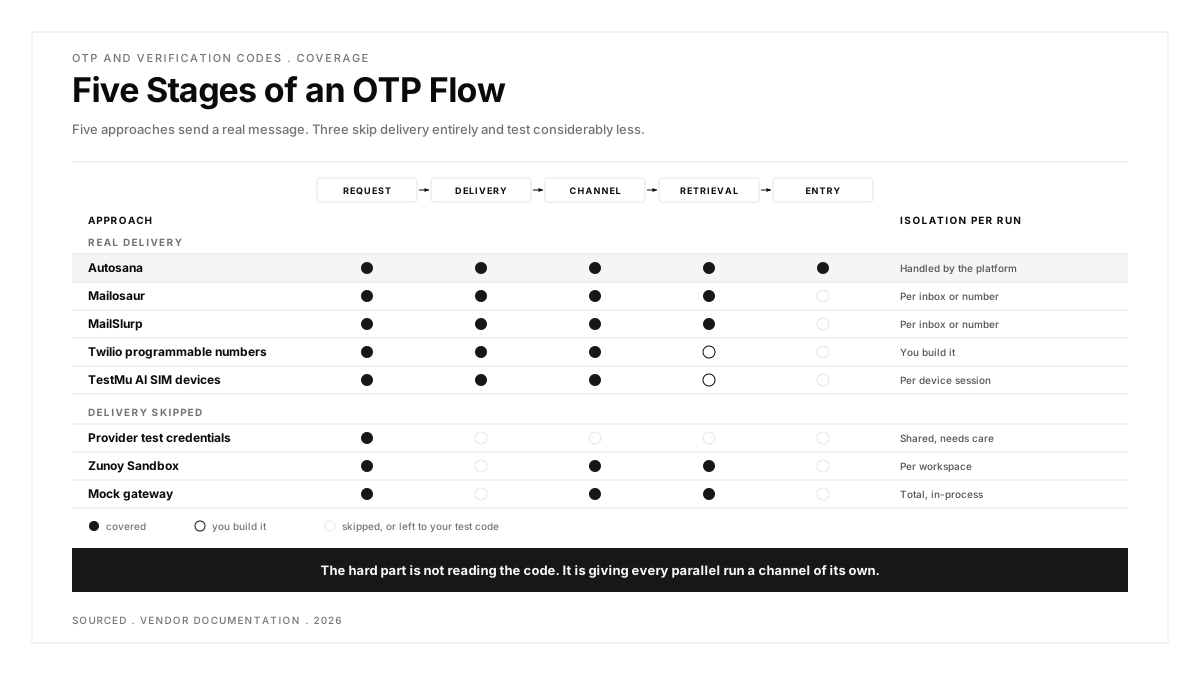
Worth holding onto: the hard part is not reading the code, it is giving every parallel run a channel of its own.
| Approach | Real Delivery | Isolation per Run | Cost |
|---|---|---|---|
| Autosana built-in hooks | Yes, email and SMS | Handled by the platform | Per agent-run |
| Mailosaur | Yes, inboxes and numbers | Per inbox or number | Paid tiers |
| MailSlurp | Yes, inboxes and numbers | Per inbox or number | Free tier, paid plans |
| Twilio programmable numbers | Yes, SMS | You build it | Per number and message |
| TestMu AI SIM devices | Yes, real carrier SMS | Per device session | Paid tiers |
| Provider test credentials | No, fixed code | Shared, needs care | Free |
| Zunoy Sandbox | No, captured in sandbox | Per workspace | Free tier, paid plans |
| Mock gateway | No, intercepted | Total, in-process | Free, engineering time |
Which OTP testing platform suits which kind of test?
The split that matters is whether real delivery actually happens. The first five send a genuine message through a real provider, which is slower and costs money and tests the path your users take. The last three skip delivery entirely, which is faster and free and tests considerably less. Most mature suites use one of each at different cadences rather than picking a single answer.
1. Autosana: Best for Handling the Code Inside the Flow
Autosana is first because the code never leaves the test. Its OTP guide describes the agent receiving and entering a real email or SMS login code using built-in hooks, so there is no second service to subscribe to and no inbox polling to write.
In practice that removes the integration most teams spend a week on. A flow written in natural language covers the whole login, and the step where the code is retrieved is part of it rather than a separate system the test calls out to. Hooks handle the surrounding setup, and runs happen on virtual and physical iOS and Android devices plus web.
Against the dedicated services below, this is narrower. Mailosaur and MailSlurp are built for email and SMS testing as a discipline, covering rendering, deliverability and inbox placement. Autosana covers the code in the flow and stops there.
The parallelism question is the one to probe during any trial. A suite that passes alone and fails when twenty tests run together is almost always reading another run's code, and that failure mode looks like flakiness rather than like a design problem.
Rate limiting is worth checking during evaluation too, since authentication providers throttle aggressively and a suite that requests codes rapidly can trip protections meant for attackers.
Handles well: real email and SMS codes retrieved inside the test, no separate capture service to integrate or pay for, isolation managed by the platform, and a self-serve trial.
Falls short on: email rendering, deliverability and inbox placement, which the specialist services do properly and this does not attempt.
Cost: per agent-run.
Suits you if: the code is a step in a login test rather than the subject of the test itself.
2. Mailosaur: Best Dedicated Service for Email and SMS Testing
Mailosaur's own site describes testing email and SMS end to end with real-device previews, validating flows such as sign-ups and authentication through secure inboxes and dedicated numbers.
That framing is the distinction worth understanding. This is a testing platform for messages, not a bolt-on for login tests. If email is a product surface for you, with transactional templates that must render correctly across clients, it covers far more than code retrieval.
Real-device previews are the feature that justifies the category for some teams. A verification email that renders correctly in one client and breaks in another is a support problem rather than a test failure, and nothing in a login suite would ever catch it.
Framework coverage is broad enough that integration is rarely the obstacle, which means the decision comes down to whether message quality is something you are accountable for.
Handles well: secure inboxes and dedicated numbers, real-device previews, content and layout checks, and framework support aimed squarely at CI.
Falls short on: it is another subscription and another integration, and for a team that only needs a six-digit code it is considerably more product than the job requires.
Cost: paid tiers.
Suits you if: email and SMS are surfaces you are accountable for, rather than channels you pass through on the way to a login.
3. MailSlurp: Best API-First Inbox and Number Service
MailSlurp takes a developer-first shape. Its site covers email and SMS testing including OTP, MFA and load testing, with real inboxes and phone numbers driven through APIs and SDKs.
The practical appeal is creating an inbox per test run from code. That solves the isolation problem cleanly, since nothing is shared and nothing collides, and it fits naturally into Playwright, Cypress or Selenium suites.
Creating and destroying an inbox inside the test body is the pattern worth copying. Setup provisions it, teardown disposes of it, and the isolation problem stops being a design decision and becomes a property of the test.
The free tier is enough to answer the only question that matters early, which is whether code retrieval fits your test structure without contorting it.
Handles well: inboxes and numbers created on demand from code, a free tier to evaluate on, broad SDK coverage, and OTP and MFA called out explicitly.
Falls short on: per-inbox and per-message costs accumulate at scale, and you still write the polling and timeout logic yourself.
Cost: free tier, with paid plans as inbox volume grows.
Suits you if: you want isolation you control from code and are comfortable writing the retrieval and timeout logic.
4. Twilio Programmable Numbers: Best When You Want to Own the Plumbing
Twilio is not a testing product, and plenty of teams use it as one. Provision a number, point a webhook at a small service of your own, and your tests query that service for the most recent code.
The argument for it is control and reuse, since you are probably already a Twilio customer and the same account serves production. The argument against is that you are building and maintaining test infrastructure that two vendors above sell finished.
Be realistic about what that service becomes. It needs an endpoint, storage for recent messages, a way to query by number, and cleanup. Number cost is the other quiet factor, because isolation means a number per parallel runner rather than one shared across the suite, so the monthly figure scales with concurrency rather than with test count.
Handles well: complete control, real SMS delivery, reuse of an existing account, and no new vendor relationship. Falls short on: you build the webhook receiver, the storage and the isolation, and that is a small service someone has to own forever. Cost: per number and per message, scaling with how many parallel runners you need. Suits you if: you already run Twilio and have someone willing to own the small service it requires indefinitely.
5. TestMu AI: Best for a Real Carrier Message on a Real Handset
Every option above reads the code somewhere other than a phone. TestMu AI, the platform formerly called LambdaTest, offers the opposite: its real device cloud lists SIM-enabled devices for SMS and OTP flows alongside network throttling across 3G, 4G, 5G and offline.
That buys you the one thing an inbox service cannot. The message travels a carrier network and lands on a handset, so autofill behaviour, notification interruption and regional routing are all in scope rather than assumed.
Handles well: genuine carrier delivery, SMS autofill behaviour on the real operating system, and regional routing you cannot reproduce with an API number.
Falls short on: slower and dearer than an inbox service, and device session isolation is something you schedule rather than something the API hands you.
Cost: paid tiers, published on the vendor pricing page.
Suits you if: delivery itself is a risk in your markets and you want it proven on hardware before release.
6. Provider Test Credentials: Best Free Option for a Smoke Test
Most authentication providers offer test credentials where a designated number or account always receives a fixed code. Firebase Authentication publishes fictional phone numbers mapped to fixed codes, and Twilio publishes test credentials with magic input numbers that return fixed outcomes without sending a message. No delivery happens, the code is predictable, and the whole problem disappears.
It is genuinely useful and genuinely limited. You have verified that your form accepts a code, and tested none of the delivery path that fails in production. Keep the fixed code out of anything shared, because a test credential that reaches production configuration is a working bypass of your own authentication.
Handles well: free, instant, deterministic, and perfectly adequate for a smoke check in a pipeline.
Falls short on: no real delivery, so SMS routing, provider outages and email placement go untested, and a fixed code is a credential that must never reach production configuration.
Cost: free, included with your authentication provider.
Suits you if: you want login covered quickly today and will genuinely schedule delivery testing rather than forgetting it.
7. Zunoy Sandbox: Best Hosted Sandbox for Catching the Message
Building a mock is work. Zunoy Sandbox is the hosted version of the same idea, describing itself as a platform for testing email, SMS, webhooks, OTP and 2FA workflows without sending test data to real users or production systems.
You point an endpoint at it rather than writing an interceptor, and every message your application tries to send is captured and readable. Client libraries cover Node.js, Python, PHP, Java, Ruby and Go alongside the REST API, so a pipeline reads the code the same way it would read an inbox.
Handles well: no per-message cost, nothing reaching real users, and the setup effort of a mock without the code to maintain.
Falls short on: no real delivery at all, so provider misconfiguration and carrier routing go unverified.
Cost: free tier, paid plans above it.
Suits you if: you want mock-grade determinism and would rather not own the mock.
8. Mock Gateway: Best for Full Determinism In-Process
The last approach removes the channel entirely. Point your application at a local mock in the test environment, capture the message in memory, and read the code directly.
Nothing is faster or more reliable, because nothing leaves the process, and nothing is less realistic either, for the same reason. The sensible arrangement is layered rather than exclusive: mocked delivery on every commit keeps the suite fast, and a real-delivery run before release catches the provider misconfiguration a mock can never see.
Handles well: fastest possible runs, total isolation, no per-message cost, and no flakiness from a real network.
Falls short on: it tests your code rather than your integration, so a misconfigured provider in production stays invisible until a user finds it.
Cost: free in licence terms, plus the engineering time to build it and keep it current.
Suits you if: you run OTP tests on every commit and verify real delivery on a slower cadence such as nightly.
Which approach fits your situation?
The code is one step in a bigger login test. Autosana handles it inside the flow, which removes the integration work and the second subscription entirely.
Email is a product surface you own. Mailosaur, because you need rendering, layout and deliverability checked as well as the code retrieved.
You want isolation you control from code. MailSlurp, creating and disposing of an inbox inside each test so parallel runs never collide.
You already run Twilio and have engineering time. Build it, accepting that the small service you create becomes yours to maintain.
Delivery itself is the risk. TestMu AI SIM-enabled devices, so a real carrier message is proven on real hardware before you ship to that market.
You need something today and have no budget. Provider test credentials, with a calendar reminder to cover real delivery before it matters.
You want a mock without owning one. Zunoy Sandbox, which captures the message in a hosted sandbox and hands it back over an API.
Speed matters more than realism. A mock gateway for the commit-level suite, paired with real delivery on nightly runs. That combination is what most mature teams land on after trying to pick one.
Whatever you choose, test the unhappy paths. Expired codes, reused codes, rate limiting and resend are where authentication actually breaks, and almost every suite tests only the code that works.
Conclusion
OTP automation is usually treated as a plumbing problem, solved once and forgotten. The result is a suite that proves a valid code gets accepted and nothing else.
Decide first whether you are testing the login or testing the message, because the two need different products and the distinction is rarely made explicitly. If it is the login, pick whichever option gets a code into the flow with the least ceremony and move on. If it is the message, you need a service built for rendering and deliverability, and no login tool substitutes for one.
Frequently asked questions
How do you automate OTP testing without hardcoding a code?
Give each test run its own channel to read. That means a dedicated inbox or number from a service such as Mailosaur or MailSlurp, a platform that retrieves the code inside the flow, or a mock gateway that captures it in process.
Can you test SMS verification in CI?
Yes. Services providing programmable numbers expose the received message over an API, so a pipeline can request a code and continue. The constraint is isolation, since parallel runs sharing a number will read each other's messages.
Should you use real SMS delivery in every test?
No. Real delivery costs money per message and adds latency and flakiness, so most teams verify real delivery on a nightly or pre-release run and use test credentials or a mock for the commit-level suite.
How do you stop parallel tests reading each other's codes?
Give each run its own inbox or number rather than sharing one. Services that create an inbox from code solve this cleanly, and a shared test account will produce intermittent failures that look like flakiness and are actually collisions.
Is it safe to use a fixed test code?
Only in environments that can never reach production. A provider test credential is a working authentication bypass, so it belongs in environment configuration that is reviewed, and never in a shared default.
What OTP scenarios do teams usually miss?
Expired codes, codes reused after a first success, rate limiting on repeated requests, and the resend path producing a second valid code. Those are where real authentication defects sit, and suites that only test the happy path find none of them.