
Best Natural Language Test Automation Tools in 2026
Comparing tools that turn plain English into running tests, and the question that separates them: whether a script is generated and who maintains it.
Yuvan Sundrani · 16 min read
autosana.ai
TL;DR
- Autosana runs the English instruction itself, so no script is generated and none needs maintaining.
- testRigor turns plain English into reviewable steps you keep in the product.
- Testsigma pairs natural language authoring with a 2,000-device cloud.
- KaneAI authors in natural language and exports runs to Python Playwright.
- mabl sells unlimited concurrency rather than per-run metering.
- Playwright MCP lets a coding agent drive a browser from a prompt, for exploration rather than a saved suite.
- A coding agent writing Playwright gives you ordinary code and ordinary maintenance.
Every tool on this list accepts a sentence in English. That is where the similarity ends, and the question that actually separates them is rarely asked in the sales call: after you type the sentence, what exists?
Some tools produce a script. Some produce steps. Some produce nothing at all and simply act. The answer decides who maintains your suite in eighteen months, and it is the only thing worth comparing.
Scepticism in the community is high and specific. A r/QualityAssurance thread on using natural language to build tests pulled 21 comments, and a broader one asking what AI testing tools people actually use in 2026 ran to 60 comments of qualified answers.
What does a natural language test actually produce?
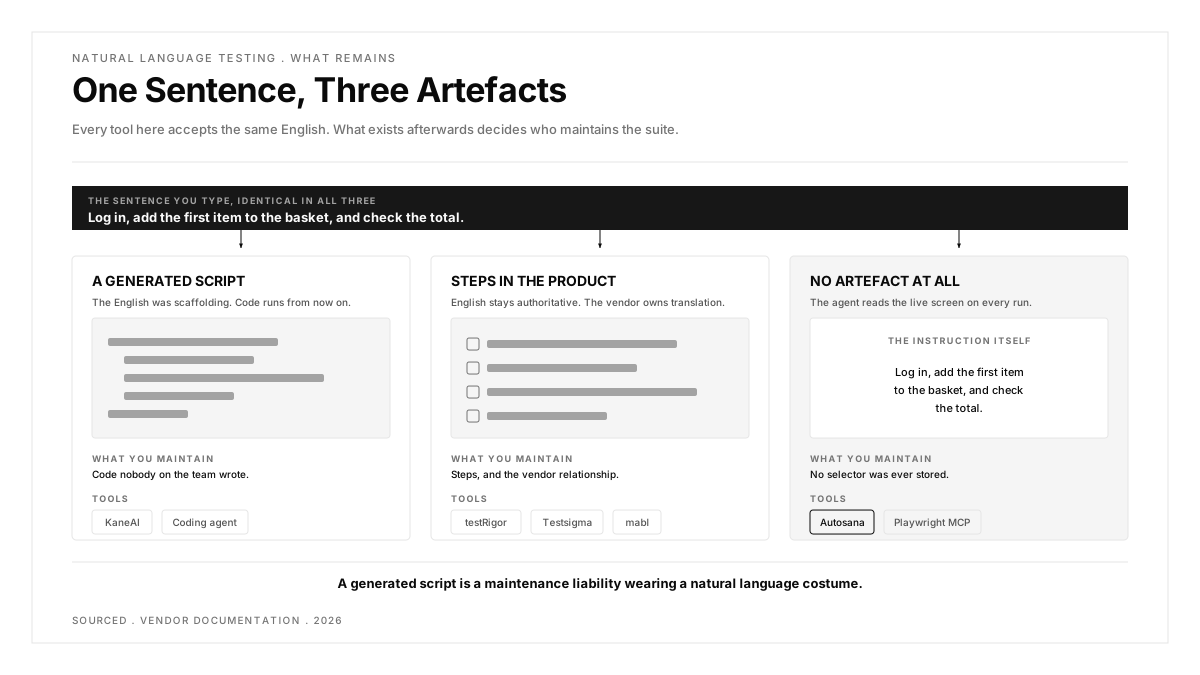
Three artefacts are possible, and each carries a different bill.
A generated script. You describe the test, the tool writes code or structured steps, and from then on the artefact is what runs. The English was scaffolding. Maintenance is identical to any other automated suite, with the added problem that nobody wrote the code being maintained.
Reviewable steps inside the product. The English stays authoritative, the tool expands it into steps you can inspect and adjust, and the vendor owns the translation layer. Portability goes, clarity stays.
No artefact at all. The instruction is the test. An agent reads it at run time, looks at the current screen, and decides what to do. Nothing to patch when a selector changes, because no selector was ever stored.
Worth holding onto: a generated script is a maintenance liability wearing a natural language costume.
| Tool | What Exists After You Type the Sentence | Where It Runs |
|---|---|---|
| Autosana | The sentence. The agent reads the live screen each run | iOS, Android, web |
| testRigor | Plain English steps held in the product | Web, mobile, desktop, mainframe |
| Testsigma | Steps in the platform, plus AI-generated cases | Web, mobile, desktop, Salesforce |
| KaneAI | Steps, exportable to Python Playwright | Web and mobile |
| mabl | A recorded low-code test | Web, mobile, API |
| Playwright MCP | Nothing persisted, the agent acts live | Web |
| Coding agent | Ordinary Playwright code in your repo | Whatever you target |
Which natural language testing tool fits which maintenance budget?
Read the middle column as the real price list. A tool that leaves code behind has handed you a normal automation suite with an unusual authoring step, and the saving is in week one rather than year two. A tool that leaves nothing behind removes the maintenance entirely and asks you to trust an agent's judgement at run time instead. Neither is free. The question is which cost your team is better equipped to carry.
1. Autosana: Best for Teams Who Want No Script to Maintain
Autosana goes first because it is the clearest example of the third category. Flows are tests written in natural language, and the docs are explicit about what happens next: the agent interprets the instructions, finds the relevant UI elements, executes the actions and verifies results at each step. A flow looks like five ordinary sentences, and those sentences are the test.
The consequence shows up when the app changes. There is no stored locator to break, because none was recorded, so a redesigned button with the same label needs no edit at all. Writing effective flow instructions pushes this further by advising that flows test user-visible behaviour rather than UI implementation details, which is the discipline that makes the approach hold.
Two supporting pieces matter for a real suite. Hooks set app state before, during and after a run through scripts, API calls and launch configurations, and code-managed flows let the whole thing live as files in your repository, synced through GitHub, so natural language does not mean losing version control.
The trade is real and worth stating. Without a stored artefact, the agent decides at run time what matches your instruction, and an ambiguous sentence produces an inconsistent run. Autosana handles that by flagging unclear instructions as a distinct issue type, pointing at the test rather than the app, but the authoring discipline is still on you.
Does this well: no generated script and no selector maintenance, natural language that survives a redesign, mobile and web in one place, and bad instructions surfaced as their own category.
Struggles with: an ambiguous sentence can run differently between executions, and there is no code artefact to port elsewhere.
Cost: per agent-run, published on the Autosana pricing page.
Use when: suite maintenance is the bottleneck and you would rather fix sentences than selectors.
2. testRigor: Best Plain English Authoring for Non-Engineers
testRigor makes the strongest version of the plain English claim on its own site: free-flowing plain English that the tool will understand and execute exactly as written. A high-level instruction such as purchase a Kindle is translated into a more specific set of steps, which you then review and refine, also in plain English.
The line that captures the model best is theirs: testRigor tests work as long as your specifications in plain English remain true. That is a genuine shift in what a test asserts, and for a team of manual testers moving into automation it removes the language barrier completely.
Two practical notes. Coverage is unusually broad, including mainframe applications, which almost nothing else on this list touches. And the pricing page at testrigor.com/pricing/ returns a Page not found at the time of writing, with the site routing to Contact Us, so there is no public figure to plan against.
Does this well: genuinely non-technical authoring, steps stay readable in English, unusually broad application coverage including mainframe, and a clear model of what a test asserts.
Struggles with: no published pricing to budget from, and the English lives inside the vendor platform rather than your repository.
Cost: not published. The pricing page is currently unavailable and the site routes to Contact Us.
Use when: the people who understand the product best are not the people who can write code.
3. Testsigma: Best Natural Language Authoring Bundled With a Device Cloud
Testsigma is the option that arrives with infrastructure attached. The Pro tier lists 800 or more browser and OS combinations, 2,000 or more real mobile devices, unlimited automated testing minutes, unlimited applications and projects, parallel execution, auto-healing scripts and a Copilot for authoring.
For teams that would otherwise buy a device cloud and an authoring tool separately, that bundling is the argument. One contract covers both, and the natural language layer is not a bolt-on to someone else's grid.
Pricing is the gap. Every tier reads Get Custom Pricing with no figures published anywhere on the page, which makes the comparison against a published per-device or per-snapshot price impossible to do honestly before a sales conversation.
Does this well: authoring and execution in one purchase, a large published device and browser count, unlimited testing minutes, and auto-healing on top of the natural language layer.
Struggles with: no published pricing at any tier, and the auto-healing implies stored selectors that can drift rather than instructions evaluated fresh.
Cost: custom quote only, no figures published.
Use when: you need both a device cloud and plain language authoring and would rather sign one contract.
4. KaneAI: Best for Natural Language That Exports to Real Code
KaneAI from TestMu AI, the platform formerly called LambdaTest, plans, authors and evolves end-to-end tests for web and mobile in natural language, describing itself as codeless automation that skips the scripting and the brittle selectors.
The feature that distinguishes it is the exit route. KaneAI exports runs to Python Playwright, which means the natural language layer is not a lock-in. You can also click through a flow once and have every action recorded and converted into reusable steps, and control flow is expressed in English too, with If/Else and While loops handling popups, retries and dynamic UI.
Kane CLI puts the same thing in the terminal: describe a flow in natural language and get a verified pass or fail against a website or mobile app.
Be clear about what the export means. Once you take the Playwright code, you own it, and the selectors inside it are ordinary selectors with ordinary maintenance. The export is an escape hatch, not a second authoring mode.
Does this well: natural language authoring with a real export path to Python Playwright, record-and-convert from a manual click-through, loops and conditionals in English, and a CLI for terminal-driven runs.
Struggles with: exported code becomes a normal maintenance burden, and the platform is mid-rebrand from LambdaTest so older documentation and URLs are inconsistent.
Cost: published on the TestMu AI pricing page.
Use when: you want plain language speed now and the option to leave with working code later.
5. mabl: Best When Concurrency Is the Cost You Are Trying to Control
mabl differs in commercial shape rather than authoring style. Its own pricing page commits to unlimited test run concurrency, unlimited local and CI test runs, unlimited applications, environments and workspaces, and unlimited participant licences, with one purchase covering web, mobile, API, accessibility and performance testing.
That matters more than it sounds. The most common unpleasant surprise in this category is a bill that scales with how often you run, which quietly discourages running often. A flat model removes the incentive to under-test.
Authoring is low-code and recorded rather than sentence-first, so if the goal is literally typing English sentences, mabl is adjacent to this list rather than central to it. There are also no published figures, so the flat model has to be priced in a conversation.
Does this well: unlimited concurrency and unlimited local and CI runs committed on the vendor's own page, one purchase across web, mobile, API, accessibility and performance.
Struggles with: low-code recording rather than true sentence authoring, and no published price for the flat model.
Cost: not published, free trial available.
Use when: per-run metering is what stops your team running tests as often as they should.
6. Playwright MCP: Best for Exploration, Not for a Saved Suite
Playwright MCP is an MCP server from Microsoft that gives an LLM browser automation through structured accessibility snapshots, deliberately bypassing screenshots and visually tuned models. It is fast and lightweight, uses the accessibility tree rather than pixel input, needs no vision model and applies tools deterministically.
In practice that makes it excellent for asking an agent to go and check something, and poor as a regression suite, because nothing is persisted. The community has landed on exactly that read: a r/Playwright thread asking whether people are using Playwright MCP for testing when it is really an exploration tool collected 36 votes and 35 comments largely agreeing.
Its own README adds a nuance worth knowing before you standardise on it. Modern coding agents increasingly favour CLI-based workflows exposed as skills over MCP, because CLI invocations avoid loading large tool schemas and verbose accessibility trees into the model context.
Does this well: free, deterministic, no vision model required, and ideal for one-off investigation driven from a prompt.
Struggles with: nothing is saved, so it is not a regression suite, and its own documentation points toward CLI workflows for high-throughput agents.
Cost: free and open source.
Use when: you want an agent to go and look at something, not to build a suite that runs nightly.
7. A Coding Agent Writing Playwright: Best When You Want Ordinary Code
The option nobody sells. Describe the test to Claude Code, Cursor or Codex, get Playwright or Appium code, commit it. A r/softwaretesting thread on automating weekly smoke tests with local LLM browser agents, at 20 comments, is teams working this out in public.
The appeal is that nothing is unusual afterwards. The code sits in your repository, runs in your pipeline, uses your existing framework and is reviewed like any other change. There is no vendor, no lock-in and no new skill to learn.
The catch is that the natural language saved you the typing and none of the maintenance. The selectors the agent chose will break exactly as often as selectors a human chose, possibly more often, since an agent optimising for a passing test tends to reach for whatever locator worked rather than the most durable one. A r/QualityAssurance thread on the most promising no-code solution, at 25 votes and 76 comments, keeps circling back to this.
Does this well: no vendor, no lock-in, code in your repository reviewed through your normal process, and immediate authoring speed.
Struggles with: all the usual selector maintenance survives intact, and agent-chosen locators are often more brittle than a careful human's.
Cost: your existing coding agent subscription.
Use when: you already have a Playwright or Appium suite and want authoring sped up without changing anything else.
Which approach fits your situation?
Maintenance is what is actually killing you. Autosana, because removing the stored artefact removes the thing you spend the time on.
Your best testers cannot code. testRigor, with the pricing conversation scheduled early since nothing is published.
You need a device cloud anyway. Testsigma, taking authoring and infrastructure in one contract.
You want plain language now and an exit later. KaneAI, for the Python Playwright export.
Per-run cost is suppressing how often you test. mabl, for the unlimited concurrency commitment on its own pricing page.
You want to ask a question, not build a suite. Playwright MCP, understanding that nothing persists.
You already have a working framework. A coding agent writing Playwright, accepting that maintenance is unchanged.
Ask every vendor the same question. After I type the sentence, what artefact exists, and who maintains it? The answers differ enormously and the marketing pages make them all sound identical.
Conclusion
Natural language authoring is sold as a saving on writing tests. Writing tests was never the expensive part.
The expensive part is the eighteen months afterwards, and that cost is decided entirely by what the tool leaves behind. Ask what the artefact is before you ask what the sentence looks like, because a tool that generates a script has moved your work rather than removed it.
Frequently asked questions
What is natural language test automation?
Writing a test as ordinary sentences instead of code. The important difference between tools is what happens next: some generate a script from the sentence, some keep readable steps inside the platform, and some run the sentence directly against the live screen with nothing stored.
Do natural language tests still need maintenance?
It depends entirely on the artefact. If the tool generated a script with stored selectors, you maintain that script exactly as you would any other, whoever wrote it. If no artefact is stored and the agent reads the current screen each run, there is no selector to patch and maintenance shifts to keeping the instruction clear.
Are plain English tests reliable enough for a release gate?
They can be, with authoring discipline. The failure mode is ambiguity rather than technology: a sentence that two people would read differently will also run differently. Writing instructions against user-visible behaviour rather than implementation detail is what makes the approach dependable.
Can you export natural language tests to code?
Some tools support it. KaneAI exports runs to Python Playwright, which gives a genuine exit route. Remember that the exported code is ordinary code with ordinary selector maintenance, so the export solves lock-in rather than upkeep.
Is Playwright MCP a test automation tool?
Not on its own. It gives an agent deterministic browser control through the accessibility tree, which is excellent for investigation, but nothing is persisted, so it does not produce a regression suite. Its own README also notes that high-throughput coding agents increasingly prefer CLI workflows for token efficiency.
Why do teams abandon no-code testing tools?
Usually because the first hard case arrives. A flow needing conditional logic, a third-party iframe or a custom component hits the ceiling of the authoring layer, and the escape hatch is either absent or requires the engineer the tool was bought to avoid needing.