Mobile + Web Testing on One Platform: Why Unified E2E Coverage Matters
Learn why unified mobile and web E2E testing can reduce duplicated tooling, maintenance, and ownership while closing the coverage gaps between iOS, Android, and web user journeys.
- Written by
- Yuvan Sundrani
- Read time
- 6 min read
- Published
TL;DR
Most product organizations run two E2E test suites in parallel. One for mobile through Appium, Espresso, XCUITest, or Detox. One for the web through Playwright, Cypress, or Selenium.
Two DSLs, two owners, two flake profiles, two CI configs, two dashboards, two bills. The seams between the two are where the coverage gaps live, and those seams are exactly where users transact.
Autosana tests mobile and web from one flow language, one dashboard, and one CI integration. The seams close because one system sees both sides.
Why do most product organizations run two E2E test suites?
A single product usually reaches its users on three surfaces. The website. The iOS app. The Android app. Ownership of the tests almost never follows that shape.
Web tests live in one repo, in JavaScript, run under Playwright or Cypress, and land in one dashboard. Mobile tests live in a different repo, in Kotlin, Swift, or Java, run under Appium or Espresso or Detox, and land in a different dashboard. Two teams. Two on-call rotations for flakes. Two runbooks for onboarding.
That split was never a design choice. It happened because the frameworks were built by different communities for different runtimes, and neither one crossed the boundary. Teams inherited the split and then paid the tax on it every quarter.
The tax has a visible line item and an invisible one. The visible one is tooling and headcount duplicated across the two suites. The invisible one is the coverage gap between them.
Where do the coverage gaps between mobile and web suites actually appear?
The user flows that generate revenue almost never live on one surface. A checkout starts on a marketing page, resumes inside an iOS app after a magic-link redirect, and confirms with a push notification. A B2B signup starts on a laptop browser, hands off to a mobile authenticator, and is completed with a SaaS onboarding email.
Every one of those hand-offs is a seam. And every seam sits outside the coverage of whichever suite tested the piece before it.
Deep links are the load-bearing example. Android documents the contract in About Deep Links on developer.android.com. Apple documents the equivalent in allowing apps and websites to link to your content on developer.apple.com.
Both contracts are enforced at the OS level. Both fail silently when a web-side association file gets stale. Neither a pure web suite nor a pure mobile suite watches the hand-off end to end.
The teams that get burnt in production are almost never burnt by a single-surface bug. They are burnt by the seam.
How much duplicated work does running two suites cost a team?
Consolidating the two suites is not just a headcount argument. It is a duplication argument.
The same user story is often written twice: once in Playwright TypeScript for the web version of the flow, once in Kotlin plus Espresso for the Android version, and sometimes a third time in Swift plus XCUITest for iOS. Three files, three assertion styles, three flake histories, and one product behaviour underneath.
When the underlying behaviour changes, all three files get updated. When one gets missed, the coverage silently drifts.
The Playwright framework itself is fast, well-designed, and canonical for the web. The Appium framework does the same job for mobile. Both are excellent inside their domain. Neither one closes the loop across domains, because that is not what either one was built to do.
What does "one platform" for mobile-plus-web testing actually mean?
The phrase "one platform" is used loosely. The check that matters is whether a single flow, written once, can execute across web browsers, iOS devices, and Android devices without translation.
Autosana flows are written in natural language and target a web app the same way they target a mobile app. Web coverage is documented under web testing on docs.autosana.ai across Chrome, Firefox, Edge, and Chromium. Mobile coverage runs against a real-device cloud documented at docs.autosana.ai/real-device-testing.
Both surface types are registered under apps on docs.autosana.ai, which is the single object that carries whichever surface the flow ends up executing against.
Ownership collapses to one team, one dashboard, and one CI integration. The seam between the surfaces is inside the same system, which is the entire point.
What are the four costs of running two separate E2E suites?
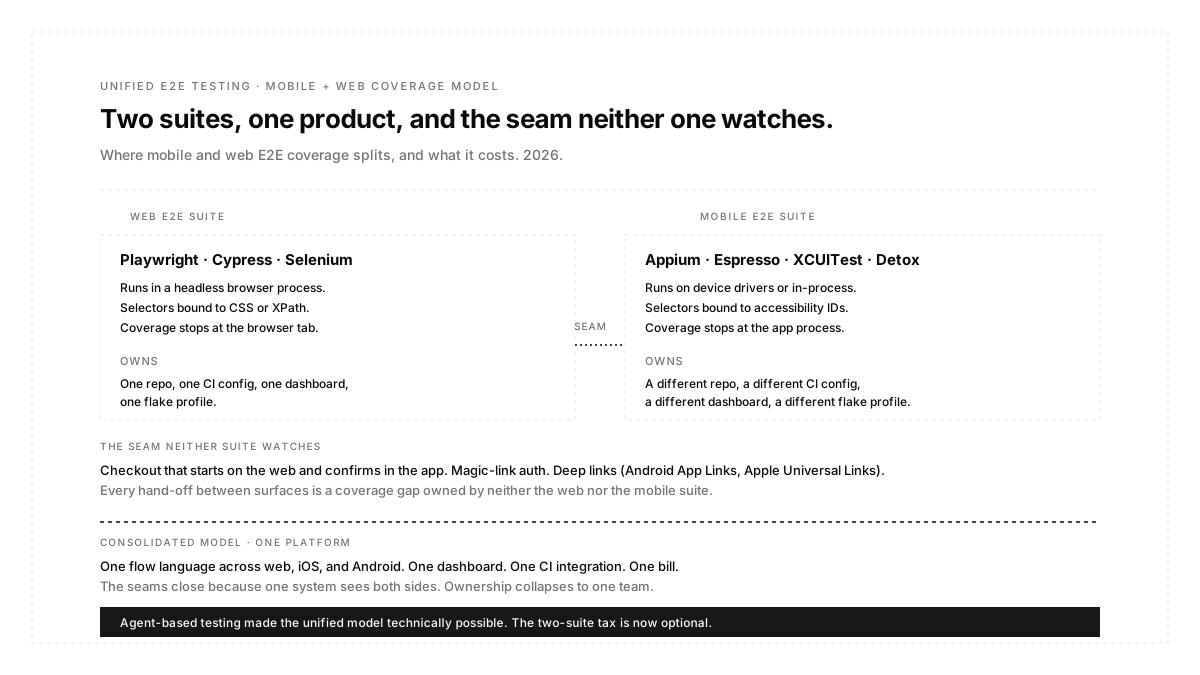
A team maintaining two E2E suites usually pays four separate costs.
Tooling. Two licensed device grids, or one grid plus one browser cloud, or one of each with separate contracts. Consolidation removes a contract.
Headcount. Two owners with two on-call rotations for flakes, or one owner stretched thin across both. Consolidation removes a rotation.
Duplication. The same user story written twice or three times, one per surface, each with its own flake history. Consolidation removes the duplicate files.
Coverage. The seams between surfaces were watched by neither suite. Consolidation closes the seams because one system sees both sides.
The line item most teams underestimate is the coverage one. Tooling and headcount are visible in the budget. Coverage gaps only become visible when a production incident traces to a seam nobody was testing.
Why did a unified mobile-plus-web testing platform not exist until now?
The reason a unified mobile-plus-web platform did not exist for most of the last decade is that the frameworks assumed a single runtime target. The playwright assumed a headless browser. Appium assumed a mobile OS driver. Cypress assumed a Chromium tab. Detox assumed a React Native bridge.
Agent-based testing broke that assumption. An AI agent that reads the screen visually and executes intent, rather than binding to a runtime-specific selector, does not care whether the screen is a browser or a device. That is what made a single flow language across mobile and web technically possible in the first place.
The pattern will spread because the two-suite tax is unsustainable at the cadence products ship redesigns in 2026. The teams that consolidate early stop paying the tax and start closing the seams.
How does Autosana fit an existing mobile-plus-web testing stack?
The consolidation does not require ripping out the existing suites. Autosana runs alongside them.
The highest-value cross-surface flows move first. Check out that starts on the web and confirms in the app. Magic-link auth that hands off from a browser to an iOS or Android device. Deep-link paths that depend on the OS-level association file being fresh on both sides.
Each of those flows is written once, in natural language, and executes against whichever surface it targets. The legacy Playwright or Cypress suite keeps producing the web coverage it already produces. The legacy Appium or Espresso or Detox suite keeps producing the mobile coverage it already produces. Autosana absorbs the seams that neither of them was designed to see.
CI-side integration runs through the Autosana GitHub bot, so cross-surface results land in the same pull request comment as the rest of the check suite.
Conclusion
Two E2E suites for one product was never a design decision. It was a compromise of the frameworks forced on the team.
The compromise is now optional. A unified mobile-plus-web platform removes the duplicated tooling, collapses the ownership into one team, closes the seam between the surfaces, and lets one flow definition run everywhere the product runs.
The move that ages best is to consolidate the highest-value cross-surface flows first (checkout, signup, magic-link auth) onto a single platform, keep the per-surface legacy suites for the coverage they already produce, and let the consolidated suite absorb the seams that the legacy suites were never designed to see. That shape is what Autosana was built for.