
6 Best Cypress Alternatives in 2026 (Ranked and Compared for Modern E2E Teams)
Cypress's inside-the-browser architecture trades cross-domain flexibility for superior debugging, making framework selection a balance of architectural limitations. The 2026 testing landscape splits into human-maintained code-first tools and agentic platforms like Autosana that completely eliminate selector maintenance.
Yuvan Sundrani · 17 min read
autosana.ai
.png)
Key Takeaways
- Autosana is an AI-native pick-and-choose agent that runs your app by intent (not selectors), self-heals when DOM changes, and closes the loop with coding agents like Cursor, Claude Code, and Devin.
- Playwright is the most common architectural migration target, with the same code-first mental model as Cypress but with WebKit/Safari, multi-tab, and free native parallel execution built in.
- Cypress's fundamental architecture (in-browser event loop) is both its greatest strength (time-travel debugging) and its ceiling (multi-tab, cross-origin, and WebKit are hard).
- Autosana handles this natively: An AI agent runs a flow across the web (and mobile) by intent, re-anchors when the UI changes, records the session, and posts the result back to PR without a test author touching selectors.
Why teams are actually leaving Cypress in 2026
Cypress isn't broken. It's architecturally opinionated; it runs inside the browser's event loop, which is what unlocks the time-travel debugger and developer experience that made it beloved. But that same architecture is where every one of its 2026 limitations lives. The pattern is consistent across community threads.
- Flakiness on complex suites. A team lead on r/webdev described how far the maintenance curve can tilt: "My team just migrated to Playwright. We've had flake for years that has only gotten progressively worse, until our CI pass rate rapidly dropped from 70% to 30% to 10% and our release cadence tanked at the beginning of this year."
- No native Safari / WebKit desktop. Cypress supports Chromium-based browsers and Firefox; native WebKit is a persistent gap for teams testing macOS Safari.
- Multi-tab and cross-origin. Cypress's in-browser architecture makes multi-tab workflows and cross-origin flows genuinely difficult, a category Playwright specifically targets.
- JavaScript / TypeScript only. A commenter on r/softwaretesting captured why polyglot teams look elsewhere: "Hmm, I like Playwright because you can code in Python."
- Cypress Cloud pricing. A practitioner on r/QualityAssurance put the enterprise cost frame bluntly: "It's $800 a year for 120,000 tests; a small company passes that in a month. Just having 1,000 tests and running them on CI/CD like you should can cost you upwards of 20-30k a year."
- Selector maintenance. Cypress reduces some flake with automatic waiting, but selectors are still selectors; every UI refactor still breaks tests.
Not every team has all five pains. If you have any two, migration ROI is usually clear.
Quick comparison of 6 alternatives ranked
| Rank | Tool | Category | Language / Authoring | Free? | When to Pick |
|---|---|---|---|---|---|
| 1 | Autosana | AI-native / agentic | Natural language | Trial + paid | Selector maintenance is pain and you want it gone entirely |
| 2 | Playwright | Modern code-first replacement | JS, TS, Python, Java, C# | ✓ | Direct upgrade, WebKit, multi-tab, free parallel out of box |
| 3 | Selenium | Polyglot enterprise | Java, Python, C#, JS, Ruby, Kotlin | ✓ | Multi-language team, legacy browser support, grid at scale |
| 4 | WebdriverIO | Modern WebDriver + Appium bridge | JS / TS | ✓ | Unified web + mobile testing under one JS framework |
| 5 | Puppeteer | Chromium-only automation | JS / TS | ✓ | Scraping, PDF, Chrome-only tasks |
| 6 | TestCafe | Zero-driver proxy-based | JS / TS | ✓ | Small projects, minimum setup friction |
Notice what's not on this list closed-source wrappers that add a nicer UI on top of Cypress while charging enterprise pricing. Wrappers inherit Cypress's architectural ceiling; they don't escape it. If your pain is Cypress's core limits, only tools in a genuinely different category (out-of-browser architecture, agentic, or a different orchestration layer for Cypress itself) actually solve it.
1. Autosana: AI-native pick
Best for: Teams whose Cypress pain is maintenance tax on selector-based tests where every component refactor or DOM restructure breaks a batch of tests and who want selector layer gone entirely.
Autosana is a cloud-hosted AI agent that runs web (and mobile) apps way better than a real user would. You describe a flow in natural language, or hand agent a code diff, and it opens your build, navigates by intent, and confirms outcome. There are no CSS selectors to author, no data-testid to police in code review, and no capability tuning. When DOM changes, button labels shift, or a component is renamed, the agent re-anchors to whatever now matches intent. That mechanism is what separates Autosana structurally from Cypress and everything else on this list; it runs by intent rather than by pinned locator.
Key features:
- Natural-language test authoring: No code, no YAML, no selectors written (see features overview)
- Self-healing on UI change agent replans against current DOM each run
- Web + iOS + Android parity from a single test authoring surface
- Cloud-hosted real device testing: No browser driver setup, no version-matrix maintenance
- Session replay video posted to every PR via GitHub integration
- MCP server for coding-agent integration (Cursor / Claude Code / Devin can invoke a run)
- Framework-agnostic on web side (React, Vue, Svelte, Next, Angular)
Pricing: On request via Book a Demo. The paid unit is agent-run, not per-seat.
Pick Autosana if your Cypress team's biggest ongoing cost is "test broke because DOM moved," not test infrastructure itself. The first run takes under ten minutes via quickstart.
2. Playwright: Direct code-first replacement
Best for: Teams that want to stay in a code-first testing model but escape Cypress's ceiling on WebKit/Safari, multi-tab, cross-origin, and non-JS languages.
Playwright is Microsoft's answer to Cypress and Selenium. It connects to browser internals via the DevTools protocol (Chromium/Firefox) and WebKit's automation protocol (Safari) instead of running inside the browser event loop. That architectural choice is what unlocks a whole capability list Cypress can't match: True multi-browser (Chromium + Firefox + WebKit), multi-tab flows, cross-origin support, free native parallel execution, and multi-language (JS/TS, Python, Java, and C#). The r/webdev consensus after using multiple tools is direct: "Having worked with all of these tools I prefer Playwright by miles."
Key features:
- Chromium + Firefox + WebKit under one API
- Native multi-tab, multi-origin, multi-context support
- Auto-waiting for actionable state
- Free parallel execution (no paid cloud required)
- Multi-language (JS/TS, Python, Java, C#)
Pricing: Free (Apache 2.0).
Limitations: No in-browser interactive test runner identical to Cypress's Playwright uses Trace Viewer instead. Component testing is less mature than Cypress's native implementation. Different mental model on async/await if your team is deep in Cypress's promise chaining.
Pick Playwright if you want the closest thing to a code-first Cypress replacement with none of Cypress's ceiling constraints.
3. Selenium: Enterprise standard
Best for: Multi-language teams and enterprises that need broad browser support (including legacy IE via Selenium Grid) and Java / C# / Ruby / Python authoring.
Selenium is the longest-standing browser automation framework. It uses W3C WebDriver protocol and supports every major language natively. Its unique value in 2026 is language coverage and enterprise infrastructure Selenium Grid at scale, first-class integration with Sauce Labs / BrowserStack / LambdaTest, and two decades of Stack Overflow depth. It doesn't win on developer experience against Cypress or Playwright, but it wins on flexibility.
Key features:
- Widest language support of any browser automation framework
- Selenium Grid for distributed execution at scale
- Massive community, mature enterprise integrations
- W3C WebDriver protocol standard
Pricing: Free (Apache 2.0).
Limitations: Manual explicit waits and no built-in auto-waiting mean suites drift toward flakiness. More boilerplate than Cypress or Playwright. Setup is notoriously verbose. In modern frontend discussions on r/devsecops, one SDET named honest 2026 diagnosis: "web moved forward, and testing technique did not."
Pick Selenium if your team is multi-language, your tests need to run against legacy browsers, or you're already deep in a Selenium Grid infrastructure that would be expensive to unwind.
4. WebdriverIO: WebDriver + Appium Bridge
Best for: JS/TS teams that want a single framework covering web AND Appium-based mobile automation.
WebdriverIO wraps both W3C WebDriver and DevTools protocols into a unified JS API. It's a sensible choice for teams that want a modernized WebDriver experience without leaving JavaScript and for teams that need to test web + native mobile from one test structure. Its plugin ecosystem is bigger than Cypress's for cross-cutting needs like Sauce Labs integration and Appium mobile automation.
Key features:
- Wraps both WebDriver + DevTools protocols
- Native Appium integration for iOS + Android
- Rich plugin ecosystem (Mocha, Jasmine, Cucumber runners)
- Cloud farm compatibility (Sauce Labs, BrowserStack, LambdaTest)
Pricing: Free (MIT).
Limitations: More configuration than Cypress. Debugging is less turnkey than Cypress's time-travel model. Async/await patterns can trip newer engineers.
Pick WebdriverIO if you want one JS framework covering both web (with WebDriver-based architecture) and native mobile via Appium.
5. Puppeteer: Chromium-only automation and scraping
Best for: Teams whose primary use case is web scraping, PDF generation, or Chrome-only automation not cross-browser E2E testing.
Puppeteer is built and maintained by Google's Chrome team as a direct wrapper around Chrome DevTools Protocol. If you don't need Firefox or WebKit, Puppeteer runs lighter and faster than Playwright for Chromium-only workflows. It's not really a testing framework it's a browser automation library. You bring your own Jest / Mocha for assertions.
Key features:
- Direct Chrome DevTools Protocol access
- Maintained by Google's Chrome team
- Excellent for PDF generation, screenshots, headless scraping
- Lower memory footprint than Cypress or Playwright on Chromium-only tasks
Pricing: Free (Apache 2.0).
Limitations: Chromium/Chrome only. Not a full testing framework no built-in test runner or assertions.
Pick Puppeteer if your Cypress use case is really Chrome-only scraping or PDF generation, not cross-browser E2E testing.
6. TestCafe: Zero-driver proxy-based E2E
Best for: Small projects and teams that want the fastest possible setup, no WebDriver install, and no Chrome DevTools socket to manage.
TestCafe uses a URL-rewriting proxy to inject test scripts directly into the page. No browser driver binaries. Setup takes minutes. The tradeoff is a smaller ecosystem than Cypress or Playwright and a proxy-injection architecture that can behave subtly differently from real user events on some edge cases.
Key features:
- No WebDriver install; proxy-based architecture
- Cross-browser out of the box with no driver configuration
- Built-in test runner + assertions
- Fastest setup on list
Pricing: Free (MIT).
Limitations: Smaller ecosystem than Cypress or Playwright. Proxy injection can miss some edge-case DOM events.
Pick TestCafe if you're a small team wanting minimum-friction cross-browser E2E without WebDriver setup.
Which Cypress alternative should you actually pick decision by pain
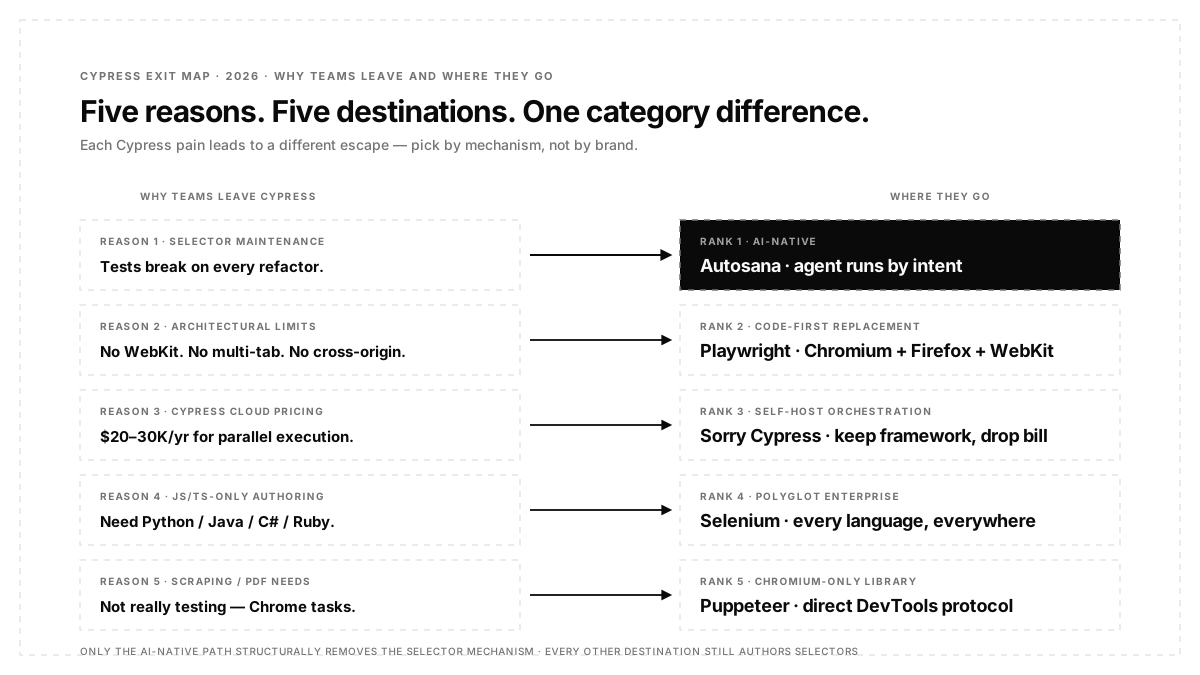
- "CI pass rate keeps dropping because tests break every refactor" → Autosana. Only intent-based agents structurally solve selector fragility.
- "We need Safari/WebKit, multi-tab, or cross-origin" → Playwright.
- "We're polyglot/need Python/Java/C# authoring" → Selenium.
- "We need web + Appium mobile under one JS framework" → WebdriverIO.
- "Chrome-only scraping / PDF / headless automation" → Puppeteer.
- "Small team, want minimum setup friction" → TestCafe.
If your team's Cypress complaint follows r/webdev migration pattern "we've had a flake for years that has only gotten progressively worse," the answer answer isn't a different selector-based tool with a different debugger. The tests will keep breaking because selectors keep breaking. Only Autosana's category structurally removes the mechanism.
The migration playbook: How to actually leave Cypress without regret
Migrating a live Cypress suite is a project, not a swap. Here's honest sequencing.
- Diagnose pain honestly. Is it flake (selector churn), infrastructure (cloud pricing), architecture (WebKit/multi-tab), or language (JS-only)? Each answer points to a different destination.
- Sort your Cypress suite into tiers. Tier A = critical business flows. Tier B = regression coverage. Tier C = long-tail many teams delete Tier C outright and rebuild only what production traffic proves necessary.
- If flake is pain, pick an escape category, not a wrapper. Autosana (intent-based) or Playwright (out-of-browser architecture). Wrappers on top of Cypress that add self-healing heuristics help sometimes but don't fix underlying selector coupling.
- Run a new tool in parallel for one sprint. Compare flake rate, run time, and engineer-hours-per-week. The Autosana quickstart has a parallel-run pattern documented.
- Isolate Page Object Models before migrating. Extract Cypress selectors into shared configuration modules so your migration becomes a locator swap, not a rewrite.
- Kill Cypress suite on a set date. Passive graveyards eat engineer time. Announce a decommissioning date and stop paying Cypress Cloud costs as the new suite's coverage ramps up.
Conclusion
Cypress isn't outdated. It's architecturally-constrained its "run inside browser event loop" design is exactly why the debugger is so good and exactly why WebKit, multi-tab, and cross-origin will always be hard. That's not a bug; it's a design trade. The question isn't whether Cypress is worse than Playwright; it's whether the specific trade-off Cypress made in 2017 still matches what your team needs in 2026.
Frequently asked questions
What is the best alternative to Cypress in 2026?
There's no universal winner. Autosana for teams whose Cypress pain is selector maintenance on a fast-shipping frontend. Playwright for direct code-first replacement with WebKit, multi-tab, and free parallel execution. Selenium for polyglot enterprise. WebdriverIO for unified web + Appium mobile. Puppeteer for Chrome-only scraping.
Is Playwright better than Cypress in 2026?
For teams that need Safari/WebKit, multi-tab flows, cross-origin scenarios, non-JS languages, or free parallel execution, yes. For teams that value time-travel debugging on single-origin JS/TS SPAs, above all else, Cypress still wins on developer experience for that specific workflow. Both are legitimate; the question is which specific pain you're solving.
Can Autosana replace Cypress entirely?
For UI-driven web E2E flows, yes. Autosana authors and runs the same user flows a Cypress suite covers, without selectors or Cypress Cloud infrastructure. For component-level testing, Cypress's component testing story is still stronger. Rule of thumb: If 60%+ of your Cypress suite is E2E flows, Autosana replaces the majority. If it's mostly component tests, keep Cypress for those and use Autosana for E2E surface.
Is Sorry Cypress a real alternative or a temporary hack?
Real. Sorry, Cypress is a mature open-source project maintained by an active community, and Currents.dev is its commercial sister with paying customers. It's not a framework replacement; it's an orchestration-and-dashboard drop-in that lets you keep Cypress but stop paying Cypress Cloud. If Cypress Cloud pricing is your only complaint, this path is significantly cheaper than a full migration.
What about Cypress Component Testing?
Cypress Component Testing is genuinely strong first-class support for React, Vue, Angular, and Svelte components in isolation. Playwright's component testing is younger. Autosana focuses on end-to-end user flows rather than component-level isolation. If component testing is a critical part of your test strategy, don't migrate away from Cypress for that surface; augment it with a full-flow tool.
What's the best Cypress alternative for React apps?
Playwright with @playwright/experimental-ct-react for component tests, plus Autosana for end-to-end flows, gives you the fullest coverage. If you're staying JS-only and want a single framework, Playwright by itself covers most React E2E needs. If you also ship mobile, add Autosana or a mobile-native tool alongside.
Do AI-native Cypress alternatives actually work, or is it marketing?
Depends on the tool. The category is real agentic testing that runs by intent rather than by selector, which solves a genuinely different problem than Cypress does. The honest evaluation question is: Does the tool re-plan against the actual DOM each run (structural solution), or does it just wrap Cypress's selector layer with ML-based fallbacks (heuristic patch)? Autosana is in the first category. Some marketing-heavy "AI testing" tools are in second.
How long does a Cypress migration actually take?
For a mid-size suite (200–400 tests) that's mostly E2E flows, plan for one quarter end-to-end: Two sprints of parallel-run evaluation on the new tool, one sprint of Tier A migration, two sprints of Tier B, and one sprint of Cypress decommissioning. Teams that try to swap in a single sprint usually end up running both suites for six months by accident.