
Codeless vs Low-Code vs Full-Code Test Automation: A Decision Framework
The three-way choice assumed authoring surface and governance model travel together. Agent-based execution separated them, so the decision became a matrix rather than a line.
Yuvan Sundrani · 18 min read
autosana.ai
TL;DR
- Codeless, low-code, and full-code describe the authoring surface, meaning who can write a test. Each one historically dragged a governance model along with it.
- The coupling was a storage artifact. Codeless flows lived in a vendor database editable only through a vendor interface, while coded tests lived in a repository editable only through that repository.
- Agent-based execution removed the need for a flow to encode interface structure, so a flow became expressible as plain text, and plain text belongs in git.
- Once authoring and governance separate, the decision stops being a line between three options and becomes a matrix of two independent questions.
- Autosana authors flow in natural language while syncing the same flow object to a git repository, so non-engineers write and engineers review through pull requests.
What do codeless, low-code and full-code actually mean?
The labels get used loosely enough to obscure the one property that separates them, which is how much code the author touches.
| Category | The Author Writes | Where the Artefact Lives | Who Can Author |
|---|---|---|---|
| Full-code | Source code in a repository | Repository, beside the app | Engineers |
| Low-code | Visual composition generating editable code | Usually a vendor project format | Engineers, plus assisted others |
| Codeless | Natural language, YAML or a visual flow builder | Historically a vendor platform | Anyone who understands the product |
Full-code means an Appium script in Java, an Espresso test in Kotlin, an XCUITest in Swift, or a Playwright test in TypeScript. The test compiles, runs and reviews through the same pipeline as the application.
Low-code means composition in a builder that emits code an engineer can still edit afterwards. The builder covers common flows while edge cases fall back to hand-written code, which makes it the pragmatic middle for mixed-skill teams.
Codeless means the author stays away from code entirely, expressing the test as sentences, structured YAML or a visual graph.
Each label answers one question: who writes the test. A second question stays unanswered by all three, which is how a change to that test gets versioned, reviewed and rolled back.
Why did the authoring choice drag governance along with it?
Because of where the artefact was stored, which is a far more mundane cause than the decade of debate suggests.
A codeless flow sat in the vendor's database, and the vendor's interface was the only editing surface. Diffing two versions meant reading a changelog the vendor chose to expose. Rolling back meant whatever restore feature existed. Branching stayed out of reach entirely, since the flow had one canonical state.
A coded test sat in a repository, so it inherited every repository primitive at no extra cost. Diff, branch, review, revert and history arrived with the storage format.
Neither property was a considered design position. Each followed from the storage decision, and the storage decision followed from the execution model, because a flow that encodes interface structure needs somewhere structured to live.
The result was that teams chose an authoring surface and received a governance model they had separately formed opinions about.
What did the coupling cost each side?
Both directions carried a real bill, and the bills landed on different people.
Teams choosing codeless gained breadth of authorship while losing engineering primitives. Test changes bypassed review, so a flow could change on a Tuesday afternoon with the record of who changed it and why sitting inside a vendor audit log rather than beside the code. Where a release broke, reconstructing which flow changed and when became an exercise in platform archaeology.
Teams choosing full-code kept every primitive while narrowing authorship to people fluent in the language. That excluded the manual QA specialist who understood the product better than anyone on the team, so their knowledge stayed in their head and left when they did.
The size of that excluded group shows up clearly in practitioner discussion. A thread on r/QualityAssurance asking manual testers what actually blocks them from moving into automation attracted sustained engagement, and the recurring answer concerned participation rather than framework preference.
A contributor on r/learnpython described the adjacent experience from the other direction, where the language itself proves learnable while the surrounding conventions, project layout and tooling consume the time that discourages people.
Both observations describe the same structure. The barrier sits around the authoring surface rather than inside the testing work.
What changed underneath the tooling?
The resolution arrived as a change in execution rather than as a new hybrid framework.
A conventional automated test encodes interface structure. It names a locator, which means something has to store that locator, resolve it, and keep it current. That requirement produces the structured storage that produced the coupling.
An agent-based test expresses intent instead. The agent reads the screen, decides which action advances the stated goal, and acts, so the flow definition carries a goal rather than a path. Nothing in it requires knowledge of the interface at authoring time.
Two consequences follow, and the second one matters most.
First, natural-language flow definitions became viable, since a sentence suffices to express an intent while a sentence would never suffice to express a locator chain.
Second, and this is the structural point, a flow definition became expressible as a plain text file. A goal written in sentences needs no proprietary schema, no element registry, and no vendor database. Plain text belongs in a repository, and once it sits in a repository, it inherits diff, branch, review, history, and revert automatically.
The authoring surface and governance model came apart. The two properties that tooling had fused now vary independently.
The decision framework: two questions rather than one
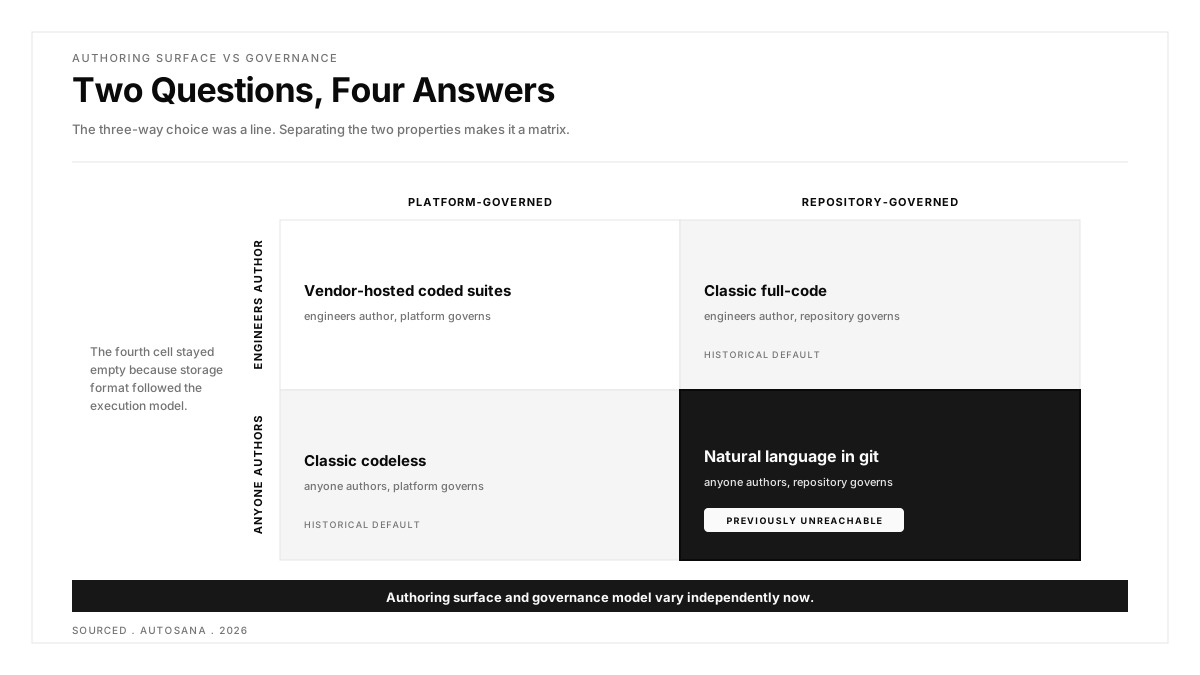
Once the properties separate, the three-way choice stops describing the decision space accurately. Ask two questions instead.
Question one, who authors? Engineers only, or anyone who understands the product.
Question two, how is it governed? Inside a platform, or inside your repository.
| Platform-Governed | Repository-Governed | |
|---|---|---|
| Engineers author | Vendor-hosted coded suites | Classic full-code, the historical default |
| Anyone authors | Classic codeless, the historical default | The cell the coupling made unreachable |
Three of those four cells describe tooling that existed throughout the coupled decade, which is why scriptless testing governance stayed an unresolved question for so long. The fourth stayed empty for structural reasons, and it is the cell most teams actually wanted, since it keeps breadth of authorship alongside engineering discipline.
Working the framework takes two sentences. Where the people who best understand your product sit outside engineering, you want the second row. Where your organisation treats review, history and rollback as requirements rather than preferences, you want the second column. Teams answering yes twice spent a decade being told to choose one.
What the review workflow looks like in the fourth cell
The practical shape matters more than the theory.
A QA analyst authors a flow in natural language. That flow becomes a file on a git branch. The reviewing engineer opens the pull request and reads a diff of sentences, which reads considerably more clearly than a diff of selectors. Comments happen in the pull request. Approval merges the flow. Rollback is a revert.
A practitioner on r/Everything_QA made the point that exploratory work creates lasting value only once findings become repeatable artefacts, and the same logic applies here, since knowledge held by a manual specialist converts into reviewed, versioned coverage rather than remaining personal.
One secondary gain deserves mention. A sentence-level diff invites review from people who would skip a selector diff, so a support lead can read a flow change and observe that the promo logic described fails to match how stacking actually behaves. That is a defect caught at review time by someone who could never have read the Kotlin.
The same test written three ways
Abstraction obscures the difference, so here is one flow expressed in each category. The flow verifies that a returning customer applies a promo code and sees the discounted total before checkout.
Full-code, roughly seven lines of Python driving a WebDriver session:
Writing those lines requires knowing that login_helper exists and which of its methods applies here, that cart_fixture is safe to read, that this repository prefers data-test attributes except where it diverges, and that the expected total gets computed elsewhere by logic the author has yet to read. Four pieces of repository knowledge, zero of which concern discounts.
Low-code, composed in a builder: the author records a session, the builder emits a step list, and the discount assertion gets configured through a form specifying an element, a comparison operator and an expected value. Edge cases fall through to a code block. The artefact lands in the vendor's project format, so review happens inside the vendor's interface.
Codeless, written as a sentence: log in as a returning customer, apply promo code SAVE10, then confirm the order total reflects the discount before checkout.
That sentence carries the identical product knowledge and omits every piece of repository knowledge. The reviewer evaluating it spends attention on whether this is the right thing to verify, which is the question that matters, whereas a reviewer reading the Python spends most of their attention confirming mechanics and has little left over.
What each version costs when the interface changes
Rename the promo input from promo-input to discount-code and the three diverge sharply.
The full-code version fails immediately, and repair requires an engineer who locates the selector, updates it, and runs the suite to confirm nothing else referenced it. The low-code version fails similarly, with repair happening inside the vendor interface, and the change arrives absent a reviewable diff where the platform governs storage.
The codeless intent-based version continues passing, since the sentence names a promo code rather than an element, and the agent resolves the field from what the screen presents.
That single difference compounds across a suite and across a year of ordinary interface work, which is the mechanism behind most of the maintenance arithmetic teams experience as a vague sense that their suite has grown expensive.
Where does the decoupled model still have limits?
Overselling this would be straightforward, so the constraints deserve naming plainly.
Per-interaction overhead rises. An agent deciding at runtime costs more per step than a deterministic in-process framework executing a compiled instruction. Teams running thousands of highly predictable interactions inside a tight window against one runtime remain better served by a framework built for that runtime.
Agents can choose incorrectly. Ambiguous interfaces, similar-looking controls, unexpected application states and thin context all permit a wrong path. Verification matters precisely because the agent decides rather than merely follows, which argues for a closed-loop check inspecting application state and network payloads alongside what appears on screen.
Authoring breadth leaves the thinking in place. Someone still determines which workflows matter, supplies representative data, defines success and investigates failures. Anyone can write the flow, while the discipline about what deserves coverage stays with the team owning the surface.
Unit and component tests keep their place. This conversation concerns the end-to-end layer. Validation rules and calculation logic belong lower, where tests run in milliseconds and stay stable.
A tester on r/softwaretesting described the common adoption failure for new testing tooling, where teams buy for the demonstration scenario, meet the first case the tool genuinely handles poorly, then discard the whole thing rather than scoping it to where it performs. Naming limits in advance is how that outcome gets avoided.
How should a team migrate?
Incrementally, because wholesale replacement invites a coverage gap during the transition.
Leave the existing suite in place for the coverage it already delivers. Move the next set of flows to the decoupled model, choosing the ones the team most wishes a non-engineer could own while keeping governance. Those flows demonstrate the model on work that matters without risking work that already functions.
Run both for a sprint or two and compare. Where the decoupled flows report consistently against the originals, confidence rests on evidence. After that, migration follows ordinary prioritisation rather than a migration programme, since each flow moves when someone has reason to touch it.
A developer on r/Frontend framed the general principle well, observing that abstractions earn adoption by proving themselves on real work rather than by arriving as a mandate.
How does Autosana implement the decoupling?
Autosana is an AI-native E2E testing agent for iOS, Android and web, and the decoupling described above is the architecture rather than a feature.
Flows are written in natural language, which supplies the codeless authoring surface. A product manager, QA analyst, designer or engineer composes one by describing what a user accomplishes.
The same flow is also definable as a file in a git repository synced through GitHub. The full schema sits at code-managed files, while validation, syncing and pull-request preview behaviour places flows on the same pull-request pipeline carrying your application code.
The flow object stays identical on both sides, so each party keeps its primitive. Non-engineers author in sentences. Engineers review in git. Pull-request analysis runs through the GitHub integration, which selects relevant flows per pull request and returns results with video attached in a comment, and runs execute on hosted real devices.
The limits stated earlier apply here as written. Per-interaction overhead exceeds a compiled in-process framework, verification remains necessary because the agent decides, and the judgement about what deserves testing stays with your team.
Where to start
Take the four-cell matrix to your next planning session and mark where your current tooling sits. Most teams land in a cell they chose by default years ago, and stating that out loud is usually enough to open the conversation.
Then name the single person on your team who understands the product best and sits outside engineering. Ask whether they can author a flow today, and ask what that answer costs you in coverage. That one question tends to settle the argument faster than any feature comparison.
.png)
FAQ
What is the difference between codeless and low-code test automation?
Codeless keeps the author away from code entirely, using sentences, YAML or a visual graph. Low-code composes visually while generating code an engineer can edit afterwards, which suits mixed-skill teams needing a fallback for edge cases.
Can codeless tests live in version control?
With an agent-based execution model, yes. A flow expressing intent rather than interface structure becomes a plain text file, and plain text inherits diff, branch, review and revert from the repository storing it.
Why were codeless tools historically weak on governance?
Because of storage rather than philosophy. Flows encoding interface structure required structured storage, which meant a vendor database whose interface was the only editing surface, so repository primitives stayed out of reach.
Who should write automated tests?
Whoever understands the behaviour being verified, which frequently includes manual QA specialists, support leads and product managers. Governance determines whether their contributions get reviewed, and that question now answers independently.
Is full-code test automation obsolete?
It remains correct for unit and component layers, and for high-volume deterministic interactions inside tight windows against one runtime. The decoupling argument concerns the end-to-end layer specifically.
What does a natural-language flow diff look like in review?
A diff of sentences describing user goals. It reads more clearly than a selector diff, which widens review participation to people who would skip a code change while still understanding the product behaviour.
Does codeless authoring remove the need for QA skills?
It removes framework, convention and selector overhead. Deciding what deserves coverage, supplying representative data and recognising a wrong result remain the skills that matter, and no authoring surface supplies them.
How does Autosana keep both authoring surfaces in sync?
The flow is one object. Authors compose it in natural language, while the same flow is definable as a repository file synced through GitHub, so each side works through its own primitive against identical content.