Codeless vs Low-Code vs Full-Code Mobile Testing: A Decision Framework
Compare codeless, low-code, and full-code mobile testing to understand the trade-offs in authoring, governance, maintenance, and team ownership, and see how Autosana combines natural-language testing with code-managed workflows.
- Written by
- Yuvan Sundrani
- Read time
- 12 min read
- Published
TL;DR
Full-code mobile testing wins when engineering owns the suite, tests live in the same repository as the app, and code review is the governance layer.
Codeless testing wins when non-engineers write flows, iteration speed beats configurability, and the highest cost is onboarding time. Low-code testing wins in the narrow middle, where a visual builder generates code that engineers still have to maintain.
The choice was framed for a decade as "codeless or code" because tools forced the trade. Autosana removes the trade by pairing natural-language authoring with code-managed governance in the same product.
What is the difference between codeless, low-code, and full-code mobile test automation?
The three categories map to three different authoring surfaces. Each one is a design choice about who writes the test and where the test lives.
Full-code means the test is source code in a repository. An engineer writes an Appium script in Java, an Espresso test in Kotlin, an XCUITest in Swift, or a Playwright test in TypeScript. The test compiles, runs, and reviews through the same pipeline as the app.
Low-code means the test is composed in a visual builder that generates code the engineer can still edit. The builder covers most flows. Edge cases fall back to hand-written code. The generated artefact usually lives in the vendor's project format.
Codeless means the test is written in natural language, YAML, or a fully visual flow builder, and the user never touches code. The test lives inside the tooling platform, not the app repository.
Confusing the three is the source of most tool-selection regret in the industry.
When is full-code mobile test automation the right choice?
Full code fits teams where engineering owns the E2E suite end to end. The person who writes the app writes the test. The test lives next to the code it covers. Pull requests are the review surface for both.
That fit unlocks three properties nothing else gives. Version control on the test. Code review on the test. Refactoring tooling on the test. Rename a class, and the IDE renames every test reference at the same time.
The cost is skill and speed. Every test change requires an engineer, a branch, a pull request, and a CI run. Non-technical stakeholders cannot author or edit flows. Onboarding a new team member into the suite takes weeks, not hours.
Full code is the right call when the E2E suite is engineering-owned, the app changes at engineering cadence, and the coverage the team most cares about is deep integration behaviour, not user-visible flows.
When is codeless mobile test automation the right choice?
Codeless fits teams where the person writing the test is not the person writing the app. Product managers. QA analysts. Designers. Founders. Anyone whose day job is not shipping Kotlin or Swift.
The fit unlocks a different set of properties. Onboarding measured in hours, not weeks. Flow authoring that a non-technical stakeholder can do without an engineer as a middleman. Iteration speed that matches the cadence of a product review, not a sprint.
The cost is governance. Flows that live inside a SaaS platform are not versioned in git by default. Rollbacks depend on the platform's history feature. Code review is not a first-class primitive. Two people editing the same flow can clobber each other in ways a git merge would have caught.
Codeless is the right call when authoring speed and non-engineer participation matter more than repository-level governance.
When is low-code mobile test automation the right choice?
Low-code sits in a middle where the appeal is intuitive and the practical fit is narrow. The pitch is "codeless authoring for happy paths, code fallback for edge cases." The lived reality is usually two authoring modes to maintain and two mental models to hold.
Low-code fits when a team has a stable happy-path suite that a visual builder covers well, plus a small set of edge cases an engineer writes by hand once and rarely revisits. It stops fitting the moment the "small set" of edge cases grows, because generated code and hand-written code diverge in style, ownership, and review discipline.
Most teams that pick low-code eventually collapse to one side or the other. The direction of collapse depends on who ends up owning the maintenance.
Low-code is the right call for the narrow case where the split is stable. It is the wrong call for teams where the codeless portion or the code portion is going to keep growing.
What do engineering teams get wrong about codeless tools?
The dismissive posture on codeless is that it does not scale. That was accurate for record-and-playback tools built in the 2010s, which produced brittle scripts bound to screen coordinates and disappeared the moment the UI moved. It is not accurate for the current generation.
Two properties changed the category. First, natural-language flow definitions that describe user intent instead of encoding UI structure. Second, self-healing execution that adapts when identifiers change. Together they remove the two failure modes that made older codeless tools untenable.
The second dismissive posture is that codeless flows cannot be versioned or reviewed. That is only true when the flow definition is proprietary and locked inside the tooling platform. When the flow is a plain text file that can live in a git repository, the objection disappears. Code review, diff, rollback, and branch merge all become table stakes.
The teams that pick codeless in 2026 and regret it are almost always the teams that picked a tool from the previous generation.
How should teams decide between codeless, low-code, and full-code?
Five questions decide the fit. The right tool is the one that answers them together, not one at a time.
| Question | Full-Code Answer | Codeless Answer |
|---|---|---|
| Who writes the test? | An engineer | Anyone on the team |
| Where does the test live? | In the app repository | In the tooling platform |
| Who reviews changes? | Code review on a pull request | The tool's history or an admin |
| How often does the UI change? | Slow enough that selector rewrites are affordable | Fast enough that self-healing pays for itself |
| When a test fails, who fixes it? | The engineer who owns the feature | Whoever authored the flow |
Teams that pick a tool by asking one of these questions in isolation usually revisit the choice inside a year. Teams that pick by answering all five together usually do not.
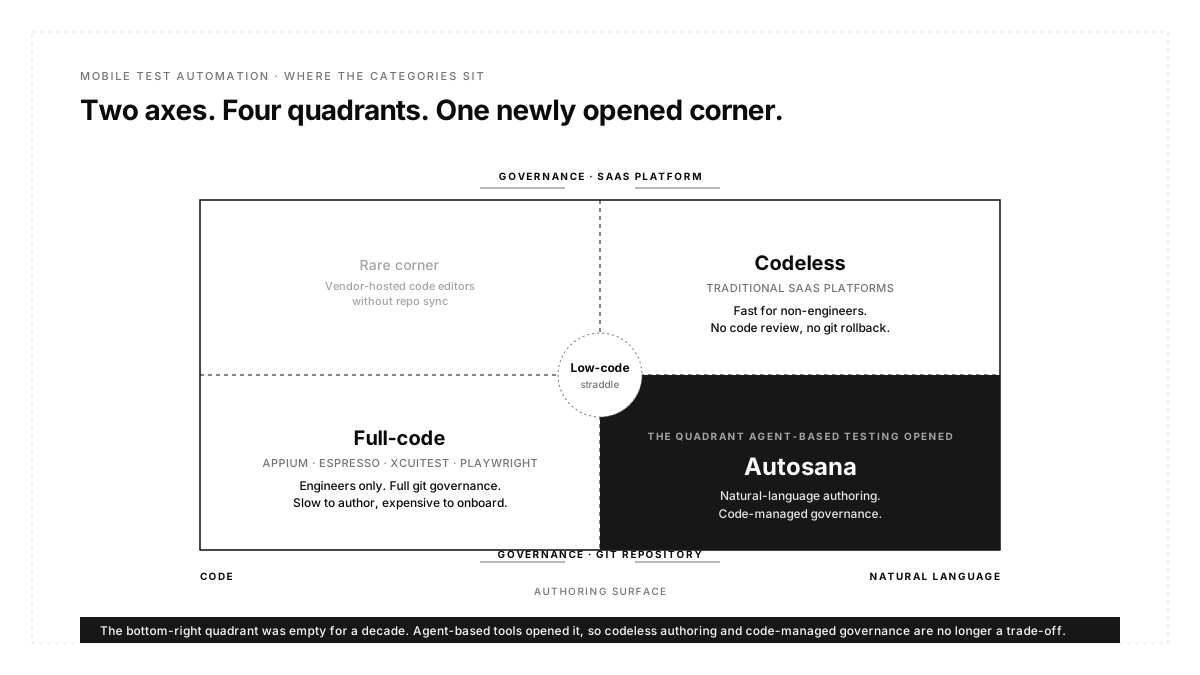
Why does the codeless-vs-code split break down for agent-based tools?
The split assumes the flow definition and the storage location are the same choice. That assumption is a decade old. It stopped being true when agent-based testing separated authoring from governance.
An AI agent that reads the screen visually does not require the flow to encode UI structure. The flow can be a natural-language description of user intent, which is codeless authoring by definition. But that natural-language definition can also be a plain text file in a git repository, which is code-managed governance by definition.
The two properties are no longer coupled. Teams can pick codeless authoring without giving up code review, versioning, or branch merges. Or they can pick code-managed governance without forcing every stakeholder to learn a testing DSL.
How does Autosana fit teams that need both codeless authoring and code-managed governance?
Autosana flows are written in natural language, which is the codeless authoring surface. Any product manager, QA analyst, or engineer can write one without touching code.
The same flow can also be defined as a file in a git repository, synced through GitHub, and reviewed on a pull request. The full file schema for code-managed flows lives at docs.autosana.ai/code-managed-files. The validation, syncing, and pull-request preview behavior is documented alongside it.
The result is one product that fits both team shapes. Codeless authoring for the people who need speed and simplicity. Code-managed governance for the people who need diff, review, and rollback. Neither side has to give up its primitive to accommodate the other.
CI-side pull-request analysis runs through the Autosana GitHub bot, which selects the relevant flows for each PR and returns results with videos in a comment. The same object appears in both the natural-language editor and the code-managed repository.
Conclusion
The codeless vs low-code vs full-code question stopped being a tool question in 2026. It became a team-shape question.
Full code fits engineering-owned suites where tests live in the repository and code review is the governance layer. Codeless fits teams where non-engineers author flows and speed of iteration beats configurability. Low-code fits the narrow middle where the split is stable.
The framing itself is ageing out. Agent-based testing separated authoring from governance, which means codeless authoring and code-managed governance are no longer trade-offs. That is the direction the category is taking, and it is the shape Autosana was built for.