8 Best testRigor Alternatives for Plain-English Testing in 2026
testRigor's plain-English layer masks hidden Selenium limitations. This guide maps eight alternatives by exit reason, from code-first frameworks like Playwright to intent-based agents like Autosana that eliminate the parser entirely.
YS
Yuvan Sundrani · 16 min read
autosana.ai
The best testRigor alternatives in 2026 split into three camps: code-first frameworks that give you full control over the execution layer (Playwright, Cypress, WebdriverIO), intent-based agents that remove the script entirely (Autosana), and AI-assisted platforms that add healing heuristics on top of traditional engines (Mabl, Testsigma, Appium, Functionize). Which one fits depends on why you are leaving testRigor: parser edge cases, the Selenium engine running underneath, opaque pricing, or an MCP server that authors tests but does not execute them on PRs. This guide ranks 8 alternatives by exit reason and maps each testRigor pain to the tool that structurally solves it.
Key Takeaways
testRigor's plain-English layer runs on Selenium under the hood, which means parser edge cases and Selenium exceptions still surface in test logs when the grammar does not map cleanly to the DOM.
Code-first alternatives (Playwright, Cypress, WebdriverIO) trade the plain-English convenience for full execution-layer visibility and deterministic debugging.
AI-assisted platforms (Mabl, Testsigma) sit between testRigor and code-first: visual builders with ML-based healing, but still selector-dependent at the core.
Mobile-specialized tools (Appium, Functionize) go deeper on native device automation than testRigor's cross-platform NLP layer can reach.
Autosana removes the script and the hidden Selenium layer entirely: an AI agent runs flows by intent, re-plans against the current UI every run, and executes tests end-to-end on PRs via its MCP server.
How do the 8 testRigor alternatives compare at a glance
Tool
Category
Authoring Model
Self-Healing
Mobile Support
Pricing
Autosana
AI-native agent
Intent description, no script
Re-plans against current UI every run
iOS + Android + Web
Per agent-run, self-serve trial
Playwright
Code-first framework
JS/TS/Python/Java/C#
No (auto-waiting only)
Viewport emulation only
Free (Apache 2.0)
Cypress
Code-first framework
JS/TS
No (auto-waiting only)
No native mobile
Free + paid Cloud
WebdriverIO
Code-first + Appium bridge
JS/TS
No
Via Appium plugin
Free (MIT)
Mabl
AI-assisted low-code
Visual builder
ML-based selector healing
Limited
Enterprise pricing
Testsigma
AI-assisted low-code
Natural language + code
AI-powered healing
Android + iOS
Free community + paid
Appium
Mobile automation framework
Code (any language)
No
Native iOS + Android
Free (Apache 2.0)
Functionize
AI-powered enterprise
Natural language + visual
ML/NLP-based healing
Web + limited mobile
Enterprise pricing
Why are teams leaving testRigor in 2026
testRigor positions itself as the "#1 Generative AI-based Test Automation Tool." The plain-English authoring model is genuinely convenient for mixed-skill QA teams. But four specific pains push engineering-led teams toward alternatives.
The NLP parser has edge cases. Every plain-English testing tool inherits the limitations of its parser grammar. When your test step does not map cleanly to testRigor's expected syntax, the result is a cryptic failure that looks like a product bug but is actually an authoring problem. A practitioner on r/QualityAssurance described the trade honestly: "I'm actually automating with it. Very easy and flexible but it does have some limitations and issues."
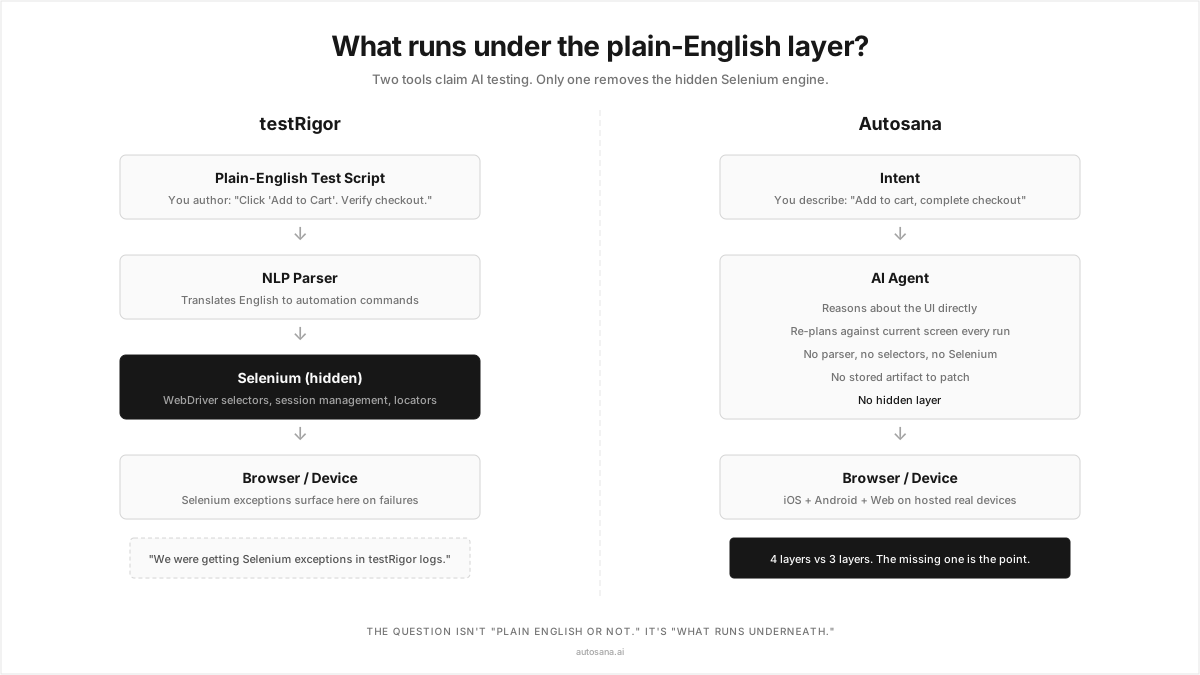
Selenium runs underneath. This is the one most teams discover late. A user on r/softwaretesting noted: "Best of all, on some test failures we were getting good old Selenium exceptions in TestRigor logs. Yes, TestRigor uses Selenium." The plain-English surface is a translation layer on top of Selenium's execution engine. When Selenium hits a locator failure or a session timeout, testRigor breaks with it, and the error messages reference a layer you never authored.
Pricing is opaque. testRigor's /pricing page returns a 404. Two tiers exist: a free Public Open Source plan and a paid Private plan with a 14-day trial. The paid rate is discovered only during signup or a sales call. For engineering teams that need budget approval before evaluation, this creates friction that free and transparent alternatives avoid entirely.
MCP authors but does not execute. testRigor ships an MCP server (updated August 2026) and a Claude Code Skills integration. Both let a coding agent write and maintain plain-English test scripts. Neither runs those tests end-to-end on a PR and posts the result back to the pull request. The MCP is an authoring assistant, not an execution runtime. For teams using Cursor, Claude Code, or Devin, this distinction matters: authoring more scripts is not the bottleneck. Running them automatically on every PR is.
Which testRigor alternative removes the test script entirely
Autosana: intent-based execution with no hidden Selenium layer
Best for: teams whose testRigor pain is the parser, the hidden Selenium layer, or the gap between MCP-authored scripts and MCP-executed test runs on PRs.
Autosana is an AI-native E2E testing agent for iOS, Android, and web. You describe a flow in natural language or hand the agent a code diff. There is no plain-English script to maintain, no NLP grammar to learn, no Selenium engine running underneath.
The structural difference from testRigor: Autosana does not parse your words into Selenium commands. The agent opens your app, navigates by intent, and confirms the outcome. When the UI changes (a button label, a layout shift, a component refactor), the agent re-plans against the current screen. There is no stored artifact to patch. This is the contrarian insight behind the "what runs under the plain-English layer" question: testRigor's layer is a parser-to-Selenium bridge, while Autosana's layer is an agent that reasons about the UI directly.
Key capabilities:
Intent-based test execution: no selectors, no scripts, no stored test artifact
Self-healing by re-planning against current UI every run, not patching a stored script
MCP server that runs tests end-to-end on PRs (execution, not just authoring)
Pricing: per agent-run with a self-serve trial. No signup-gated discovery. Book a demo for a per-run quote against your PR volume.
Limitations: not built for mainframe, Windows desktop, or heavy API-with-mocks testing. Sub-100ms visual regression is a different category (Percy, Applitools). GPU-shader validation, game-engine internals, and offline-only PWAs without a backend fixture story fall outside the scope.
Pick Autosana if your team is spending more time debugging testRigor's parser and tracing Selenium exceptions than testing the actual product. First run is under ten minutes via the quickstart.
Which testRigor alternatives give you code-first control
If the exit reason is "I want to see exactly what my tests do at every layer," code-first frameworks remove the translation layer entirely. A commenter on r/softwaretesting put the tradeoff directly: "If you have automators as QA, use Playwright because it's better in almost every..."
Playwright as a testRigor alternative
Best for: teams that want a modern, multi-language, cross-browser framework with full execution visibility and no NLP parser between them and the browser.
Playwright connects directly to browser internals via the DevTools protocol. Auto-waiting is native, not bolted on. Cross-browser coverage (Chromium, Firefox, WebKit) ships under a single API. Multi-language support spans JS/TS, Python, Java, and C#. The codegen tool records interactions into runnable test files. No NLP parser, no hidden Selenium engine, no grammar to learn. See the Playwright docs for the full API surface.
Pricing: free (Apache 2.0).
Limitations: still selector-based at the core. Auto-waiting solves timing but not "the button was renamed." No native mobile testing beyond viewport emulation. Newer community depth than Selenium for debugging obscure edge cases.
Cypress as a testRigor alternative
Best for: JS/TS frontend teams that value time-travel debugging and in-browser execution over cross-platform breadth.
Cypress runs inside the browser's own event loop. DOM snapshots per step, real-time reloading, and a developer experience frontend engineers genuinely enjoy. Strong plugin ecosystem (cypress-axe, cypress-testing-library). First-class TypeScript out of the box. Where testRigor abstracts away the execution model, Cypress makes it visible and debuggable at every step.
Pricing: free (MIT) + Cypress Cloud paid tier for parallel execution and dashboard.
Limitations: JS/TS only. Cannot automate cross-tab or cross-origin flows cleanly. WebKit/Safari desktop testing is not first-class. Parallel execution requires the paid Cloud tier.
WebdriverIO as a testRigor alternative
Best for: teams that want one JS framework covering web and Appium-based mobile under a unified API, with the WebDriver mental model they already know.
WebdriverIO wraps both modern DevTools protocols and traditional W3C WebDriver. Native Appium integration means the same test structure covers web and native mobile. Rich plugin ecosystem with Mocha, Jasmine, and Cucumber runners. Cloud farm compatible with Sauce Labs, BrowserStack, and LambdaTest.
Pricing: free (MIT).
Limitations: more configuration overhead than Cypress or Playwright. Async/await patterns can trip newer engineers. Debugging is less turnkey than Cypress's time-travel model.
Which testRigor alternatives offer an AI-assisted middle ground
If the exit reason is "I want AI assistance but also need a selector fallback when the NLP layer falls short," these platforms sit between testRigor's plain-English-only model and raw code-first frameworks.
Mabl as a testRigor alternative
Best for: enterprise QA teams where non-technical stakeholders contribute to automation and ML-based self-healing is a hard requirement.
Mabl is a commercial low-code platform that adds machine-learning selector healing on top of a traditional WebDriver-style engine. When developers rename a class or restructure a component, Mabl attempts to re-identify the element based on behavioral properties rather than the literal locator. A commenter on r/Everything_QA listed Mabl alongside testRigor when surveying the landscape: "testRigor, TestGrid, Testim, Mabl, Functionize etc... There are many tools, just do some research." The honest trade: self-healing is heuristic and works better on cosmetic shifts than deep structural refactors.
Limitations: closed-source. Deep refactors can still break tests despite ML healing. Cost curve rises with volume. No open MCP server for coding-agent integration.
Testsigma as a testRigor alternative
Best for: teams that want natural-language authoring combined with the ability to drop into code when the NLP layer falls short.
Testsigma offers both natural-language test steps and traditional coded steps in a single platform. The NLP layer handles straightforward flows; engineers can override with code for complex logic. AI-powered test maintenance watches for element changes and suggests fixes. The hybrid model addresses a common frustration with pure plain-English tools. An engineer on r/developersIndia captured the broader concern: "low-code platforms don't scale well for complex applications." Testsigma's code fallback is explicitly designed to answer that objection.
Pricing: free community edition + paid cloud tiers.
Limitations: NLP parser still has edge cases on complex flows. Self-hosted option requires infrastructure management. Community is smaller than Playwright or Cypress ecosystems.
Which testRigor alternatives go deeper on mobile testing
If the exit reason is "testRigor's mobile coverage is too shallow for native app depth," these tools specialize in the device layer.
Appium as a testRigor alternative
Best for: teams that need open-source, language-agnostic native mobile automation with full control over the device layer and reviewable test code.
Appium is the open-source standard for native mobile test automation. It wraps platform-specific frameworks (XCUITest on iOS, UiAutomator2 on Android) under a unified WebDriver-compatible API. Any language, any device, full native control. The testRigor code review discussion on r/QualityAssurance touched on the broader process challenge: review workflows that work for Playwright or Appium scripts do not translate cleanly to plain-English test artifacts. If your team values code review discipline and version-controlled tests, Appium keeps everything in reviewable code.
Pricing: free (Apache 2.0).
Limitations: verbose setup. WebDriverAgent rebuilds on iOS updates create maintenance burden. Session startup is slower than platform-native frameworks. No built-in self-healing or AI assistance.
Functionize as a testRigor alternative
Best for: enterprise teams that want AI-powered test creation for web (and limited mobile) without building a code-first automation practice from scratch.
Functionize uses machine learning and NLP to create and maintain tests. The platform learns from your application's behavior and adapts tests when the UI changes. Enterprise-grade reporting, cloud execution, and visual testing are included. The AI layer handles much of the maintenance that selector-based tools push onto engineers, though the mechanism is heuristic rather than intent-based re-planning.
Pricing: enterprise (contact sales).
Limitations: enterprise-only pricing with no self-serve tier. Web-first, with mobile coverage narrower than Appium or Autosana. Smaller community than open-source alternatives. Limited coding-agent integration compared to tools that ship MCP servers.
How to choose a testRigor alternative based on your exit reason
The right alternative depends on the specific testRigor pain driving the switch. Here is the decision framework by exit reason:
"Parser edge cases are wasting engineering time." Playwright or Cypress. Full code-first control, zero NLP grammar to learn. If you also need mobile, WebdriverIO bridges web and Appium under one API.
"Selenium under the hood is causing failures I cannot debug." Autosana. No Selenium engine, no hidden translation layer. The agent runs by intent against the current UI every run.
"Pricing is opaque and I need budget approval before evaluation." Playwright (free), Cypress (free core), Appium (free), Testsigma (free community edition), or Autosana (self-serve trial with transparent per-run pricing).
"MCP authors tests but does not execute them on PRs." Autosana. Its MCP server runs tests end-to-end and posts session replay back to the PR via GitHub integration.
"I need deeper native mobile automation." Appium for open-source full control. Autosana for intent-based mobile with hosted real devices included.
"I want AI assistance but with a code fallback." Testsigma or Mabl. Both add healing heuristics with the option to drop into code or visual builders when the NLP layer hits its limits.
"Enterprise visual testing with minimal code." Functionize. AI-powered creation with enterprise reporting and cloud execution built in.
Frequently asked questions
What is the best testRigor alternative in 2026?
No universal winner. Autosana for teams whose pain is the hidden Selenium layer and parser edge cases. Playwright for code-first control with auto-waiting. Cypress for JS/TS teams valuing time-travel debugging. Mabl for enterprise low-code with ML healing. Match the tool to the specific testRigor limitation driving the switch.
Does testRigor use Selenium under the hood?
Community reports confirm Selenium exceptions appear in testRigor's test logs. The plain-English authoring layer translates steps into Selenium-based execution. Selenium's failure modes (selector fragility, WebDriver session timeouts) can surface even though you never authored a selector directly.
Is testRigor actually free?
testRigor offers a free Public Open Source plan. The Private paid plan requires a 14-day trial signup, then transitions to pricing that is not published publicly. The /pricing page returns a 404. Paid rates are discovered during signup or on a sales call.
Can Autosana replace testRigor for mobile testing?
For iOS and Android E2E flows, yes. Autosana runs mobile apps by intent on hosted real devices with session replay on every PR. For mainframe, Windows desktop, or heavy API mocking, testRigor covers surfaces Autosana does not target. If most of your testRigor scope is UI-driven mobile and web, Autosana replaces it.
How does testRigor's MCP server differ from Autosana's MCP server?
testRigor's MCP helps a coding agent write and maintain plain-English test scripts. Autosana's MCP lets a coding agent run tests end-to-end against a PR and posts the verdict back. Same protocol, different job: authoring assistant versus execution runtime.
Is Playwright better than testRigor for engineering teams?
For teams that want full execution-layer visibility, deterministic debugging, and zero NLP grammar, Playwright is the stronger pick. testRigor wins for mixed-skill teams where business analysts author tests in plain English. The choice depends on who writes and maintains the tests.
What is the cheapest testRigor alternative?
Playwright, Cypress (core), WebdriverIO, and Appium are free and open source. Testsigma offers a free community edition. Autosana offers a self-serve trial with transparent per-run pricing. Mabl and Functionize are enterprise-priced with sales-gated quotes.
Does testRigor integrate with CI/CD and coding agents?
Yes. testRigor ships an MCP server and a Claude Code Skills integration for test authoring in CI workflows. The distinction: testRigor's integrations help write tests, not execute them as an automated PR check. Autosana's MCP runs tests on every PR and posts results directly to GitHub.

.png)
.png)