
Best Mobile Automation Testing Tools in 2026: 10 Compared by Automation Approach
Ten mobile automation testing tools compared by how they automate: code-first frameworks, YAML-based flows, AI agents, and codeless platforms. Honest reviews with pricing.
Yuvan Sundrani · 13 min read
autosana.ai

Key Takeaways
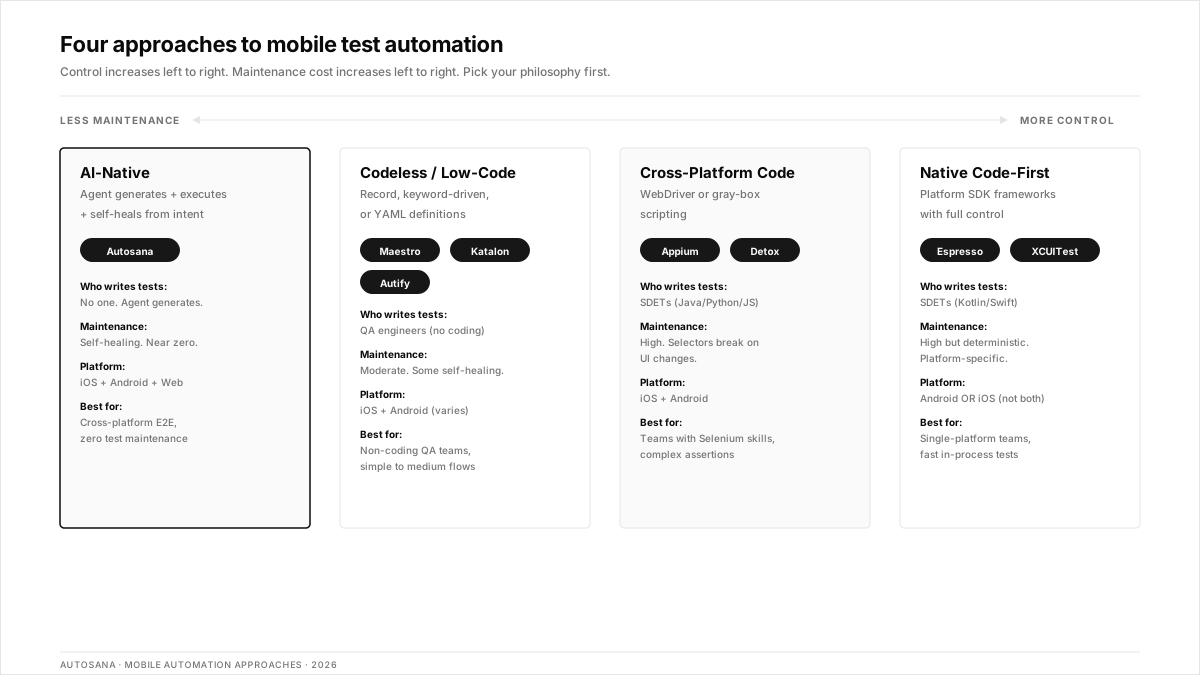
- Mobile automation tools split into four approaches: code-first (Appium, Espresso, XCUITest, Detox), simple/YAML (Maestro), codeless/low-code (Katalon, Autify), and AI-native (Autosana, which generates and self-heals tests from intent).
- Code-first frameworks offer maximum control but the highest maintenance cost. Teams report spending 40%+ of QA time maintaining flaky selectors that break on UI changes.
- The "best" tool depends on who writes the tests. SDETs writing Kotlin pick Espresso. QA engineers who do not code pick Maestro or Katalon. Teams that want no one writing tests pick Autosana.
- Cloud device labs (BrowserStack, Firebase Test Lab) are execution infrastructure, not automation tools. You still need a framework or agent to write the tests before the lab can run them.
- Autosana is an AI-native automation tool that generates intent-based E2E flows, runs them on real iOS, Android, and web devices, self-heals across OEM skins and OS updates, and posts session replay to every PR.
Which mobile automation testing tools are teams using in 2026?
| Tool | Automation Approach | Best For | Platform | Pricing |
|---|---|---|---|---|
| Autosana | AI agent (intent-based) | Teams wanting tests generated and self-healed automatically | iOS + Android + Web | Contact for pricing |
| Appium | Code-first (WebDriver) | QA engineers with Selenium skills needing cross-platform automation | iOS + Android | Free, open source |
| Espresso | Code-first (native) | Android SDETs needing fast in-process UI tests | Android only | Free (Android SDK) |
| XCUITest | Code-first (native) | iOS SDETs aligned with Apple SDK updates | iOS only | Free (Xcode) |
| Detox | Code-first (gray-box) | React Native teams needing flake-resistant E2E | iOS + Android (RN) | Free, open source |
| Maestro | YAML-based (simple) | Teams wanting mobile automation without coding | iOS + Android | Free; paid cloud |
| Katalon | Low-code + scripted | Mixed teams needing both keyword-driven and coded tests | iOS + Android + Web | Free; from $208/mo |
| Autify | Codeless (record + replay) | Non-technical QA teams needing fast mobile automation setup | iOS + Android + Web | Contact for pricing |
| BrowserStack App Automate | Execution infrastructure | Enterprise teams needing 3,000+ real devices for CI | iOS + Android | From $225/mo |
| Firebase Test Lab | Execution infrastructure | Android-first teams with Google-hosted real devices | Android + iOS | Free tier; pay-per-use |
Code-first frameworks
These give QA engineers and SDETs full scripting control. They offer the most power and the most maintenance cost.
Appium: best cross-platform code-first automation
Key Features:
- Cross-platform automation using the WebDriver protocol for native, hybrid, and mobile web apps
- Language flexibility: Java, Python, JavaScript, Ruby, C#
- No app modification required. Tests run on production binaries
- Large ecosystem with community plugins, cloud lab integrations, and CI/CD support
Why teams pick it: Appium is the standard for cross-platform mobile automation. Teams with Selenium experience reuse their skills across iOS and Android. The WebDriver protocol provides a familiar API. A developer on r/androiddev described the tradeoff: Appium works across platforms, but setup overhead and selector brittleness push teams toward simpler alternatives.
The tradeoff: Setup complexity (Appium server, desired capabilities, driver management). Slower than native frameworks because tests run out-of-process. Selectors break when view IDs change. The maintenance cost scales linearly with test count.
Where Autosana fits in: Autosana replaces Appium's E2E layer for teams tired of selector maintenance. The AI agent navigates by visual intent, not element IDs. Teams keep Appium for API-level testing and layer Autosana for regression testing across platforms.
Espresso: best native Android automation
Key Features:
- Google's first-party Android test framework with automatic UI thread synchronization
- In-process execution for fast, deterministic assertions
- Direct access to the view hierarchy
- Kotlin and Java with Google's Espresso APIs
Why teams pick it: Fastest Android automation framework. Tests run in the same process as the app, eliminating cross-process flakiness. The automatic synchronization model (IdlingResource) waits for the app to be idle before executing assertions.
The tradeoff: Android only. Kotlin or Java is required. Tests break when view IDs change or Jetpack Compose recomposition shifts the semantics tree. No iOS, no web, no cross-platform.
XCUITest: best native iOS automation
Key Features:
- Apple's official UI testing framework built into Xcode
- Direct communication with the iOS accessibility layer
- Swift or Objective-C test authoring
- Immediate compatibility with new iOS releases
Why teams pick it: XCUITest is what Apple ships. Faster and more reliable than any third-party iOS wrapper. Tests update when Apple updates the accessibility layer. A practitioner on r/softwaretesting noted the deeper problem: "Every test comes from that same mental model." XCUITest is powerful, but tests reflect developer assumptions, not user behavior.
The tradeoff: iOS and iPadOS only. No Android, no web. Accessibility identifiers change across SwiftUI updates. Cloud execution requires a third-party lab.
Detox: best for React Native automation
Key Features:
- Gray-box E2E testing framework built for React Native
- Internal state synchronization: tests wait until the app is genuinely idle
- Cross-platform (iOS and Android) from a single JavaScript codebase
- Designed for CI stability with automatic retry and timeout management
Why teams pick it: Detox reduces flakiness in React Native apps by monitoring the app's internal state (network requests, animations, timers) before executing the next step. A senior engineer on r/ExperiencedDevs described the test scale problem: framework choice matters less than having tests that survive RN version upgrades. Detox handles the synchronization; the question is who writes and maintains the tests on top.
The tradeoff: React Native only. Not useful for native Kotlin/Swift apps or web. Detox configuration is complex: Metro bundler, build configurations, and device management add setup friction. Breaking changes between Detox and RN versions are common.
YAML and simple automation
Maestro: best mobile automation without coding
Key Features:
- YAML-based test definitions with built-in waiting and retry logic
- Visual element selection alongside accessibility-based selectors
- No setup complexity: single CLI install, no server process
- Local and cloud execution options
Why teams pick it: Maestro removes the coding barrier entirely. QA engineers write tests in YAML. Setup is minutes, not hours. A practitioner on r/QualityAssurance described the appeal: "Purely automation" works when the goal is fast regression feedback without framework overhead.
The tradeoff: YAML simplicity limits complex assertions, conditional logic, and data-driven testing. The Maestro Cloud pricing is separate from the open-source CLI. No web coverage. Less mature ecosystem than Appium.
Codeless and low-code automation
Katalon: best low-code mobile automation
Key Features:
- Dual-mode: keyword-driven recording (low-code) and full Groovy/Java scripting
- Built-in object repository with self-healing locators
- Mobile, web, API, and desktop testing in one platform
- Free tier with community support; paid from $208/mo
Why teams pick it: Katalon bridges QA engineers who want codeless recording and SDETs who need scripting control. The self-healing locator feature reduces maintenance compared to raw Appium selectors.
The tradeoff: Groovy as the scripting language limits the talent pool. Execution limits on the free tier. Enterprise features require paid plans. Tests are coupled to the Katalon ecosystem.
Autify: best codeless record-and-replay
Key Features:
- Record user actions in a browser or on mobile to generate automation scripts
- AI-powered element identification that adapts to UI changes
- No coding required for test creation or maintenance
- Web and mobile automation in one platform
Why teams pick it: Autify is the fastest path from zero automation to running tests. Non-technical QA teams record their manual test flows and Autify replays them. The AI element identification reduces the selector maintenance burden.
The tradeoff: Record-and-replay hits limits on complex workflows with dynamic data, conditional branching, or multi-step authentication. Contact for pricing with no public transparency. Less control than coded frameworks for edge cases.
AI-native automation
Autosana: best for teams that want zero test maintenance
Key Features:
- Intent-based E2E flows generated from plain-English descriptions
- Runs natively on real iOS devices, Android devices (Samsung, Pixel, Xiaomi, OnePlus), and web browsers
- Self-heals when OEM skins change dialog layouts or OS updates alter permission flows
- Session replay posted to every PR via GitHub integration
- MCP server connects to coding agents so tests update when the code changes
Why teams pick it: A QA engineer on r/softwaretesting described the frustration: "AI is a nightmare for QA" when the tool generates noise instead of signal. Autosana takes the opposite approach: the agent generates tests from intent, navigates by visual understanding, and only surfaces genuine failures. No selectors to break. No scripts to maintain.
The tradeoff: Not a code-first framework. SDETs who want line-by-line control over test logic should use Espresso, XCUITest, or Appium. Autosana does not replace unit tests, API contract tests, or performance profiling. The Gobi Maps case study shows the sweet spot: cross-platform E2E regression.
Execution infrastructure (not automation tools)
BrowserStack App Automate and Firebase Test Lab
These are not automation tools. They are execution surfaces. BrowserStack provides 3,000+ real iOS and Android devices (from $225/mo). Firebase Test Lab provides Google-hosted Android and iOS devices (free tier: 15 virtual, 5 physical device tests/day).
Both require a test framework (Appium, Espresso, XCUITest, Maestro) or an AI agent (Autosana) to write the tests. The lab runs them. A DevOps engineer on r/devops shared the reality: "flaky tests consumed 40% of QA time." Running flaky tests on more devices does not fix the flakiness. Fix the automation approach first, then scale the execution surface.
How to choose the right mobile automation approach
- SDET team writing Kotlin, Android only: Espresso + Firebase Test Lab
- SDET team writing Swift and iOS only: XCUITest + BrowserStack or Xcode Cloud
- QA team with Selenium/WebDriver skills, cross-platform: Appium + BrowserStack
- React Native team: Detox for gray-box synchronization
- Non-coding QA team, simple flows: Maestro or Katalon
- Non-coding QA team, record-and-replay: Autify
- Any team wanting zero-maintenance cross-platform E2E: Autosana
Where mobile automation testing tools do not help
- Performance profiling. Instruments (iOS) and Android Profiler measure CPU, memory, and GPU rendering. Automation tools measure pass/fail.
- Accessibility audits. Accessibility Scanner (Android) and Xcode Accessibility Inspector require human judgment beyond what automation can assert.
- Security testing. MobSF, OWASP ZAP, and Burp Suite handle mobile binary analysis and API security scanning.
- App store compliance. Apple and Google review guidelines require manual verification beyond automated testing.
Conclusion
The best mobile automation testing tool depends on your automation philosophy. Code-first (Appium, Espresso, XCUITest, Detox) for maximum control. YAML-based (Maestro) for simplicity without coding. Low-code (Katalon, Autify) for bridging technical and non-technical teams. AI-native (Autosana) for zero-maintenance cross-platform E2E that self-heals. Pick the approach first, then compare tools within it.
.png)
Frequently asked questions
What is the best free mobile automation testing tool?
Appium is the most capable free cross-platform option. Espresso (Android) and XCUITest (iOS) are free with their SDKs. Maestro is free for local execution. Detox is free for React Native teams.
Can you automate mobile testing without coding?
Yes. Maestro uses YAML definitions. Katalon offers keyword-driven recording. Autify records user actions. Autosana generates tests from plain-English intent. The Firebase Robo test crawls apps without scripts.
What is the difference between Appium and Espresso?
Appium is cross-platform (iOS + Android), runs out-of-process via WebDriver, and supports multiple programming languages. Espresso is Android-only, runs in-process for faster execution, and requires Kotlin or Java. Appium offers breadth. Espresso offers speed and reliability on Android.
How does AI self-healing work in mobile test automation?
AI self-healing means the tool automatically adapts when UI elements change. Instead of failing because a button ID changed, the tool re-identifies the element using visual recognition, accessibility properties, or contextual understanding. Autosana uses intent-based visual navigation that survives OEM skin changes, OS updates, and UI refactors.
Should you use Appium or Maestro for mobile automation in 2026?
Appium for teams with WebDriver skills who need full scripting control and complex assertions. Maestro for teams who want simple YAML-based flows without coding. Appium has the larger ecosystem. Maestro has the faster setup. Neither self-heals when the UI changes.
What is the best mobile automation tool for React Native?
Detox is purpose-built for React Native with gray-box synchronization. Appium works but lacks RN-specific state awareness. Maestro supports RN apps with YAML flows. Autosana handles RN apps as part of cross-platform E2E without framework-specific configuration.
How do you run mobile automation tests in CI/CD?
Most tools offer CLI commands or APIs for CI integration. Espresso runs via Gradle tasks. XCUITest runs via xcodebuild. Appium runs via the Appium server. BrowserStack and Firebase provide CI plugins. Autosana posts session replay directly to pull requests via GitHub/GitLab integration.
Is codeless mobile testing reliable for complex apps?
For simple, linear user flows (login, browse, checkout), codeless tools work well. For complex workflows with dynamic data, conditional logic, multi-step authentication, or API-dependent state, codeless tools hit limits. The gap between codeless and coded narrows as AI-native tools like Autosana handle complexity through intent understanding rather than recorded steps.