
Autosana vs Waldo: Which one should you actually pick?
Compare Autosana and Waldo (Tricentis Testim Mobile) across platform coverage, agentic testing, self-healing, MCP integration, pricing, and migration to choose the right mobile and web testing approach.
Yuvan Sundrani · 15 min read
autosana.ai
.png)
Autosana is an AI-native testing agent that runs your iOS, Android, and web app by intent. The agent reads your PR diff, runs the flow, and posts a video plus verdict back through a documented MCP server. Waldo, now branded Tricentis Testim Mobile after Tricentis acquired the company in 2023, is a codeless mobile-testing product for iOS and Android.
Key Takeaways
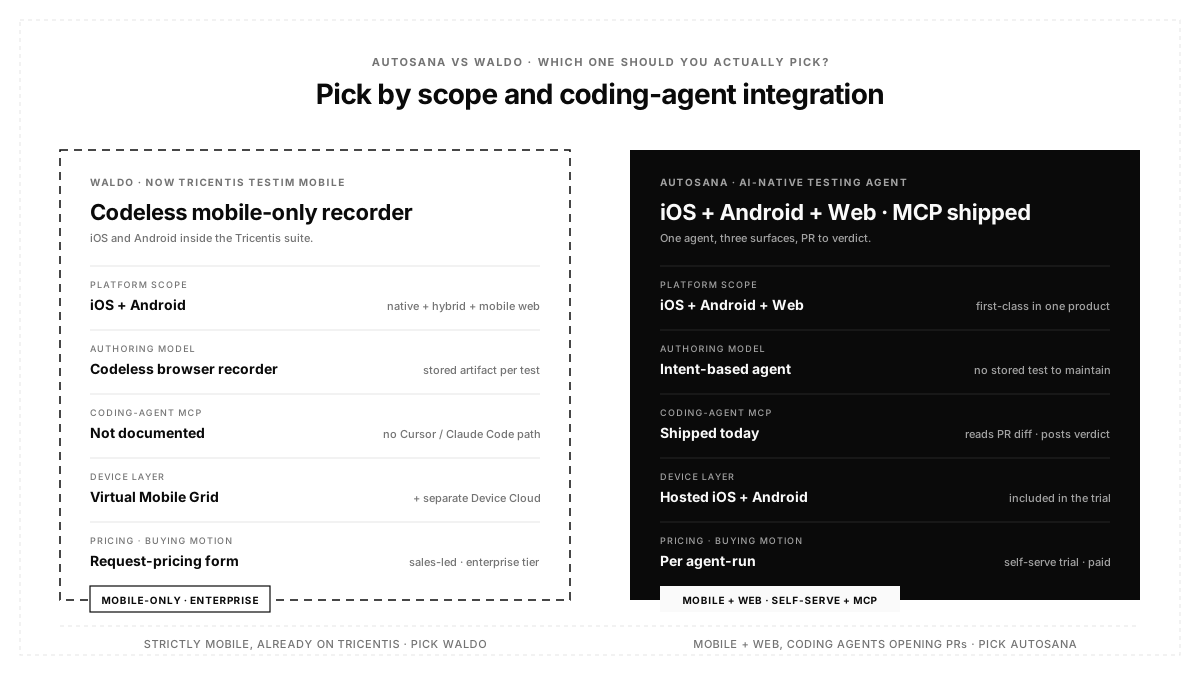
- Autosana covers iOS, Android, and web with hosted device infrastructure included in the trial. Waldo (Tricentis Testim Mobile) covers iOS + Android mobile (native + hybrid + mobile web).
- Autosana ships MCP with documented PR-level execution, GitHub integration, and video-verdict posting today. Tricentis Testim Mobile does not publish MCP, Claude Code, or Cursor integration on its product page.
- Autosana prices per agent run with a self-serve trial. Tricentis Testim Mobile uses a request-pricing form; third-party aggregators (G2, Capterra) place it in enterprise-tier territory.
- Autosana's agent replans against the current UI every run. There is no stored test to patch or heal. Waldo's authoring is codeless with a stored recorder-produced artifact.
- The features overview promises intent-based tests that self-heal on every run, no script to store or maintain between releases.
How do Autosana and Waldo compare at a glance?
| Axis | Autosana | Waldo (Tricentis Testim Mobile) |
|---|---|---|
| Category | AI-native testing agent | Codeless mobile test automation (Tricentis product) |
| Test Authoring | Natural language or code diff, run by an agent | Codeless browser-based recorder, cloud execution |
| Self-Healing | Re-plans against the current UI every run | Proprietary app-understanding produces stable tests |
| Platform Coverage | iOS + Android + Web | iOS + Android (native + hybrid + mobile web) |
| Coding-Agent MCP | MCP server → agent runs tests end-to-end on PR (shipped, documented) | Not documented on the Testim Mobile product page |
| Real-Device / Virtual Layer | Hosted iOS + Android, included in trial | Virtual Mobile Grid (cloud iOS simulators + Android emulators) + Tricentis Device Cloud (physical) |
| Pricing Model | Per agent-run (self-serve trial + paid) | Request-pricing form; enterprise-tier per third-party aggregators |
| Setup to First Test | ~10 min (quickstart) | Signup + Tricentis onboarding |
| Buying Motion | Self-serve | Sales-led / enterprise contract |
What is Waldo?
Waldo was a codeless mobile test automation SaaS acquired by Tricentis in July 2023. In 2026, waldo.com redirects to tricentis.com, and the product ships as Tricentis Testim Mobile.
Coverage is iOS and Android (native + hybrid + mobile web) with a Virtual Mobile Grid for cloud simulators and emulators, backed by the separate Tricentis Device Cloud for real devices.
What is Autosana?
Autosana is a cloud-hosted AI agent that tests iOS, Android, and web apps the way a real user would. You describe a flow in natural language, or hand the agent a code diff. There is no test artifact between you and the outcome.
When the UI changes, the agent re-anchors to whatever now matches the intent. Runs across iOS and Android and web, with hosted device infrastructure and an MCP server for coding-agent workflows.
How do the two tools handle test authoring?
Waldo's model is codeless recording. You walk through the app in a browser-based session, Waldo captures the actions, and the recording becomes a stored test the platform executes and manages across releases. It's positioned as accessible to mixed-skill teams, with proprietary app-understanding tech reducing the stability tax on captured tests.
Autosana skips the recording step. You describe the flow ("open cart, tap checkout, enter test card, confirm order") and the agent decides which element matches the intent at runtime. Nothing is stored between the description and the run.
The trade shows up in community discussion. On r/QualityAssurance, a thread on good no-code mobile automation tools regularly weighs the ergonomics of a recorder-based product against the friction of maintaining stored recordings when the app evolves. Recorded artifacts are still artifacts.
How does the platform coverage compare?
Testim Mobile is mobile-focused. Per the product page, coverage is iOS + Android (native + hybrid + mobile web). Desktop and standalone web app testing are not on this product; those live under separate Tricentis products (Tosca Desktop for desktop, Testim for web, though the web Testim product does not currently have a public page).
Autosana covers iOS + Android + web as first-class surfaces in a single product. Per docs.autosana.ai/real-device-testing, hosted iOS and Android device infrastructure ships as part of the trial. The web-testing docs cover the same intent-based execution model across desktop browsers.
For teams that ship iOS, Android, and a web dashboard behind the same product, one Autosana agent handles all three. For teams whose scope is strictly mobile-only under a broader enterprise Tricentis contract, Testim Mobile fits that shape.
A r/QualityAssurance thread on picking one tool for both web and mobile framings: this decision is often the friction is not choosing a mobile-only tool per se; it's stitching mobile onto a separate web-testing tool later.
How does coding-agent (MCP) integration work in each?
This is where Autosana leads.
Autosana's MCP server is documented and shipping today. PR opens, a coding agent (Cursor, Claude Code, or Devin) invokes MCP, Autosana reads the code diff, runs the flow across iOS, Android, and web by intent, and posts a video plus verdict back via GitHub integration. The whole pipeline from PR to verdict is reproducible.
Tricentis Testim Mobile does not publish an MCP server on its product page. No Claude Code integration, no Cursor integration, and no IDE integration are documented on the current Testim Mobile surface. The one "MCP" string in the page HTML is a CSS class name fragment, not a feature.
For teams where coding agents are already opening PRs and the bottleneck is running the tests on every one, Autosana ships the wiring. On r/QualityAssurance, a thread on picking a mobile test-automation framework in 2026 keeps returning to this axis: which tools let the coding agent finish the loop today?
How does Waldo (Testim Mobile) pricing actually work?
Pricing is not published on the Testim Mobile product page. The pricing URL at tricentis.com/products/testim-mobile/pricing/ opens a form titled "Request Tricentis Testim Mobile pricing."
Third-party aggregators (G2, Capterra) place Testim Mobile in enterprise-tier territory, typical of Tricentis products. No free tier is publicly documented on the product page. Buying is a sales-led motion with a custom quote.
The community trade-off shows up in r/QualityAssurance, where threads on the best automation tool for non-coders regularly weigh no-code accessibility against enterprise-tier price tags for teams that only need mobile scope.
Autosana prices are per agent-run rather than per seat or contract, with a self-serve trial. The curve flattens as headcount grows because you pay for runs, not editor licenses or enterprise minimums. Book a demo for a per-run quote against your PR volume.
How does maintenance scale as your suite grows?
Testim Mobile's stability claim is "proprietary technology" that "understands how your application is structured to produce stable tests." The product page does not publish a percentage maintenance-reduction claim. The underlying test remains a stored artifact that Testim Mobile maintains against UI changes.
Autosana's mechanism is different. The agent re-plans against the current UI on every run. There is no stored test to heal because there is no stored test. If the intent is still satisfiable, the test passes.
The r/QualityAssurance thread on favorite Android QA testing tools surfaces the trade often: teams weigh recorder-based products against the ongoing cost of updating recordings when the app evolves. Early customer stories including the Gobi Maps case study show what intent-based execution looks like at Series A scale, where there is no artifact to maintain.
Which one should you actually pick?
Pick Waldo (Tricentis Testim Mobile) if:
- Your scope is mobile-only (iOS + Android) and you're already inside the Tricentis suite for other testing needs.
- You prefer a codeless recorder-based authoring model for mixed-skill teams.
- Enterprise contract, request-pricing motion, and sales-led onboarding fit your procurement.
- You need Tricentis's Virtual Mobile Grid or Device Cloud for a specific device / simulator scope.
Pick Autosana if:
- Your product is iOS, Android, or web (or a mix) and shipped weekly or faster.
- Coding agents (Cursor, Claude Code, and Devin) open PRs faster than a human can maintain recorded tests, and you want the MCP server to run tests end-to-end today.
- You want a single agent covering iOS + Android + web rather than mobile-only tied to a broader suite.
- You value the features overview promise of intent-based tests that self-heal on every run, with per-agent-run pricing on a self-serve trial.
The community sorts this axis often. On r/QualityAssurance, a thread asking for recommended automated testing frameworks for mobile put it plainly: "BrowserStack is the best tool for device automation if you don't want to use your own devices." Device access is one layer. What runs on those devices, a recorder-based test or an intent-based agent invoked from your PR, is the next question.
Both are legitimate. Pick by scope and by whether coding-agent integration matters today.
How do you migrate from Waldo (Testim Mobile) to Autosana without regret?
If the intent-based path fits, migrating a Testim Mobile suite is a project, not a swap:
- Sort your Testim Mobile recordings into tiers. Tier A = critical business flows (login, checkout, payments). Tier B = regression. Tier C = long-tail edge cases. Many teams delete Tier C.
- Run Autosana in parallel with Testim Mobile for one sprint. The Autosana quickstart walks through the parallel-run pattern. Compare flake rate, run time, and engineer hours.
- Migrate Tier A first. Keep both suites live for one full release cycle.
- Migrate Tier B in the second wave. Delete Tier C or rebuild only what production traffic proves necessary.
- Add web coverage under Autosana. If your team was running mobile-only under Testim Mobile and pointing web tests elsewhere, this is a chance to unify.
- Decommission the overlapping mobile scope on a set date. Passive graveyards eat future engineer time.
Migration is easier when the target has no stored artifact. Adding web coverage is a common accelerant.
What's the takeaway for your team?
Waldo, now Tricentis Testim Mobile, is a codeless mobile-only test automation product for teams inside the Tricentis suite. If your scope is strictly iOS + Android and you're comfortable with request-pricing enterprise motion, Testim Mobile is a defensible pick.
Autosana is an AI-native testing agent for iOS, Android, and web with MCP shipped today, GitHub PR integration documented, and per-agent-run pricing on a self-serve trial. If your product is mobile + web, if your coding agents are already opening PRs, or if the bottleneck is human-in-the-loop maintenance of recorded tests, Autosana is the pick that removes those steps entirely.
Bring a build. We'll run it end-to-end across iOS, Android, and web in 30 minutes, and you can compare directly against your current Testim Mobile scope before making a call.
Frequently asked questions
Which is better for mobile testing, Autosana or Waldo?
For mobile-only scope on an existing Tricentis contract, Testim Mobile fits. For teams that also ship web, want per-run pricing, or want the MCP server to run tests end-to-end on each PR, Autosana fits. Both are legitimate for the mobile part of the job.
Does Waldo (Testim Mobile) self-heal like Autosana?
Both self-heal via different mechanisms. Testim Mobile uses proprietary app understanding to produce stable tests from recordings, without publishing a percentage maintenance-reduction claim. Autosana's agent replans against the current UI on every run: there is no stored recording to patch. Different approach, different failure modes.
Can Autosana replace Waldo entirely?
For iOS, Android, and web E2E flows: yes. For teams that specifically need Tricentis's Virtual Mobile Grid, Device Cloud, or the broader Tricentis suite unified with Testim Mobile, that scope stays. Rule of thumb: if your goal is mobile + web coverage under one agent with MCP-based PR execution, Autosana replaces the scope.
How long does a Waldo-to-Autosana migration take?
For a mid-size mobile scope (200 to 400 recordings), plan for one quarter end-to-end: two sprints of parallel-run evaluation, one sprint of Tier A migration, two sprints of Tier B, and one sprint of decommissioning the overlapping Testim Mobile scope. Adding web coverage under Autosana in the same window is a common pattern.
What is Waldo Sessions?
Waldo Sessions was Waldo's browser-based manual-exploration surface (record and replay mobile sessions, inspect view hierarchies, and network logs, and session flows). After the acquisition, its capabilities are folded into the broader Tricentis Testim Mobile product; no dedicated product page exists for Waldo Sessions on tricentis.com in 2026.