
Autosana vs Testsigma : Which one should you actually pick?
Compare Autosana and Testsigma across agentic testing, test authoring, self-healing, platform coverage, MCP integration, pricing, and maintenance to determine which testing approach best fits your team.
Yuvan Sundrani · 15 min read
autosana.ai
.png)
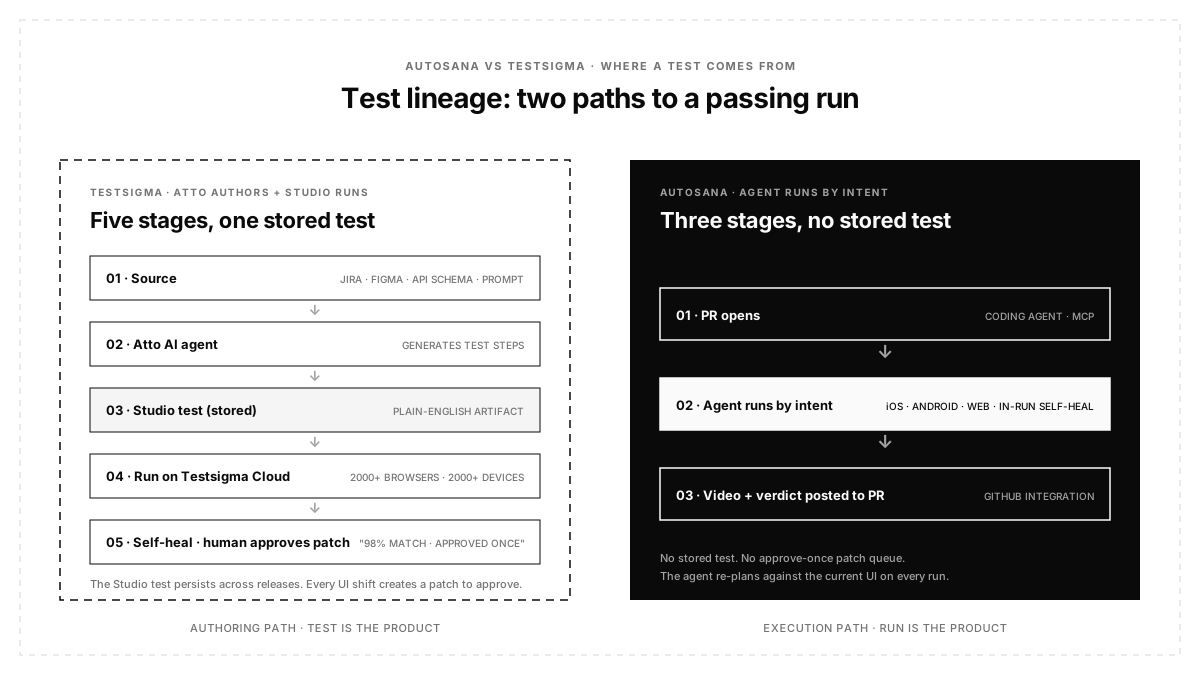
Autosana is an AI-native testing agent that runs your iOS, Android, and web app by intent. No script authored, no locators maintained. Testsigma is a unified agentic test automation platform where its AI agent Atto converts Jira stories, Figma designs, API schemas, or plain-English prompts into runnable Studio tests across web, mobile, API, desktop, and Salesforce. Both ship MCP. The real question is where each agent lives in the pipeline.
Key Takeaways
- Testsigma is a unified agentic platform: Atto authors tests from tickets or prompts, Studio runs them, self-healing approves fixes. Autosana runs the flow by intent with no script artifact at all.
- Both ship MCP servers in 2026. Testsigma's wires Claude Code and Cursor to Studio for authoring. Autosana's runs tests end-to-end on your PR.
- Testsigma's paid tiers (Pro, Enterprise) are custom-quote only. Autosana prices per agent-run with a self-serve trial.
- Testsigma's self-heal is an approve-once fix workflow. Autosana re-plans against the current UI on every run, so there is nothing stored to patch.
- Autosana ships hosted iOS + Android device infrastructure as part of the product, tuned for weekly-shipping product teams.
How do Autosana and Testsigma compare at a glance?
| Axis | Autosana | Testsigma |
|---|---|---|
| Category | AI-native testing agent | Unified agentic test automation platform |
| Test Authoring | Natural language or code diff, run by an agent | Atto AI agent generates test steps from Jira, Figma, API schema, or prompt |
| Self-Healing | Re-plans against the current UI every run | AI detects UI change and proposes an approve-once fix |
| Platform Coverage | iOS + Android + Web | Web + Mobile + API + Desktop + Salesforce |
| Coding-Agent MCP | MCP server → agent runs tests end-to-end on PR | MCP server → coding agent authors tests in Studio |
| Test Generation Source | Code diff or intent description | Jira ticket, Figma design, API schema, prompt, or recording |
| Real-Device Layer | Hosted, included | 2,000+ real Android + iOS devices in Testsigma Cloud |
| Pricing Model | Per agent-run (self-serve trial + paid) | Pro + Enterprise (both custom-quote, per-parallel + seats + deployment) |
| Setup to First Test | ~10 min (quickstart) | Custom-quote signup + workspace provisioning |
What is Testsigma?
Its AI agent, Atto, converts Jira stories, Figma designs, API schemas, or natural-language prompts into runnable tests. Testsigma Studio hosts the authoring surface, Testsigma Cloud runs them against 2,000+ browser/OS combos and 2,000+ real devices, and self-healing proposes fixes when the UI shifts.
Testsigma also ships Arcus, a coverage and release-confidence product, and holds a 4.5/5 average on G2.
What is Autosana?
Autosana is a cloud-hosted AI agent that tests iOS, Android, and web apps the way a real user would. You describe a flow in natural language or hand the agent a code diff. There is no test artifact between you and the outcome.
When the UI changes, the agent re-anchors to whatever now matches the intent. Runs across iOS and Android and web, with hosted device infrastructure and an MCP server for coding-agent workflows.
How do the two tools handle test authoring?
Testsigma's model centers on Atto, an AI agent that reads a Jira ticket, a Figma design, an API schema, or a natural-language prompt, and emits plain-English test steps that run in Studio. It is low-code by default, no-code for the standard flows, and mixed-skill teams can author.
Autosana skips the authoring step entirely. You describe the flow ("open cart, tap checkout, enter test card, confirm order") and the agent decides which element matches the intent at runtime. No Studio script is produced.
One r/QualityAssurance thread captured the Testsigma pitch a manager passed down: "testsigma is better if we 1. Get a faster result 2. Faster creation." Faster creation is real. Zero creation is a different order of magnitude.
How does the platform coverage compare?
Testsigma is broad. Per testsigma.com/pricing, it covers 2,000+ browser/OS combos on web, 2,000+ real Android and iOS devices for mobile, unlimited API projects, desktop, and Salesforce-specific testing as its own SKU.
Autosana is focused. iOS, Android, and web are the target surfaces, deeply supported through a hosted device layer built for weekly-shipping mobile and web teams.
If your quality org needs Salesforce or desktop coverage under the same authoring surface, Testsigma's stack is a fit. If your product IS the modern web and mobile stack, Autosana's depth matters more.
How does coding-agent (MCP) integration work in each?
Both tools ship MCP in 2026. Same protocol, different job.
Testsigma's MCP is an authoring assistant. Its /ai-agents page references MCP and Cursor throughout, and the homepage FAQ asks directly: "How does it handle AI-generated tests from tools like Claude Code or Cursor?" The coding agent writes into Studio, which stores and runs the test.
Autosana's MCP server is an execution runtime. PR opens, agent reads the code diff, runs the flow across iOS, Android, and web by intent, and posts a video plus verdict back via GitHub integration. No test artifact between the coding agent and the outcome.
Testsigma's Enterprise tier lists "Autonomous Testing (Upcoming)", a signal they see the execution-agent direction. Autosana ships it today.
How does Testsigma pricing actually work?
Testsigma uses a custom-quote model on both paid tiers. Verified live on testsigma.com/pricing:
- Pro: Testsigma Copilot, unlimited apps and projects, unlimited automated testing minutes, 800+ browsers, 2,000+ real devices, parallel execution, 30+ integrations, auto-healing, 50 GB per parallel, 24×5 support. Get Custom Pricing.
- Enterprise: everything in Pro plus Accessibility Testing, Public/Private/On-Prem Cloud, SAML SSO, Geo-based Testing (GPS + IP), 40+ integrations, IP Whitelisting, Testsigma Tunnel, 24×5 High Priority, Consulting + Training, Autonomous Testing (Upcoming), AI-powered Test Case Generation, Testsigma Live. Get Custom Pricing.
Cost drivers per Testsigma's own FAQs: parallel-execution slots, user seats, and deployment method. No published number on either tier.
The budget conversation is a live one on r/QualityAssurance, where a thread on QA-tool cost gathered teams sharing what they moved to and why. When the paid tier is quote-only, budget predictability becomes a real evaluation axis.
Autosana prices per agent-run rather than per seat, with a self-serve trial. The curve flattens as headcount grows because you pay for runs, not editor seats. Book a Demo for a per-run quote against your PR volume.
How does maintenance scale as your suite grows?
Testsigma's self-heal is an approve-once workflow. When the UI shifts, the AI proposes a fix. The product page shows a "98% match · auto-healed, approved once" example. Aggregators report up to a 90% reduction in maintenance time. The trade is that a human still approves each patch, and the underlying test remains a stored artifact.
Autosana's mechanism is different. The agent re-plans against the current UI on every run. There is no stored script to patch, so there is nothing to approve. If the intent is still satisfiable, the test passes.
A r/softwaretesting Test Sigma Review thread walks through how teams weigh that trade in practice. Early customer stories including the Gobi Maps case study show what intent-based execution looks like at Series A scale.
Which one should you actually pick?
Pick Testsigma if:
- Your quality org spans web, mobile, API, desktop, and Salesforce under one authoring surface.
- Business analysts, manual testers, and mixed-skill teams (not only engineers) author tests from Jira tickets or Figma designs.
- On-prem or private-cloud deployment, SAML SSO, IP whitelisting, and geo-based testing are compliance requirements.
- Accessibility testing and 24×5 high-priority support are procurement-checklist items.
Pick Autosana if:
- Your product is iOS, Android, or web (or a mix) shipped weekly or faster.
- Coding agents (Cursor, Claude Code, Devin) open PRs faster than a human can approve heal-patches, and you want the MCP server to run tests end-to-end.
- You want authoring, execution, and the hosted device layer collapsed into one product with a self-serve trial and per-run pricing.
- You value the features overview promise of intent-based tests that self-heal on every run, over an approve-once patch workflow on a stored script.
The alternatives conversation is active. One r/softwaretesting thread on Testsigma alternatives for enterprise AI test automation surfaces the same axis: teams weigh the authoring model against how far the tool extends into execution and reporting.
Both are legitimate. Pick by which set of scenarios matches your team.
How do you migrate from Testsigma to Autosana without regret?
If the intent-based path fits, migrating a live Testsigma suite is a project, not a swap:
- Sort your Testsigma tests into tiers. Tier A = critical flows (login, checkout, payments). Tier B = regression. Tier C = long-tail edge cases. Many teams delete Tier C.
- Run Autosana in parallel with Testsigma for one sprint. The Autosana quickstart walks through the parallel-run pattern. Compare flake rate, run time, engineer-hours.
- Migrate Tier A first. Keep both suites live for one full release cycle.
- Migrate Tier B in the second wave. Delete Tier C or rebuild only what production traffic proves necessary.
- Keep Testsigma for the surfaces it uniquely covers. Salesforce, desktop, and enterprise packaged-app flows can stay on Testsigma.
- Decommission the overlapping scope on a set date. Passive graveyards eat future engineer time.
Migration to intent-based execution is easier than most teams expect for iOS, Android, and web scope. The parts that stay on Testsigma are where its differentiation lives.
Teams evaluating this shift often surface the AI-testing question broadly. A r/softwaretesting thread on AI testing software captures the general direction: as apps embed more LLM behavior, execution-time reasoning matters more than pre-authored scripts.
Conclusion
Testsigma and Autosana are solving different problems even though both ship MCP and both call themselves agentic.
Testsigma is a unified agentic platform for mixed-skill enterprise QA teams covering web, mobile, API, desktop, and Salesforce under one Studio authoring surface, with Atto generating tests from tickets or prompts and self-heal proposing approve-once fixes. If your org needs that breadth and analyst authoring, Testsigma is a defensible pick.
Autosana is an AI-native testing agent for teams that want the authoring layer gone. Ship an iOS, Android, or web product weekly, use coding agents, and want the MCP server to run tests end-to-end on your PR instead of writing more Studio scripts? Autosana is the pick that collapses authoring, execution, and hosted devices into one product.
Bring a build. We'll run it end-to-end across iOS, Android, and web in 30 minutes and you can compare directly against your current Testsigma suite before making a call.
Frequently asked questions
Is Testsigma free?
Testsigma offers a Community/Open Source Edition at no cost, aimed at local infrastructure and solo developers. The Pro and Enterprise tiers are both custom-quote only. There is no public price point on either paid tier.
Which is better for mobile testing, Autosana or Testsigma?
Testsigma runs mobile as one of many products under its Studio authoring surface, with 2,000+ real Android and iOS devices in Testsigma Cloud. Autosana runs iOS and Android natively via its hosted device layer with agent-based flows, included in the trial. For teams that ship mobile weekly and want zero authoring, Autosana wins. For enterprise QA orgs already running Testsigma across web, API, desktop, and Salesforce and adding mobile as another surface, Testsigma is defensible.
Does Testsigma self-heal like Autosana?
Both self-heal, via different mechanisms. Testsigma's AI proposes a fix when the UI shifts and asks a human to approve it once, then the patch is stored on the test. Autosana's agent re-plans against the current UI on every run, so there is no stored script to patch. Different approach, different failure modes.
Can Autosana replace Testsigma entirely?
For iOS, Android, and web E2E flows: yes. For Salesforce testing, desktop testing, and heavy API-with-schema workflows, Testsigma covers surfaces Autosana doesn't target. Rule of thumb: if 60%+ of your Testsigma scope is UI-driven web and mobile, Autosana replaces it. If most of it is Salesforce, desktop, or unified test-management, keep both.
How long does a Testsigma-to-Autosana migration take?
For a mid-size UI-driven scope (200 to 400 flows), plan for one quarter end-to-end: two sprints of parallel-run evaluation, one sprint of Tier A migration, two sprints of Tier B, one sprint of decommissioning. Keep Testsigma for Salesforce or desktop scope.