
Autosana vs Mabl : Which one should you actually pick?
Compare Autosana and mabl across agentic testing, test authoring, self-healing, platform coverage, MCP integration, pricing, and migration to choose the right testing approach for your team.
Yuvan Sundrani · 16 min read
autosana.ai
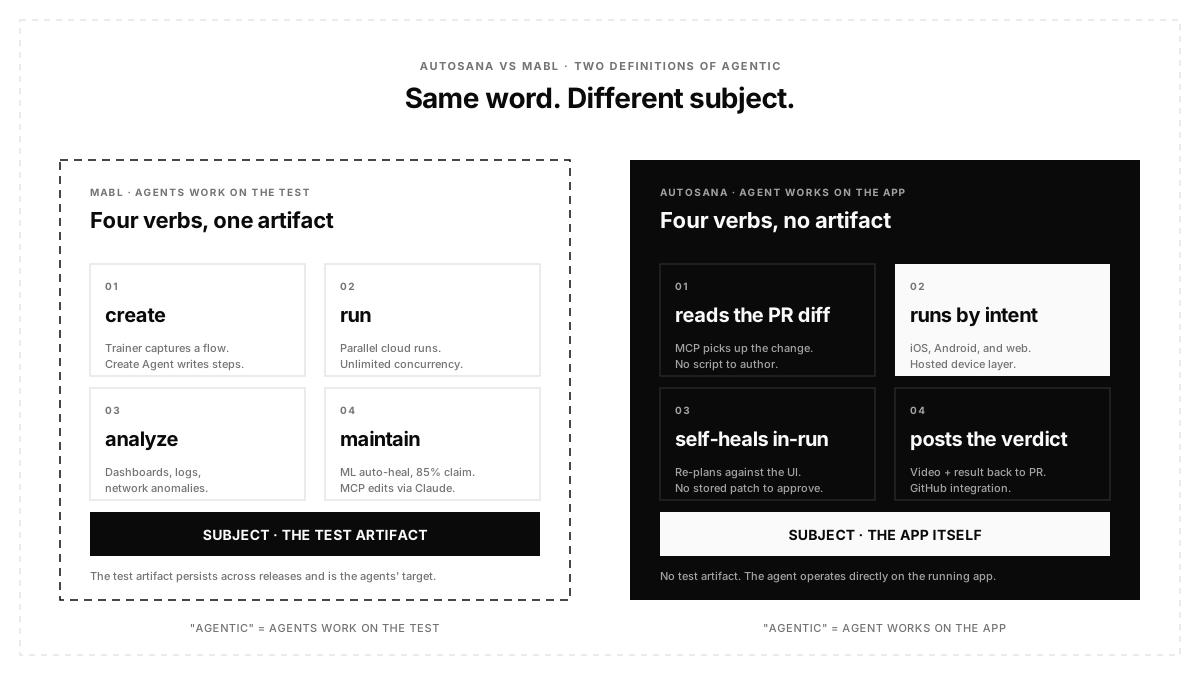
Autosana is an AI-native testing agent that runs your iOS, Android, and web app by intent. No script exists between you and the outcome. Mabl is a low-code intelligent test automation platform where AI agents create, run, analyze, and maintain tests across browser, mobile, API, accessibility, and performance. Both call themselves "agentic." The real split is where each agent operates: on the test artifact or on the app itself.
Key Takeaways
- Both are marketed as agentic testing. Mabl's agents work on the test artifact (create, heal, edit, manage). Autosana's agent works on the app itself (reads the PR diff, runs by intent, no test artifact).
- Both ships documented MCP servers in 2026. Mabl's MCP is a workflow and authoring assistant for Claude, Cursor, Copilot, Windsurf, and Rovo. Autosana's MCP is the execution runtime that runs the flow end-to-end on your PR.
- MABL pricing is contact-sales, credits-based. Aggregators report entry around $450/month for 500 cloud test-run credits plus unlimited local runs and unlimited cloud concurrency. Autosana prices per agent run with a self-serve trial.
- mabl claims 85% maintenance reduction on Selenium-style tests through auto-healing. Autosana skips the healing step: the agent replans against the current UI every run.
- Autosana ships hosted iOS + Android device infrastructure included with the trial, plus GitHub integration that posts a video and verdict back to your PR.
How do Autosana and MABL compare at a glance?
| Axis | Autosana | mabl |
|---|---|---|
| Category | AI-native testing agent | #1 agentic testing platform (low-code + AI) |
| Test Authoring | Natural language or code diff, run by an agent | Point-and-click Trainer + natural-language authoring, low-code with JavaScript/Appium/Playwright extensions |
| Self-Healing | Re-plans against the current UI every run | ML auto-healing with 85% maintenance-reduction claim |
| Platform Coverage | iOS + Android + Web | Web + Mobile (iOS/Android) + API + Accessibility + Performance + AI Application Testing |
| Coding-Agent MCP | MCP server → agent runs tests end-to-end on PR | MCP server → coding agent queries, investigates, authors, and edits tests |
| MCP AI Clients Supported | Cursor, Claude Code, Devin via MCP | Claude, Cursor, Copilot, Windsurf, Rovo |
| Test Generation Source | Code diff or intent description | Trainer recording or natural-language prompt via "Create Agent" |
| Real-Device Layer | Hosted, included in trial | Cloud execution for browser + mobile |
| Pricing Model | Per agent-run (self-serve trial + paid) | Contact-sales credits-based, entry ~$450/mo (500 cloud credits, unlimited local runs) |
| Setup to First Test | ~10 min (quickstart) | Trainer install + workspace |
Source: mabl values from mabl.com, mabl.com/pricing, and docs.mabl.com/docs/mabl-mcp/mabl-mcp-overview.html, verified live. Autosana values from features overview and product docs.
What is mabl?
The platform covers browser UI, native mobile apps, API, accessibility, performance, and a dedicated AI application testing product for LLM-based apps. Tests are created via a point-and-click trainer or natural-language prompts, with hybrid code access for developers.
Named customers include JetBlue, Barracuda, Lowe's, Panasonic, InvestCloud, and Intact. Machine learning has been embedded in the platform since 2017.
What is Autosana?
Autosana is a cloud-hosted AI agent that tests iOS, Android, and web apps the way a real user would. You describe a flow in natural language, or hand the agent a code diff. There is no test artifact between you and the outcome.
When the UI changes, the agent re-anchors to whatever now matches the intent. Runs across iOS and Android and web, with hosted device infrastructure and an MCP server for coding-agent workflows.
How do the two tools handle test authoring?
Mabl's model is a low-code trainer. You point-and-click through the app, MABL records the flow, and the trainer produces a test that runs on their cloud. In 2026, natural-language authoring layers on top: describe a flow, and Mabl's "Create Agent" generates the test steps. Developers can extend with JavaScript, Appium snippets, or open-source Playwright tests.
Autosana skips the trainer step. You describe the flow ("open cart, tap checkout, enter test card, confirm order"), and the agent decides which element matches the intent at runtime. There is no test artifact stored between the description and the run.
Community context matches the trade. On r/QualityAssurance, the recurring question about mabl is the shape of the authoring surface and how teams keep the tests coherent over time. Every low-code authoring model creates a stored artifact the team owns.
How does the platform coverage compare?
Mabl is broad. Per mabl.com/platform, it covers cross-browser web, native iOS and Android, API testing, accessibility, performance, and a dedicated AI application testing product for testing LLM-based features.
Autosana is focused. iOS, Android, and web are the target surfaces, deeply supported through a hosted device layer built for weekly-shipping mobile and web teams.
If your quality org needs accessibility, performance, or LLM-app testing under one authoring surface, mabl's stack fits. If your product is iOS, Android, or web (or a mix) and the bottleneck is human-in-the-loop test authoring, Autosana's depth on the modern stack matters more.
How does coding-agent (MCP) integration work in each?
Both tools ship documented MCP servers in 2026. Same protocol, different job.
Mabl's MCP is an authoring and workflow assistant. Per docs.mabl.com/, the mabl MCP server "connects your AI client to mabl's testing tools so you can work with your test data using natural language." Supported clients: Claude, Cursor, Copilot, Windsurf, and Rovo. Use cases: query test results, investigate failures, author and edit tests, and manage the testing workflow. The coding agent operates on the test artifact.
Autosana's MCP server is the execution runtime. PR opens, the agent reads the code diff, runs the flow across iOS, Android, and web by intent, and posts a video plus verdict back via GitHub integration. The coding agent operates on the app.
Both are legitimate framings of "agentic." Which one fits depends on whether your bottleneck is writing tests faster or running them on every PR without a test author in the loop. One r/QualityAssurance thread on real AI-in-QA usage captured the community sorting through this axis right now.
How does MABL pricing actually work?
Mabl uses a contact-sales credits-based model. No public tier prices on mabl.com/pricing. Verified facts from the pricing page and aggregator cross-checks:
- 14-day free trial on paid tiers.
- Base package: ~$450/month per aggregator reporting (G2, Capterra), bundling 500 cloud test-run credits.
- Free at any tier: unlimited local test runs, unlimited user licenses, and unlimited cloud concurrency.
- Cost drivers: cloud test-run volume + add-ons (native mobile app testing, performance, accessibility, dedicated TAM, SSO / audit logs).
- Public claims: "reducing testing costs by up to 80%" and "cutting maintenance by 85%" (from mabl.com/selenium-alternative).
Community discussion tracks the enterprise-motion tradeoff. On r/QualityAssurance, teams weighing AI-QA tool spend regularly flag credit-based pricing as a budget-predictability concern for high-frequency CI pipelines.
Autosana prices are per agent run rather than per credit or per seat, with a self-serve trial. The curve flattens as headcount grows because you pay for runs, not credits or editor licenses. Book a demo for a per-run quote against your PR volume.
How does maintenance scale as your suite grows?
Mabl's auto-healing uses ML that adapts tests when the UI changes. Their selenium-alternative page claims an 85% reduction in test maintenance toil. The trade: the underlying test artifact remains stored, and the auto-healing operates on that artifact when locators shift.
Autosana's mechanism is different. The agent replans against the current UI on every run. There is no stored test to heal because there is no test to store. If the intent is still satisfiable, the test passes.
The migration path is a real conversation. On r/Playwright, one team documented moving 500+ mabl tests to Playwright, framing the actual problem this way: "The biggest challenge isn't translating individual test steps; it's preserving th…" The stored artifact is what has to translate. Early customer stories, including the Gobi Maps case study, show what intent-based execution looks like at Series A scale, where there is no artifact to migrate.
.png)
Which one should you actually pick?
Pick mabl if:
- You want a unified low-code platform covering web, mobile, API, accessibility, performance, and AI-app testing under one Trainer authoring surface.
- Business analysts, manual testers, and mixed-skill teams (not only engineers) create tests via point-and-click or natural-language prompts.
- Your bottleneck is authoring speed: you want AI to generate, edit, and heal test artifacts your team maintains.
- Enterprise features (SSO, audit logs, dedicated TAM, and dashboards with network anomaly tracking) are procurement requirements.
Pick Autosana if:
- Your product is iOS, Android, or web (or a mix) and shipped weekly or faster.
- Coding agents (Cursor, Claude Code, and Devin) open PRs faster than a human can approve heal-patches on a stored test, and you want the MCP server to run tests end-to-end without a test artifact in the loop.
- You want authoring, execution, and the hosted device layer collapsed into one product with a self-serve trial and per-run pricing.
- You value the features overview promise of intent-based tests that self-heal every run, over a healed test artifact you maintain.
Community sorting on this axis is active. On r/QualityAssurance, teams asking for AI-based tool recommendations regularly land on the same question: does the AI author the test, or does it run the test? Both are real answers, and both are legitimate categories.
Both are legitimate. Pick by which "agentic" fits your pipeline.
How do you migrate from MABL to Autosana without regret?
If the intent-based path fits, migrating a live MABL suite is a project, not a swap:
- Sort your mabl tests into tiers. Tier A = critical business flows (login, checkout, payments). Tier B = regression. Tier C = long-tail edge cases. Many teams delete Tier C.
- Run Autosana in parallel with mabl for one sprint. The Autosana quickstart walks through the parallel-run pattern. Compare flake rate, run time, engineer-hours.
- Migrate Tier A first. Keep both suites live for one full release cycle.
- Migrate Tier B in the second wave. Delete Tier C or rebuild only what production traffic proves necessary.
- Keep mabl for the surfaces it uniquely covers. Accessibility scoring, performance metrics, and AI-application testing can stay on mabl if that scope matters.
- Decommission the overlapping scope on a set date. Passive graveyards eat future engineer time.
Migration is easier for iOS, Android, and web weekly-release scope. Accessibility and performance suites tend to stay where they are.
On r/QualityAssurance, a thread asking for opinions on AI testing tools frames the migration decision honestly: teams weigh the artifact-migration cost against the maintenance cost of keeping the current stack. The math changes when the target has no artifact at all.
Conclusion
Mabl and Autosana both call themselves agentic. The word means different things in each product.
Mabl is a unified low-code platform where AI agents work on the test artifact. They create it via the Trainer or natural-language prompt, heal it when locators shift, edit it via MCP through Claude or Cursor, and manage the workflow around it. If your quality org authors and maintains test suites across web, mobile, API, accessibility, performance, and AI apps, mabl is a defensible pick.
Autosana is an AI-native testing agent where the agent works on the app. There is no test artifact. The agent reads the PR diff, runs the flow by intent across iOS, Android, and web, self-heals in-run, and posts the video plus verdict back to the PR. If your bottleneck is human-in-the-loop test authoring on a weekly-shipping product, Autosana is the pick that removes the artifact entirely.
Bring a build. We'll run it end-to-end across iOS, Android, and web in 30 minutes and you can compare directly against your current mabl suite before making a call.
Frequently asked questions
Is MABL free?
mabl offers a 14-day free trial on paid tiers. Beyond the trial, pricing is contact-sales and credits-based. Unlimited local test runs, unlimited user licenses, and unlimited cloud concurrency are included at every tier. Aggregators report entry around $450/month bundling 500 cloud test-run credits.
Which is better for mobile testing, Autosana or mabl?
mabl covers native iOS and Android as one of six product areas under its unified Trainer authoring surface. Autosana runs iOS and Android natively via its hosted device layer with agent-based flows, included in the trial. For teams that ship mobile weekly and want zero test authoring, Autosana. For enterprise QA orgs running mABL across web, mobile, API, accessibility, and performance and adding mobile as another surface, mABL is defensible.
Does Mabl self-heal like Autosana?
Both self-heal via different mechanisms. Mabl's ML adapts the stored test when the UI shifts, with a public claim of 85% maintenance-time reduction. Autosana's agent replans against the current UI on every run: there is no stored test to heal. Different approach, different failure modes.
Can Autosana replace MABL entirely?
For iOS, Android, and web E2E flows: yes. For dedicated accessibility scoring, performance benchmarking, and AI application testing surfaces, mabl covers the scope Autosana doesn't target. Rule of thumb: if 60%+ of your mabl scope is UI-driven web and mobile, Autosana replaces it. If most of it is accessibility, performance, or LLM-app testing, keep both.
How long does a mabl-to-Autosana migration take?
For a mid-size UI-driven scope (200 to 400 flows), plan for one quarter end-to-end: two sprints of parallel-run evaluation, one sprint of Tier A migration, two sprints of Tier B, one sprint of decommissioning the overlapping mabl scope. Keep mabl for accessibility, performance, or AI-app scope.
What does "agentic" mean in MABL vs. Autosana?
Both use "agentic." In mabl, agents autonomously create, run, analyze, and maintain tests. The agents act on the test artifact. In Autosana, the agent reads the PR diff, runs the flow by intent, self-heals in-run, and posts the verdict back. The agent acts on the app. Same word, different subject.