
Autosana vs LambdaTest : Which one should you actually pick?
Compare Autosana and LambdaTest across agentic testing, test authoring, platform coverage, MCP integration, pricing, self-healing, and maintenance to determine which testing approach best fits your team.
Yuvan Sundrani · 16 min read
autosana.ai
.png)
Autosana is an AI-native testing agent that runs your iOS, Android, and web app by intent. One agent, one runtime, MCP that runs your PR end-to-end with a documented setup and video-verdict posting. LambdaTest is a broad AI-agentic testing cloud built around KaneAI, its natural-language test-authoring agent, alongside a 14-product platform covering real device cloud, browser cloud, HyperExecute, Test Manager, Smart UI, and more.
Key Takeaways
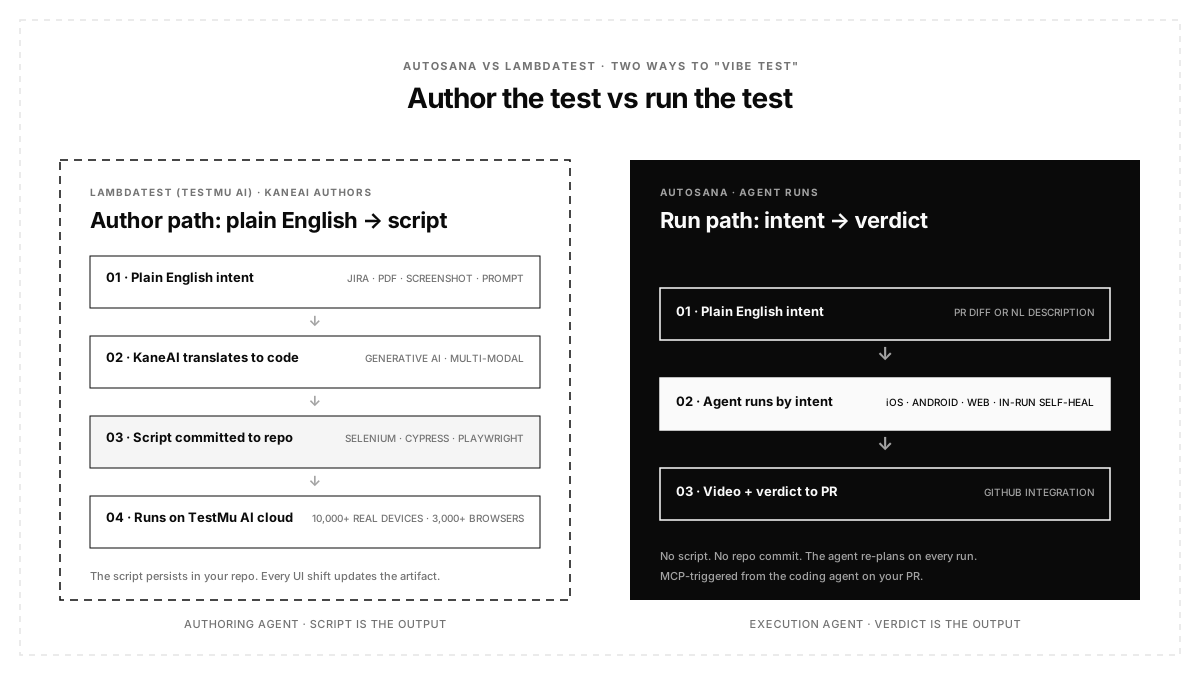
- LambdaTest, now branded TestMu AI, ships KaneAI, its AI test-authoring agent that translates plain English into Selenium, Cypress, or Playwright scripts you commit to your repo.
- Autosana skips the script. The agent runs the flow by intent, self-heals in-run, and posts a video plus verdict back to your PR. No stored test artifact.
- Both ship documented MCP servers in 2026 with support for Claude Code, Cursor, and other coding agents. Different jobs.
- LambdaTest publishes tiered pricing: KaneAI $17/mo (Starter) · $89/mo (Pro) · $179/mo (Max), plus modular product pricing for HyperExecute, Live Testing, Web Automation, Smart UI, and more. Autosana prices per agent-run with a self-serve trial.
- Autosana ships hosted iOS + Android device infrastructure included in the trial, plus GitHub integration that posts a video and verdict back to your PR.
How do Autosana and LambdaTest compare at a glance?
| Axis | Autosana | LambdaTest |
|---|---|---|
| Category | AI-native testing agent | Native AI-agentic testing cloud (KaneAI + 14-product platform) |
| Test Authoring | Natural language or code diff, run by an agent | KaneAI writes plain English → Selenium/Cypress/Playwright script you commit |
| Self-Healing | Re-plans against the current UI every run | KaneAI intelligent self-healing on stored KaneAI-generated tests |
| Platform Coverage | iOS + Android + Web | Web (3,000+ browser/OS combos) + Mobile (10,000+ real iOS/Android devices) + API |
| Coding-Agent MCP | MCP server → agent runs tests end-to-end on PR (Cursor, Claude Code, Devin) | MCP server with 4 tool suites (HyperExecute, Automation, SmartUI, Accessibility); supports Cursor, Claude Code, Copilot, Windsurf, and more |
| Test Generation Source | Code diff or intent description | Jira, PDFs, screenshots, natural language via KaneAI |
| Real-Device Layer | Hosted iOS + Android, included in trial | 10,000+ real devices; day-zero flagship access |
| Pricing Model | Per agent-run (self-serve trial + paid) | KaneAI $17/$89/$179/mo + modular products (HyperExecute $159/mo, Web Automation $29–$199/mo, Live Testing $15–$39/mo, Smart UI $199/mo) |
| Product Surface | Single agent | 14 SKUs across KaneAI, Kane CLI, HyperExecute, Test Manager, Live Testing, Real Device Cloud, Web Automation, App Automation, API Testing, Smart UI, Accessibility, Agent Testing, Performance, Test Analytics |
| Setup to First Test | ~10 min (quickstart) | Signup + product + framework wiring |
What is LambdaTest?
LambdaTest, now branded TestMu AI at testmuai.com
KaneAI, an AI-native test agent that translates plain English into automated tests. KaneAI exports to Selenium, Cypress, Playwright, and Appium, the tests live in your repo, in your CI. Around KaneAI, the platform runs 14 products including Kane CLI, HyperExecute (test orchestration, 70% faster claim), Real Device Cloud (10,000+ devices), Test Manager, Test Analytics, Smart UI, and Agent Testing (a product to test AI agents themselves).
Named enterprise customers include Microsoft, OpenAI, GitHub, NVIDIA, Dashlane, Bajaj Finserv, and Dunelm. LambdaTest is a Gartner Magic Quadrant 2025 Challenger in AI-augmented software testing tools.
What is Autosana?
Autosana is a cloud-hosted AI agent that tests iOS, Android, and web apps the way a real user would. You describe a flow in natural language, or hand the agent a code diff. There is no test artifact between you and the outcome.
When the UI changes, the agent re-anchors to whatever now matches the intent. Runs across iOS and Android and web, with hosted device infrastructure and an MCP server for coding-agent workflows.
How do the two tools handle test authoring?
LambdaTest's KaneAI is an AI test-authoring agent. You describe what you want to test in plain English, KaneAI generates the test steps, and the output is a Selenium, Cypress, or Playwright script that you commit to your repo. Per testmuai.com/kaneai, KaneAI produces "framework-compliant test code" so you can commit directly. Multi-modal input: Jira tickets, PDFs, screenshots, video.
Autosana skips the script. You describe the flow ("open cart, tap checkout, enter test card, confirm order") and the agent decides which element matches the intent at runtime. Nothing is stored between the description and the run.
Community context is active around KaneAI. On r/opensource, a thread on open-source alternatives to LambdaTest Kane AI compared it against 16 open-source browser-testing options, weighing generated-script maintenance against pure-script alternatives. Every generated-test tool inherits the maintenance profile of the framework it targets.
How does the platform coverage compare?
LambdaTest is broad. Per testmuai.com/real-device-cloud, the platform provides 10,000+ real iOS and Android devices with day-zero flagship access. The browser cloud carries 3,000+ browser/OS combinations across Chrome, Safari, Firefox, and Edge on Windows, macOS, and Linux. Beyond browser and mobile, the platform covers API testing, accessibility, performance (JMeter/Gatling), and Agent Testing for AI-agent QA itself.
Autosana runs iOS + Android + web on hosted device infrastructure included with the trial. Per docs.autosana.ai/apps and docs.autosana.ai/web-testing, the surfaces are first-class in a single product. No API testing product, no accessibility scoring, no performance-testing SKU.
A r/reactnative thread on real device app testing services surfaces the coverage question often: teams evaluating LambdaTest for React Native mobile weigh the device breadth against the ecosystem depth they actually use.
How does coding-agent (MCP) integration work in each?
Autosana's MCP server runs tests end-to-end on your PR. A coding agent (Cursor, Claude Code, Devin) invokes MCP, Autosana reads the code diff, runs the flow across iOS, Android, and web by intent, and posts a video plus verdict back via GitHub integration. No test artifact between the coding agent and the outcome.
LambdaTest's MCP server exposes four tool suites: HyperExecute MCP (config, project analysis), Automation MCP (test failure diagnosis with logs and network activity), SmartUI MCP (visual diff translation), and Accessibility MCP (WCAG audits). Supported clients: Cursor, Claude Code, Claude Desktop, GitHub Copilot, Windsurf, Continue, Cline, Zed AI, JetBrains AI Assistant. Kane CLI Agent Mode adds terminal-based execution via kane-cli run "…" --agent.
Two documented MCPs, two different jobs. LambdaTest wraps its 14-product platform for AI clients to configure, debug, and audit. Autosana runs the flow on your PR without a test artifact.
The community is actively sorting this axis. On r/Everything_QA, a thread on moving away from BrowserStack captured the pattern: "LambdaTest is pretty much the best alternative in this case." Different teams pick different agent shapes.
How does LambdaTest pricing actually work?
LambdaTest publishes tiered pricing across every product. Verified live on testmuai.com/pricing (annual rates shown):
KaneAI Platform (AI test agent):
- Starter: $17/mo: 2,000 credits, 1 agent, CLI only
- Pro: $89/mo: 12,000 credits, cloud web authoring, 100 HyperExecute mins
- Max: $179/mo: 25,000 credits, web + mobile cloud authoring, 300 mins
- Enterprise: custom
Modular products (each with a Free tier):
- HyperExecute: Public Cloud $159/mo (unlimited minutes, multi-OS)
- Test Manager: Premium $49/seat/mo (2,000 AI credits/user/mo)
- Live Testing: Virtual $15/mo · ChromeOS $29/mo · Real Device Plus $39/mo
- Web Automation: Desktop Linux $29/mo · Multi-OS $79/mo · Virtual $139/mo · Real Device Plus $199/mo
- Smart UI (visual regression): $199/mo
- Performance Testing: Basic $79/mo · Pro $349/mo
- Agent Testing: contact sales
A r/softwaretesting thread on device farms for cross-browser and accessibility testing surfaces the trade-off: teams that need multiple LambdaTest products often stack costs across KaneAI + HyperExecute + Real Device Plus + Smart UI, which adds up quickly.
Autosana prices per agent-run rather than per credit, per seat, or per parallel session, with a self-serve trial. The curve flattens as headcount grows because you pay for runs, not editor licenses or bundled modules. Book a Demo for a per-run quote against your PR volume.
How does maintenance scale as your suite grows?
LambdaTest's KaneAI includes intelligent self-healing: when UI elements or selectors change, KaneAI updates the stored KaneAI-generated test on the fly to prevent broken pipelines. The trade: the underlying Selenium, Cypress, or Playwright script persists in your repo, and every heal is a change to that script.
Autosana's mechanism is different. The agent re-plans against the current UI on every run. There is no stored script to heal because there is no stored script. If the intent is still satisfiable, the test passes.
A r/softwaretesting thread on QA tools and platforms surfaces the trade often: teams weigh authoring-agent tools that generate scripts against execution-agent tools that skip the artifact. Early customer stories including the Gobi Maps case study show what intent-based execution looks like at Series A scale, where there is no artifact to maintain.
Which one should you actually pick?
Pick LambdaTest if:
- Your scope spans web + mobile + API + accessibility + performance under one broad testing cloud with 14 product SKUs.
- Your team wants an AI test-authoring agent (KaneAI) that produces framework-compliant Selenium, Cypress, or Playwright scripts you commit to your repo.
- 10,000+ real devices with day-zero flagship access, or 3,000+ browser/OS combos, are hard requirements.
- Agent Testing (testing AI agents themselves) is on your quality roadmap.
- Tiered pricing across multiple products with modular billing fits your procurement.
Pick Autosana if:
- Your product is iOS, Android, or web (or a mix) shipped weekly or faster.
- Coding agents (Cursor, Claude Code, Devin) open PRs faster than a human can maintain KaneAI-generated scripts, and you want the MCP server to run tests end-to-end today.
- You want a single agent covering iOS + Android + web rather than 14 SKUs across multiple product areas.
- You value the features overview promise of intent-based tests that self-heal on every run, with per-agent-run pricing on a self-serve trial and no stored test artifact.
Community sorting on this axis is active. A r/softwaretesting thread on mobile automation testing in 2026 kept returning to the same shape of question: does the tool author tests, or does it run them?
Both are legitimate. Pick by whether you want authoring assistance across a broad platform or single-agent execution on your PR.
How do you migrate from LambdaTest to Autosana without regret?
If the intent-based path fits, migrating a KaneAI or HyperExecute suite is a project, not a swap:
- Sort your LambdaTest tests into tiers. Tier A = critical business flows (login, checkout, payments). Tier B = regression. Tier C = long-tail edge cases. Many teams delete Tier C.
- Run Autosana in parallel with LambdaTest for one sprint. The Autosana quickstart walks through the parallel-run pattern. Compare flake rate, run time, engineer-hours.
- Migrate Tier A first. Keep both suites live for one full release cycle.
- Migrate Tier B in the second wave. Delete Tier C or rebuild only what production traffic proves necessary.
- Keep LambdaTest for the surfaces it uniquely covers. API testing, accessibility scoring, performance load testing, and Agent Testing can stay on LambdaTest.
- Decommission the overlapping iOS + Android + web scope on a set date. Passive graveyards eat future engineer time and credit spend.
Migration is easier for iOS, Android, and web weekly-release scope. Multi-product enterprise scope tends to stay where it is.
Conclusion
LambdaTest and Autosana are shaped for different jobs.
LambdaTest is a broad AI-agentic testing cloud with KaneAI as the flagship test-authoring agent and 14 products around it. If your quality org spans web, mobile, API, performance, and AI-agent testing, and you want AI-assisted authoring that outputs Selenium, Cypress, or Playwright scripts your team commits, LambdaTest is a defensible pick.
Autosana is an AI-native testing agent for iOS, Android, and web with MCP shipped today for PR-level execution, GitHub integration documented, and per-agent-run pricing on a self-serve trial. If your product ships weekly, if your coding agents are already opening PRs, or if the bottleneck is maintaining generated scripts, Autosana is the pick that runs the proof without a script in the loop.
Bring a build. We'll run it end-to-end across iOS, Android, and web in 30 minutes and you can compare directly against your current LambdaTest scope before making a call.
Frequently asked questions
Is LambdaTest still called LambdaTest?
LambdaTest rebranded to TestMu AI in January 2026. The lambdatest.com domain redirects to testmuai.com. The product line and KaneAI carry forward under the new name. Teams and search results still use "LambdaTest" widely.
Which is better for mobile testing, Autosana or LambdaTest?
LambdaTest's Real Device Cloud offers 10,000+ real iOS and Android devices with day-zero flagship access, plus App Automation for Appium, Espresso, XCUITest, and Detox scripts. Autosana runs iOS and Android natively via its hosted device layer with agent-based flows, included in the trial. For teams that need device breadth and want to run Appium scripts, LambdaTest. For teams that want the agent to run the flow by intent without a script, Autosana.
Does LambdaTest's KaneAI self-heal like Autosana?
Both self-heal, via different mechanisms. KaneAI updates the stored KaneAI-generated test on the fly when UI or selectors change. The underlying Selenium, Cypress, or Playwright script stays in your repo. Autosana's agent re-plans against the current UI on every run: there is no stored script to heal.
Can Autosana replace LambdaTest entirely?
For iOS, Android, and web E2E flows: yes. For API testing, Smart UI visual regression, dedicated Accessibility scoring, JMeter/Gatling performance load, or Agent Testing (AI-agent QA), LambdaTest covers surfaces Autosana doesn't target. Rule of thumb: if 60%+ of your LambdaTest scope is UI-driven web and mobile, Autosana replaces it. If most of it is API, performance, or Agent Testing, keep both.
How long does a LambdaTest-to-Autosana migration take?
For a mid-size UI-driven scope (200 to 400 tests), plan for one quarter end-to-end: two sprints of parallel-run evaluation, one sprint of Tier A migration, two sprints of Tier B, one sprint of decommissioning the overlapping LambdaTest scope. Keep LambdaTest for API, performance, or Agent Testing scope.
What is agent testing on LambdaTest?
Agent Testing is LambdaTest's product for testing AI agents themselves (chatbots, voice agents, phone agents). It evaluates 9+ quality metrics including hallucination, bias, and completeness, and produces a Green/Yellow/Red go-live verdict. This is a distinct product from KaneAI, which is the test-authoring agent for testing your app.