
Autosana vs Kobiton: Which one should you actually pick?
Compare Autosana and Kobiton across agentic testing, Appium automation, real-device coverage, self-healing, MCP integration, pricing, and deployment options to determine which testing approach best fits your team.
Yuvan Sundrani · 16 min read
autosana.ai
.png)
Autosana is an AI-native testing agent that runs your iOS, Android, and web app by intent. No script, no locators, no Appium suite to babysit. Kobiton is a real-device cloud plus AI-augmented mobile testing platform where you record a manual session on real devices and Kobiton generates production Appium scripts you keep and maintain. Different exits from the same Appium-maintenance problem.
Key Takeaways
- Kobiton keeps Appium and speeds it up: record on real devices, auto-generate Appium scripts, self-heal element lookups, run on public or on-prem clouds. Autosana leaves Appium behind: the agent runs the flow by intent, no script exists.
- Kobiton publishes prices: Startup $83/mo (500 min), Accelerate $399/mo (3,000 min), Scale $9,000/yr, Enterprise custom. Autosana prices per agent-run with a self-serve trial.
- Kobiton's homepage advertises support for Claude, Copilot, Cursor, Gemini, and Codex, but publishes no MCP server documentation, no setup guide, and no GitHub integration reference. Autosana ships MCP with documented PR-level execution.
- Kobiton is mobile-only. Autosana covers iOS, Android, and web.
- Autosana ships hosted iOS + Android device infrastructure included with the trial, plus GitHub integration that posts a video and verdict back to your PR.
How do Autosana and Kobiton compare at a glance?
| Axis | Autosana | Kobiton |
|---|---|---|
| Category | AI-native testing agent | Real-device cloud + AI-augmented mobile testing |
| Test Authoring | Natural language or code diff, run by an agent | Record manual session → generated Appium script OR scriptless replay OR Selenium/Espresso/XCUITest |
| Self-Healing | Re-plans against the current UI every run | Patches Appium script element-lookups (trained on 80M+ tests) |
| Platform Coverage | iOS + Android + Web | Mobile-only (iOS + Android, native + mobile web) |
| Real-Device Layer | Hosted, included in trial | 7,000+ real devices; public cloud + BYOD private cloud + on-prem air-gapped |
| Coding-Agent MCP | MCP server → agent runs tests end-to-end on PR (docs published) | Homepage claims Claude/Cursor/Copilot support; no MCP docs or setup guide published |
| Pricing Model | Per agent-run (self-serve trial + paid) | Startup $83/mo (500 min) · Accelerate $399/mo (3,000 min) · Scale $9,000/yr · Enterprise custom |
| Deployment | Cloud-hosted | Public cloud, hosted private (5-device minimum), on-prem, air-gapped |
| Setup to First Test | ~10 min (quickstart) | Signup + workspace, or on-prem provisioning |
What is Kobiton?
Kobiton is a mobile-first testing platform built around a real-device cloud. The homepage frames it as "Test, automate, and release mobile apps faster with Kobiton's real device cloud for QA and engineering teams."
Its core products are the Mobile Device Cloud (7,000+ real iOS and Android devices), AI Augmented Testing (Appium script generation from manual sessions, claimed to cut manual coding 90%), and No-Code Validations (accessibility, performance, crash, and visual checks baked in). Self-healing is trained on 80M+ tests. Rated 4.3/5 on G2 and Capterra.
What is Autosana?
Autosana is a cloud-hosted AI agent that tests iOS, Android, and web apps the way a real user would. You describe a flow in natural language or hand the agent a code diff. There is no test artifact between you and the outcome.
When the UI changes, the agent re-anchors to whatever now matches the intent. Runs across iOS and Android and web, with hosted device infrastructure and an MCP server for coding-agent workflows.
How do the two tools handle test authoring?
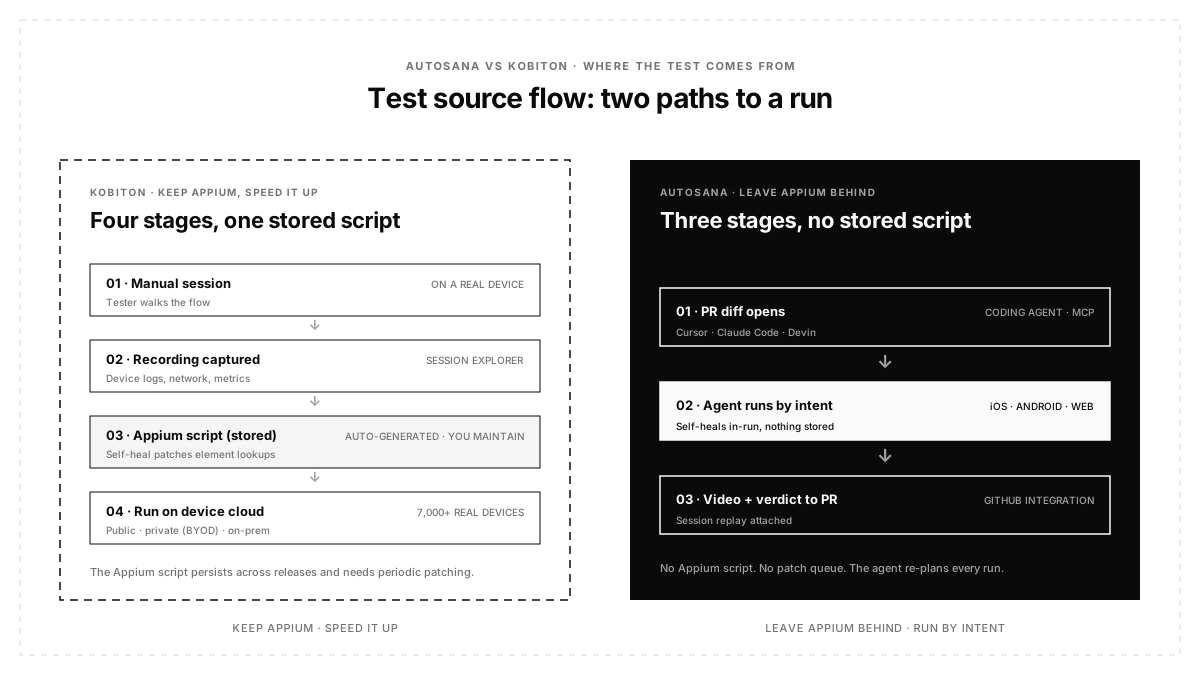
Kobiton's model is hybrid. You can record a manual session on a real device and Kobiton generates a production-ready Appium script (their page claims 90% reduction in manual coding), or replay a recorded session scriptless across devices, or write Appium / Selenium / Espresso / XCUITest by hand. In every path except pure scriptless replay, you end up with a stored script the team maintains.
Autosana skips the script. You describe the flow ("open cart, tap checkout, enter test card, confirm order") and the agent decides which element matches the intent at runtime. Nothing is stored between the intent and the outcome.
The pitch works for teams that want to keep Appium. On r/QualityAssurance, a direct 4-way device-farm comparison thread captured Kobiton's value proposition plainly: "Kobiton: best performance to value, minimalistic device farm looking to be the p…" The trade to think through: generated Appium scripts are still scripts.
How does the real-device story compare?
Kobiton's identity is the device layer. Per kobiton.com/platform/mobile-device-cloud/, 7,000+ real iOS and Android devices sit in the public cloud, and Enterprise buyers can add hosted private device slots (5-device minimum), fully on-prem installations, or air-gapped setups ("Deploy Behind Your Firewall").
Autosana ships hosted iOS and Android device infrastructure included in the trial. It is public-cloud only. If you need air-gapped or on-prem, Kobiton is the right shape.
The community conversation on r/QualityAssurance about favorite Android QA tools regularly surfaces device-cloud choice as a first-order decision. If devices are the bottleneck, Kobiton competes on breadth and deployment options.
How does coding-agent (MCP) integration work in each?
Autosana ships an MCP server with documented setup. PR opens, the agent reads the code diff, runs the flow across iOS, Android, and web by intent, and posts a video plus verdict back via GitHub integration. The whole pipeline from PR to verdict is documented and reproducible.
Kobiton's homepage carries a bullet that says "Test from Claude, Copilot, Cursor, Gemini or Codex." On the current public site, that is where the claim ends. There is no MCP server documentation, no setup guide, no GitHub repo or CLI reference for the coding-agent path, and no integrations-page entry for any of the named tools. The marketing surface promises the integration; the implementation surface does not yet.
The community is actively evaluating this axis. A r/QualityAssurance thread on reliable real-device platforms captured the framing well: "Saucelabs and Browserstack are the two big ones. " Device access is table stakes. What runs on those devices, and how the coding agent hooks into it, is where the differentiation moved in 2026.
How does Kobiton pricing actually work?
Kobiton is one of the few competitors in this segment with published prices. Verified live on kobiton.com/pricing:
- Startup: from $83/month. 500 minutes/month, public cloud, manual + scripted automation, free trial.
- Accelerate: from $399/month. 3,000 minutes/month, Public Cloud, Manual + Scripted.
- Scale: from $9,000/year, annual only. Higher device concurrency, parallel testing for intermediate teams.
- Enterprise: Request Pricing. Unlimited Appium script generation, unlimited users, AI-Driven testing, No-code testing, Self-healing Appium execution, dedicated devices, fully on-prem, visual + accessibility + performance validations, and priority support.
Cost levers: monthly testing minutes + feature access + device concurrency + deployment path.
Budget is a real evaluation axis. One r/QualityAssurance thread on mobile frameworks captured the alternative angle: "BrowserStack is the best tool for device automation if you don't want to use your own devices." Kobiton's BYOD and enterprise on-prem tiers are the counter-move for teams that do want their own devices, without paying per minute on a public cloud.
Autosana prices are per agent run rather than per seat or per minute, with a self-serve trial. The curve flattens as headcount grows because you pay for runs, not editor seats or minute buckets. Book a Demo for a per-run quote against your PR volume.
How does maintenance scale as your suite grows?
Kobiton's self-heal patches Appium script element lookups when the UI shifts. The claim on kobiton.com/platform/ai-augmented-testing/ is that the model is trained on 80M+ tests and eliminates most "NoSuchElement" exceptions. The trade: the underlying Appium script remains a stored artifact your team owns.
Autosana's mechanism is different. The agent replans against the current UI on every run. There is no stored script, so there is nothing to patch when the flow reshapes. If the intent is still satisfiable, the test passes.
Real-device operational edges also show up in maintenance. On r/androiddev, a thread about real-device farms captured a lifecycle issue teams hit: "While you are running your old version of app, you cannot upload and install a new…" The device layer has its own operational surface, separate from the test-authoring layer. Early customer stories including the Gobi Maps case study show how intent-based execution reads at Series A scale.

Which one should you actually pick?
Pick Kobiton if:
- You want to keep Appium as your runtime and accelerate it: record manual sessions, generate production Appium scripts, self-heal locators, run at scale.
- Real devices are the bottleneck, and you need 7,000+ options, or a Bring Your Own Device private cloud, or on-prem / air-gapped deployment for compliance.
- You already run Appium / Selenium / Espresso / XCUITest scripts and want to keep them, not rebuild.
- Published pricing with clear monthly-minute buckets is a procurement requirement.
Pick Autosana if:
- Your goal is to leave Appium behind: no script, no locator repository, no self-heal patches to approve.
- Your product is iOS, Android, or web (or a mix) shipped weekly or faster, and coding agents (Cursor, Claude Code, Devin) are opening PRs faster than a human can babysit an Appium suite.
- You want the MCP server to run tests end-to-end on your PR, with the setup path documented today, not a homepage bullet with no docs behind it.
- You value the features overview promise of intent-based tests that self-heal every run, over a stored Appium artifact you patch.
On-prem is the other decisive axis. A r/PerformanceTesting thread on vendors that support true private setups captured why compliance-heavy teams sort here first. If air-gapped is the requirement, Kobiton fits. If it isn't, the modern-web / mobile / coding-agent axis is where Autosana wins.
Both are legitimate. Pick by which exit from Appium maintenance you actually want.
How do you migrate from Kobiton to Autosana without regret?
If the intent-based path fits, migration is a project, not a swap:
- Sort your Kobiton scripts into tiers. Tier A = critical flows (login, checkout, payments, core journeys). Tier B = regression. Tier C = long-tail edge cases. Many teams delete Tier C.
- Run Autosana in parallel with Kobiton for one sprint. The Autosana quickstart walks through the parallel-run pattern. Compare flake rate, run time, and engineer hours.
- Migrate Tier A first. Keep both suites live for one full release cycle.
- Migrate Tier B in the second wave. Delete Tier C or rebuild only what production traffic proves necessary.
- Keep Kobiton for the surfaces it uniquely covers. Air-gapped labs, BYOD private device fleets, and heavy Appium-legacy suites you don't want to touch.
- Decommission the overlapping scope on a set date. Passive graveyards eat future engineer time.
The migration is easier than most teams expect for iOS and Android weekly-release scope. Air-gapped or BYOD-heavy scope stays where it is.
What's the takeaway for your team?
Kobiton and Autosana are solving different problems even though both live in the mobile-testing space.
Kobiton is a real-device cloud plus Appium-acceleration platform for teams that want to keep Appium and add speed, breadth, and self-heal on top. If devices are your bottleneck, if air-gapped or BYOD is a compliance need, or if a mature Appium suite is worth accelerating rather than replacing, Kobiton is a defensible pick.
Autosana is an AI-native testing agent for teams that want the Appium layer gone entirely. Ship iOS, Android, or web weekly, use coding agents that open PRs faster than any human can approve a self-heal patch, and want the MCP server to run tests end-to-end on the PR with the setup documented today. Autosana is the pick when the goal is not to speed up scripts but to remove them.
Bring a build. We'll run it end-to-end across iOS, Android, and web in 30 minutes and you can compare directly against your current Kobiton scope before making a call.

Frequently asked questions
Is Kobiton free?
Kobiton offers a free trial on the startup tier. Beyond that, paid tiers start at $83/month (Startup, 500 minutes), $399/month (Accelerate, 3,000 minutes), and $9,000/year (Scale, annual only). Enterprise is a custom quote.
Which is better for mobile testing, Autosana or Kobiton?
Kobiton's core value is the device layer: 7,000+ real devices, BYOD private cloud, and on-prem air-gapped options for compliance-heavy teams. Autosana's core value is the agent layer: intent-based execution across iOS, Android, and web, with no script to author or maintain. For teams that want to keep Appium and add device breadth, Kobiton. For teams that want to leave Appium behind and let a coding agent drive the run, Autosana.
Does Kobiton self-heal like Autosana?
Both self-heal, via different mechanisms. Kobiton's model, trained on 80M+ tests, patches Appium script element-lookups when the UI shifts. The stored Appium script remains yours to maintain. Autosana's agent re-plans against the current UI on every run: there is no stored script to patch.
Can Autosana replace Kobiton entirely?
For iOS, Android, and web E2E flows on public cloud: yes. For air-gapped device labs, on-prem private device fleets, and heavy Appium-legacy suites you want accelerated (not removed), Kobiton covers surfaces Autosana doesn't target. Rule of thumb: if your goal is to leave Appium, Autosana replaces the scope. If your goal is to accelerate Appium on your own devices, keep Kobiton.
Does Kobiton integrate with Claude Code, Cursor, or other coding agents?
Kobiton's homepage advertises support for Claude, Copilot, Cursor, Gemini, and Codex. As of today, the public site publishes no MCP server documentation, no setup guide, and no GitHub repo for those integrations. Autosana ships MCP with a documented setup path and PR-level execution today.
How long does a Kobiton-to-Autosana migration take?
For a mid-size iOS and Android UI-driven scope (200 to 400 flows), plan for one quarter end-to-end: two sprints of parallel-run evaluation, one sprint of Tier A migration, two sprints of Tier B, one sprint of decommissioning. Keep Kobiton for air-gapped or BYOD-heavy scope.
How many real devices does each tool provide?
Kobiton advertises 7,000+ real devices in its public cloud, plus optional hosted private slots (5-device minimum) and fully on-prem device labs. Autosana ships hosted iOS and Android device infrastructure included with the trial, on public cloud only.