
Autosana vs Functionize: Which one should you actually pick?
Compare Autosana and Functionize across platform coverage, agentic testing, self-healing, MCP integration, pricing, and migration to determine which testing approach fits your development workflow.
Yuvan Sundrani · 16 min read
autosana.ai
.png)
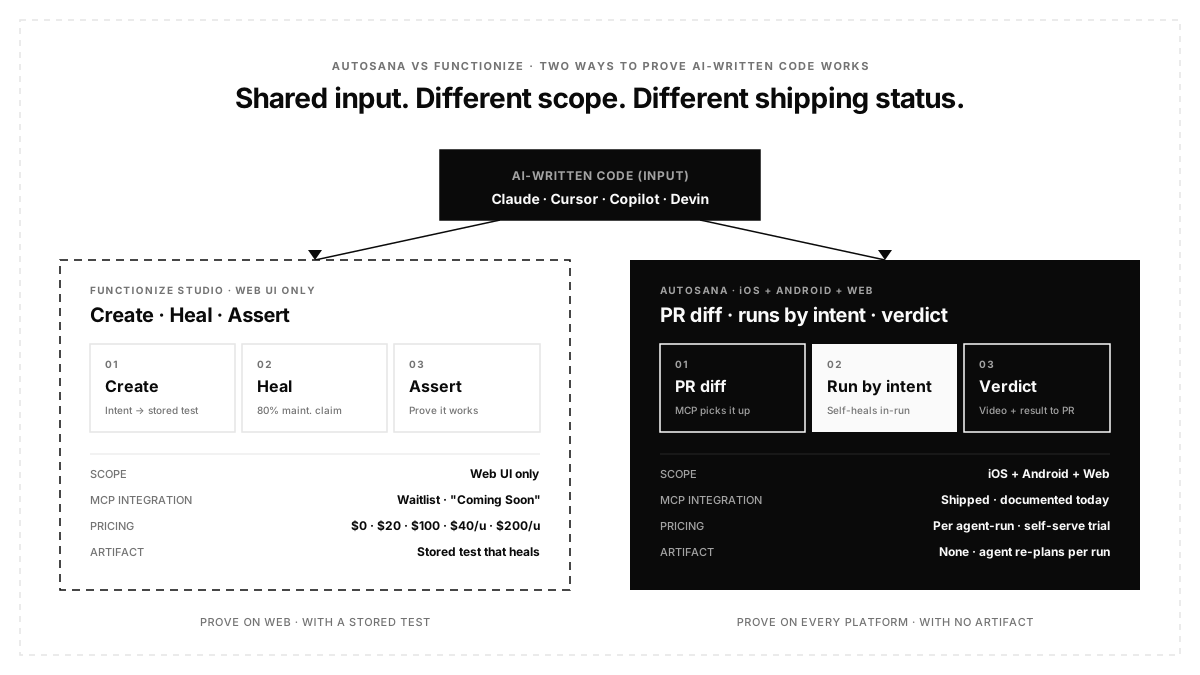
Autosana is an AI-native testing agent that runs your iOS, Android, and web app by intent. The agent reads the PR diff and posts a video plus verdict back through a documented MCP server. Functionize is "The Agentic Quality Platform" that positions itself as the verifier for AI-written code, focused on the full web UI workflow. Both call themselves agentic. The real split is scope (web-only vs iOS + Android + web) and MCP status (waitlist vs shipped today).
Key Takeaways
- Functionize is web-only per its public site. Autosana covers iOS + Android + web, with hosted device infrastructure included in the trial.
- Functionize's 2026 tagline is "Agents write the code. Studio proves it works." Autosana's agent runs the flow by intent, with no test artifact stored between the description and the run.
- Functionize's MCP integration is on a waitlist. Autosana ships MCP with documented PR-level execution, GitHub integration, and video-verdict posting today.
- Both publish tiered pricing. Functionize: Free $0/mo, Pro $20/mo, Max $100/mo (Individual); Growth $40/user/mo, Scale $200/user/mo (Team); Enterprise custom with 12-month minimum. Autosana prices per agent run with a self-serve trial.
- Functionize claims: 80% maintenance reduction on stored tests. Autosana skips the stored test: the agent replans against the current UI every run.
How do Autosana and Functionize compare at a glance?
| Axis | Autosana | Functionize |
|---|---|---|
| Category | AI-native testing agent | The Agentic Quality Platform (verifier for AI-written code) |
| Test Authoring | Natural language or code diff, run by an agent | "You set what good looks like, Studio handles the testing" (intent-based) |
| Self-Healing | Re-plans against the current UI every run | Auto-heal with 80% maintenance-reduction claim; three pillars (Create, Heal, Assert) |
| Platform Coverage | iOS + Android + Web | Web UI only (mobile, API, desktop not on public site) |
| Coding-Agent MCP | MCP server → agent runs tests end-to-end on PR (shipped, documented) | Waitlist only. Integrations page: "Coming Soon" |
| Test Generation Source | Code diff or intent description | Intent + purpose-built ML (8 years training on testing data) |
| Real-Device Layer | Hosted iOS + Android, included in trial | Not published as a first-class surface |
| Pricing Model | Per agent-run (self-serve trial + paid) | Free $0 · Pro $20 · Max $100 · Growth $40/user · Scale $200/user · Enterprise custom (12-mo min) |
| Setup to First Test | ~10 min (quickstart) | Signup + credits allocation |
What is Functionize?
Functionize positions itself as "The Agentic Quality Platform" with the 2026 tagline "Agents write the code. Studio proves it works." The single product, Functionize Studio, is described as "an independent testing agent for your full web UI workflow. Built to prove quality."
Its differentiation argument: purpose-built ML models trained on 8 years of testing intelligence, not foundation-model wrappers. The company claims 95-98% of testing tasks can run on smaller CPU-optimized models rather than GPU-dependent large LLMs.
Named customers include McAfee, Conduent, ServiceNow, Uponor, Banjo Health, and Norstella. Headline metrics: 10x productivity, 75% faster time to market, 80% maintenance reduction.
What is Autosana?
Autosana is a cloud-hosted AI agent that tests iOS, Android, and web apps the way a real user would. You describe a flow in natural language, or hand the agent a code diff. There is no test artifact between you and the outcome.
When the UI changes, the agent re-anchors to whatever now matches the intent. Runs across iOS and Android and web, with hosted device infrastructure and an MCP server for coding-agent workflows.
How do the two tools handle test authoring?
Functionize's model is intent-based: you describe what good looks like and Studio interprets, executes, and heals against the intent. It is not record-and-playback. It is not a low-code visual builder. The output is a stored test the platform manages across releases.
Autosana skips the stored test. You describe the flow ("open cart, tap checkout, enter test card, confirm order"), and the agent decides which element matches the intent at runtime. Nothing is stored between the description and the run.
Both approaches surface in the community evaluation conversation. One r/Everything_QA thread on tools leading the shift to AI-driven testing put it plainly: "For instance, Testim and Functionize use AI for self-healing test automation. Applitools applies computer vision to visual validation. Mabl…" Every tool in that list stores a test artifact. Autosana does not.
How does the platform coverage compare?
Functionize is web-focused. The public site emphasizes "full web UI workflow" and names enterprise systems (Salesforce, ServiceNow, Workday, and SAP) as targets. Mobile testing (iOS or Android native), API testing, and desktop are not published on the public site.
Autosana runs iOS, Android, and web as first-class surfaces. Per docs.autosana.ai/real-device-testing, hosted device infrastructure ships as part of the product.
For teams shipping web SaaS to enterprise buyers, Functionize's scope matches the target. For teams that also ship iOS or Android (or a mix), the coverage gap is the first question to answer.
A r/QualityAssurance thread on what AI tools people are actually using surfaces the same question for teams shopping in this category: which surfaces does the tool actually cover under one authoring model?
How does coding-agent (MCP) integration work in each?
This is where the products diverge sharpest.
Functionize markets itself as the verifier for AI-written code. But per functionize.com/integrations, MCP is not shipped. The integrations page reads "Coming Soon." An MCP waitlist page exists. There is no live Claude Code integration, no Cursor integration, and no IDE integration currently documented on their public site.
Autosana ships MCP today. Per docs.autosana.ai/mcp-setup, a coding agent (Cursor, Claude Code, or Devin) invokes the MCP server, reads the PR diff, runs the flow across iOS, Android, and web by intent, and posts a video plus verdict back via GitHub integration. The whole pipeline from PR to verdict is documented and reproducible.
The community is actively evaluating this axis. On r/QualityAssurance, a thread asking for AI-based tool recommendations kept surfacing the same distinction: which tools actually let a coding agent run tests end-to-end today versus which still promise it. Shipped integration and a waitlist are different products.
How does Functionize pricing actually work?
Functionize publishes tiered prices, rare in this segment. Verified live on functionize.com/pricing:
- Free (Individual): $0/mo. 200 credits/mo, max 5 parallel runs. No SMS testing, MFA/OTP, email testing, or multi-team workspace.
- Pro (Individual): $20/mo. 400 credits/mo, max 5 parallel.
- Max (Individual): $100/mo. 2,000 credits/mo, max 10 parallel.
- Growth (Team): $40/user/mo. 400 credits/user/mo, max 5 parallel.
- Scale (Team): $200/user/mo. 2,000 credits/user/mo, max 10 parallel.
- Enterprise: custom pricing, 12-month minimum.
- Promo: 50% off first 2 months plus 1,000 bonus credits.
Cost drivers: credit consumption on cloud test runs, seat count on Team plans, and enterprise contract terms.
The trade-off shows up in the community. On r/QualityAssurance, a thread asking for opinions on AI testing tools regularly weighs credit-limited plans against per-run pricing for high-frequency CI pipelines. Credits are predictable per test but scale hard with regression volume.
Autosana prices are per agent run rather than per credit or per seat, with a self-serve trial. The curve flattens as headcount grows because you pay for runs, not credits or editor licenses. Book a Demo for a per-run quote against your PR volume.
How does maintenance scale as your suite grows?
Functionize's auto-heal claim is 80% maintenance reduction. Their three-pillar model is Create, Heal, Assert. When the UI shifts, Studio's ML adapts the stored test against the new page. The trade: the underlying test artifact persists, and every heal is a change to that artifact.
Autosana's mechanism is different. The agent replans against the current UI on every run. There is no stored test to heal, because there is no stored test. If the intent is still satisfiable, the test passes.
The r/QualityAssurance thread on what AI QA tools people are actually using surfaces this trade often: teams weigh maintenance-reduction claims against the ongoing cost of an artifact that has to be re-verified after every heal. Early customer stories including the Gobi Maps case study show what intent-based execution looks like at Series A scale, where there is no artifact.

Which one should you actually pick?
Pick Functionize if:
- Your product is web-only and shipped to enterprise buyers.
- Your team wants a purpose-built ML testing platform that argues against foundation-model wrappers.
- Public tiered pricing that starts free is a procurement fit ($0 to $100 for individuals, $40 to $200 per user for teams, and enterprise custom).
- You want a single-product platform (studio) rather than a multi-SKU suite.
Pick Autosana if:
- Your product is iOS, Android, or web (or a mix) and shipped weekly or faster.
- Coding agents (Cursor, Claude Code, and Devin) open PRs faster than a human can wait for MCP to leave the waitlist.
- You want the MCP server to run tests end-to-end on your PR today, not on a "Coming Soon" integrations page.
- You value the features overview promise of intent-based tests that self-heal every run, over a stored test artifact you patch through Create-Heal-Assert.
Both are legitimate. Pick by scope and by whether the coding-agent integration you need is shipped today.
How do you migrate from Functionize to Autosana without regret?
If the intent-based path fits and you also need iOS or Android coverage, migration is a project, not a swap:
- Sort your Functionize Studio tests into tiers. Tier A = critical business flows (login, checkout, payments). Tier B = regression. Tier C = long-tail edge cases. Many teams delete Tier C.
- Run Autosana in parallel with Functionize for one sprint. The Autosana quickstart walks through the parallel-run pattern. Compare flake rate, run time, and engineer hours.
- Migrate Tier A first. Keep both suites live for one full release cycle.
- Migrate Tier B in the second wave. Delete Tier C or rebuild only what production traffic proves necessary.
- Keep Functionize for the web scope it uniquely serves. If your team runs it for enterprise SaaS proof and doesn't need mobile, leaving Functionize in place for that scope is fine.
- Decommission the overlapping web scope on a set date. Passive graveyards eat future engineer time.
Migration is easier when the target has no stored artifact. Adding iOS and Android coverage is the reason most teams pick up this migration in the first place.
Conclusion
Functionize and Autosana both call themselves agentic, and both pitch as verifiers for AI-written code. The two decisions that split them are scope and shipping status.
Functionize is a web-only agentic quality platform with published tier pricing, purpose-built ML, and a single-product studio. If your product is a web SaaS and you're not blocked on coding-agent integration, Functionize is a defensible pick.
Autosana is an AI-native testing agent for iOS, Android, and web with MCP shipped today, GitHub PR integration documented, and per-agent-run pricing on a self-serve trial. If your product is mobile-and-web, or your coding agents are already opening PRs faster than a waitlist can move, Autosana is the pick that runs the proof today.
Bring a build. We'll run it end-to-end across iOS, Android, and web in 30 minutes, and you can compare directly against your current Functionize scope before making a call.

Frequently asked questions
Is Functionize free?
Functionize offers a free individual plan at $0/month with 200 credits/month and 5 parallel runs (no SMS testing, MFA/OTP, email testing, or multi-team workspace). Beyond that, Pro is $20/mo, Max is $100/mo, Growth is $40/user/mo, Scale is $200/user/mo, and Enterprise is custom with a 12-month minimum.
Which is better for mobile testing, Autosana or Functionize?
Functionize does not publish mobile coverage on its public site: the product is positioned around the full web UI workflow. Autosana runs iOS and Android natively via its hosted device layer with agent-based flows, included in the trial. For any team that ships mobile, Autosana is the pick. For teams shipping web SaaS only, Functionize is defensible.
Does Functionize self-heal like Autosana?
Both self-heal via different mechanisms. Functionize's ML adapts the stored test when the UI shifts, with a public claim of 80% maintenance-time reduction (three pillars: Create, Heal, and Assert). Autosana's agent replans against the current UI on every run: there is no stored test to heal.
Can Autosana replace Functionize entirely?
For iOS, Android, and web E2E flows: yes. For teams that specifically need Functionize's purpose-built ML approach to web enterprise apps and are not blocked on coding-agent integration, Functionize remains a fit for that scope. Rule of thumb: if you also ship mobile or if MCP-based PR execution matters, Autosana replaces it.
How long does a Functionize-to-Autosana migration take?
For a mid-size UI-driven scope (200 to 400 flows), plan for one quarter end-to-end: two sprints of parallel-run evaluation, one sprint of Tier A migration, two sprints of Tier B, one sprint of decommissioning the overlapping web scope. Keep Functionize for scope that specifically needs its purpose-built ML approach.
What does Functionize's "purpose-built ML" argument mean?
Functionize argues against wrapping foundation models (Claude, ChatGPT) for testing. They claim purpose-built ML trained on 8 years of testing data and enterprise app patterns outperforms generic LLMs, and that 95-98% of testing tasks can run on smaller CPU-optimized models. Autosana's design integrates with those coding agents via MCP rather than replacing them.