
Autosana vs BrowserStack : Which one should you actually pick?
Compare Autosana and BrowserStack across testing infrastructure, agentic execution, device coverage, MCP integration, pricing, and maintenance to determine which approach best fits your testing workflow.
Yuvan Sundrani · 16 min read
autosana.ai
.png)
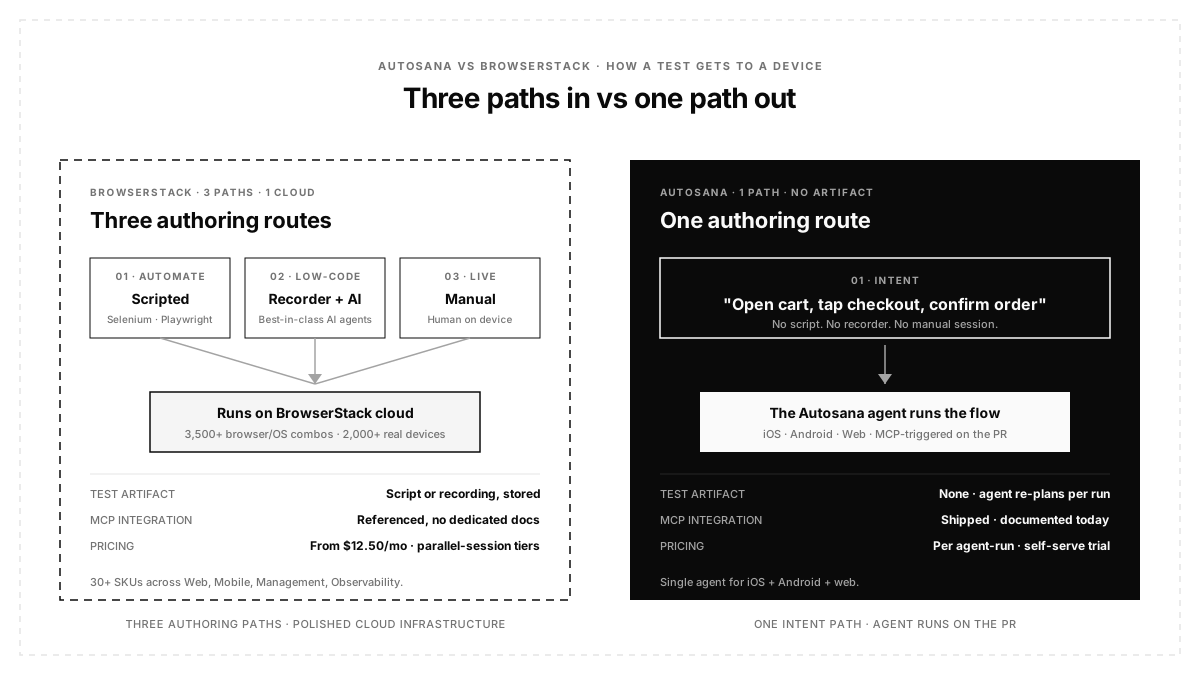
Autosana is an AI-native testing agent that runs your iOS, Android, and web app by intent. One agent, one runtime, MCP that runs your PR end-to-end with a documented setup and video verdict posting. BrowserStack is the polished testing platform that gives you access to 3,500+ browser/OS combinations and 2,000+ real iOS and Android devices, with three authoring paths (Automate scripts, Low-Code Automation recorder, and Live manual sessions) and 30+ product SKUs.
Key Takeaways
- BrowserStack is a broad testing platform: infrastructure at scale (3,500+ browser/OS combos, 2,000+ real devices), 30+ product SKUs, and multiple test authoring paths from scripts to low-code automation with AI agents.
- Autosana is one agent that runs iOS + Android + web by intent, with MCP shipped and documented today for PR-level execution via Cursor, Claude Code, or Devin.
- BrowserStack pricing starts at $12.50/month for entry tiers with a free option; automation scales per parallel session. Autosana prices per agent run with a self-serve trial.
- BrowserStack's AI push is real: low-code automation with "best-in-class AI agents," test observability with a 75% failure-triage-reduction claim, and Percy AI for visual regression. Autosana's agent is different: no stored test to author, heal, or observe.
- Autosana ships hosted iOS + Android device infrastructure included in the trial, plus GitHub integration that posts a video and verdict back to your PR.
How do Autosana and BrowserStack compare at a glance?
| Axis | Autosana | BrowserStack |
|---|---|---|
| Category | AI-native testing agent | Cloud testing platform (infrastructure + tooling) |
| Test Authoring | Natural language or code diff, run by an agent | Three paths: Automate (Selenium/Playwright/Cypress) · Low-Code Automation (recorder + AI agents) · Live (manual) |
| Self-Healing | Re-plans against the current UI every run | AI-driven authoring in Low-Code; Test Observability for failure triage (75% reduction claim) |
| Platform Coverage | iOS + Android + Web | 3,500+ browser/OS combos + 2,000+ real iOS/Android devices |
| Coding-Agent MCP | MCP server documented + shipped today (Cursor, Claude Code, Devin) | MCP referenced in integrations; dedicated docs URL returns 404 |
| Test Generation Source | Code diff or intent description | Selenium/Appium/Playwright scripts, or Low-Code recorder |
| Real-Device Layer | Hosted iOS + Android, included in trial | 2,000+ real devices; Custom Device Lab option for on-prem |
| Pricing Model | Per agent-run (self-serve trial + paid) | From $12.50/month; Automate ~$129–$169/parallel/mo, App Automate ~$199–$249/parallel/mo per aggregator |
| Product Surface | Single agent | 30+ SKUs across Web / Mobile / Management / Observability |
| Setup to First Test | ~10 min (quickstart) | Signup + product selection + framework wiring |
What is BrowserStack?
The platform spans 30+ SKUs organized into Web Testing (Live, Automate, Accessibility, Low-Code Automation, Percy, Load Testing, Test Companion), Mobile App Testing (App Live, App Automate, App Accessibility, App Low-Code Automation), and Management & Optimization (Test Management, Test Observability).
Named customers include Google, Slack, Microsoft, Amazon, LinkedIn, Atlassian, and Zoom. BrowserStack reports serving 50,000+ customers across 135+ countries.
What is Autosana?
Autosana is a cloud-hosted AI agent that tests iOS, Android, and web apps the way a real user would. You describe a flow in natural language, or hand the agent a code diff. There is no test artifact between you and the outcome.
When the UI changes, the agent re-anchors to whatever now matches the intent. Runs across iOS and Android and web, with hosted device infrastructure and an MCP server for coding-agent workflows.
How do the two tools handle test authoring?
BrowserStack offers three authoring paths. Automate takes your Selenium, Playwright, or Cypress scripts and runs them on the BrowserStack cloud. Low-Code Automation ships a recorder with "best-in-class AI agents" to build tests without code. Live is fully manual, a human clicks through the app on a real device via the browser. Three surfaces, one infrastructure.
Autosana skips authoring. You describe the flow ("open cart, tap checkout, enter test card, confirm order") and the agent decides which element matches the intent at runtime. Nothing is stored between the description and the run.
Community context tracks the trade often. On r/QualityAssurance, a thread on BrowserStack alternatives captured the ecosystem trade honestly: "BrowserStack is widely used, super polished and has tons of devices and browsers, but it can get pricey." Polish and device breadth cost money. So does maintaining scripts or recorded tests as the app evolves.
How does the platform coverage compare?
BrowserStack is the definition of breadth. Per browserstack.com, the platform offers 3,500+ browser and OS combinations plus 2,000+ real iOS and Android devices. Legacy OS versions and older devices are a specific strength for teams that need to reproduce production issues on the exact hardware customers use.
Beyond public cloud, BrowserStack ships Custom Device Lab (Dedicated Cloud) for on-premise or private-device deployments, a real advantage for compliance-heavy teams.
Autosana runs iOS + Android + web on hosted device infrastructure included with the trial. Per docs.autosana.ai/apps and docs.autosana.ai/web-testing, the surfaces are first-class in a single product. No custom device lab, no 3,500-browser matrix, the design tradeoff for a per-run agent product rather than a bring-your-own-scripts cloud.
A r/QualityAssurance thread on Mobile Device Farm (AWS vs BrowserStack vs Saucelabs vs Kobiton) surfaces the tradeoff every quarter: device breadth is one axis, what runs on those devices is a different one.
How does coding-agent (MCP) integration work in each?
Autosana ships MCP today with a documented setup. Per docs.autosana.ai/mcp-setup, a coding agent (Cursor, Claude Code, Devin) invokes the MCP server, Autosana reads the PR diff, runs the flow across iOS, Android, and web by intent, and posts a video plus verdict back via GitHub integration. The whole pipeline from PR to verdict is documented and reproducible.
BrowserStack references MCP, Claude, and Cursor on its integrations page, though a dedicated MCP documentation URL was not surfaced during our live check. AI-native integration is clearly on the roadmap. For teams that need the coding-agent-invokes-MCP-runs-tests loop today, Autosana's shipped documentation is the meaningful difference.
The broader trend is community-visible. On r/Everything_QA, a recent thread on teams evaluating BrowserStack alternatives framed the coding-agent question head-on: "We've been deep in the BrowserStack ecosystem for a while, cross browser testing, app testing, test management, the whole thing. and honestly its starting…" Ecosystem depth is a strength; it's also friction when a new workflow (coding agents opening PRs) wants to slot in cleanly.
How does BrowserStack pricing actually work?
BrowserStack publishes tiered pricing with a three-metric matrix: user seats + parallel execution sessions + modular add-ons. Annual billing saves up to 25%.
Verified live starting price on browserstack.com/pricing:
- Free: 30 min Live, 100 min Automate, 5K Percy screenshots/mo (per third-party aggregator confirmation)
- Entry paid: starting at $12.50/month (per pricing-page meta title)
- Tiers per Explore: Freelancer, Team, Pro, Enterprise
- Automate Pro: ~$129–$169/parallel/mo (aggregator)
- App Automate: ~$199–$249/parallel/mo (aggregator)
- Percy: ~$449–$599/mo add-on for 10–25K screenshots
- Test Observability: adds 15–25% to your Automate contract
- Enterprise: custom pricing, SLAs, SSO
The trade-off is real. A r/QualityAssurance thread on cheaper BrowserStack alternatives has been active for years around scaling costs. When you stack Automate + App Automate + Percy + Test Observability at team scale, corporate bills quickly clear five figures per year.
Autosana prices per agent-run rather than per seat or parallel session, with a self-serve trial. The curve flattens as headcount grows because you pay for runs, not editor licenses or bundled add-ons. Book a Demo for a per-run quote against your PR volume.
How does maintenance scale as your suite grows?
BrowserStack's approach is a mix:
Low-Code Automation ships AI agents that assist authoring and healing inside the recorder-generated tests.
Test Observability claims a "75% reduction in failure triage time" by surfacing flaky patterns and top errors.
Percy AI on visual regression. Notably, BrowserStack does not lead with a specific self-heal percentage claim the way Testsigma (90%), testRigor (99.5%), mabl (85%), or Functionize (80%) do.
Autosana's mechanism is different. The agent re-plans against the current UI on every run. There is no stored test to heal because there is no stored test. If the intent is still satisfiable, the test passes.
Early customer stories including the Gobi Maps case study show what intent-based execution looks like at Series A scale, where there is no artifact to maintain. On r/QualityAssurance, a thread on real BrowserStack user experience keeps returning to this: scripts and recorded tests are the maintenance surface, no matter how good the AI-assisted authoring gets.

Which one should you actually pick?
Pick BrowserStack if:
- You need maximum device and browser breadth (3,500+ browser/OS combos, 2,000+ real devices, legacy device access).
- Your team already runs Selenium, Playwright, Cypress, or Appium scripts and wants a cloud to run them on with zero infrastructure management.
- On-premise or private device labs are a compliance requirement (Custom Device Lab / Dedicated Cloud).
- You want Percy for visual regression, Accessibility Testing, and Test Observability under one vendor.
Pick Autosana if:
- Your product is iOS, Android, or web (or a mix) shipped weekly or faster.
- Coding agents (Cursor, Claude Code, Devin) open PRs faster than a human can maintain scripts or recorded tests, and you want the MCP server to run tests end-to-end today.
- You want a single agent covering iOS + Android + web rather than 30+ SKUs across multiple product areas.
- You value the features overview promise of intent-based tests that self-heal on every run, with per-agent-run pricing on a self-serve trial.
The alternatives conversation is a live one. A r/accessibility thread on BrowserStack alternatives sorts on device breadth. Recent r/Everything_QA discussion sorts on ecosystem cost and depth. Teams pick BrowserStack when infrastructure breadth is the answer. Teams pick Autosana when the answer is skipping the script entirely.
Both are legitimate. Pick by what you actually want the tool to do.
How do you migrate from BrowserStack to Autosana without regret?
If the intent-based path fits, migrating a BrowserStack Automate or App Automate suite is a project, not a swap:
- Sort your BrowserStack tests into tiers. Tier A = critical business flows (login, checkout, payments). Tier B = regression. Tier C = long-tail edge cases. Many teams delete Tier C.
- Run Autosana in parallel with BrowserStack for one sprint. The Autosana quickstart walks through the parallel-run pattern. Compare flake rate, run time, engineer-hours.
- Migrate Tier A first. Keep both suites live for one full release cycle.
- Migrate Tier B in the second wave. Delete Tier C or rebuild only what production traffic proves necessary.
- Keep BrowserStack for the surfaces it uniquely covers. Legacy device coverage, visual regression via Percy, and Custom Device Lab on-prem scope can stay on BrowserStack.
- Decommission the overlapping iOS + Android + web scope on a set date. Passive graveyards eat future engineer time and per-parallel-session cost.
Migration is easier for iOS, Android, and web weekly-release scope. Legacy device breadth and visual regression tend to stay where they are.
Conclusion
BrowserStack and Autosana are shaped for different jobs.
BrowserStack is a broad testing platform for teams that want infrastructure at scale: 3,500+ browser combos, 2,000+ real devices, three authoring paths (Automate scripts, Low-Code recorder, Live manual), Percy visual regression, Accessibility Testing, Test Observability. If your team already runs scripts and wants the polished cloud to run them on, BrowserStack is a defensible pick.
Autosana is an AI-native testing agent for teams that want the agent to run the tests, not run their tests on someone else's cloud. Ship iOS, Android, or web weekly, use coding agents that open PRs, and want the MCP server to run tests end-to-end on your PR with a documented setup and per-agent-run pricing? Autosana is the pick that runs the proof without a script or a recorder in the loop.
Bring a build. We'll run it end-to-end across iOS, Android, and web in 30 minutes and you can compare directly against your current BrowserStack scope before making a call.
.png)
Frequently asked questions
Is BrowserStack free?
BrowserStack offers a free tier that includes 30 minutes of Live testing, 100 minutes of Automate, and 5,000 Percy screenshots per month. Paid tiers start at $12.50/month per the pricing page meta title, with Automate at roughly $129–$169 per parallel session per month and App Automate at roughly $199–$249 per parallel session per month according to third-party aggregators.
Which is better for mobile testing, Autosana or BrowserStack?
BrowserStack's App Automate runs your Appium, Espresso, or XCTest scripts on 2,000+ real iOS and Android devices with legacy OS support. Autosana runs iOS and Android natively via its hosted device layer with agent-based flows, included in the trial. For teams that already have Appium scripts and want a polished cloud to run them on, BrowserStack. For teams that want the agent to run the flow by intent without a script, Autosana.
Does BrowserStack self-heal like Autosana?
BrowserStack's approach is different. Its Low-Code Automation ships AI agents that assist authoring, Test Observability surfaces flaky patterns (with a 75% failure-triage-reduction claim), and Percy AI covers visual regression. BrowserStack does not lead with an explicit self-heal percentage the way some competitors do. Autosana's agent re-plans against the current UI on every run, so there is no stored test to heal.
Can Autosana replace BrowserStack entirely?
For iOS, Android, and web E2E flows: yes. For teams that specifically need 3,500+ browser/OS combinations, legacy device coverage, on-premise Custom Device Lab, Percy visual regression, or dedicated accessibility scanning, BrowserStack covers surfaces Autosana doesn't target. Rule of thumb: if your goal is intent-based execution on iOS + Android + web with MCP-based PR runs, Autosana replaces the scope.
How long does a BrowserStack-to-Autosana migration take?
For a mid-size UI-driven scope (200 to 400 tests), plan for one quarter end-to-end: two sprints of parallel-run evaluation, one sprint of Tier A migration, two sprints of Tier B, one sprint of decommissioning the overlapping BrowserStack scope. Keep BrowserStack for legacy device coverage, Percy, or Custom Device Lab scope.
What is BrowserStack Automate TurboScale?
Automate TurboScale is BrowserStack's high-volume parallel testing product for teams running large concurrent test suites. It sits alongside Automate and App Automate in the broader testing platform, priced separately.